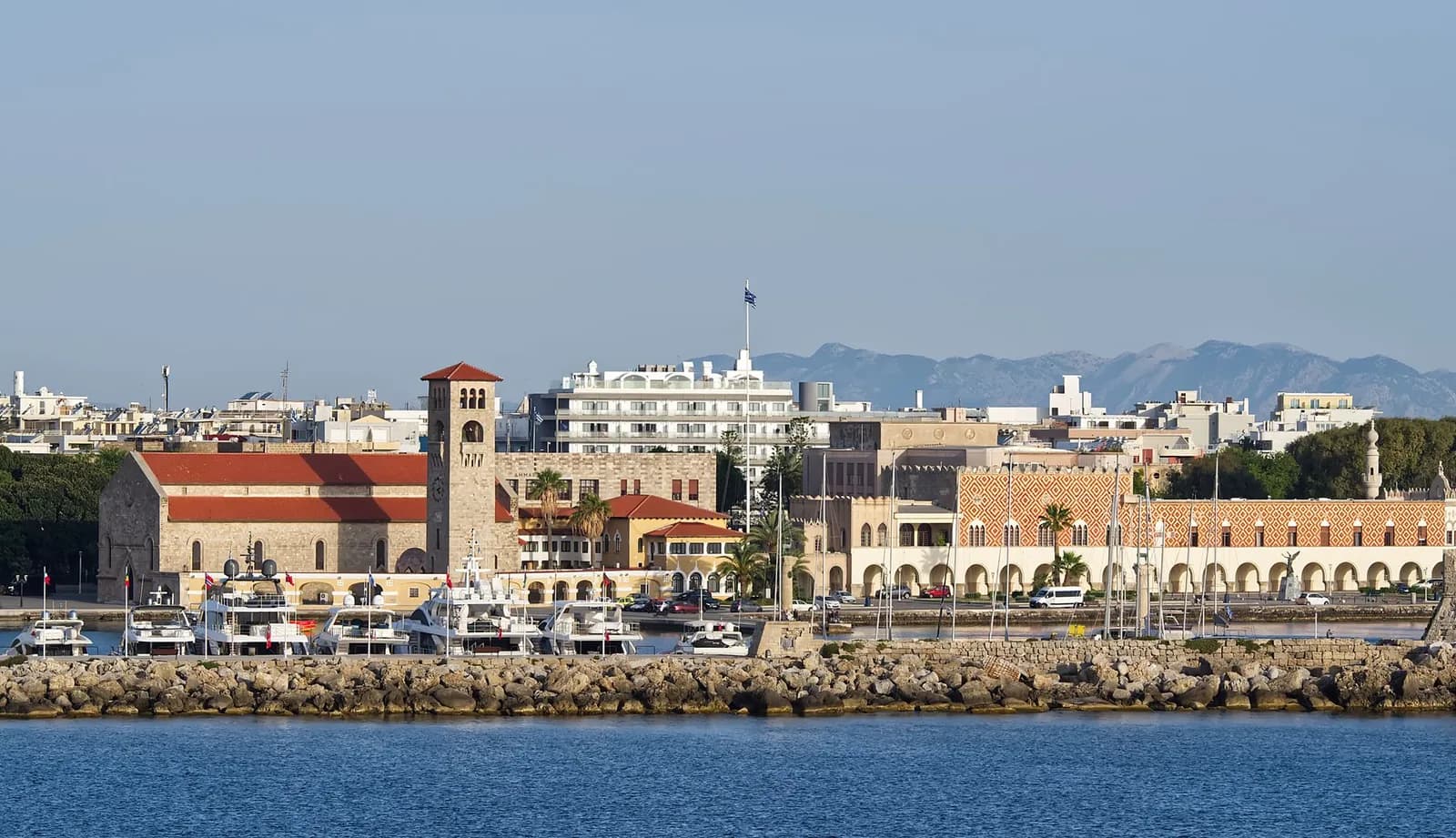
Rhodes airport: twenty minutes to the town, an hour to Lindos
RHO sits in the far north-west corner of an island that runs eighty kilometres to the south-east. Where you have booked decides whether the transfer is a bus ride or most of an afternoon.
Rhodes International Airport, code RHO and named after the boxer Diagoras, is at Paradisi on the north-west coast, 14 km from Rhodes Town. It handled 6.92 million passengers in 2024, which makes it the fourth busiest airport in Greece, and it stays open twenty-four hours a day. The number that matters more is the other one: the island is eighty kilometres long and the runway is at the top of it.
Where Rhodes airport actually is
The terminal is on the coast road between Kremasti and Paradisi, with the sea on one side and the foot of the hills on the other. It is a corner position, not a central one, and that explains every transfer figure on this page. Rhodes Town, Ixia and Ialysos are all within twenty minutes because they are on the same short stretch of north-west coast. Everything sold as a beach holiday on the east side is somewhere between half an hour and an hour and a half away.
Position
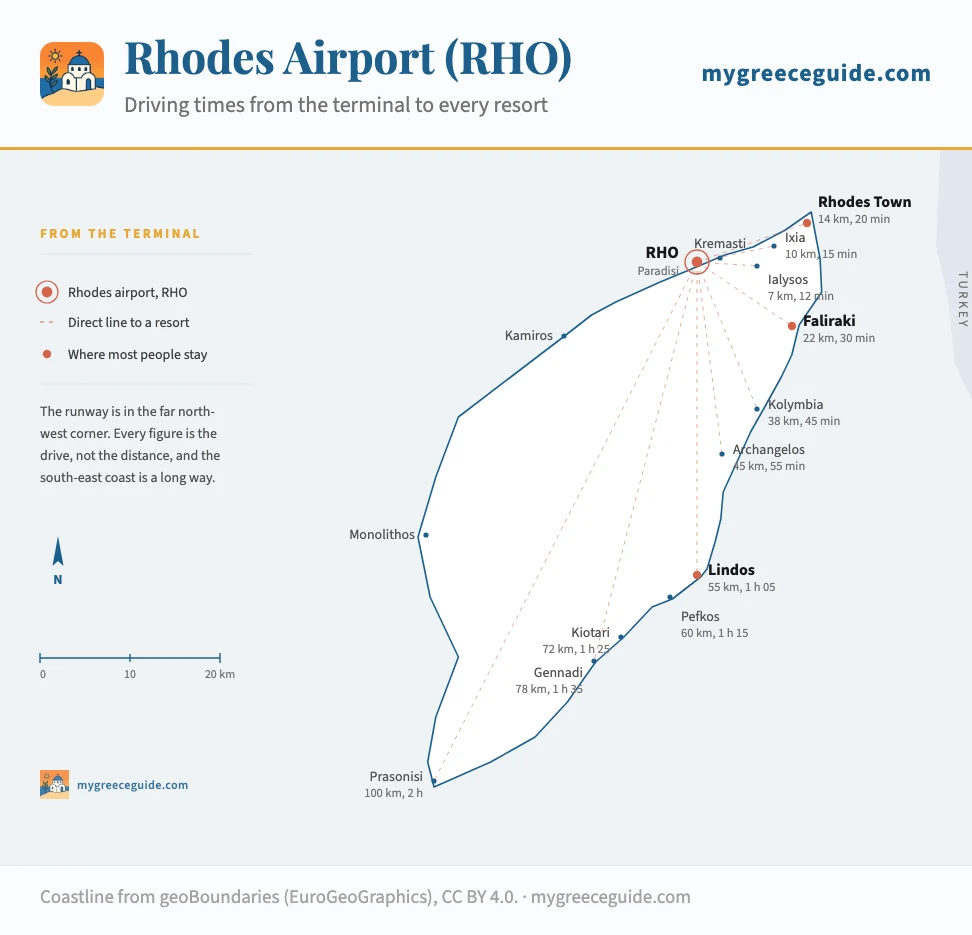
That corner is also the windy side. The north-west coast takes the meltemi through the summer, which is why Ixia is full of windsurfers and why the beaches there are shingle rather than sand. The sheltered water and the sand are on the east coast, on the other side of the transfer. If you have not chosen a resort yet, how the island is laid out is worth ten minutes before you book anything, because the airport is only one of the things that sits a long way from Lindos.
Ten minutes from the terminal
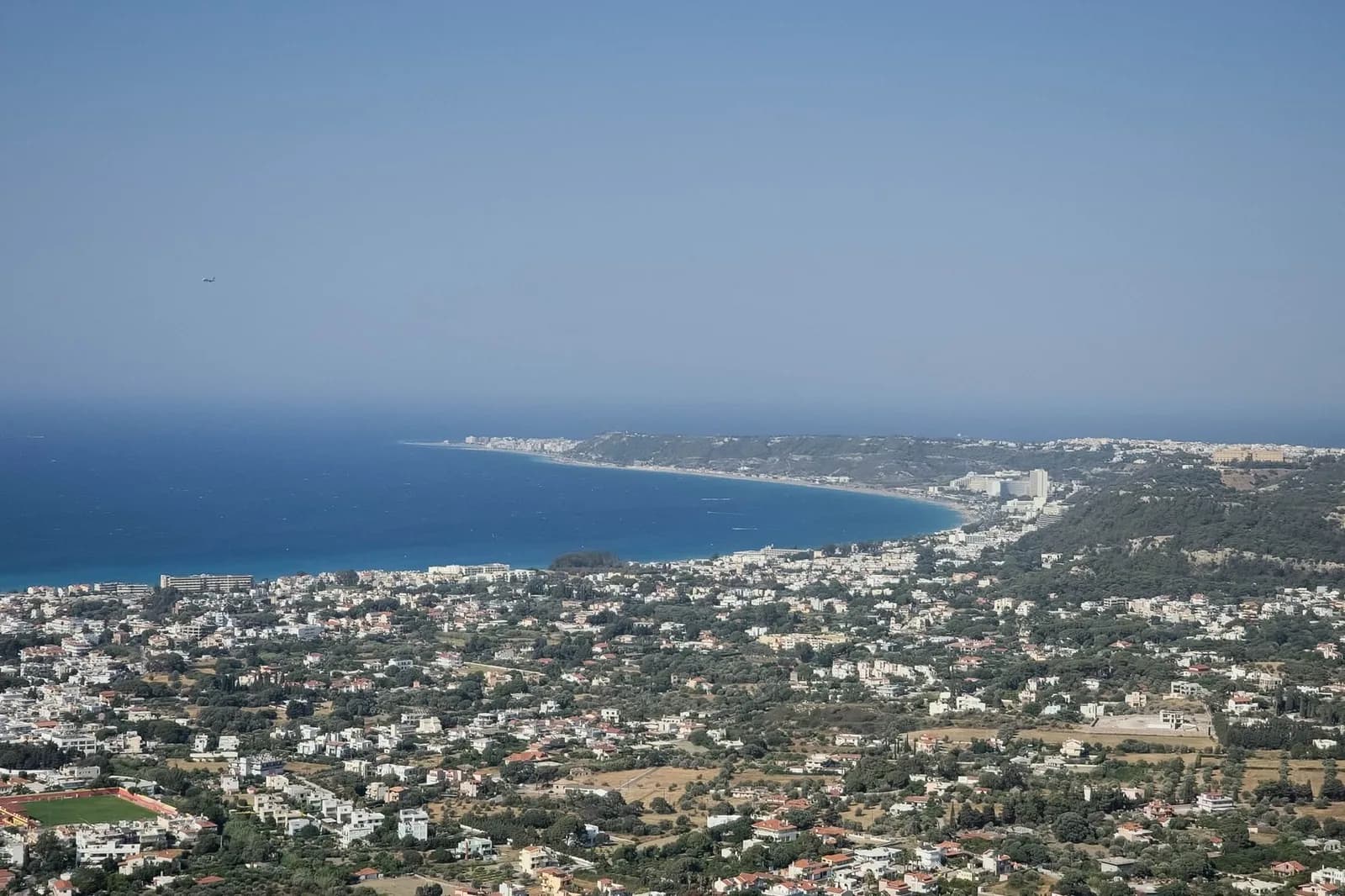
What the transfer costs, resort by resort
The taxi column is the fare board at the rank outside arrivals, which is regulated and published rather than metered, so it is the one price on Rhodes you can check before you get in. The bus column is the part nobody writes down.
| From RHO to | Distance | By car | Taxi rank | By bus |
|---|---|---|---|---|
| Kremasti | 3 km | 5 min | About 12 € | RODA west line, the stop before the airport |
| Ialysos | 7 km | 12 min | About 18 € | RODA west line, direct, every 30 min in season |
| Ixia | 10 km | 15 min | About 21 € | RODA west line, direct |
| Rhodes Town | 14 km | 20 min | 27 to 29 € | RODA west line, 35 to 40 min with the stops |
| Kallithea | 19 km | 25 min | About 34 € | Change in Rhodes Town onto a KTEL east service |
| Faliraki | 22 km | 30 min | 31 to 34 € | Change in Rhodes Town, then the frequent KTEL coast bus |
| Afandou | 28 km | 35 min | About 45 € | Change in Rhodes Town, KTEL east |
| Kolymbia | 38 km | 45 min | About 55 € | Change in Rhodes Town, KTEL east |
| Archangelos | 45 km | 55 min | About 65 € | Change in Rhodes Town, KTEL east |
| Lindos | 55 km | 1 h 05 | 74 to 80 € | Change in Rhodes Town, then 1 h 25 on the KTEL Lindos bus |
| Pefkos | 60 km | 1 h 15 | 79 to 88 € | Change in Rhodes Town, and few services beyond Lindos |
| Kiotari and Gennadi | 72 to 78 km | 1 h 25 to 1 h 35 | 90 to 100 € | Change in Rhodes Town, a handful of KTEL south runs a day |
Rhodes Town costs under thirty euros and Lindos costs the better part of eighty, which is fair enough for three times the distance but catches anyone who budgeted for a short hop. The other column is the surprise. The bus stops being a real option the moment you cross to the east coast, and not because of the distance.
Which of the three options you should actually take
The honest answer changes completely depending on where you have booked, so start there rather than from the mode of transport.
Where are you staying on Rhodes
North and west
East and south
Lindos and Pefkos
Two thirds of the way down the east coast
- BusRODA into town, change to KTEL, 1 h 25 more. Close to three hoursNot worth it
- Taxi74 to 80 € from the rank, about an hourTake this
- Hire carLindos village is closed to traffic and the car parks fill earlyWorkable
The transfer people underestimate, and the reason this page exists. An hour by road from a runway that looks close on a map, and the bus version is a three-hour relay across two companies. Budget the taxi at booking rather than discovering it at the rank.
Two bus companies, and only one of them comes here
Rhodes does not have a bus network. It has two, run by different companies, and they meet nowhere except in Rhodes Town. RODA runs the city and the west coast, which is the side the airport is on, and its station is on Averof Street behind the New Market. KTEL runs the east coast and the south, which is where all the resorts are, from a station a few minutes away along the same waterfront.
So the airport bus is a RODA bus. It stops outside the terminal, costs about 2.60 € from the driver or a little less bought in advance, runs roughly every thirty minutes through the season from early morning until around midnight, and reaches Averof Street in 35 to 40 minutes because it calls at every village along the coast road. For Rhodes Town, Ixia or Ialysos, that is a genuinely good service and better value than anything else on offer.
For anywhere else it is the first leg of a relay. Getting to Lindos by bus means the RODA bus into town, a walk to the KTEL station with your luggage, then an hour and twenty-five minutes on the Lindos coach, which costs about six euros and does not run especially often. Total journey, with the wait between them, close to three hours. The taxi does it in one. That is the gap the phrase « buses connect the airport with the island » hides, and it is why the best answer to this question on the whole internet is currently a Reddit thread.
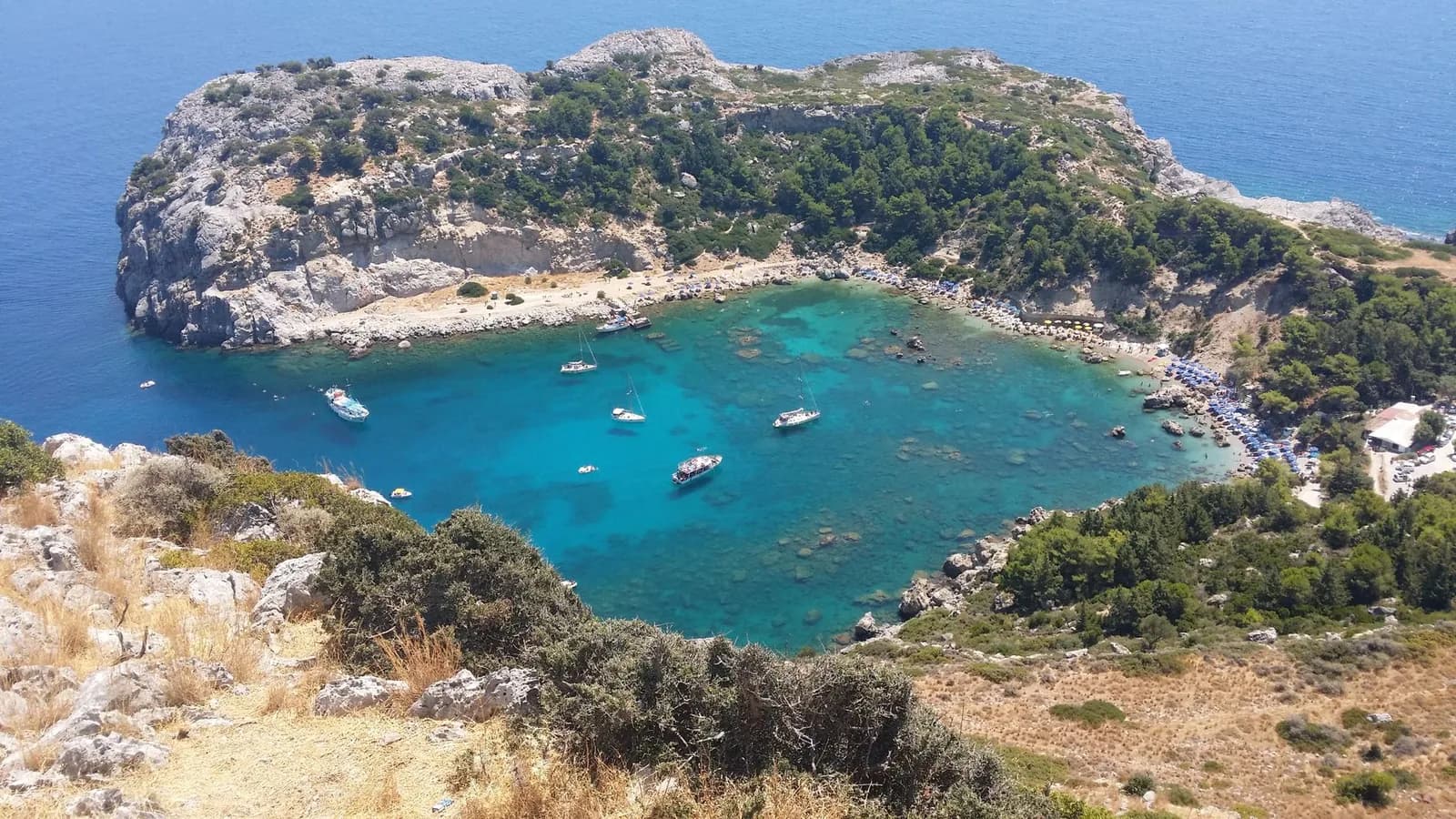
Half an hour further
The taxi rank, the fare board and the absence of Uber
Taxis wait outside arrivals for every flight and there is no need to book one. Rhodes works to published fixed fares between the airport and each resort rather than to a meter, and the board is displayed at the rank, so the price is knowable in advance. Check it before you get in and agree the figure, which is normal practice here rather than a sign that something is wrong.
On top of the fare there is an airport supplement of a few euros, a small charge for each bag over ten kilos, and a night tariff that applies in the small hours. A family of four with four suitcases going to Lindos should expect the meter-free equivalent of ninety euros rather than seventy-five.
Uber does not operate in Rhodes, and neither do Bolt or Lyft. This comes up constantly because the app works perfectly well in Athens. On the island the choices are the rank, a pre-booked private transfer, or your own car, and for a group heading a long way south the pre-booked transfer is often the same money as the taxi with less standing about.
Hiring a car, and when it pays for itself
On a lot of Greek islands a hire car is optional. On Rhodes it depends entirely on which end you are staying at. From Rhodes Town or the west coast strip you can have a good week without one, because the old town is walkable and the buses on that side are frequent. From anywhere on the east coast past Faliraki, a car is close to compulsory unless you intend to stay inside the hotel, because the KTEL timetable thins out badly in the afternoon and the villages worth eating in are ten minutes apart by road and two hours apart by bus.
A taxi to Kiotari and back is close to two hundred euros, which is most of a week of car hire outside August. If the transfer alone costs what the car would, the car wins before you have driven anywhere. Book it before you fly: Rhodes is a big rental market but a finite one, the automatics go first because almost everything on the island is manual, and walk-up rates in August are the worst you will ever pay.
Departures, the summer queues and the new border checks
Arriving at RHO is usually quick. One terminal, a short walk, and the only real variable is how fast the belts clear when two widebodies land together. Departing in July or August is a different building.
Nearly seven million passengers pass through a single terminal, and most of them do it between May and October. Charter flights leave in waves rather than spread through the day, so the check-in hall is empty at eleven and three deep at two. Bag drop is where the time goes, not security, which rarely takes more than twenty minutes.
Since April 2026 there is a second queue to plan for. The EU Entry and Exit System is now fully live, and it replaces the passport stamp with a facial image and four fingerprints for every non-EU passenger on a short stay. Rhodes is heavily British, which means a large share of its traffic now goes through that process. First registration adds a minute or two per person and lasts three years, so a second trip is faster, but the first summer of it has meant longer waits at peak times across Greece. It costs nothing and no website can register you in advance, whatever they charge for.
Practically: two hours before a summer departure is the floor, two and a half on a Saturday or Sunday changeover, and hand the hire car back before you join any queue rather than after it.
No, Rhodes does not have two airports
It has four airfields and one of them takes passengers. The question comes up often enough to be worth answering properly, because search results do offer the others. Maritsa, a few kilometres inland from the coast, was the island's civil airport until Diagoras opened in 1977, and it is now used by the air force and by light aircraft. Kalathos, on the east coast near Lindos, and Kattavia, in the far south, were both laid down during the Second World War and neither has had a scheduled flight since. None of the three can be booked, and none of them is a closer way into Lindos.
Inside the terminal
One passenger terminal, opened in 2005 and remodelled by Fraport Greece from 2017, which took check-in desks from forty to forty-five, gates from sixteen to eighteen and security lanes from seven to twelve. Landside there are car hire desks, ATMs, exchange, a couple of cafés and the bus stop outside the door. Airside there is duty free, a lounge, the usual food chains and enough seating for an ordinary hour rather than a peak one.
The runway is a single strip, 06 and 24, 3,305 metres long, which is generous and the reason RHO takes larger aircraft than most Greek island airports. There is no night curfew, unlike Zante, where nothing flies between ten and five, so a delayed flight into Rhodes arrives late rather than tomorrow.
What happens between November and April
Less than you would expect, which sets Rhodes apart from most of the islands. The European charters come off the schedule through October and the terminal quietens down, but the Athens link runs all year at a useful frequency and a handful of European routes survive the winter. Rhodes Town has fifty thousand residents and keeps working regardless of the season, so the airport never shuts the way the smaller island strips do.
What does close is the east coast. Faliraki, Kolymbia and the southern resorts shutter almost completely, and the KTEL timetable contracts with them. A February trip to Rhodes means basing yourself in the town, which is no hardship. If you are weighing the island against its neighbours in the chain, the Dodecanese comparison covers what Kos, Symi and Karpathos each do differently, and the map of the group shows how far apart they really are. The rest of the country's entry points sit on the airports hub.
Questions people ask about Rhodes airport
What airport do you fly to in Rhodes?
Rhodes International Airport « Diagoras », code RHO, at Paradisi on the north-west coast. It is about 14 km from Rhodes Town and it is the only airport on the island taking passengers, so every flight sold as Rhodes or Rodos lands here. It is one of the busiest airports in Greece outside Athens, with 6.92 million passengers in 2024, and unlike a lot of Greek island airports it works all year rather than closing down with the charter season.
Does Rhodes have two airports?
No, only one takes passengers. The confusion is real enough though, because the island has three other strips. Maritsa, a few kilometres inland, was the civil airport until 1977 and is now military and general aviation. Kalathos on the east coast and Kattavia in the far south were both built in the Second World War and neither has scheduled flights. If a search result offers you a Rhodes airport that is not RHO, it is one of those, and you cannot fly into it.
How far is Rhodes airport from Lindos?
About 55 km, which is an hour by road and closer to an hour and a quarter when the coast road is busy in August. The airport is in the north-west corner of the island and Lindos is two thirds of the way down the east coast, so the drive crosses the top of Rhodes and then runs south. The taxi rank charges 74 to 80 € for it. Almost every guide describes the airport as close to everything, which is true of Rhodes Town and not remotely true of Lindos.
Is there a bus from Rhodes airport?
Yes, and it only goes one way. The RODA west coast line stops outside the terminal and runs into Rhodes Town in 35 to 40 minutes, roughly every half hour through the summer, from early morning to around midnight. It costs about 2.60 € from the driver. What it does not do is reach the east coast, because that side of the island belongs to a different company, KTEL, whose buses leave from a different station in Rhodes Town. Any resort past Kallithea means changing companies mid-journey.
How much is a taxi from Rhodes airport?
The rank outside arrivals works to a published fare board rather than a meter, so you can check the price before you get in. Rhodes Town is 27 to 29 €, Ixia and Ialysos 18 to 21 €, Faliraki 31 to 34 €, Lindos 74 to 80 €, and the far south around 90 to 100 €. There is an airport supplement of a few euros and a small charge per bag over 10 kg, and the night tariff is higher. Taxis wait for every arrival and there is no need to book one.
Is there Uber in Rhodes?
No. Uber, Bolt and Lyft do not operate on the island, and no amount of opening the app at the terminal will change that. The alternatives are the licensed taxi rank outside arrivals, which runs to fixed published fares, a pre-booked private transfer, or a hire car. There is a local taxi app used on the island, but at the airport the rank is simpler and costs the same.
Is Rhodes Airport chaotic?
Arrivals are usually fine. Departures in July and August are the problem, and the reason is that a single terminal handles nearly seven million passengers concentrated into five months, with charter flights leaving in waves rather than spread through the day. Since April 2026 there is a second reason: the EU Entry/Exit System now fingerprints and photographs every non-EU passenger, which adds a minute or two per person at passport control and a good deal more when three British departures fall in the same hour.
How long does it take to get through security at Rhodes Airport?
Security itself is usually fifteen to twenty minutes, and it is rarely what delays you. The queues that matter are bag drop, where a charter check-in can take half an hour, and passport control for flights leaving the Schengen area, which is where the biometric checks happen. Two hours before departure is the floor in summer and two and a half is more comfortable on a Saturday or Sunday. Outside the season the same building empties and the whole thing takes twenty minutes.
