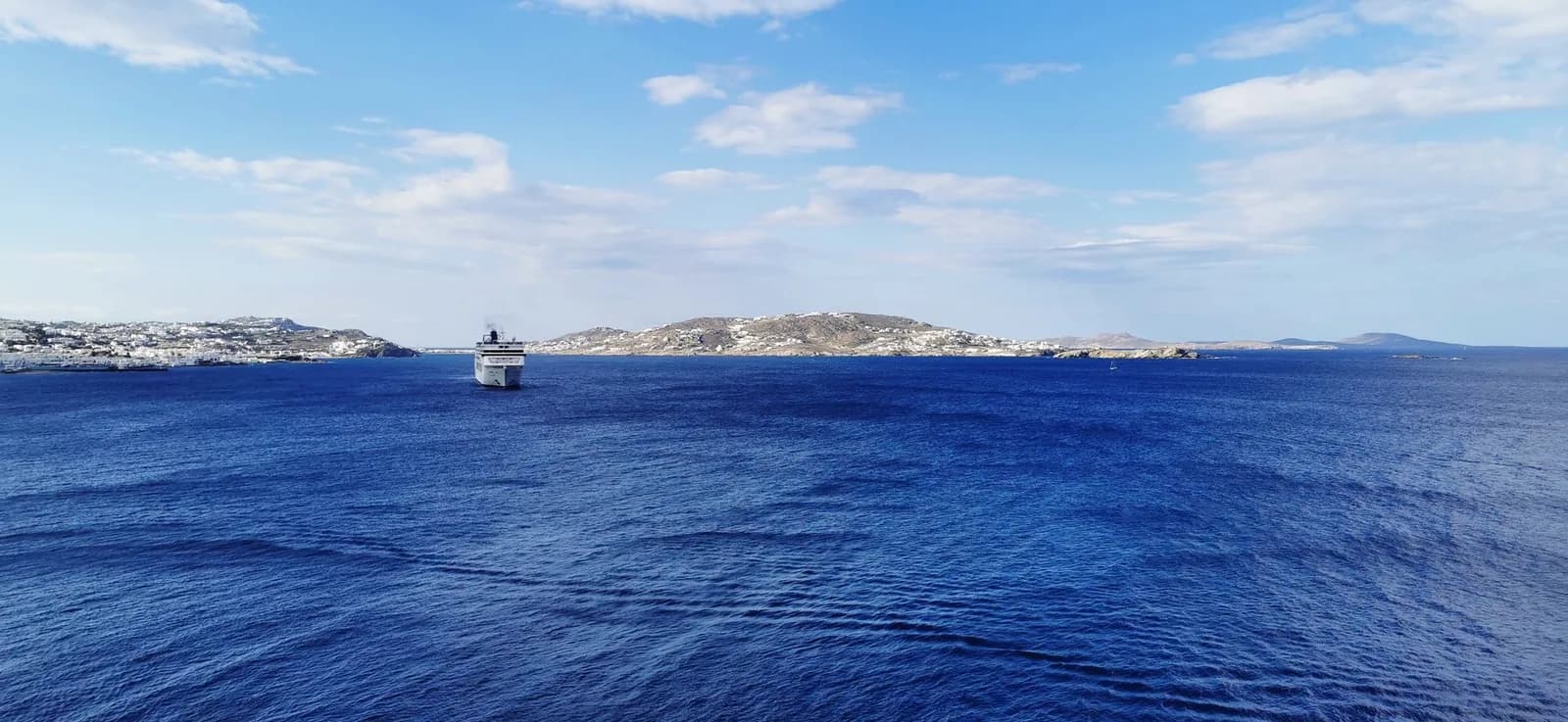
Athens to Mykonos ferry: which port you actually leave from
The crossing is the easy part. Most fast ferries to Mykonos sail from Rafina, an hour east of Athens, and not from Piraeus. Book a hotel in Plaka and a boat from Rafina and you have lost your morning before you start.
Athens has two ferry ports that serve Mykonos, and they are on opposite sides of the city. Piraeus is the one everybody has heard of, south-west of the centre and on the metro. Rafina is a small working harbour on the east coast of Attica, near the airport, with no metro and no train. A large share of the fast boats to Mykonos go from Rafina.
Nothing on a booking confirmation makes this obvious. The ticket says Athens, the timetable says 07:30, and the port name sits in small type near the bottom. People read Athens, picture Piraeus, and get to the wrong side of the city with a boat leaving in twenty minutes. It is the single most common way to miss this crossing, and it is entirely avoidable if you check the port the day you book rather than the morning you sail.
Piraeus or Rafina: what changes between them
The crossing itself barely differs. Everything around it does, starting with how long it takes to reach the quay and ending with how easy the port is to move around once you are there. Piraeus handles the whole Aegean and sprawls over several kilometres of numbered gates. Rafina is one quay you can see from end to end.
| Piraeus | Rafina | |
|---|---|---|
| Where it is | South-west of Athens, on the Saronic Gulf | East coast of Attica, facing the Aegean |
| From Syntagma or Plaka | About 30 min by metro, line 1 or line 3 | About 1 h by KTEL bus, no metro, no train |
| From Athens airport | About 1 h 10 by metro, longer by road | About 25 to 35 min by bus or taxi |
| Operators to Mykonos | Blue Star Ferries, some Seajets departures | Seajets, Fast Ferries, Golden Star Ferries |
| Crossing time | About 2 h 30 on a fast boat, near 5 h on a conventional one | About 2 h 15 to 2 h 45 on a fast boat |
| Size of the port | Huge, a dozen numbered gates spread over several kilometres | Small, one quay, everything within sight |
| Suits you if | You are sleeping in central Athens, or you want the slow cheap boat | You land at the airport that day, or you are staying on the east coast |
Read the last line of that table first. There is no better port in the abstract, only a better port for where you are standing the night before.
Which one suits your trip
Four situations cover almost everyone who makes this crossing. Pick the one that matches yours and book the port, then the boat.
Say where you sleep and the port follows
Where are you leaving from?
Sail from
Piraeus
Take the boat that leaves from Piraeus
From Plaka, Monastiraki or Syntagma the metro drops you at the port in about half an hour, for the price of a normal ticket. Rafina from the same hotel means a bus across the city first, and the bus does not run often enough at dawn to make a 7 am sailing comfortable.
- Getting there
- Metro line 1 or line 3 to Piraeus station, then a walk or the free shuttle to your gate.
- Watch out
- Piraeus is not one quay but a ring of them. Your gate number is printed on the ticket and the walk between the far ones takes twenty minutes.
Getting to each port from Athens
Piraeus is the easy one. Metro line 1 has run there since the nineteenth century and line 3 was extended to the same station a few years ago, which also connects the port directly to the airport without changing trains. From Syntagma or Monastiraki you are looking at about half an hour underground. The station sits opposite the passenger terminals, and free shuttle buses loop around the gates for the ones that are too far to walk with luggage.
Rafina has no rail link of any kind. From the centre of Athens you take a KTEL Attikis bus from the terminal near Pedion tou Areos, and the trip takes roughly an hour depending on traffic on Marathonos Avenue. Buses run through the day but thin out early in the morning and late at night, which is exactly when the fast boats sail. A taxi from the centre costs several times the bus fare and still takes forty-five minutes on a good day. The two ports sit on opposite sides of Attica, and seeing the city, the metro line and the harbour on one drawing makes that obvious in a way a booking page never does.
From the airport the picture flips. Rafina is about twenty-five to thirty-five minutes away by bus or taxi, since both are on the same eastern edge of Attica. Piraeus from the airport is an hour and ten on the metro, and worse by road at rush hour. If you are landing and sailing on the same day, that difference is the whole argument. How the metro, the X95 bus and a taxi compare once you come off the plane at Eleftherios Venizelos decides whether a same-day crossing is realistic or a gamble on traffic.
Piraeus
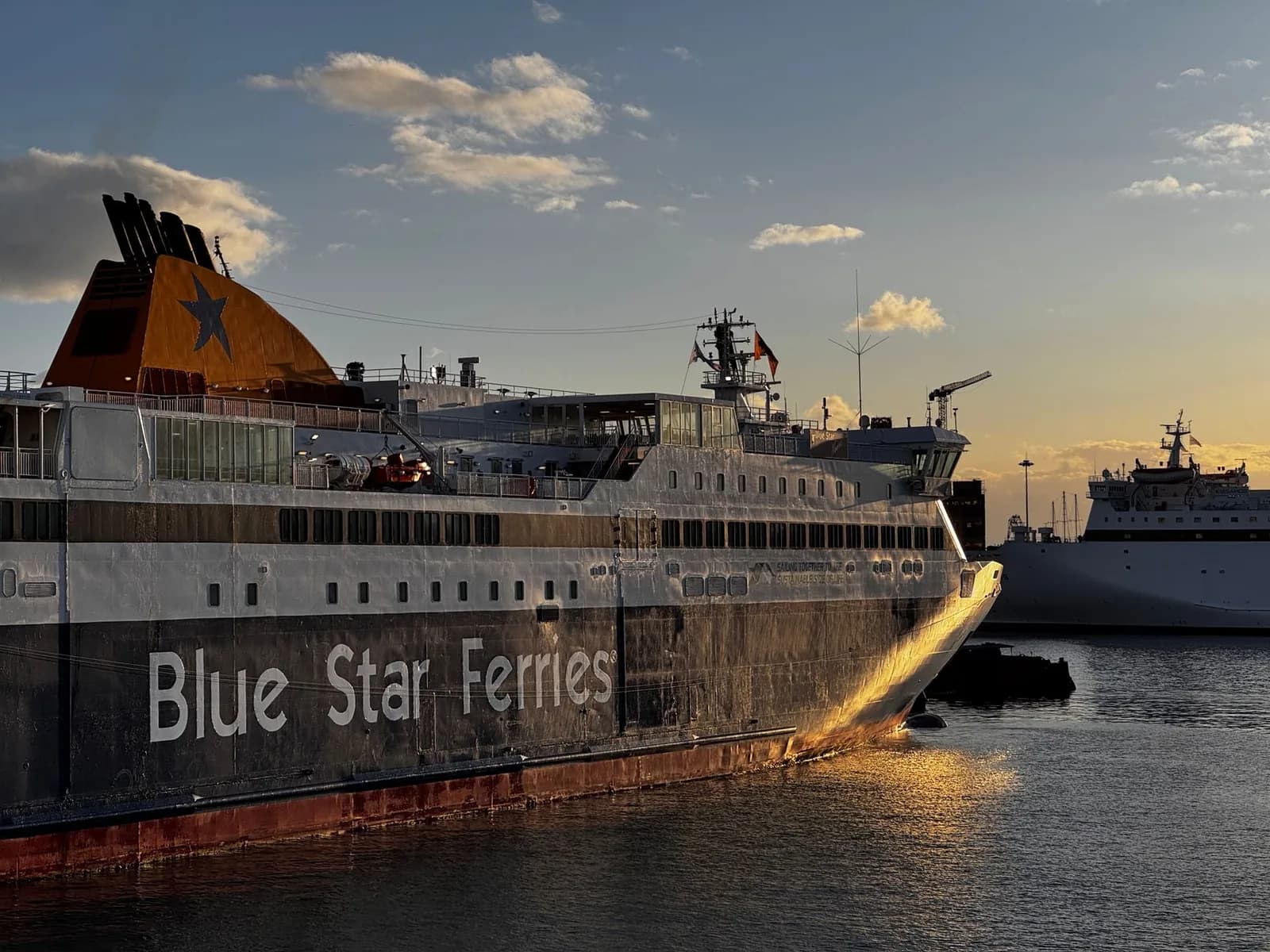
How long the crossing takes
Two and a half hours is the figure to hold in your head for a fast boat. Quoted times run between a little over two hours and just under three, depending on the vessel, the operator and whether the sailing stops at Tinos or Andros on the way. The conventional ships from Piraeus take around five hours and almost always call somewhere else first.
Those numbers are the schedule, not the day. Wind slows the fast catamarans down before it stops them, and a sailing advertised at 2 h 20 can land forty minutes late in a stiff northerly without anything being wrong. Never plan a same-day connection out of Mykonos airport on the back of a ferry arrival in July or August. The bus between the port and the airport runs hourly and skips the seven and eight o'clock departures, which is the gap that catches people out.
The slow ship has arguments beyond price. It is bigger, so it rolls less. It has deck space and proper seating instead of an aircraft cabin, and it holds its schedule in weather that cancels the catamarans. Anyone who gets seasick should take it on purpose.
Who runs the route
Four names cover almost every sailing. Seajets runs the largest fleet of fast catamarans in the Cyclades and operates from both ports. Fast Ferries and Golden Star Ferries work mainly out of Rafina. Blue Star Ferries runs the conventional ships from Piraeus, and it is the one to look for if you want a deck, a table and a crossing that does not get cancelled at the first sign of wind.
Timetables are published season by season, usually confirmed a few months ahead for the summer, and they change. The winter service is a different route altogether: a handful of sailings a week instead of a dozen a day, and some operators disappear from the schedule entirely between November and March. Our guide to Greek ferries covers how the operators differ across the whole network.
The meltemi, and why boats get cancelled in August
The meltemi is a dry northerly that blows down the Aegean through July and August, and the northern Cyclades take it head on. Mykonos, Tinos and Andros sit in the worst of it. It can run for three or four days without dropping, under a sky that stays completely clear, which is why the cancellation email always arrives on what looks like perfect beach weather.
The fast catamarans go first. They are light, they slam in a short sea, and the port authority pulls them from service well before the conventional ships stop. If your crossing is called off you are normally offered the next available sailing or a refund, but on a busy August weekend the next available sailing can be the following day. Build a day of slack around any flight home, and treat a tight connection in high season as a plan that will eventually fail.
Two habits help. Book a morning departure, since the wind usually builds through the afternoon. And if you have a choice between the fast boat and the slow one on a windy forecast, the slow one is more likely to sail.
Arriving in Mykonos: two ports again
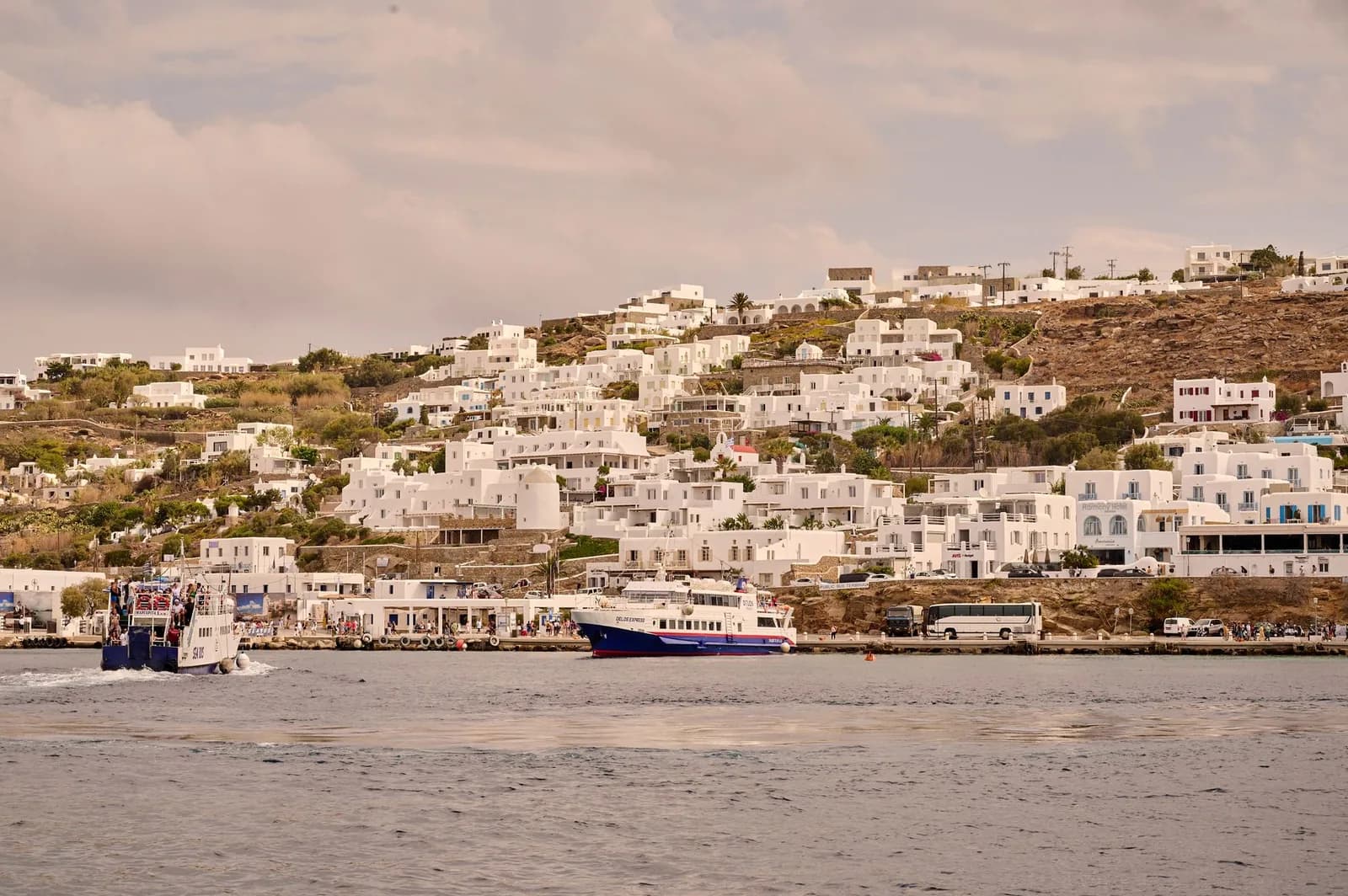
The port question repeats itself at the other end. Mykonos has an old port, right at the edge of the town and walkable to most of Chora, and a new one at Tourlos about two kilometres north. Nearly all the ferries from Athens dock at Tourlos. Small local boats, the Delos excursions and some seasonal services use the old harbour.
Two kilometres with luggage on a hot afternoon is not a walk. There is a bus between Tourlos and the town, taxis queue at the terminal, and most hotels will send a transfer if you tell them the sailing you are on. The mistake is assuming you will step off the boat into the postcard, then finding a car park and a main road instead. The island map shows where the two ports sit relative to the town, and which of the two bus stations serves which half of the island once you are ashore.
Very few people cross to Mykonos and stop there. The same boats carry on down the chain, and the most common next leg is the short hop south to Naxos, from the New Port at Tourlos. Since Mykonos holds the most expensive beds in the Cyclades, the usual shape of a two week trip is a couple of nights here and the rest somewhere calmer. That decision is made on rooms rather than on sailings, and what those couple of nights on Mykonos actually cost depends on which bay you pick. It is worth knowing how Parikia and Naoussa split the island of Paros between them, that a room within walking distance of the quay on Naxos costs a fraction of the equivalent here, and that sleeping on Milos means choosing a base and hiring a car, because nothing on that island is walkable from anything else. Fix those three before you fix the order of the crossings.
The old port
Booking the ticket
Prices move with the season, the operator and how fast the boat is, and they are quoted per sailing rather than per route. Expect the fast catamarans to cost noticeably more than the conventional ship, expect August to cost more than May, and expect a car to add more than a second passenger does. Anything more precise than that on a page like this would be out of date before you read it.
Book several weeks ahead for July and August, particularly for a vehicle or a specific morning departure. Outside those months a few days is usually enough. Whatever you book, check three things on the confirmation before you close the tab: the departure port, the operator, and the arrival port in Mykonos. Those three lines are where this crossing goes wrong, and none of them is the boat itself.
Questions people ask about this crossing
How long is the ferry from Athens to Mykonos?
Roughly two and a half hours on a fast boat, and close to five on a conventional one. The fast catamarans out of Rafina are usually quoted between 2 h 15 and 2 h 45, the ones out of Piraeus a little longer because the boat has to clear the Saronic Gulf first. Blue Star Ferries, the big slow ship from Piraeus, takes around five hours and often calls at another island on the way. Exact times move with the season and the operator, so read the sailing rather than the average.
Does the Mykonos ferry leave from Piraeus or Rafina?
Both, but not equally. Most of the fast crossings go from Rafina, on the east coast of Attica, while Piraeus keeps the conventional overnight-style ships and a smaller number of fast departures. Rafina is about an hour from central Athens by bus and has no metro, so anyone staying in Plaka or Syntagma should check the port on the ticket before booking anything else.
Is it better to fly or ferry Athens to Mykonos?
The flight takes about forty minutes and the fast ferry two and a half hours, but the gap narrows once you count the airport. Two hours before a domestic flight, plus the transfer at each end, and the plane saves less than an hour door to door for most people. The ferry usually wins on cost outside the peak weeks, lets you carry as much luggage as you can lift, and lands you a short bus ride from the town rather than out by the airstrip. The plane wins in bad weather, since the meltemi cancels boats and rarely grounds aircraft, and it wins if you are staying in central Athens with an early start, because Rafina is an hour away by bus.
How much does it cost to take a ferry from Athens to Mykonos?
Any figure quoted on a guide page will be wrong by the time you book. Greek fares are reissued season by season and move with the operator, the month and how far ahead you buy. What holds steady is the shape of it: a high-speed catamaran costs substantially more than a conventional ship on the same water, August costs more than May, a vehicle costs more than an extra passenger, and a cabin on an overnight sailing is a separate line again. Price the flight at the same time, because on this route it is often in the same bracket as the fast boat.
Can I do a day trip to Mykonos from Athens?
It is possible in high season and it is not much fun. An early fast boat gets you in during the morning and the last one back leaves in the late afternoon, which buys you a few hours on the island for a full day of travelling. Add the hour each way to Rafina and it becomes a very long day for a walk around Chora. If the return sailing is cancelled for wind, and in July or August that is a real possibility, you are sleeping in Mykonos at peak prices with no room booked. One night on the island costs less stress than the round trip in a day, and the organised day cruises that include Delos are a better use of the same hours.
