Kefalonia airport: how far your resort really is
EFL is nine kilometres below Argostoli and an hour and a half from Fiskardo. On an island this big and this steep, the distance to your hotel matters more than anything else about the airport.
Kefalonia International Airport, code EFL, is a small single-terminal airport on the south coast of the largest island in the Ionian. It fills up with British charter flights between May and October and empties almost completely for the winter. Kefalonia, though, is 780 square kilometres of mountain, and the drive from arrivals to your room runs anywhere from twelve minutes to ninety. That is the part worth checking before you book, and almost nobody does.
Where Kefalonia airport actually is
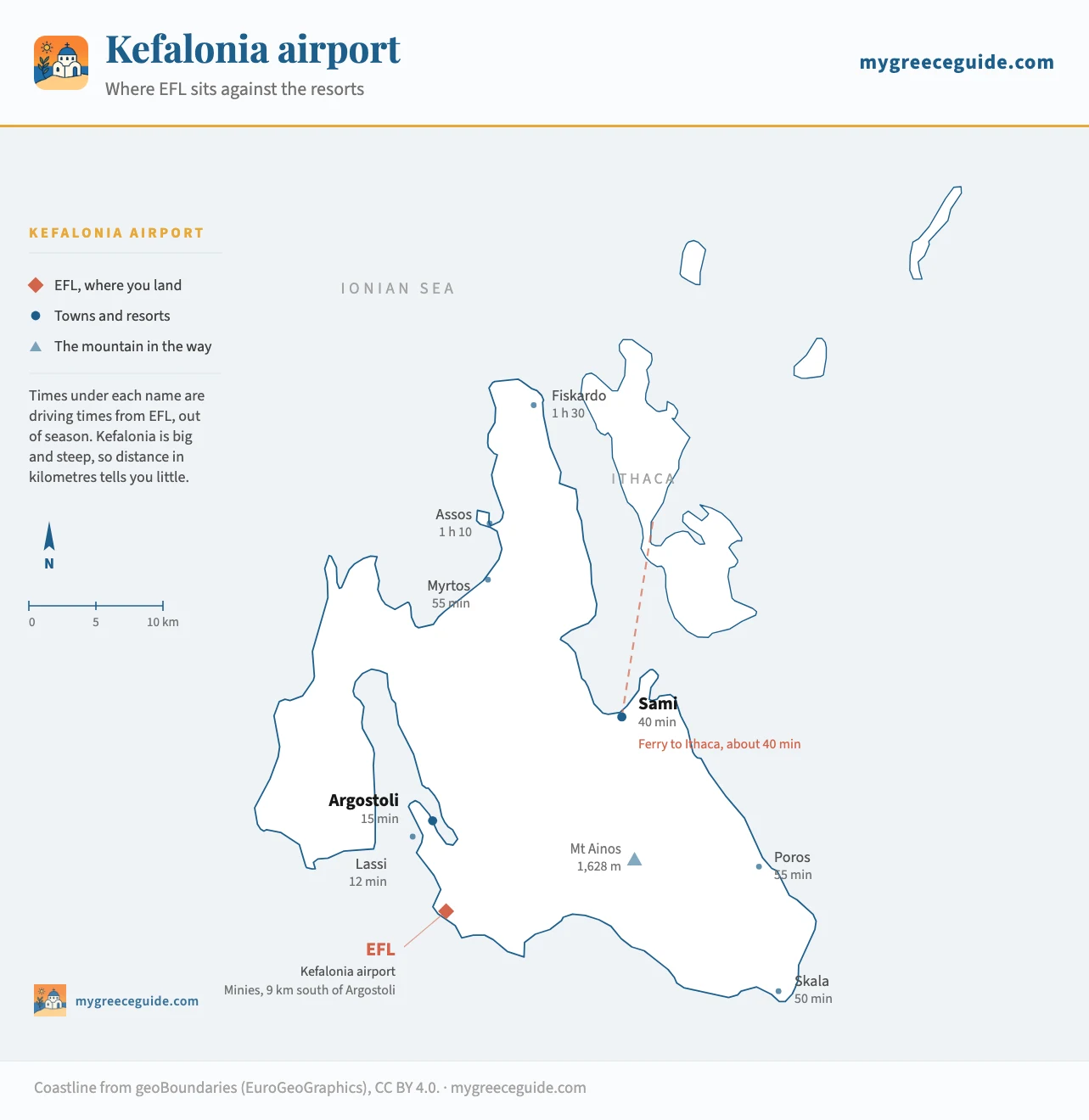
The runway lies at Minies, on one of the few flat stretches the island has, about nine kilometres south of Argostoli. That puts it a quarter of an hour from the capital and a little less from the hotels at Lassi, which is why the south-west corner of Kefalonia feels so easy to arrive in. A great many people search for an Argostoli airport and there is no such thing. The airport is named for the island, sits outside the town, and is the only civil runway on Kefalonia.
Position
How long the drive takes, resort by resort
Kilometres are a poor guide here, so the table leads with time. The airport sits at the southern end of an island that runs a long way north, and the road up the west coast is the slow one.
| From EFL to | Distance | By car | What is there |
|---|---|---|---|
| Lassi | 7 km | about 12 min | The hotel strip nearest the runway, on the headland west of the capital |
| Argostoli | 9 km | about 15 min | The capital, the bus station and the only shops that stay open in winter |
| Lixouri | 36 km by road | about 50 min, or the ferry | Across the gulf. The little boat from Argostoli crosses in a fraction of the drive |
| Sami | 32 km | about 40 min | East coast port, the boats to Ithaca and the caves at Melissani |
| Skala | 41 km | about 50 min | South-east corner, the longest sand on the island and a lot of the package hotels |
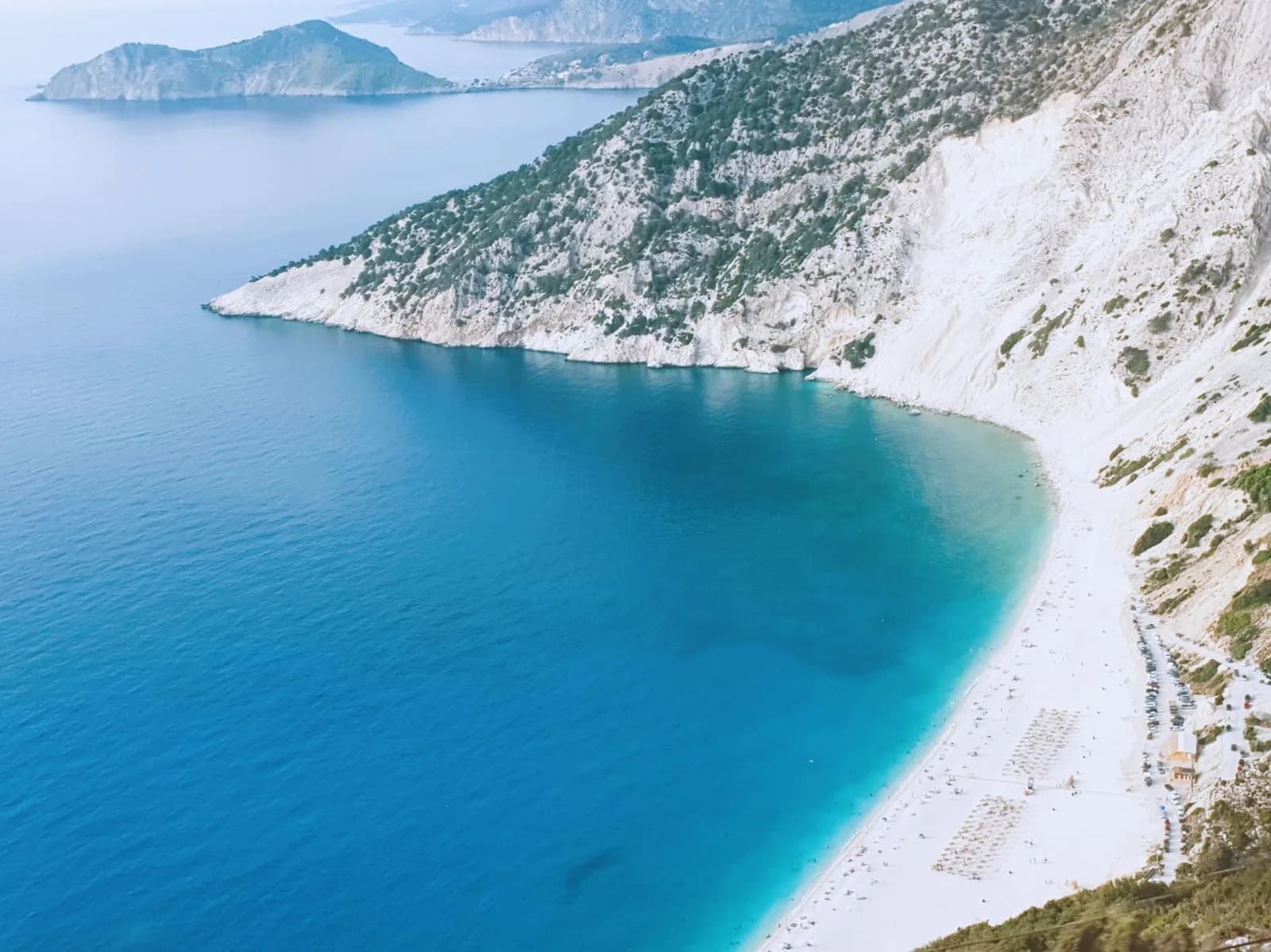
| Myrtos | 38 km | about 55 min | The beach on every photograph of Kefalonia, reached by a steep hairpin descent |
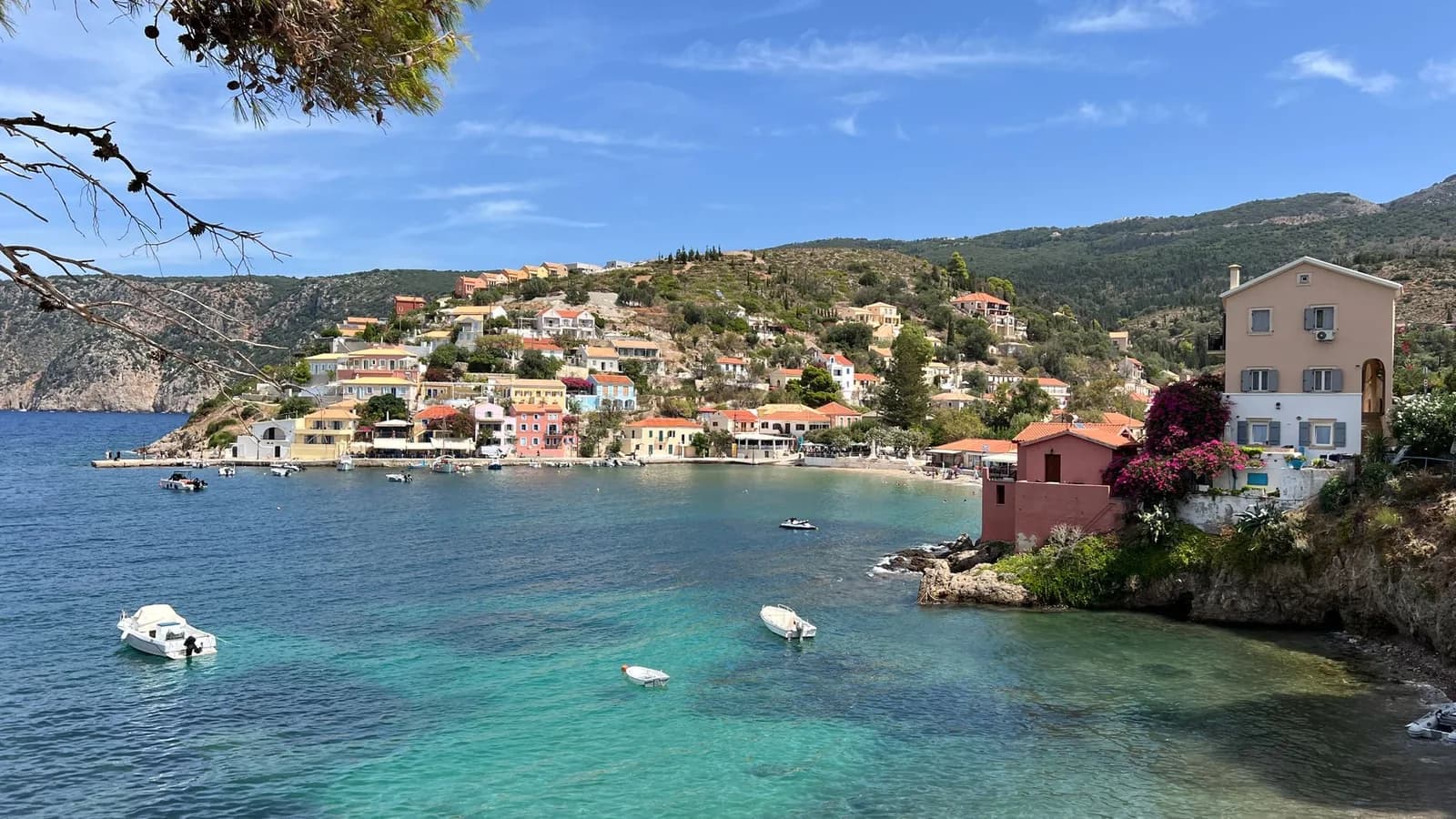
| Assos | 46 km | about 1 h 10 | The village on the isthmus below the Venetian fort, north-west coast |
| Fiskardo | 56 km | about 1 h 30 | The northern tip. The transfer nobody checks before booking a villa here |
Driving times are for an ordinary day outside July and August, at the pace these roads actually allow rather than the one a mapping app assumes. Add time in peak season, after dark, and on the northern road, which is narrow, unlit and full of switchbacks. There is no column for the bus because the island network runs from Argostoli rather than from the terminal, and its timetable is rewritten every season.
The row that catches people out is Fiskardo, and it catches them out every summer. Fifty-six kilometres reads like an hour on any other Greek island. Here it is closer to an hour and a half of switchbacks along a coast road that climbs and drops the whole way, and it is a very different proposition at eleven at night than at four in the afternoon. Villas in the north are booked on the strength of the photographs and the transfer is discovered later.
Your resort decides what this airport is worth
There is no single verdict on EFL, because the same terminal is fifteen minutes from one base and ninety from another. Pick where you are sleeping and the answer changes shape. If that is still open, our guide to where to stay on Kefalonia runs through the eight bases and the hotels in each.
Where are you actually staying?
West coast, either side of the gulf mouth
The short transfer
This is the corner of the island the airport was built for. Lassi is over the hill from the runway and Argostoli is a quarter of an hour beyond it, so a late arrival costs you nothing. It is also the one base where you could survive without a car for a few days, because the island buses leave from Argostoli and the town has a waterfront worth an evening on its own. You will still want a car for the beaches.
- Drive from EFL
- 12 to 15 min
- Hire car
- Useful, not essential
Why a car is not optional here
Kefalonia is the biggest of a group that never behaves like the Cyclades, and it is arranged awkwardly, with a long northern peninsula, a western lobe across a gulf, and a mountain in the middle of everything. The bus network exists for residents, not for visitors on a week's holiday. Services run out of Argostoli, they are sparse, they thin out further at weekends, and out of season several routes stop altogether. Nothing scheduled goes to Myrtos, which is the beach on the front of every brochure about this island.
Taxis fill some of that gap and they are not a plan for a fortnight. What most visitors do is collect a car at the airport, and that is where the second piece of advice comes in: book it before you fly rather than on arrival. The island fleet is finite, August exhausts it, and automatics run out first because most of what is here is manual. Walk-up rates in high season on a small island are the worst rates you will ever pay.
A summer airport, and what happens the rest of the year
EFL is one of the most seasonal airports in Greece, and the shape of its year is worth understanding before you plan anything outside July. The overwhelming majority of its traffic is European charter and low-cost flying between May and October, with a heavy British share: Kefalonia has been a package destination from the UK for decades, and the schedule reflects that far more than it reflects the rest of Europe. Saturday in high summer is a different airport from Tuesday in May.
Then it stops. The direct routes come off the schedule through October and do not come back until spring, leaving a domestic link to Athens that runs on a reduced frequency and, in the quietest weeks, not every day. A November or February trip to Kefalonia is entirely possible and it goes via Athens, with a connection to build into the day and a limited choice of departure times. Half the island's tavernas and hotels are shut anyway, so the flight schedule is only telling you what the island itself has decided.
Ithaca and Zante, from the same airport
One of the better arguments for EFL is what it puts within a boat ride. Ithaca has no airport, and Kefalonia is how almost everyone reaches it. The crossing from Sami to Piso Aetos takes half an hour and runs all year, with a second, summer-only route from Fiskardo in the north. The Kefalonia to Ithaca ferry guide has the 2026 times and the catch at Piso Aetos, where no bus meets the boat. Homer's island is small and almost entirely undeveloped, and it works as a day out or as the second half of a fortnight.
Zante, the neighbour to the south, is reachable by a seasonal boat from Pesada to Agios Nikolaos on its northern coast. Treat that one with more caution: it runs in summer only, the frequency changes from year to year, and both ports are a fair drive from the places you would actually be staying. It is a genuine option for a two-island trip and a bad thing to build a connecting flight around.
Corfu closes the chain at the top, and it is the one Ionian pairing that no boat solves. There is no direct crossing from Kefalonia, so a fortnight taking in both means either two flights through Athens or a long drive up the mainland to the Igoumenitsa ferry. Seeing how far apart the two ends of the Ionian sit tends to settle that plan before it costs anyone a day of the holiday.
An hour and ten from the terminal
Inside the terminal
One terminal, one runway, and a building sized for the island rather than for the August peak. Arrivals are usually quick, because there is not much of a walk between the aircraft and the door. Departures are where a small airport with a summer charter schedule shows. When several flights leave inside the same hour the check-in hall fills and the seating airside runs short. There is not a great deal to eat or buy once you are through.
Two hours before a summer departure is sensible and closer to three on a Saturday. Drop the hire car before you join any queue, not after. Outside the season the same building empties out and the whole process takes minutes.
Anna Pollatou, and the names people search for
The full name is Kefalonia International Airport « Anna Pollatou », after the rhythmic gymnast born on the island, an Olympian and world medallist who died in a road accident in 2014. The dedication is local rather than commercial, which is not how most Greek airports got their names.
The names that cause confusion are the other ones. Airlines and booking engines write the island as Kefalonia, Cephalonia or Kefallinia depending on which transliteration they settled on, and travel agents sell transfers to Argostoli airport, which is where the searches come from and not where the runway is. All of them mean EFL at Minies. The rest of the country's entry points sit on the airports hub, and the the Ionian drawn against the rest of the country is worth a look if you are still working out how these islands fit together.
Questions people ask about Kefalonia airport
Which airport do you fly to for Kefalonia?
Kefalonia International Airport, code EFL, at Minies on the flat strip of south coast about nine kilometres below Argostoli, which is roughly a quarter of an hour by road. It is the only airport on the island, and it is named for the island rather than for the town, so there is no separate Argostoli airport to look for and anything sold as an Argostoli transfer is this one. The alternative arrival is by boat, from Patras and Kyllini on the mainland or from Lefkada and Ithaca in season.
What airlines fly from Kefalonia, Greece?
Olympic Air, Aegean and Sky Express hold the year-round side, essentially the link to Athens and onward connections from there. The rest is seasonal and heavily British and northern European: Jet2, TUI, easyJet, Ryanair, British Airways, Transavia, Volotea and various charter operators appear in the summer schedule and disappear from it again in the autumn. Check your own dates rather than the route map, because the list changes from one season to the next.
What is the best month to visit Kefalonia?
June and September, if the flights from your city cover them. Both give you warm sea, open tavernas and roads you can actually drive, without the August crowding on Myrtos and the queue for a table in Fiskardo. July and August are the busiest and the most expensive, and the hire car fleet is finite. May and October are lovely and thinner: some seasonal routes have not started or have already stopped, so the trip may mean connecting through Athens. Between November and April the island is quiet and most of it is closed.
Is Kefalonia worth going to?
Yes, with one condition: be ready to drive. It is the largest of the Ionian islands, 780 square kilometres of mountain, and what makes it worth the trip is spread right across that, from Myrtos and Assos in the north-west to the caves at Melissani and the harbour at Fiskardo. The bus network is built for residents rather than visitors, so without a car you see a small corner of it. It also puts Ithaca within a forty minute crossing, which no other airport does.
What is the name of Kefalonia airport?
Kefalonia International Airport « Anna Pollatou », after the rhythmic gymnast born on the island who died in a road accident in 2014. The code is EFL for booking and LGKF for pilots and flight trackers. You will also see the island written Cephalonia or Kefallinia depending on which transliteration the airline settled on, and the airport listed as Argostoli. All of them mean the same single runway at Minies.
What is there inside Kefalonia airport?
Very little, and that is worth knowing before a delayed evening flight. One terminal, a small airside area with a café or two, a duty free counter and a handful of gift stands, and seating that runs short when several charter flights leave inside the same hour. Arrivals are quick because there is not much of a walk between the aircraft and the door. Departures are the part to plan: two hours in summer, closer to three on a Saturday, and drop the hire car before you join any queue.
