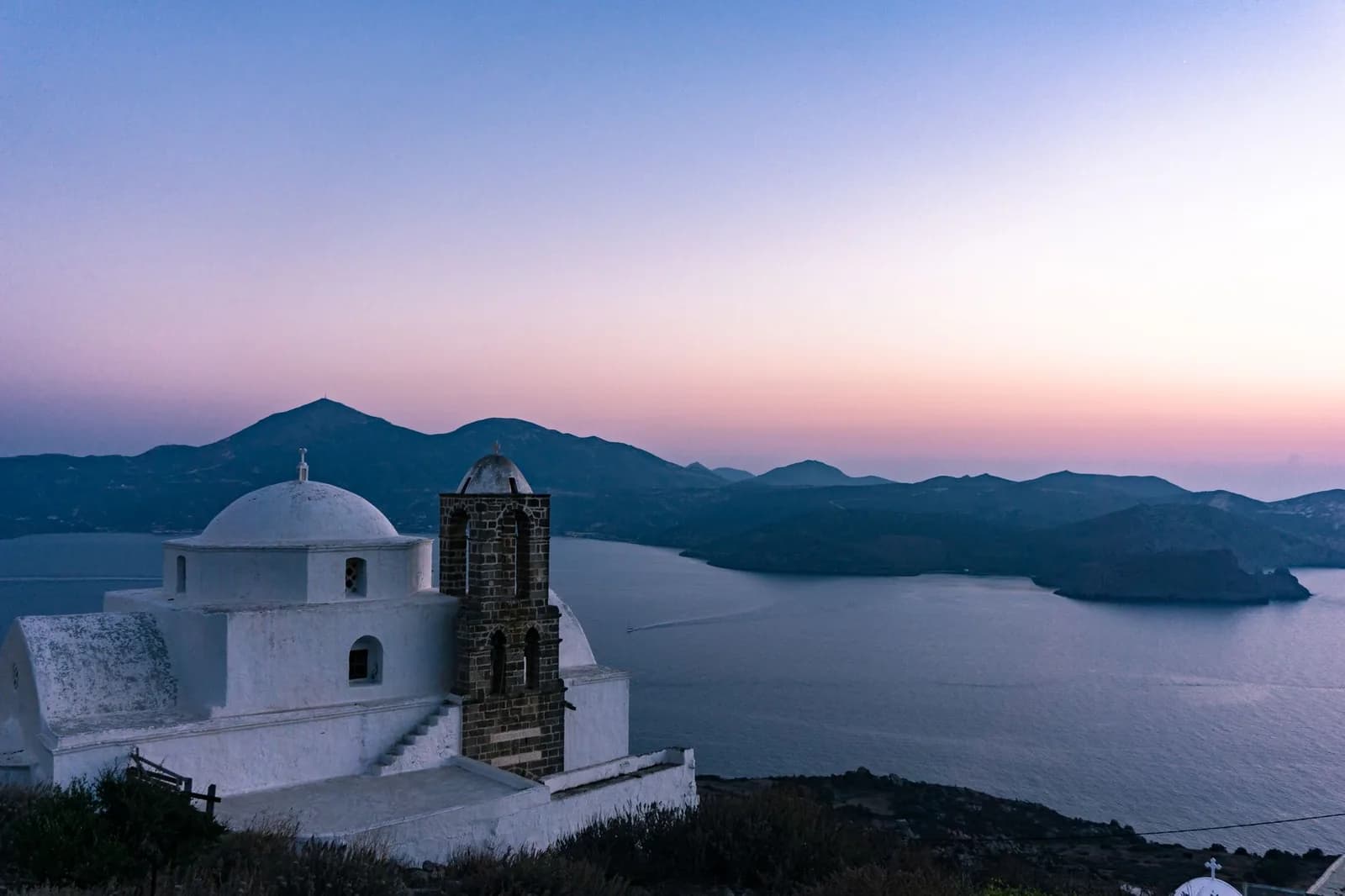
Milos hotels: the village you book decides the island you get
Milos is big, volcanic and awkwardly shaped, and its beaches are scattered around a coastline that takes a day to drive. Where you sleep matters more here than on any other Cyclade.
Sarakiniko and Kleftiko did their work on social media and Milos went from a mining island nobody could place to a name on every Cyclades shortlist. The hotels have not caught up. There are still far fewer beds here than on Paros or Santorini, they are spread thinly across half a dozen villages that have nothing to do with each other, and the island is large enough that the wrong one costs you an hour of driving every day.
The places you can actually stay, side by side
Milos is shaped like a horseshoe around an enormous flooded crater, and almost everything sits on the northern arm of it. Distances look small on paper. They are not small in practice, because the roads follow the terrain and the terrain is volcanic.
| Base | From Adamas | From the airport | What is there | Car or quad | Relative price |
|---|---|---|---|---|---|
| Adamas | The port itself | About 5 km, 10 min | Ferry quay, hire desks, supermarkets, the Kleftiko boats | Useful, not essential | The widest range on the island |
| Pollonia | About 12 km, 20 min | About 14 km, 25 min | Fishing harbour, the best concentration of tables, the Kimolos boat | Yes, unless you plan to stay put | The highest, and rising |
| Plaka and Trypiti | About 5 km, 10 min | About 7 km, 15 min | The Chora, the castle, the catacombs, the sunset | Yes, and somewhere to park it | Mid, with very few rooms |
| Provatas | About 9 km, 15 min | About 7 km, 15 min | A sheltered sand beach and a handful of hotels | Essential | Mid to high for what is there |
| Paleochori | About 11 km, 20 min | About 10 km, 20 min | The south coast's headline beach, hot sand, two tavernas | Essential | Mid |
| Klima and Mandrakia | About 5 km, 10 min | About 6 km, 15 min | Syrmata, the painted boathouses, no shops at all | Essential | Mid, and hard to book at any price |
Driving times are for a summer afternoon on the surfaced roads. Several beaches on the south and west of Milos sit at the end of unsurfaced tracks that add far more time than the kilometres suggest, and a few of them are off limits to hire cars under the rental agreement. The price column compares the bases with each other rather than with anywhere else in the Cyclades.
Which base suits the trip you have booked
Four questions settle this for nearly everyone: are you driving, are you travelling as a couple, do you want to swim from the doorstep, and does the evening view matter. The single biggest mistake on Milos is booking a beautiful room in an isolated cove and then discovering that dinner is a twenty-minute drive on an unlit road, which is a different holiday from the one that was imagined.
Choose what the trip is built around
What is your trip built around?
Buses on Milos run for residents rather than for beach hopping, and the timetable thins out either side of August. Stay where the boats, the shops and the tavernas already are, and buy the rest of the island as day trips.
Adamas
The port, at the head of the bay
- Getting around
- Everything walkable, boats leave from the quay
- The trade-off
- The least atmospheric village on the island
The ferry docks here, the Kleftiko boats leave from here, the island bus stop is here, and you can eat, shop and hire a quad without getting into anything. It is a working port rather than a postcard, which is exactly why it works when you are not driving.
Pollonia
The north-east corner
- Getting around
- One street, one beach, boats to Kimolos
- The trade-off
- Twenty minutes from the port, and taxis are scarce
Compact enough to spend a week in on foot, with the best eating on Milos and a small beach in the middle of the village. Some boat trips pick up here too. You will need a transfer or a taxi to reach it from the ferry, and those are worth arranging before you land.
Adamas: the port, and where the boats leave from
Adamas is where the ferry from Piraeus docks, and it is the least photogenic place on Milos. It is also the one that solves the most problems. The hire desks are here, the supermarkets are here, the bus that serves the island starts here, and the town is flat enough to walk with luggage. Rooms range from plain studios a street back from the water to the more expensive things along the seafront, which is why it holds more of the island's accommodation than anywhere else.
Which boat you are on decides how much that matters. Milos sits on the western Cyclades line rather than the busy central one, so the conventional ferry is a long haul and the fast catamaran is not an everyday service. A slow sailing can put you on the quay at Adamas well after dark, and on that arrival a room you can walk to with a bag in each hand is worth more than a view, because Pollonia is another twenty minutes away on an unlit road.
There is a second reason to consider it that has nothing to do with convenience. Kleftiko cannot be reached by road, only by boat, and the boats leave from Adamas with a smaller number going from Pollonia. The white sea stacks and caves on the south-west coast are the image that sold you the island, and getting there means a full day at sea around the bottom of Milos. Staying at the port means walking to the quay in the morning rather than driving to it and finding somewhere to leave the car.
Four at the port, which is where the boat trips leave from and the only place on Milos with a choice of tavernas after dark.
 Mid-range
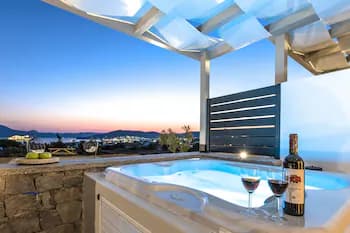
Aelia Suites Milos
AdamasFrom
$147
Suites above the port with the bay in front, five minutes from where the Kleftiko boats tie up.
- Above the port
- Suites
- Near the boats
Nightly rate from the Hotels.com catalogue
See availability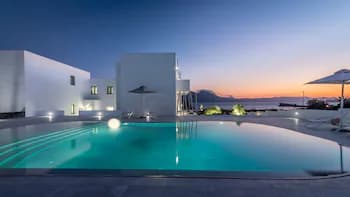 Mid-range
Olea Bay Hotel
AdamasFrom
$93
A proper hotel with a pool on the edge of Adamas, which on Milos is rarer than it sounds: most beds here are studios.
- Pool
- Walk to the port
- Sea view
Nightly rate from the Hotels.com catalogue
See availability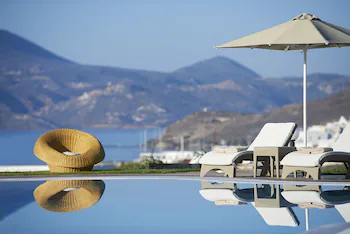 Mid-range
Santa Maria Village
Papikinos, AdamasFrom
$110
Three hundred metres from Papikinos beach at the quiet end of the bay, with a pool and parking, for a week with a car.
- Near the beach
- Pool
- Parking
Nightly rate from the Hotels.com catalogue
See availability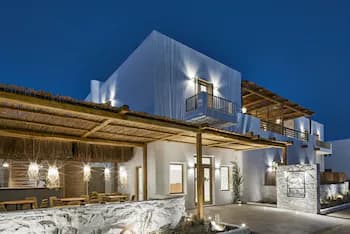 Mid-range
Arco Solium Suites
AdamantasFrom
$79
The value address at the port, and the one that still has rooms when the island fills up in June.
- Value
- At the port
- Suites
Nightly rate from the Hotels.com catalogue
See availability
Pollonia: the fishing village that turned into the couples' choice
Pollonia is at the north-eastern tip of Milos, twenty minutes from the port, facing Kimolos across a narrow strait. It was a fishing hamlet within living memory and it still looks like one from the water: a curve of small houses, tamarisk trees leaning over the sand, boats pulled up at one end. What has changed is what is behind them. This is where the island eats best, by a distance, and where the small design-minded hotels and studios have gone up rather than in Adamas.
The consequence is predictable. Pollonia is the most expensive corner of Milos and the first to fill, and in July and August it fills months rather than weeks in advance. The village is also small enough to walk end to end in ten minutes, which is either the appeal or the limitation depending on how long you are staying. Beyond a week, the lack of anything else within walking distance starts to show.
Four in the fishing village at the north-east corner, which is where couples end up and where the Kimolos boat leaves.
 Luxury
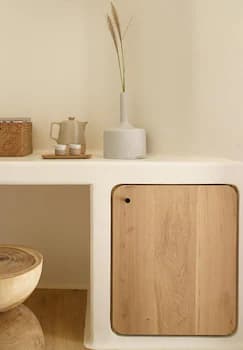
White Pebble Suites
PolloniaFrom
$249
Suites above the village with the Kimolos channel in front, and the most polished address on this side of the island.
- Sea view
- Suites
- Above the village
Nightly rate from the Hotels.com catalogue
See availability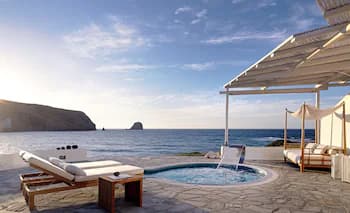 Luxury
Melian Boutique Hotel & Spa
PolloniaFrom
$227
A boutique hotel with a spa a short walk from the beach, and the couples choice people mean when they say Pollonia.
- Spa
- Boutique
- Walk to the beach
Nightly rate from the Hotels.com catalogue
See availability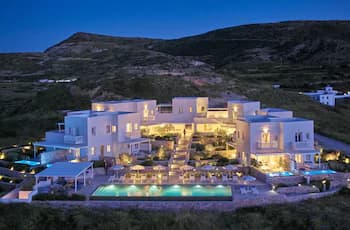 Mid-range
Milos Breeze Boutique Hotel
PolloniaFrom
$170
On the slope above the bay with a pool looking at Kimolos, ten minutes on foot from the tavernas on the water.
- Pool
- Faces Kimolos
- Boutique
Nightly rate from the Hotels.com catalogue
See availability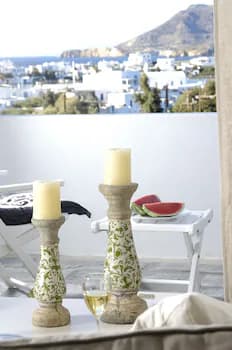 Mid-range
Kapetan Tasos Suites
PolloniaFrom
$98
Suites in the village at half what the two above ask, and the beach is a two-minute walk either way.
- In the village
- Value
- Near the beach
Nightly rate from the Hotels.com catalogue
See availability
Plaka and Trypiti: the view, and hardly any beds
The Chora is up on the ridge above Adamas, and it is really two villages that run into each other. Plaka is the higher and the prettier, a knot of whitewashed lanes with a church on a rock at the top that the whole island climbs to at sunset. Trypiti is its quieter neighbour, strung along the crest with restored windmills, the Roman theatre and the early Christian catacombs below it, and a footpath down to the sea at Klima.
Both are wonderful to stay in and neither has much to offer. These are lived-in villages rather than resorts, so the accommodation is a scattering of guesthouses and rented houses rather than hotels, and what exists goes early. Cars stop at the edge of Plaka and the rest is steps, which matters if you are arriving off the ferry with two suitcases. Nothing here is near a beach either. You will drive to swim, every day.
The view villages have almost no beds, and these are the three worth knowing about, including a boathouse on the water at Klima.
 Mid-range
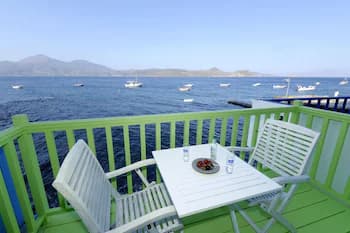
Tsakanos Sirma
KlimaFrom
$130
A syrma, one of the fishermen's boathouses painted along the water at Klima, converted to sleep in. There is no hotel equivalent of this anywhere else in Greece.
- A syrma
- On the water
- Klima
Nightly rate from the Hotels.com catalogue
See availability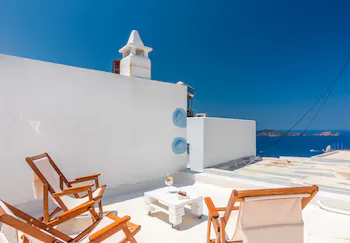 Mid-range
View From The Top
PlakaIn Plaka itself, the hill village with the castle above it, where the sunset crowd walks up every evening and almost nobody sleeps.
- In Plaka
- Village
- Sunset walk
Check live prices and availability
See availability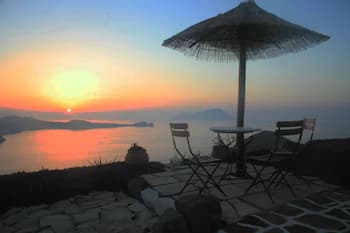 Value
ValueKastro Milos
Kastro, PlakaRooms up in the Kastro at the top of Plaka. No pool, no parking anywhere near, and the whole gulf under your window.
- In the Kastro
- View
- No parking
Check live prices and availability
See availability
Provatas and Paleochori: sleeping on the beach, driving for everything else
The south coast is the sheltered one. The meltemi blows out of the north all summer, so when Sarakiniko and Pollonia are being sandblasted, Provatas and Paleochori are calm. That is the case for staying down here, along with the obvious one of walking out of your room onto the sand. Provatas is a short shallow crescent that suits families. Paleochori is longer, more dramatic, backed by coloured cliffs, with sand hot enough at one end that the local taverna once cooked in it.
The case against is the same for both. There is no village behind either beach, so dinner is whatever taverna is open and everything else is a drive. The road from Adamas is fine and the trip takes fifteen or twenty minutes, but it goes both ways and it is dark at night. Base yourself here if the plan is to swim, read and stay put. Do not base yourself here if the plan is to see the island.
Three on the south coast, where you sleep on the beach and drive for everything else.
 Mid-range
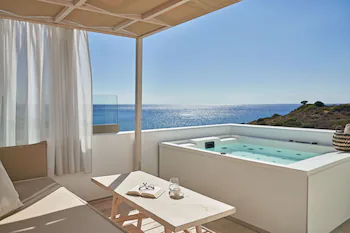
Volcano Luxury Suites Milos
PaleochoriFrom
$175
Above Paleochori, the beach where the sand is warm from the ground under it, and where the sea keeps its colour longest into the evening.
- Above Paleochori
- Suites
- Volcanic beach
Nightly rate from the Hotels.com catalogue
See availability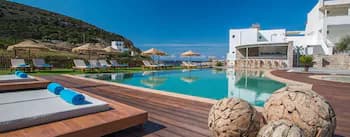 Mid-range
Golden Milos Beach
ProvatasOn the sand at Provatas, the shallow south-coast beach that works with young children, twenty minutes from the port.
- On the beach
- Shallow water
- Family
Check live prices and availability
See availability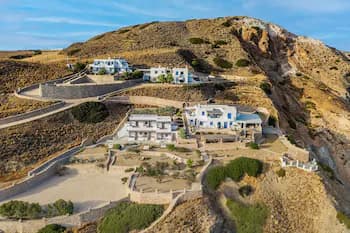 Mid-range
Psaravolada Hotel Milos
Agia KyriakiFrom
$88
Between Agia Kyriaki and Tsigrado at the empty end of the south coast. A car is not optional here.
- Quiet coast
- Near Tsigrado
- Car essential
Nightly rate from the Hotels.com catalogue
See availability
Scores, review counts and photos are Booking.com data checked in September 2026, and the buttons open the property on Hotels.com. Rates move with the dates, so check them there.
The syrmata: sleeping in a fisherman's boathouse
The most characteristic thing you can rent on Milos barely appears in English at all. The syrmata are the boathouses cut into the rock at the waterline in coves such as Klima, Mandrakia, Firopotamos and Fourkovouni, with wide painted doors at sea level where the boat was winched in for the winter and a room or two above it for the family. The doors are painted every colour there is, which is why photographs of Klima appear on every article about the island, usually without anyone mentioning that people live behind them.
Syrmata
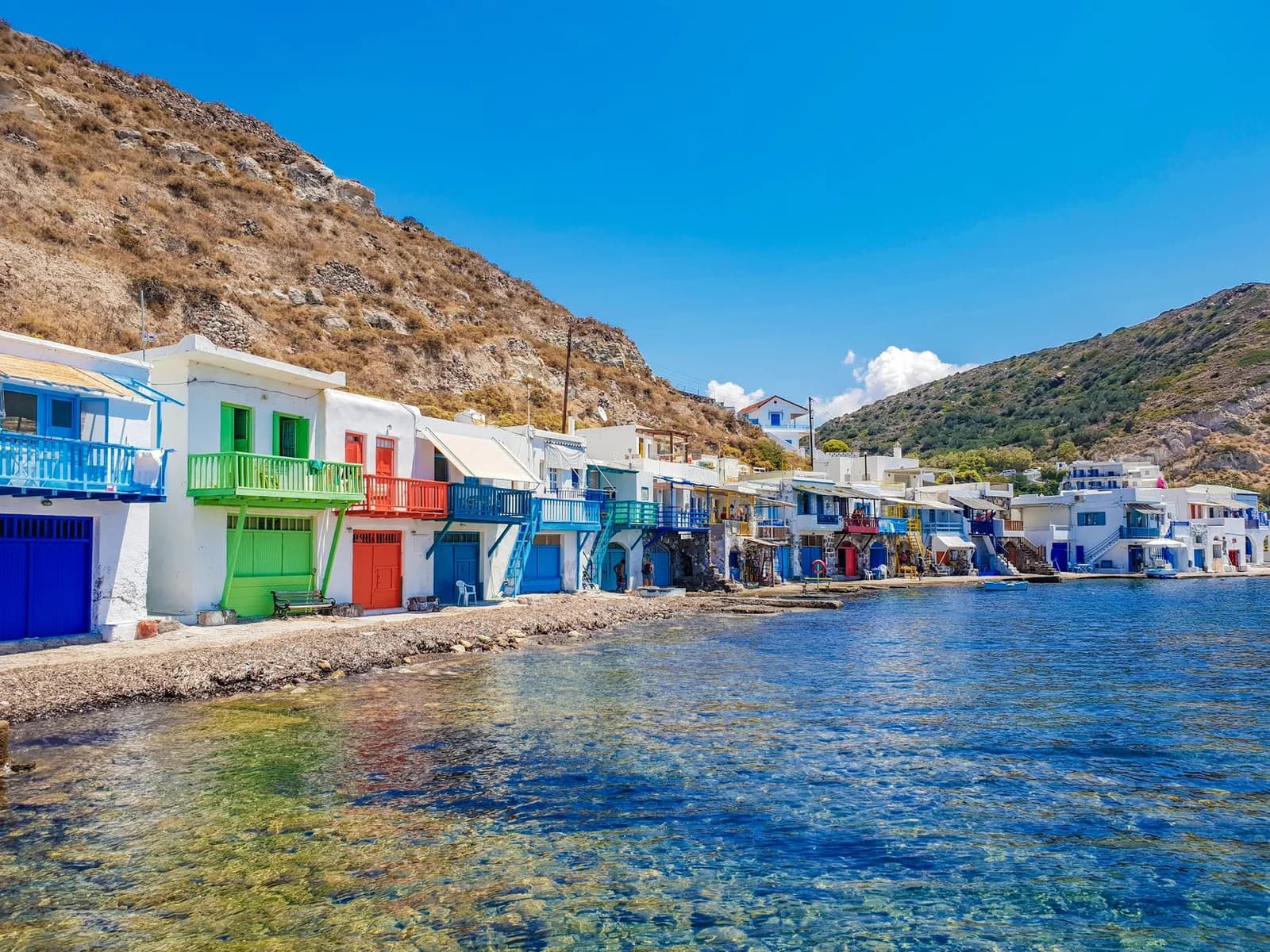
A few have been converted and are let out, and staying in one is the closest thing Milos has to a signature. They were built for boats rather than for people, so expect low ceilings, steps straight down into the sea, and a cove with no shop, no bus and nowhere obvious to leave a car. The number available is tiny and demand for them is not, so this is the category to decide on first and book around, rather than the one to look at last.
Why Milos books out earlier than islands twice its size
Milos is not short of rooms because it is exclusive. It is short of rooms because it spent the twentieth century mining bentonite and perlite rather than building hotels, and the visitors arrived faster than the beds did. The season is compressed too, running from around May to early October with a hard peak in the two summer months, and the western ferry line that serves the island has fewer sailings than the routes to Mykonos or Santorini, and how thin the sailings from Piraeus really are is the other half of the same planning problem, since the boat you can get often decides the nights you can book.
In practice that means the room search on Milos behaves differently from the one on a bigger island. Booking two months out for August will show you a thin, expensive list rather than a choice, and it will not improve as the date approaches. Decide on the village first using the table above, then take what is available in it, rather than filtering by price across the whole island and ending up somewhere you did not intend to stay.
One last thing worth settling before you book anything. Nothing on this island works properly without a vehicle unless you have deliberately chosen a base that removes the need, and hire cars and quads on Milos come from a handful of local firms with small fleets that empty out weeks ahead in high summer. Reserve the vehicle at the same time as the room, not afterwards. If you want to see how the villages sit relative to each other before you commit, our map of Milos places them against each other in about a minute, and colours every beach by whether a road reaches it.
Questions people ask about staying on Milos
Which is the best place to stay in Milos?
Adamas if you want to be at the centre of everything, Pollonia if you want the nicest village and the best eating, Plaka or Trypiti if the view matters more than the beach, and the south coast at Provatas or Paleochori if you intend to swim from the moment you wake up. There is no single best area, because Milos is large and its beaches sit at the end of their own roads rather than in a line. The honest deciding question is whether you have a vehicle: without one, the answer narrows to Adamas or Pollonia and nothing else.
Where do most people stay in Milos?
Adamas and Pollonia between them take the large majority. Adamas has the volume because it is the ferry port, so it holds the widest range of studios, rooms and hotels along with the hire desks, the supermarkets and the bus stop. Pollonia has the higher end and a smaller number of beds. Plaka and Trypiti up on the ridge have very few rooms because they are lived-in villages rather than resorts, and the south coast is a scattering of places rather than a cluster.
Is Adamas or Pollonia better for a hotel on Milos?
Adamas is the practical choice and Pollonia is the pretty one. Adamas puts the hire desks, the supermarkets, the bus stop and most of the Kleftiko boats within walking distance of your room, and it is flat enough to cross with luggage. Pollonia is a small fishing village at the far north-east corner with a better beach, better restaurants and a calmer evening, and it costs more and books out earlier for exactly those reasons. Pollonia is also twenty minutes from the quay on an unlit road, which matters if your ferry lands late.
Is seven days in Milos too much?
Not if you have a vehicle. The coastline runs well past a hundred kilometres and the beaches are scattered around it rather than strung along one road, so a week is roughly what it takes to see Sarakiniko, Firiplaka, Tsigrado, Paleochori, Provatas, the north coast fishing coves and the boat day round to Kleftiko without rushing any of it. Without a car or a quad, seven days is a stretch: the bus network is built around residents, and you would be leaning on boat trips to fill the week. Many people pair a shorter Milos stay with Kimolos or Sifnos, both of which are a short hop away.
Which is better, Crete or Milos?
They answer completely different briefs. Crete is 260 km long, has two airports, thousands of hotels, gorges, Minoan sites and a season that runs from spring to late autumn, and you could return to it for years without repeating yourself. Milos is one volcanic island you can drive across in half an hour, with the strangest coastline in the Cyclades and a fraction of the beds. For a first trip to Greece, or for two weeks with children, Crete. For a week of swimming in extraordinary water with a boat day in the middle, Milos. The one thing Milos does not have is scale, which is exactly why the good rooms go early.
Are there luxury or boutique hotels on Milos?
A growing number, and they are recent. Milos spent decades as a mining island rather than a holiday one, so its expensive accommodation is nearly all newly built or newly converted rather than inherited, and it is concentrated around Pollonia, on the slopes above Adamas bay and in a handful of properties on their own coves. Milos Cove and Milos Breeze are the names that come up most often in that bracket. What the island still lacks is depth at the top end: there are simply not many of these rooms, the season is short, and demand has grown faster than the building has.
More islands, and what a bed costs on each, in our rundown of the other islands.
