Athens to Santorini by ferry: which boat, and what it actually costs you
This is the busiest crossing in Greece and the one people get wrong most often. There are two completely different boats on it, they are not interchangeable, and the plane belongs in the comparison too.
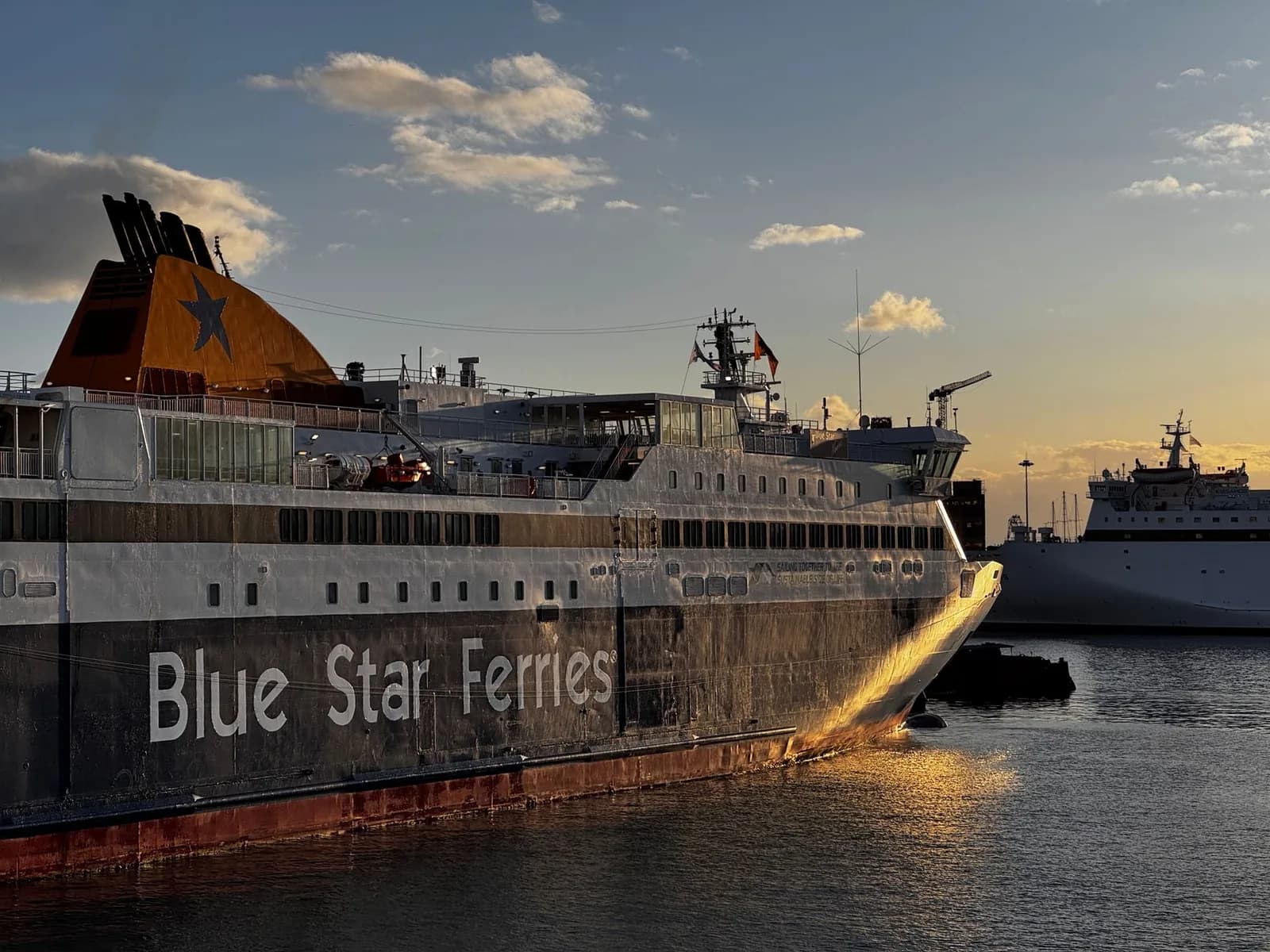
Every ferry from Athens to Santorini leaves from Piraeus. From there the route splits in two. The conventional boat, run by Blue Star Ferries, takes about eight hours, costs the least, carries cars and sails through weather that stops everything else. The high-speed boats, SeaJets among them, do it in around five hours for two to three times the fare, and they are the first thing cancelled when the wind gets up. Which of the two is right depends on what you are protecting: the budget, the stomach, or the afternoon.
Which one to take
Five people ask this question for five different reasons, and the honest answer changes each time. Sometimes it is not a boat at all.
Say what matters and the boat follows
What matters most on this crossing?
The budget matters more than the afternoon you lose to the crossing.
Take
The conventional ferry, booked early
Blue Star charges a fraction of what the high-speed operators do for the same water, and the gap widens the further ahead you book. Eight hours on a large ship with sun decks, a canteen and a proper lounge is a very different day out from five hours strapped into an airline seat below the waterline.
- Second best
- A flight, if a sale happens to land on your dates.
- Watch for
- Deck class is the cheap fare and it does not reserve you a seat. On a full August sailing that means the floor, so pay the small supplement for a numbered seat.
Ferry, fast ferry or flight
Most guides compare the two ferries and leave the plane out, which hides the single most useful fact about this route. The flight is 45 minutes and it often undercuts the fast boat.
| Option | Who runs it | Door to door | Relative cost | Vehicles | In bad weather |
|---|---|---|---|---|---|
| Conventional ferry | Blue Star Ferries | About 8 h, with stops | The cheapest of the three | Yes | Sails in almost anything |
| High-speed ferry | SeaJets, Golden Star, Minoan | About 5 h | Two to three times the conventional fare | On some vessels only | First to be cancelled in wind |
| Flight | Aegean, Olympic, Sky Express, Volotea | 45 min in the air | Often below the high-speed fare | No | Rarely affected |
Fares on this route swing by a factor of three between February and August, and the timetable is republished every season, so treat the columns above as relative rather than absolute. Check the operator or a booking site for your own dates before you plan around any of it.
The two very different boats
A Blue Star ship is a large conventional ferry with a car deck, several passenger decks, a canteen, a bar and open air outside. You can walk around, sit in the sun, watch Paros and Naxos come past and treat the eight hours as part of the trip rather than a cost. Deck class is the cheap ticket and it is unreserved, so on a full summer sailing it means whatever floor space you can find. The seat supplement is small and worth it.
A high-speed vessel is a different machine. Seating is airline style, assigned, and mostly enclosed, with limited or no access to an outside deck once you are moving. It is faster because it is lighter, and lighter is exactly why it slams into a head sea instead of rolling over it. Seasickness on this route is far more common on the fast boats than the slow ones, and it is not a small effect: five hours of it will remove a day from your holiday.
There is also a difference in what a stop means. The conventional sailing calls at Paros, Naxos and Ios, which is either dead time or the whole point depending on whether you are hopping. If Naxos is already on your itinerary, the slow boat is not slow, it is the route.
Each of those stops is also a crossing in its own right, with its own arrival problem, and it is worth reading them the other way round if Santorini is the end of a loop rather than the start. The boat that ties up at Parikia on Paros puts you on the crossroads of the whole Cyclades network, and the run that lands under the Portara drops you in the middle of a town instead of at the foot of a cliff. Further west, the quieter line out to Milos and the volcanic coast runs on a different chain of islands and connects to Santorini only in season, which is the kind of detail that decides whether a two island trip works at all.
Leaving from Piraeus
Piraeus is the port for Santorini, and for practical purposes the only one. Athens has a second ferry port at Rafina, closer to the airport and useful for Mykonos, Andros, Tinos and the nearer Cyclades, but it is not a reliable way to reach Santorini. If a search engine offers you Rafina for this crossing, read the itinerary twice. Rafina is the normal port for the fast boats over to Mykonos, which is exactly why the two crossings get confused by people doing both in one trip.
Getting to Piraeus from central Athens takes roughly 40 minutes on metro line 1, and the port is much larger than that journey prepares you for. Sailings leave from numbered gates spread around a working commercial harbour, and the Cyclades berths are a serious walk from the station with luggage. Early morning departures are the norm on this route, which means leaving the city while the metro is still thin. Arriving 45 minutes to an hour before departure is not overcautious here. Working out where the port sits against your hotel is a five minute job on the city map of Athens and it saves the argument in the taxi at six in the morning.
Landing at Athinios, which is not a town
Santorini does not have a proper ferry harbour in the way other islands do. What it has is Athinios, a concrete platform cut into the base of the caldera cliff, with a road behind it and almost nothing else. No village, no station, no square to wait in. Everyone who arrives has to get up the cliff, and the only way up is a series of hairpins that takes about 25 minutes to Fira.
The arrival
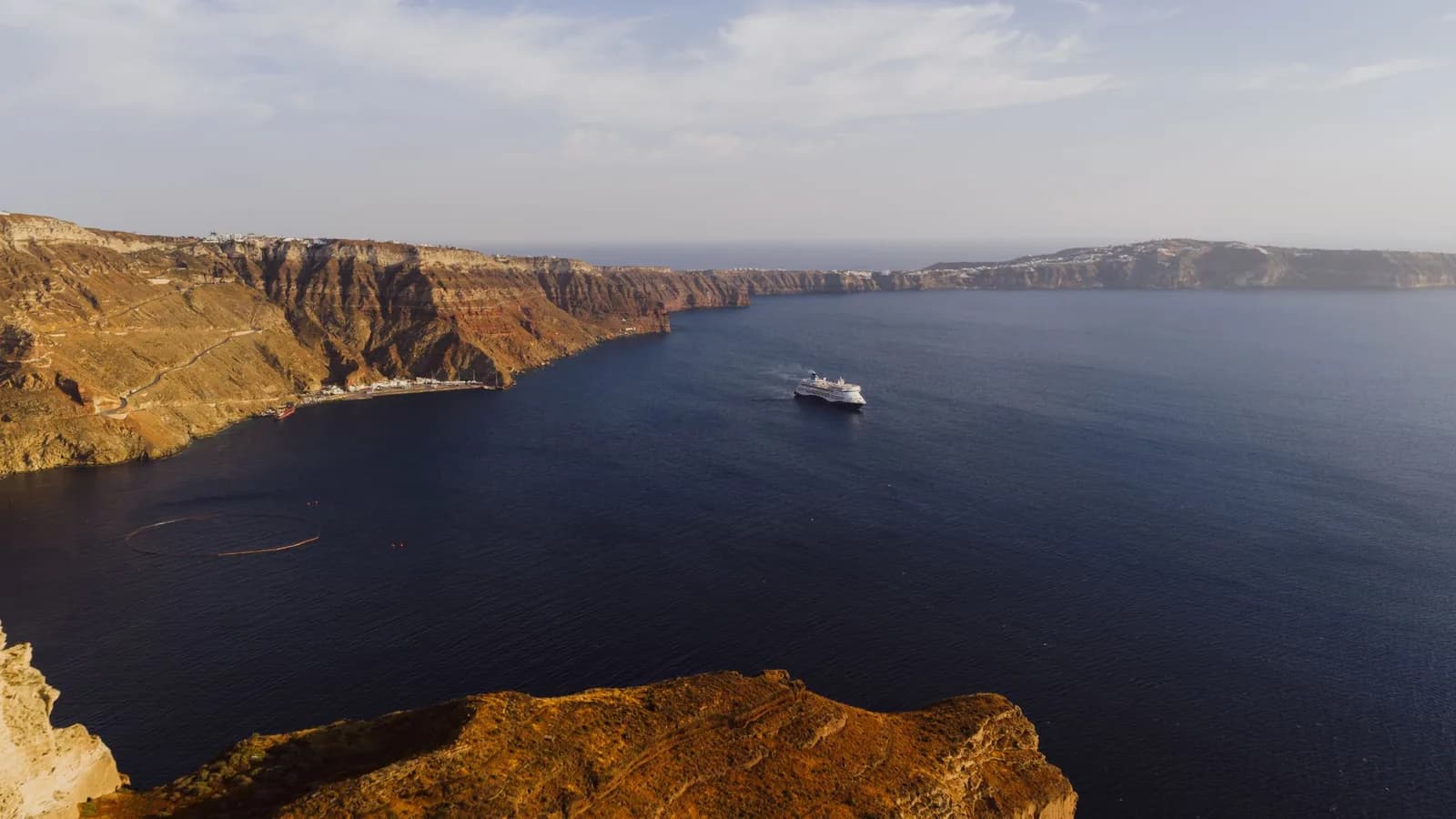
Buses meet the main arrivals and run to the Fira terminal, and they fill in the order people reach them. Taxis exist in small numbers and are gone within minutes of a big boat docking. Most hotels either run a transfer or will book one, and if you are landing after dark, or with more luggage than you can carry uphill, arranging that before you sail is the difference between a twenty minute drive and an hour of standing on concrete.
Worth knowing: the Old Port below Fira, the one with the cable car and the donkey path, is not where ferries go. That is where cruise ship tenders land. Book a hotel transfer to the wrong port and you have crossed the island for nothing. The three points, Athinios, the Old Port and Fira on the rim above both, are easier to keep straight on a drawing of the island than in a booking confirmation that just says Santorini.
When the wind stops it
The meltemi is a dry northerly that blows across the Aegean through the summer, strongest in July and August, and it is the reason Greek ferry schedules are less fixed than they look. The port authority, not the operator, decides when a vessel sails, and high-speed craft are held back long before conditions become genuinely rough. Cancellations arrive at short notice and the rebooking is onto the next available sailing, which in high season can be the following day.
Where that bites is your last day. Never plan to take a fast ferry back to Athens on the morning of an international flight. Come back the day before, or take the conventional boat, or fly. This is the single most expensive mistake made on this route, and it is made every summer.
Booking the crossing
Greek ferry timetables are released season by season rather than a year ahead, so a December search for a July crossing can show you an empty board. The route has not gone anywhere; the season has not been loaded. When it is, the July and August weekends go first, the car deck ahead of the seats, and the morning departures ahead of the afternoon ones.
Check what your booking actually gives you before you travel. Some Greek operators still issue tickets that have to be collected in paper form at the port or from an agency, while others accept a scan on your phone, and the rule differs by company rather than by route. Getting that wrong at a Piraeus gate half an hour before departure is not a problem you can solve in time. The rest of the network, and how the operators compare on other routes, is covered on our Greek ferries guide.
Athens to Thira is the same crossing
Thira is the island. Santorini is the name the rest of the world uses for it, inherited from the Venetians, and Greek operators, port boards and timetables often prefer Thira. Searching for an Athens to Thira ferry returns the same Blue Star and SeaJets sailings as an Athens to Santorini one, because there is only one crossing and one arrival port.
The name that does cause real trouble is Fira, spelled with an F. Fira is the capital town, up on the caldera rim, and it is where most people stay. Thira is the island it sits on. A transfer booked to the wrong one of those two, or to the Old Port instead of Athinios, is a wasted hour on the day you have the least patience for it.
The same goes for the hop north to Ios, listed as Thira to Ios on many timetables: it leaves from Athinios too, takes 35 minutes on a jet, and works as a day trip on the right pair of boats. The Santorini to Ios ferry guide lists the sailings that let you come back the same evening.
Questions people ask about the Athens to Santorini ferry
How long is the ferry from Athens to Santorini?
Around 8 hours on a conventional Blue Star sailing and around 5 hours on a high-speed one, from the port of Piraeus. The conventional boat is slower partly because it is slower and partly because it calls at Paros, Naxos and Ios on the way, so the exact figure depends on how many stops your sailing makes. Timetables are reissued every season, so check the operator for your own dates.
What is the best way to get from Athens to Santorini?
There are three, and the right one depends on the trip rather than the island. The conventional Blue Star ship is the cheapest, the steadiest and the one that carries cars, at the cost of most of a day. The high-speed boat takes roughly half as long for a good deal more money and is the first thing cancelled when the meltemi blows. The flight from Athens airport is well under an hour in the air and frequently costs less than the fast ferry, which is the fact most route guides leave out. Take the slow boat if you are island hopping or watching the budget, the plane if the day matters, and the fast boat mainly when the timetable leaves you nothing else.
How much does a fast ferry ticket from Athens to Santorini cost?
Nobody can quote you a figure that will still be true when you book. Greek fares are set season by season, they move with the operator, the month and how far ahead you buy, and a page like this one would be out of date before you read it. What is stable is the ratio: the high-speed crossing typically costs two to three times the conventional Blue Star fare, and a vehicle costs more than an extra passenger. Since the flight often lands in the same bracket as the fast boat, price the plane at the same time rather than assuming the ferry is the cheap option.
Which port in Athens does the Santorini ferry leave from?
Piraeus, which is the big commercial port on the coast south-west of the city, about 40 minutes from the centre by metro line 1. Rafina, the other Athens ferry port, serves Mykonos, Andros, Tinos and the nearer Cyclades, and it is not a dependable option for Santorini. If your ticket says Piraeus, allow time to find your gate: the port is large and the Cyclades berths are a long walk from the metro.
Is it better to take a ferry or fly from Athens to Santorini?
Fly if speed is the only thing you are buying: the flight is well under an hour in the air and it frequently costs less than the high-speed ferry. The ferry earns its place on price against that fast boat, on carrying a vehicle, and on being part of an island hopping route where you are stopping at Paros or Naxos anyway. It also has the better arrival. Coming into the caldera by sea, with the cliff rising in front of the bow, is not something a small airport apron can match. The one case where the plane is not optional is a windy week in August, when the catamarans are being held in port and the aircraft are not.
Do ferries to Santorini get cancelled?
High-speed ferries do, regularly, when the meltemi blows through July and August. They are light craft and the operators pull them well before conditions become dangerous. Conventional Blue Star sailings are far more robust and keep running through weather that grounds the catamarans, which is one of the better arguments for taking the slow boat if your dates are tight.
How do you get from the ferry port to Fira?
Athinios port sits at the foot of the caldera cliff with nothing around it, and the road up is a series of hairpins that takes about 25 minutes to Fira. Buses meet the main arrivals, taxis are scarce and get taken immediately, and most hotels either run a transfer or will arrange one. Book it in advance if you are landing after dark or with luggage.
