Mykonos to Santorini by ferry
Two to three hours across open water, several times a day in summer, and one thing that separates the people who arrive from the people who spend the afternoon at a ticket desk: this route runs on fast boats only, and fast boats stop when the wind gets up.
The ferry from Mykonos to Santorini is the busiest leg of the classic Cyclades trip, and it is straightforward for most of the summer. Boats leave through the day, the crossing takes two to three hours, and you can be on a terrace in Fira by mid-afternoon. What catches people out is the small print: which of Mykonos's two ports you sail from, how many islands the boat stops at on the way, and what you do on the mornings the wind closes the route.
How long the crossing takes
Roughly 120 km of open Aegean separate the two islands, and the fast boats cover it in a little over two hours when they go straight there. Most of them do not. The route runs down the spine of the Cyclades, and operators pick up passengers on the way, so a sailing that calls at Paros, then Naxos, then Ios will land you closer to three hours after you left. Neither version is worse value, but they are different afternoons.
Each stop costs about twenty minutes of manoeuvring, ramp and paperwork, and you stay on board for all of them. If the timing matters, look at the arrival time on the specific sailing rather than at the headline duration for the route, because the two can be an hour apart on the same day. Add half an hour at each end as well. Boarding at Mykonos in August is a queue on a hot quay, and getting off at Athinios means several hundred people funnelled down one ramp into a car park.
Why this route cancels, and why that surprises people
Almost every sailing between Mykonos and Santorini is a high-speed catamaran or hydrofoil. Conventional ships, the big slow ones with cabins and a car deck, appear on this pairing only occasionally. The two types behave completely differently in bad weather, and that is what makes this leg the fragile one on a Cyclades trip.
The meltemi is the dry north wind that blows down the Aegean through July and August, usually in spells of two to four days. A conventional ferry sails through most of it and simply arrives late. A catamaran cannot: it is light, it is fast, and above a certain sea state the operator pulls it. So on the routes served by big ships, wind means a slower crossing. On this one, wind means no crossing at all, and people find that out with a hotel already booked at the other end.
Leave slack on this leg. A flight home the morning after your boat was due is a booking with no margin in it, and a fixed date at the end of the trip deserves an empty day in front of it. With a buffer, a cancelled sailing costs you an afternoon. Without one it costs you the flight.
What to do when the sailing is cancelled
Word comes the night before, or at breakfast. That head start is worth something only if you spend it deciding rather than queueing, and what you decide is set by whatever is already booked at the far end.
Choose the constraint that is fixed
The boat is cancelled. What is your constraint?
This is the expensive version of the problem, and the one worth spending money to get out of. Do not wait to see whether tomorrow's boat runs, because if the wind is up today it is usually up tomorrow too.
Fly Mykonos to Santorini
45 min in the air
There is a seasonal direct hop, and Athens connections the rest of the year. The direct seats sell out within hours of a cancellation, so book from the port, not from the hotel. Small aircraft are grounded by the same wind sometimes, but far less often than the fast boats.
Reroute through Naxos or Paros
Most of a day
Both sit halfway down the chain and both are served by conventional ferries, which sail in weather that stops the catamarans. You take one boat across, wait, and take another down. It works, and it is the option most people never think of.
Move the flight instead
A change fee
Sometimes cheaper than the alternatives and always calmer. Compare it honestly against a same-day flight before you dismiss it.
Two habits of the system are worth learning early. A cancelled ticket gets refunded or moved, but the refund is frequently issued as credit with that operator rather than back to your card, so establish which one you are being handed before you accept it. And the sea is not closed because one boat is: a heavier vessel from a rival company may be crossing the same water that afternoon.
The other thing a cancellation often produces is an unplanned night in the middle of the Cyclades, because the boat that is still sailing frequently goes as far as Paros or Naxos and no further. What a room on Naxos costs at short notice and where you would want to sleep in Parikia or Naoussa are both worth a glance before the trip rather than from a ferry queue, since these two islands are where the chain breaks and they are pleasant places to be stuck.
Which port you leave from, and which one you arrive at
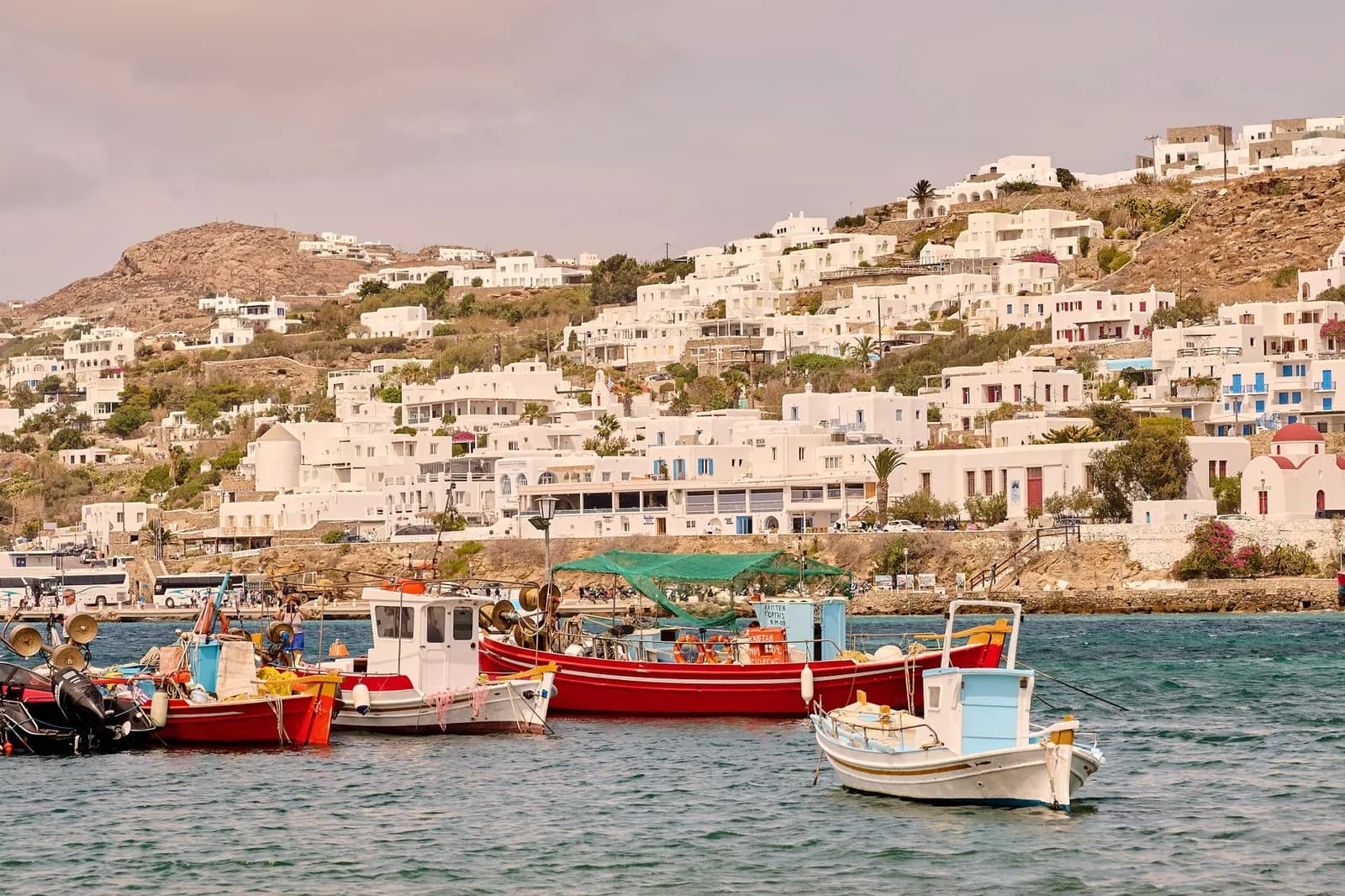
Mykonos has two, and they are not next to each other. The Old Port sits at the edge of Mykonos Town, walkable from most of it, and handles smaller vessels and local boats. The New Port at Tourlos is a couple of kilometres north, reached by road, and takes the larger fast ferries and the cruise ships. Your ticket says which one you are using, and it is the single most common way to miss a boat here. Check it the night before, not in the taxi. The plan of the Chora shows how far apart the two actually are on the ground. The same split decided your arrival, since the boats coming out from the mainland use one port or the other depending on whether they left Piraeus or Rafina.
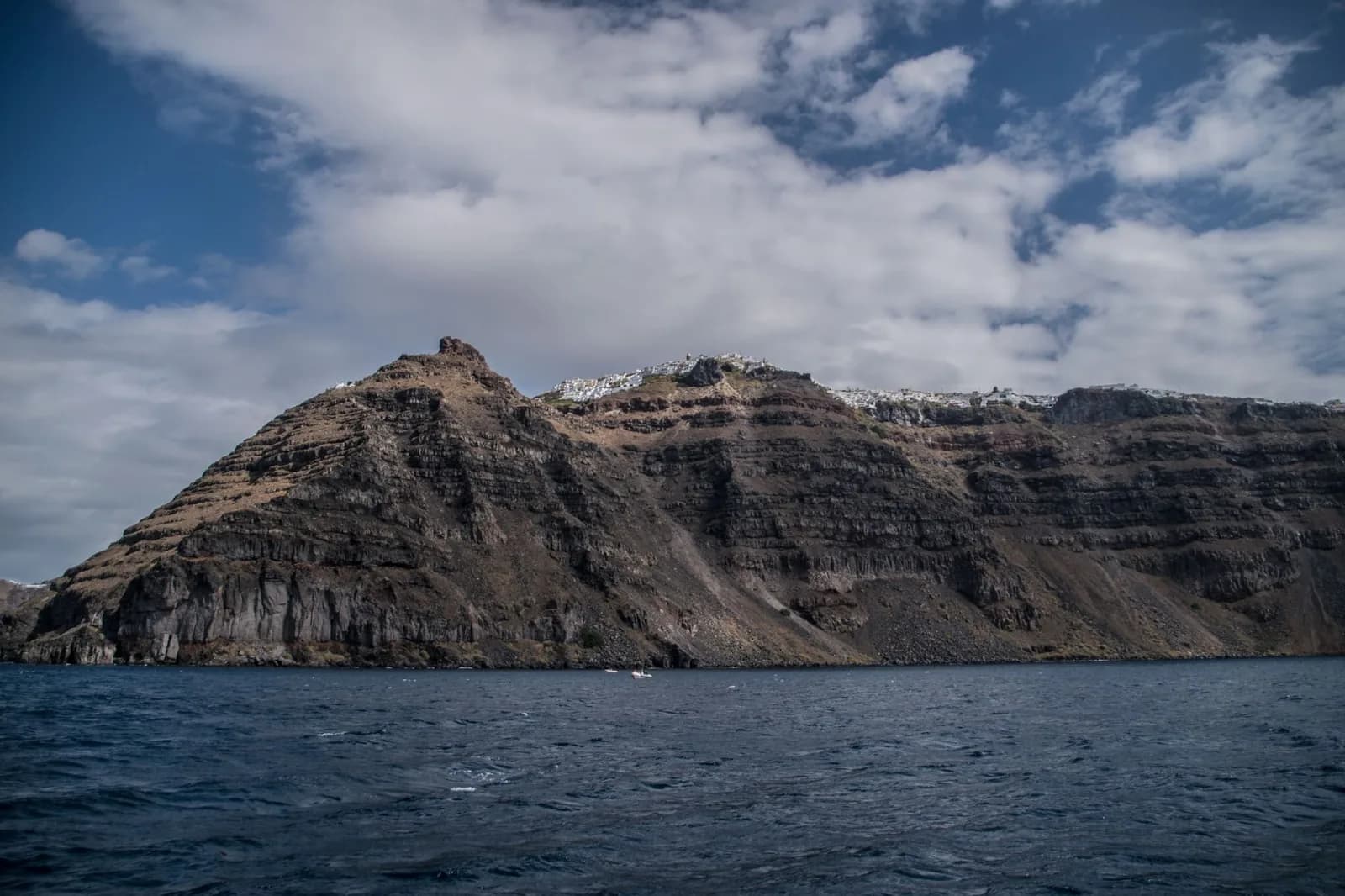
Santorini is simpler and stranger. Everything arrives at Athinios, a shelf of concrete at the foot of the caldera cliff on the west coast, with a few ticket booths, a taverna and nothing else. There is no town, and the only way out is up: the road climbs the cliff in hairpins before it reaches the inhabited plateau. Reckon on about 25 minutes up to Fira and closer to 45 to Oia. Seeing how the island sits above that cliff makes the transfer make sense: the villages are strung along the rim, the beaches are on the flat side facing away from it, and the port is below all of it.
Arrange the transfer before you board. The buses are there, but they load in the order passengers physically reach them, the taxi rank is short and prices itself accordingly, and almost every hotel will send a driver once it knows your sailing. Watching three coaches leave the quay without you, with your bags at your feet, is a bad way to start. How long that leg takes depends on which village you booked on the rim, which is the same decision that sets what you pay for the view.
The crossing itself, and the seasickness nobody warns you about
Fast catamarans are stable in flat water and unpleasant in anything else. They sit high, they slam rather than roll, and the cabins are sealed with airline-style seating and no outside deck to escape to. People who have never been seasick in their lives are sometimes sick on this crossing, and on a bad afternoon the crew hands out bags without being asked.
If you are prone to it, take something an hour before boarding rather than when you start to feel it, book a seat low and towards the middle of the vessel where the movement is smallest, and eat something light beforehand instead of nothing. On a calm day none of this matters and the two hours pass with the Cyclades sliding by the window.
Santorini to Mykonos: the same route in reverse
The ferry from Santorini to Mykonos is the same fleet running the other way, with the same crossing time and the same exposure to the wind. Two differences are worth planning for. The departure is from Athinios, so you need to be at the bottom of the cliff with time to spare, and the road down is slow when several ships load at once. Leave the hotel a good ninety minutes before your sailing in high season.
The other is that many people run this leg at the end of a trip, heading for a flight out of Mykonos. Same rule as before, in the same direction: do not make that flight the next morning. If it is Santorini you are flying out of instead, the airport sits on the far side of the island rather than anywhere near the port, so the transfer is a different journey from the one you did on arrival. And check which Mykonos port you are landing at, because arriving at Tourlos expecting to walk into town is a surprise with a suitcase.
Booking the right sailing
Seajets carries most of the traffic on this route, with Golden Star Ferries and Blue Star Ferries also present depending on the season and the year. Schedules for the following summer are typically released in stages over the winter and firm up in spring, so a route that looks empty in January is not necessarily a route that will be empty in July.
Book once the schedule is out if you are travelling in July or August, both because the cheaper fares go first and because the mid-morning departures sell out. Pick a sailing that leaves in the morning rather than late in the day: if it is cancelled you still have the afternoon to do something about it, and you arrive at Athinios in daylight. Then read your ticket for the port, the vessel name and the number of stops, which are the three things that actually change your day.
If you want to see where this leg sits in the wider network, the ferry guide covers the other Cyclades crossings and the operators behind them, and the islands drawn at their real coordinates show how far apart these places really are.
Questions people ask about this crossing
How long is the ferry from Mykonos to Santorini?
Between two and three hours in practice. The gap is not about speed, it is about stops: a boat that runs straight through sits at the low end, and one that calls at Paros, Naxos or Ios on the way sits at the high end. Companies publish the crossing time per sailing, so check the one you are actually booking rather than the route average. Add half an hour at each end for boarding and for getting off, because both ports push a lot of people through one ramp.
How far is Santorini from Mykonos by ferry?
About 120 km of open Aegean, running south-west down the spine of the Cyclades. The boats either cross it directly or thread through the islands on the way, which is why two sailings covering the same distance can land an hour apart. It is also why the wind matters so much here: most of that water is exposed, with nothing to shelter a light, fast hull once the meltemi is up.
Is it better to fly or take the ferry from Mykonos to Santorini?
The ferry for almost everyone. It is direct, it runs through the day in summer, and door to door it usually beats the plane once you count the drive to Mykonos airport and the wait at each end. Flying earns its place in two situations: when the sea has closed and you have a fixed date at the other end, or when you are travelling outside the season and the sailings have thinned out. The seats on those small aircraft go quickly on exactly the days everyone needs them.
How much is a ferry ride from Mykonos to Santorini?
Fast ferries on this route are priced more like a short flight than like public transport, and the fare moves a great deal between the shoulder months and August. Booking early is worth more here than almost anywhere else in the Cyclades, because the cheaper seats on the popular mid-morning departures go weeks ahead. Fares are per person, cabin classes cost more than the standard seat, and a vehicle roughly doubles the bill, though very few visitors take a car between these two islands.
Is there a car ferry from Mykonos to Santorini?
Rarely, and never count on it. The route is worked almost entirely by high-speed catamarans and hydrofoils, and most of them carry a handful of vehicles at best or none at all. The conventional ships that take cars properly appear on this pairing only occasionally. Since Greek hire contracts usually forbid taking the car off its island anyway, the normal approach is to drop the vehicle on Mykonos and pick up another one on Santorini.
Which is the best ferry from Mykonos to Santorini?
The one that leaves in the morning and makes the fewest stops. A morning departure gives you the rest of the day to react if it is cancelled, and it lands you at Athinios in daylight, which matters on a road that climbs a cliff. The number of calls on the way decides whether the crossing is two hours or three. Read the vessel and the routing on the ticket rather than the company name, since operators swap boats between sailings and the hull is what decides your afternoon.
Which is prettier, Santorini or Mykonos?
They win on different things. Santorini has the landscape: a drowned volcano with villages balanced on the rim, and a sunset that people plan whole trips around. Mykonos has the town, which is the finest whitewashed maze in the Cyclades, and beaches you can actually swim off, plus a nightlife Santorini does not try to match. If you want a view, sail south. If you want somewhere to walk in the evening and a proper beach in the afternoon, stay put.
