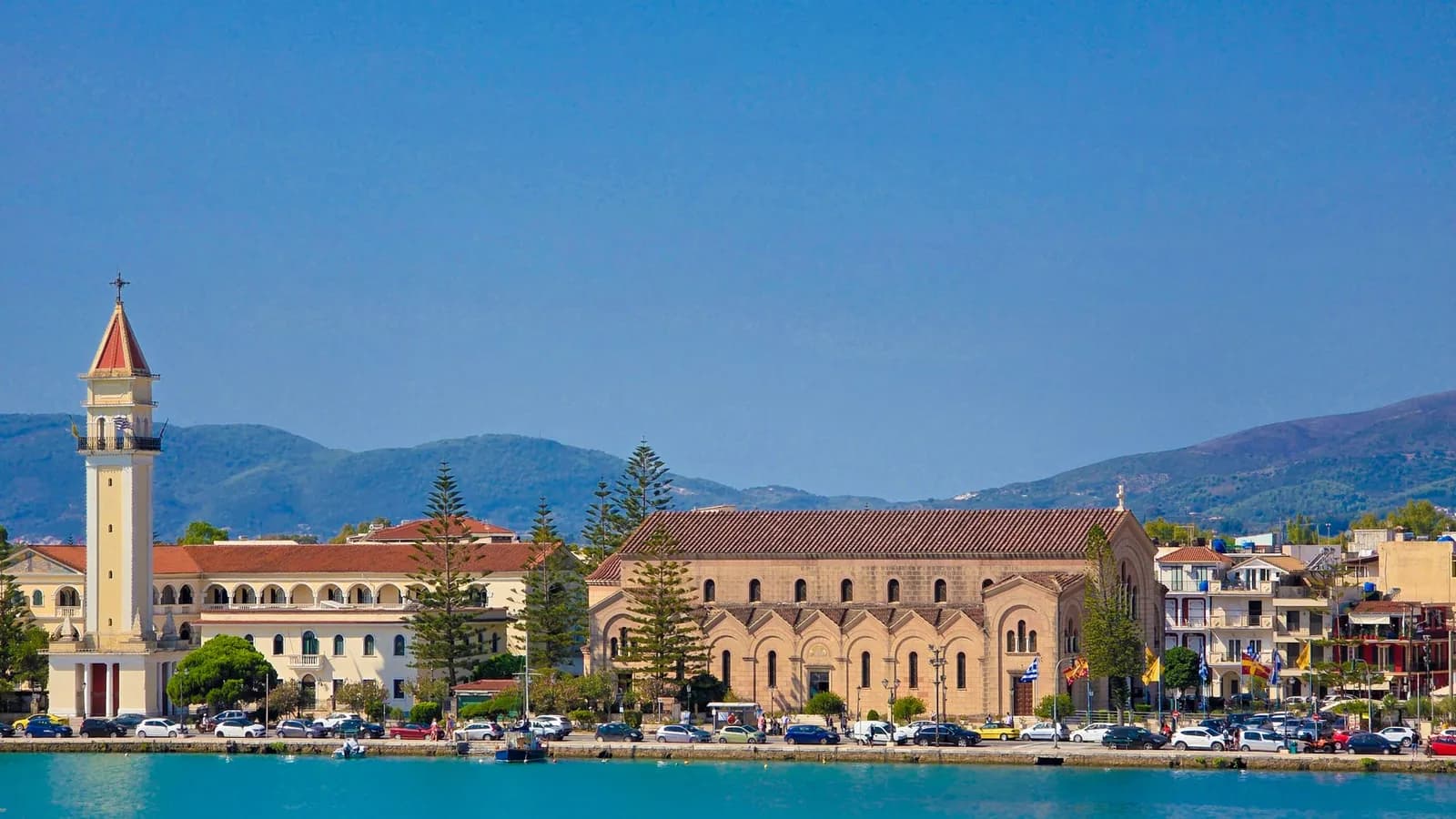
Zante airport: the transfer, and the bus that will not be there
ZTH puts almost every resort on Zakynthos within half an hour of the runway, which makes it one of the easiest arrivals in Greece. The catch is the hour you land at, because the public option stops at teatime and takes Sundays off.
Zakynthos International Airport, code ZTH, is a single-runway charter airport on the flat south-eastern corner of the island, six kilometres below Zakynthos Town and about ten minutes from Laganas. It handled 2.22 million passengers in 2024, nearly all of them European and nearly all of them between May and October. Your hotel is almost certainly within half an hour of that runway. Whether anything is running when you land is the harder question, and the answer turns on the hour and the day of the week.
Where Zante airport actually is
The runway sits at Ampelokipi, on the agricultural plain behind the Gulf of Laganas, with Kalamaki on one side and Laganas on the other. That plain is the reason the island has an airport at all: Zakynthos is cliff down its entire western half, and the flat land is all in the south-east. It also explains why the transfer figures on this page are so short. The runway was put down in the middle of the exact area that later filled with hotels, and the resorts nearest to it hear it: which ones, and what else separates them, is in where to stay in Zakynthos.
Position
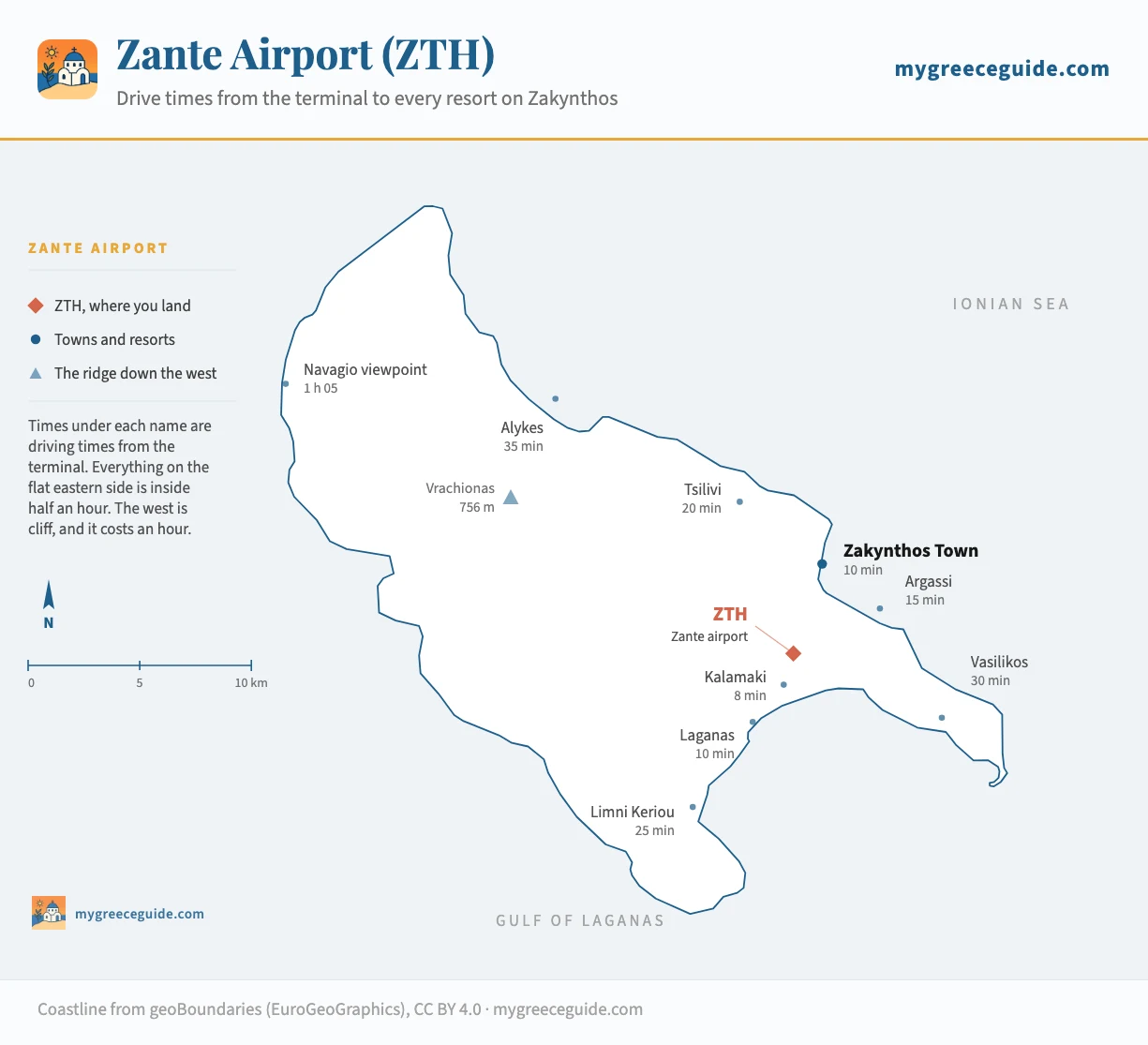
How long the drive takes, resort by resort
Zakynthos is small and the roads on the eastern side are decent, so kilometres and minutes broadly agree here. The column that does not agree with anything is the last one.
| From ZTH to | Distance | By car | On public transport |
|---|---|---|---|
| Kalamaki | 5 km | about 8 min | No direct bus. Change in town |
| Laganas | 8 km | about 10 min | No direct bus. Change in town |
| Zakynthos Town | 6 km | about 10 min | The only direct one, and it stops early |
| Argassi | 8 km | about 15 min | No direct bus. Change in town |
| Tsilivi | 11 km | about 20 min | No direct bus. Change in town |
| Limni Keriou | 14 km | about 25 min | Nothing useful |
| Vasilikos | 20 km | about 30 min | Nothing after mid-afternoon |
| Alykes and Alykanas | 24 km | about 35 min | No direct bus. Change in town |
Driving times are for an ordinary day at the pace these roads allow, not the one a mapping app assumes. Add ten minutes to anything routed through Zakynthos Town in the late afternoon, when the waterfront and the port road fill up. The right-hand column is the one worth reading twice: the single airport bus goes to the town bus station and nowhere else, so every resort on this list is a second bus and a wait.
Compare that with Kefalonia next door and you can see what kind of airport this is. There, a villa in the north is ninety minutes of switchbacks from the terminal and people book it without checking. Here the longest ordinary transfer is Alykes at thirty-five minutes, and a late arrival costs you very little. The Kefalonia figures are worth a glance if you are weighing the two islands, because the arrival is one of the few real differences between them.
The airport bus exists, and it has three gaps
Every guide to this airport says there is a bus, which is true and not very useful. The service is run by KTEL Zakynthou, it costs a couple of euros, it stops outside arrivals, and it reaches the town bus station in about twenty minutes. Then the detail starts to matter.
There are nine departures a day, and they stop at teatime. The timetable runs from early morning to roughly seven in the evening, which puts the last bus out of the terminal at about 19:40. A large part of the ZTH schedule from Britain, Poland and the Netherlands lands after that.
It does not run on Sunday at all. That is the gap that catches people, because Sunday is one of the heaviest changeover days in the charter season. On the day the airport is fullest, the public option is not operating.
And it only goes to the bus station. Nothing runs from the terminal to Laganas, Tsilivi, Argassi or Kalamaki. Reaching any of them by bus means riding into town, finding the right island service and waiting for it, with your luggage, which is a reasonable thing to do at eleven in the morning and an unreasonable one at eight at night. The island network itself is built around the town rather than around visitors, and it thins out badly in the afternoon: nothing useful goes down the Vasilikos peninsula after the middle of the day.
Nothing flies after ten, because of the turtles
No aircraft takes off or lands at ZTH between 22:00 and 05:00, and the reason is lying on the sand a couple of kilometres from the threshold. The runway was built on the edge of Laganas Bay, which is the single most important nesting ground for loggerhead turtles in the Mediterranean. In 1999 it became the first national park in the Mediterranean created to protect sea turtles. The turtles come ashore at night through the summer to lay, at Kalamaki and along the bay, and engine noise and landing lights are exactly what stops them. The restriction has been in force since the early 1990s.
For a passenger this is not a piece of trivia, it is a scheduling rule with teeth. A flight that slips towards ten in the evening does not fly late, it flies tomorrow, because it would arrive inside a window the airport is not allowed to use. Airlines can ask for an exception where the circumstances are genuinely extenuating, and a routine delay does not qualify. Every summer this catches people who assume a two-hour delay means a two-hour delay.
It is also the reason the airport feels the way it does. Seven hours a night are closed to it, so 2.2 million passengers have to pass through a single runway inside a seventeen-hour day, and the schedule bunches. That is why so many flights leave at hours nobody would choose, and why the last useful arrival slot, between seven and ten in the evening, is both the busiest one and the one with no bus behind it. The park itself is worth understanding before you book a beach, and where the protected bay actually sits explains a good deal about the southern half of the island.
What is actually open when you land
Since the hour decides everything here, the honest way to answer the transfer question is to start from your landing time rather than from your resort. Pick your slot below.
What time does your flight land?
The bus has gone, or is about to
This is the last window there is, because nothing may land after 22:00. A large share of the UK and northern European schedule is squeezed into it, and it is also the window where the public option quietly disappears.
- Airport busLast one, or already gone
- The final departure leaves the terminal around 19:40. Land at 19:10, clear the bags fast and you might make it. Land at 20:00 and there is nothing.
- Taxi rankWorking, and thinning
- Drivers meet the evening bank of arrivals, so there are cars. Whether there is one for you depends on how many people ahead of you had the same plan.
- Hire car desksUsually staffed
- Desks cover the scheduled arrivals in season, which includes this window. Outside the summer, check that your supplier actually opens for your flight rather than assuming it.
- Pre-booked transferMeets the flight
- This is the hour that justifies the booking. Your driver waits for the flight, not for the timetable, and a delayed landing does not strand you.
Hiring a car, and why the island fleet runs out
You can have a good week on Zakynthos without driving, which is not true of most Greek islands, because the beaches nearest the resorts are walkable and the boat trips leave from harbours you can reach by taxi. What you cannot do without a car is see the other half of the island. Navagio, the Blue Caves at Cape Skinari, Porto Vromi, the hill villages behind the ridge and the empty west coast are all an hour away and none of them has a bus worth the name.
If you are hiring, do it before you fly. Zakynthos is a small market and the fleet is finite, so August exhausts it and the automatics go first, since almost everything on the island is manual. Walk-up rates at a busy island desk in high season are the worst you will ever pay, and on a Sunday afternoon in July you may find there is nothing left to walk up to.
Ten minutes from the terminal
One runway, and what August does to it
ZTH has a single strip, runway 16 and 34, 2,228 metres of asphalt, and one terminal building to go with it. Through that it pushed 2.22 million passengers in 2024, up nearly seven per cent on the year before, on around fifteen thousand aircraft movements. Almost all of it arrives inside five months, and the busiest single market is Britain, which sent close to three quarters of a million people through the building in 2024, ahead of Poland, the Netherlands, Italy and Germany.
One strip and a seventeen-hour day is a tight pair of constraints for that many people, and it is why your flight home may leave at an hour nobody would choose. It also means the airport has no redundancy at all. When the strip closes, for any reason, everything stops.
Why the airport closed twice in 2026
This comes up often enough in searches to be worth answering plainly, and the answer is that both closures are over. The first was planned. Fraport Greece, which has run the airport under concession since 2017, rebuilt the runway between 2 and 16 February 2026, resurfacing the full length to improve drainage and structural margins so the strip could take heavier aircraft. February was chosen because it is the emptiest fortnight of the Zakynthos calendar, and the airport reopened on the 17th, well before the season.
The second was not planned at all. On 9 July 2026 a Hellenic Air Force F-16 made an emergency landing at ZTH after a problem shortly after take-off, and the aircraft caught fire on the runway. The pilot got out unhurt. Clearing a burnt military jet from a single-runway airport in the middle of the season closed the strip and disrupted flights for a while, and there was no second runway to fall back on. Both episodes are historical now, and nothing about either affects a trip today.
Zante, Zakynthos, and the second airport that does not exist
Zakynthos is the Greek name and Zante is the Venetian one, and both refer to the same island and the same runway. Venice held these islands for four centuries and left the form behind; the British package industry then kept it in circulation from the 1970s onwards, which is why a flight sold as Zante in Manchester is sold as Zakynthos in Athens. There is no distinction to learn and nothing to book differently.
For the same reason there is no second airport, whatever a search box suggests. One terminal, one runway, one set of desks. The full name is Zakynthos International Airport « Dionysios Solomos », after the poet born on the island who wrote the words of the Greek national anthem, and the codes are ZTH for booking and LGZA for flight trackers. If you want to see how it sits against the rest of the chain of islands off the west coast, Kefalonia is the neighbour to the north and the only one linked to Zakynthos by boat, on a summer-only crossing between two ports that are a long way from anywhere either island puts its visitors.
Inside the terminal
One building, sized for the island rather than for a Saturday in August. Landside there are car hire desks, ATMs, a café and the bus stop outside the door. Airside there is a duty free shop, somewhere to buy a coffee and a sandwich, and seating that runs short when three departures fall inside the same hour. Arrivals are quick and departures are where the building shows its size.
Two hours before a summer flight is sensible and closer to three on a peak Saturday. Drop the hire car before you join any queue rather than after it. Outside the season the same building empties completely and the whole process takes minutes.
What happens between November and April
The direct routes come off the schedule through October and do not return until spring, leaving the domestic link to Athens, which runs on a reduced frequency and, in the quietest weeks, not every day. A February trip to Zakynthos is entirely possible and it goes through Athens with a connection to build into the day.
Whether it is worth doing is a separate question, and the flight schedule is mostly telling you what the island itself has decided. Laganas in January is shuttered end to end. Zakynthos Town keeps working, because eighteen thousand people live there, and the west coast is greener in winter than at any other time. Seeing how the island splits in two makes the seasonal question easier to answer, and the rest of the country's entry points sit on the airports hub.
Questions people ask about Zante airport
What airport do you fly to for Zante?
Zakynthos International Airport, code ZTH, on the flat south-eastern plain at Ampelokipi. It is about six kilometres from Zakynthos Town and roughly ten minutes from Laganas, and it is the only airport on the island. Everything sold as a Zante flight lands here. The alternative way in is the ferry from Kyllini on the Peloponnese, which takes about an hour and is how most Greek residents arrive.
What airport do you fly to for Zakynthos?
The same one. Zante and Zakynthos are two names for a single island, so ZTH covers both spellings and there is no second choice to weigh up. If your search engine offers you Kefalonia or Preveza instead, those are neighbouring islands and the mainland, and reaching Zakynthos from either means a ferry rather than a drive.
Are there two airports in Zante?
No. There is one civil airport, one terminal and one runway, and the island is small enough that a second would have nowhere to go. The confusion usually comes from booking sites listing the airport as both Zakynthos and Zante, or from travellers comparing it with Kefalonia next door, which has its own airport at Minies.
Is it Zante or Zakynthos?
Zakynthos is the Greek name and the official one, which is why it appears on the airport, the port and every road sign. Zante is the Venetian form, kept alive by four centuries of Venetian rule and then by the British package industry, which has marketed the island under that name since the 1970s. Airlines use whichever their market recognises, so the same aircraft can be sold as a Zante flight in Manchester and a Zakynthos flight in Athens.
Why was Zante Airport closed?
Twice in 2026, for two unrelated reasons, and it is open now. Fraport Greece shut the runway from 2 to 16 February to rebuild it, resurfacing the whole strip to improve drainage and structural margins, and deliberately chose February because it is the quietest fortnight of the Zakynthos year. Then on 9 July a Hellenic Air Force F-16 made an emergency landing and caught fire on the runway. The pilot got out safely, but the strip closed while the aircraft was cleared, and with only one runway there is no way to keep flights moving during either event.
Why can't you fly from Zante after 10pm?
Because the runway sits beside the nesting beaches of the National Marine Park of Zakynthos. No aircraft may take off or land at ZTH between 22:00 and 05:00, a restriction in force since the early 1990s to keep engine noise and landing lights away from the loggerhead turtles that come ashore at Kalamaki and around Laganas Bay at night through the summer. Airlines can ask for an exception in genuinely extenuating circumstances, and an ordinary delay is not one, so a departure that slips towards ten in the evening usually moves to the following morning instead of flying late.
How long does it take to get through Zante Airport?
Arriving, usually twenty minutes to three quarters of an hour from the aircraft door to the car park, because the walk is short and the only real variable is how quickly the single baggage belt clears several flights. Departing is the part to plan. Two hours before a summer flight is sensible and closer to three on a peak Saturday, when the curfew has pushed a lot of movements into the same afternoon and the check-in hall fills up. Hand the hire car back before you join any queue rather than after it.
Why is Zakynthos so popular?
Mostly because of one photograph. Navagio, the cove with a rusting freighter on the sand under a three hundred metre cliff, has done more for the island's bookings than any campaign, and it pulls people who have never heard the name Zakynthos. Underneath that, the island is easy: a flat eastern half with a lot of hotel capacity, cheap direct charters from northern Europe, sandy beaches rather than the pebble coves of the Aegean, and a loggerhead turtle population that makes the Gulf of Laganas a national marine park.
