The Saronic islands: the Greek islands you can do in a day from Athens
Five islands in the gulf outside Piraeus, the closest forty minutes away by boat. Every one of them fits in a summer day from Athens. The real question is how much of that day you spend on the water, and what you miss by going home.
The Saronic islands are Aegina, Agistri, Poros, Hydra and Spetses, strung down the gulf between Athens and the Peloponnese. They are the only Greek islands you can reach, enjoy and leave again between breakfast and dinner in Athens, which is why they matter to anyone with a city break and a free day. The only thing that changes from one to the next is how much of that day the boat eats.
What a day trip actually gets you
How much of the day do you actually get?
Pick an island to see the verdict.
On the waterAshoreLast boat backWeekday timetable, July 2026, fastest boats
The easy one. You can decide over breakfast.
- The day
- Fast boats leave Piraeus from half past six and run roughly every half hour through the day. The last fast boat back leaves Aegina town just before nine in the evening.
- Take
- The fast boat out if the morning matters, the car ferry back if you want to sit on deck with a drink. The car ferry takes about 1 h 10 and costs less.
- Watch
- The Temple of Aphaia is 13 km from the port, on the far side of the island. Allow half a day for it and the bus, not a quick detour.
Read the ribbons as time ashore against time at sea. Aegina, Agistri and Poros are easy: an hour or less on the boat and a last sailing home late enough that you are not watching the clock. Hydra is the one that changes the calculation. The day fits, with about nine hours ashore, but you leave at exactly the moment the island empties out and becomes what people come back for. Spetses fits on paper and not much better in practice: nearly four hours of catamaran for seven and a half on land.
The gulf
The gulf is small: Aegina is about 30 km out of Piraeus, and even Spetses, at the far end, is closer to Athens by sea than most of the Cyclades. For where the port sits in the city and how the metro gets you there, the map of Athens, the metro lines and the port is the one to have open on the morning you sail.
The three-island cruise: what you get for the day
Every tour site sells it, and the itinerary barely changes from one to the next: one boat, three islands, back in time for dinner. The timings are the thing to look at before you book: about an hour and a half on Hydra, 45 minutes on Poros and two hours on Aegina, with lunch served on board between the stops and roughly six hours of the day spent at sea.
That makes it the right choice in one situation: you have a single free day in Athens and you want to see what a Greek island harbour looks like, three times over. It is the wrong choice if you want to swim, walk up to the monastery above Hydra, or sit through a long lunch, because 45 minutes on Poros covers the walk from the boat to the clock tower and back. For those, a ferry to one island does more with the same day and costs less.
One practical trap: the cruise boats do not leave from Piraeus. They sail from the marinas at Faliro and Kallithea, further along the coast, and most tickets include a hotel pick-up. If yours does not, make sure the taxi is going to the marina.
The five islands, and which one suits you
All five fit inside two hours of Piraeus, and they are less alike than they look from the boat. Hydra is the one with the character, Aegina the one with the town, Poros the green one, Agistri the beach, Spetses the one with the money.
Hydra: the island with no cars
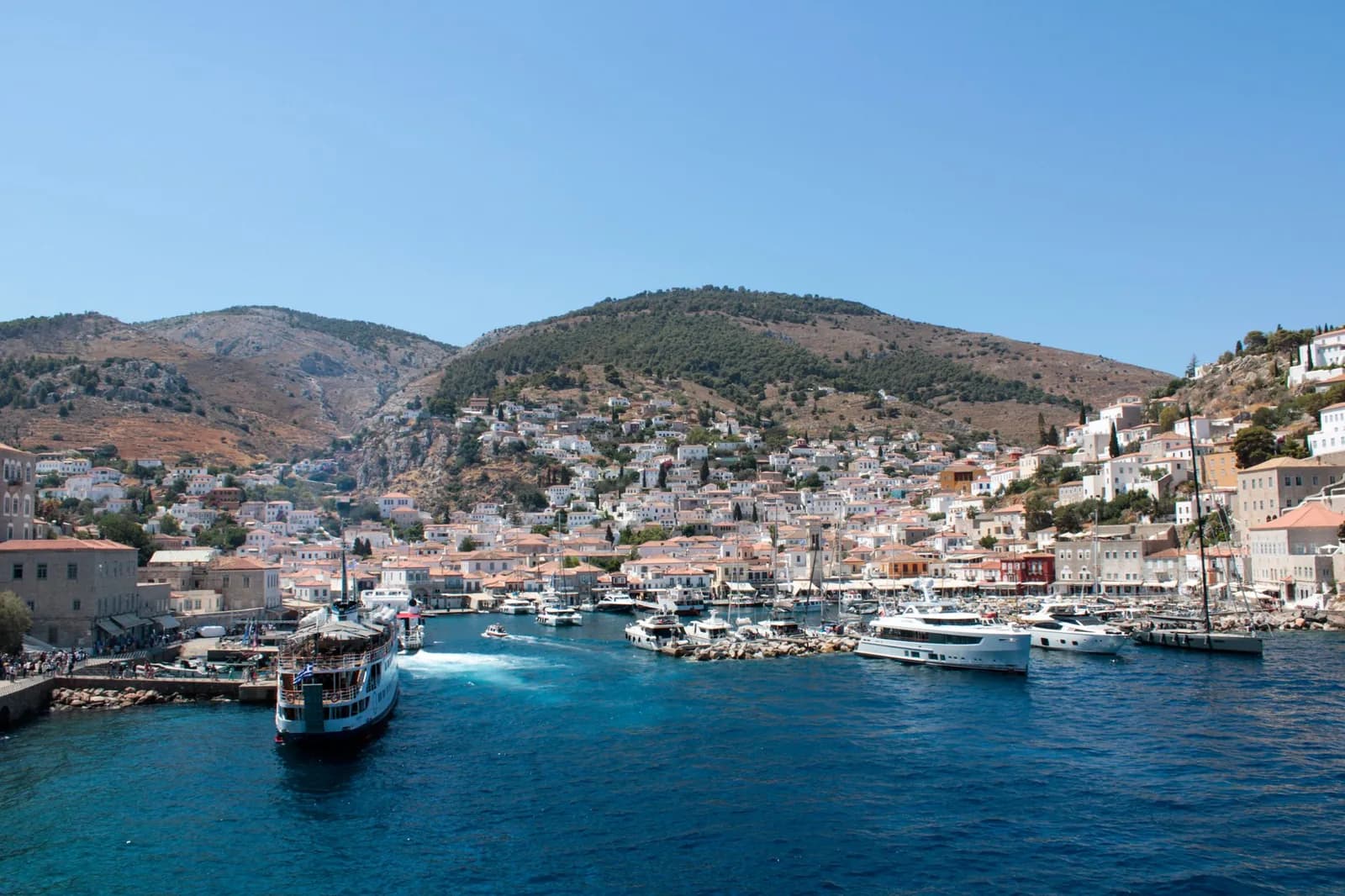
Hydra is a single harbour town built in grey stone up the sides of a bowl, and a bare mountain behind it with almost nothing else. Private cars and scooters are banned, so luggage goes up the lanes by donkey or by hand and you get to the swimming spots along the coast on foot or by water taxi. The harbour has barely been built over since the captains' mansions went up in the 18th and 19th centuries, which is why it looks the way it does in every photograph. The boats from Piraeus are fast catamarans only, a little over an hour on a direct sailing.
Aegina: pistachios and the Temple of Aphaia
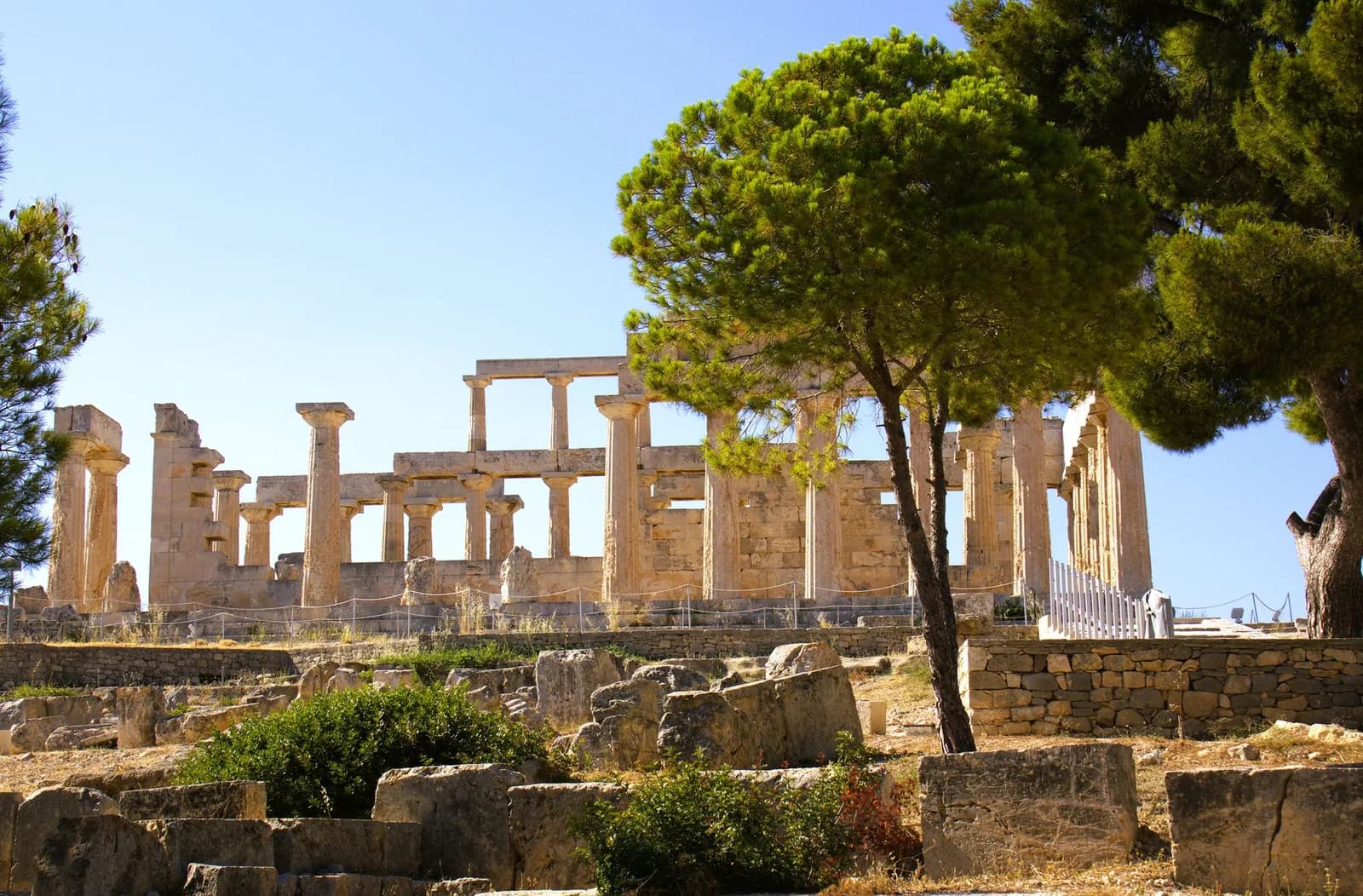
Aegina is the largest of the five and the only one that feels like a working town rather than a resort. The island is famous in Greece for its pistachios, which carry their own protected designation of origin, and you will see them sold by the bag along the harbour front. The reason to go beyond the town is the Temple of Aphaia, a Doric temple from around 500 BC on a pine-covered hilltop about 13 km east of the port, reached by local bus or taxi. It is one of the best-preserved temples in Greece and it gets a fraction of the Acropolis crowds.
Aegina, on the hill above Agia Marina
Poros: a few hundred metres off the Peloponnese
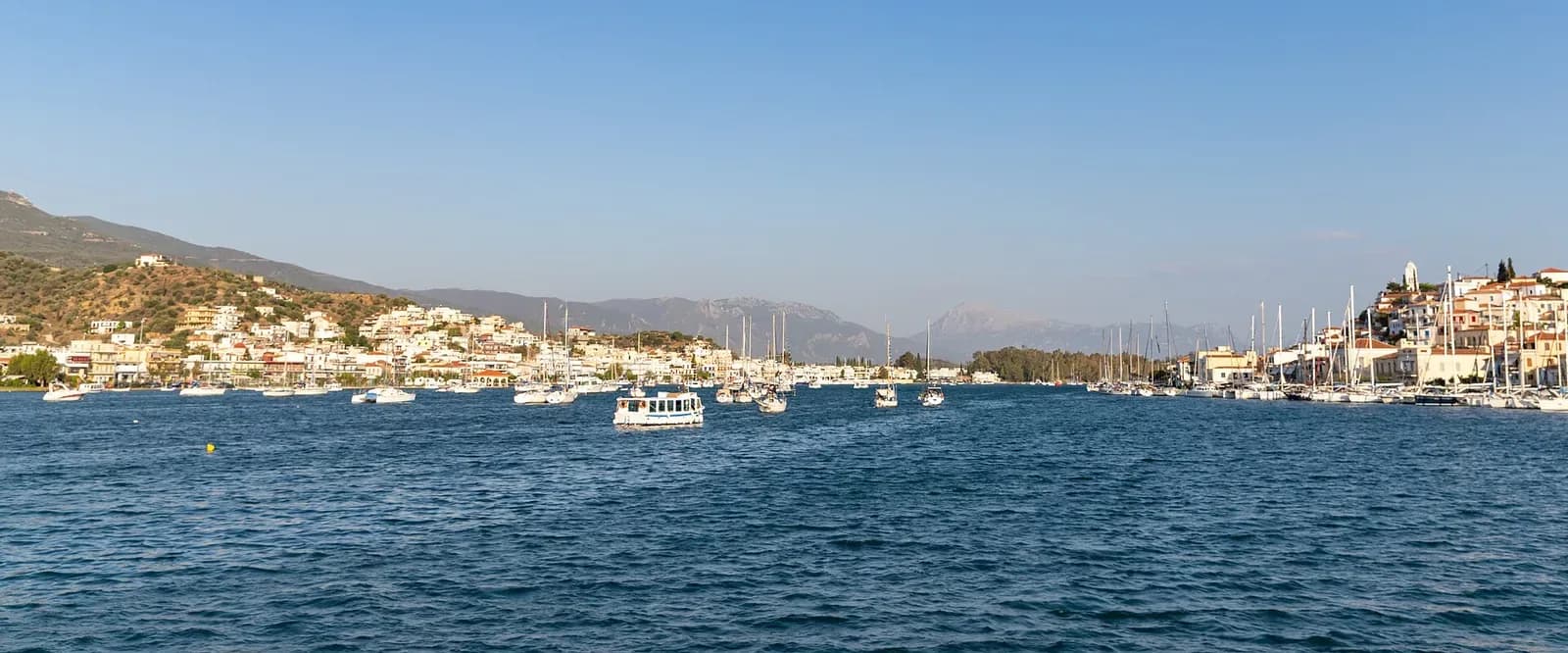
Poros is really two islands joined by a narrow neck: a small volcanic one carrying the town, and a larger one covered in pine forest. What makes it unusual is the strait. At its narrowest the water between Poros town and Galatas on the mainland is about 350 metres, crossed every half hour by a car ferry and all day and night by little passenger boats. Across the water are the lemon groves of Galatas, tens of thousands of trees, and inland the remains of a Temple of Poseidon on the pine-covered half of the island.
The strait at Poros
Spetses: the furthest, and the most elegant
Spetses sits at the mouth of the gulf, off the southern tip of the Argolid. It has the grandest houses in the group, a pine-wooded interior and a road of about 25 km around the coast, which you cover by bicycle, taxi or horse-drawn carriage, because visitors cannot drive private cars on the island. The fast boats take close to two hours via Hydra, which is why it works much better as a stay than as a day out.
Agistri: the beach day
Agistri is the smallest, a short hop beyond Aegina, and almost entirely pine forest running down to rocky coves. There is nothing much to visit and nobody goes for the sights. It is the island to pick when the plan is to swim and do nothing else, and it combines with Aegina through the local boat that links the two in about twenty minutes.
When a night is worth it
Two of the five reward a night more than the others. On Hydra, the change comes when the last boats pull out. The cafés on the quay stay full, the lanes go quiet and the harbour lights come up with no traffic noise behind them, because there is none. On Spetses a night simply turns four hours of sailing into something reasonable, and the evening walk along the old harbour is the best thing on the island.
Rooms on both run expensive in July and August and fill at weekends with people from Athens, so a Sunday to Thursday stay is both cheaper and calmer. On Hydra, favour something close to the harbour unless you enjoy carrying a suitcase up stepped lanes in the heat.
The back door: driving in from the Peloponnese
Look at the map again. Poros, Hydra and Spetses are all within a few minutes of the mainland, and if you have a car, you never need Piraeus at all. You drive round through the Corinth canal and down the Argolid coast, leave the car on the mainland side, and cross.
- Galatas to Poros: about two and a half hours from Athens. A car ferry crosses every half hour from early morning to late evening, and the passenger boats run round the clock. This is the one crossing that takes your car.
- Metochi to Hydra: about 2 h 45 from Athens. Passenger boats take around fifteen minutes, with guarded parking on the mainland side and water taxis when the boats are not running.
- Kosta to Spetses: about three hours from Athens. A small car ferry crosses a few times a day, but visitors leave their car at Kosta and cross by boat or water taxi, because private cars are not allowed to drive on the island.
This is also how the islands fit into a longer trip. Epidaurus is under an hour from Galatas and Nafplio not much further, so the natural route is to take in the loop round the Peloponnese from Athens and spend a night on Poros or Hydra at the eastern end of it.
Piraeus, the gates, and booking the boat
Almost everyone goes by sea from Piraeus. The Saronic boats leave from the part of the port nearest the metro station, which is the end of line 1 and a stop on line 3, the line that also runs from the airport. Getting from the airport to Piraeus takes a little over an hour by metro. The conventional ferries to Aegina and Agistri leave from gate E8, a few minutes' walk from the station. The fast boats use E8 or E9 depending on the operator, and even the operators disagree with themselves on it, so read the gate on your ticket rather than trusting a guide, including this one.
Aegina is the one island where you can turn up and buy a ticket at the quay; there are dozens of sailings a day. For Hydra, Poros and Spetses, book ahead in summer and at every weekend, because the catamarans are small and the Friday and Sunday evening sailings sell out. The general logic of the Greek ferry system, which operators run which routes and how the tickets work, is on the guide to Greek ferries.
Weekends, seasons, and combining with the other islands
These are the Athenians' own islands, and the weekend is when you notice. The operators add sailings on Friday evening and Sunday evening for a reason, and they sell weekday returns cheaper for the same one. If you can choose, go midweek. The season for the fast boats to Hydra and Spetses runs roughly from late March to the end of October. Aegina has boats every day of the year, and the mainland crossings to Poros and Spetses keep going through the winter, but outside the summer the timetables thin out and the slow ferry to Poros drops to Sundays only.
Because the Saronic boats and the Cyclades boats both leave from Piraeus, the two combine without a flight. A night on Hydra or Aegina at the end of a Cyclades week puts you an hour from Athens the night before your flight home instead of five, which is a safer place to be when the wind is up. If you are still choosing between groups, how the six island groups are laid out is the place to start.
Questions people ask about the Saronic islands
Which Saronic island should I visit?
Hydra, if you only pick one and can stay a night: a stone harbour town with no cars, and an evening that is completely different once the day boats have gone. Aegina if you want the easiest day out of Athens, with a proper temple and a working town. Poros if you want green hills, swimming and a long lunch. Agistri for a plain beach day under pine trees. Spetses is the most elegant of the five and the furthest, so it is the one to stay on rather than visit.
Are the Saronic Islands worth visiting?
Yes, as long as you know what they are. They are the islands Athenians go to at the weekend, not a substitute for the Cyclades. You will not find white cube villages or the Santorini caldera. What you get instead is an island within an hour of the city, old stone harbour towns, pine woods down to the sea, and a trip that does not need a flight or a travel day. For anyone with only a few days in Athens, that is the whole point.
What is the best island for a day trip from Athens?
Aegina. The fast boat takes about 40 minutes, sailings run from early morning into the evening, and the last fast boat back leaves just before nine at night, so you do not have to plan anything. Poros is the next best, an hour away with a late boat home. Hydra works as a day trip too, with about nine hours ashore, but it is the island most people regret not staying on.
How do I get to the Saronic Islands from Athens?
By boat from Piraeus, the main port, which is at the end of metro line 1 and on line 3. Aegina and Agistri have both fast boats and car ferries. Poros has fast boats and one slow ferry a day, and Hydra and Spetses are served by fast catamarans only. The alternative is to drive round through the Peloponnese and cross from the mainland: Galatas to Poros, Metochi to Hydra or Kosta to Spetses, each a crossing of a few minutes. Day cruises leave from the Faliro marinas, not from Piraeus.
Can you visit Hydra, Poros and Aegina in one day?
Only on the organised day cruise, which leaves the Faliro marinas around 8 in the morning and returns around 7:30 in the evening. You get roughly an hour and a half on Hydra, 45 minutes on Poros and two hours on Aegina, with lunch on board. The scheduled ferries do not connect the three in a way that makes it possible on your own. It is a good look at the islands and a poor way to spend time on any of them.
Are there cars on Hydra?
No. Hydra bans private cars and scooters, and the only motor vehicles on the island are the municipal ones. Luggage goes up the stepped lanes by donkey, mule or porter, and you get round the coast by water taxi. Spetses restricts cars too: private cars cannot drive on the island, and you leave yours at Kosta on the mainland. Aegina, Agistri and Poros have ordinary roads.
Can you combine the Saronic islands with the Cyclades?
Yes, because both leave from Piraeus. The simple version is a night or two on Hydra or Aegina at the start or end of a Cyclades trip, with Piraeus as the hinge: you come back to the port and take the next boat out. It costs one short crossing rather than a flight, and it breaks up a long week of island hopping with somewhere quieter and closer to the airport.
