Athens to Milos by ferry: the boats, the times, and the line nobody tells you about
Milos is the Cycladic island everyone has decided to visit at once. It is also on the wrong branch of the ferry network for the itinerary most people have already half booked.
Every ferry from Athens to Milos leaves from Piraeus, and there are two of them in practice: a conventional ship that takes about seven hours and calls at other islands on the way, and a high-speed craft that does it in three to three and a half for roughly double the fare. There is also a plane, because Milos has an airport. All of that is the easy part. The thing that decides your trip is that Milos sits on the western Cyclades line, not the central one, which is why so many people arrive with a second island booked that they cannot reasonably get to.
Slow boat, fast boat or the plane
Most guides leave the flight out of the comparison, which hides a useful fact about this particular island. Milos has a runway and a scheduled service from Athens, and the fare often lands within striking distance of the fast ferry.
| Option | Who runs it | Time on the move | Relative cost | Vehicles | In bad weather |
|---|---|---|---|---|---|
| Conventional ferry | Blue Star, Zante Ferries, Aegean Sea Lines | About 7 h, with stops | The cheapest of the three | Yes | Sails in almost anything |
| High-speed ferry | SeaJets, Aegean Speed Lines | About 3 h to 3 h 30 | Roughly double the conventional fare | On some vessels only | First to be cancelled in wind |
| Flight | Sky Express, ATH to MLO | About 40 min in the air | Close to the high-speed fare | No | Rarely affected |
Which companies hold this line moves from one season to the next, and so do the departure times, the number of daily sailings and the fares. Read the columns as an order of magnitude, then check the operator or a booking site for your own dates. Price the plane at the same time as the fast boat, because on Milos the two often land within a few euros of each other.
The conventional ship is the better day out and the better value, and on a route this long that is not a small thing. You get open decks, somewhere to eat, and Serifos and Sifnos sliding past the rail. The cheapest fare buys you the boat but not a seat on it, which is fine in May and a mistake on a full August sailing, so pay the small supplement then. The high-speed boats are airline seating, mostly enclosed, and they slam into a head sea rather than rolling over it. If you do not travel well on water, seven hours on a big ship will treat you better than three on a catamaran.
Milos is on the western line, and that changes the whole trip
The Cyclades are not one network. Out of Piraeus the boats fan out along two main branches. The central line carries the traffic everyone knows: Paros, Naxos, Ios, Santorini, with Mykonos hanging off it and off Rafina too. The western line is quieter and runs down the other side of the archipelago through Kythnos, Serifos, Sifnos, Kimolos and Milos. Those two branches barely touch each other, and where they do touch it is seasonal.
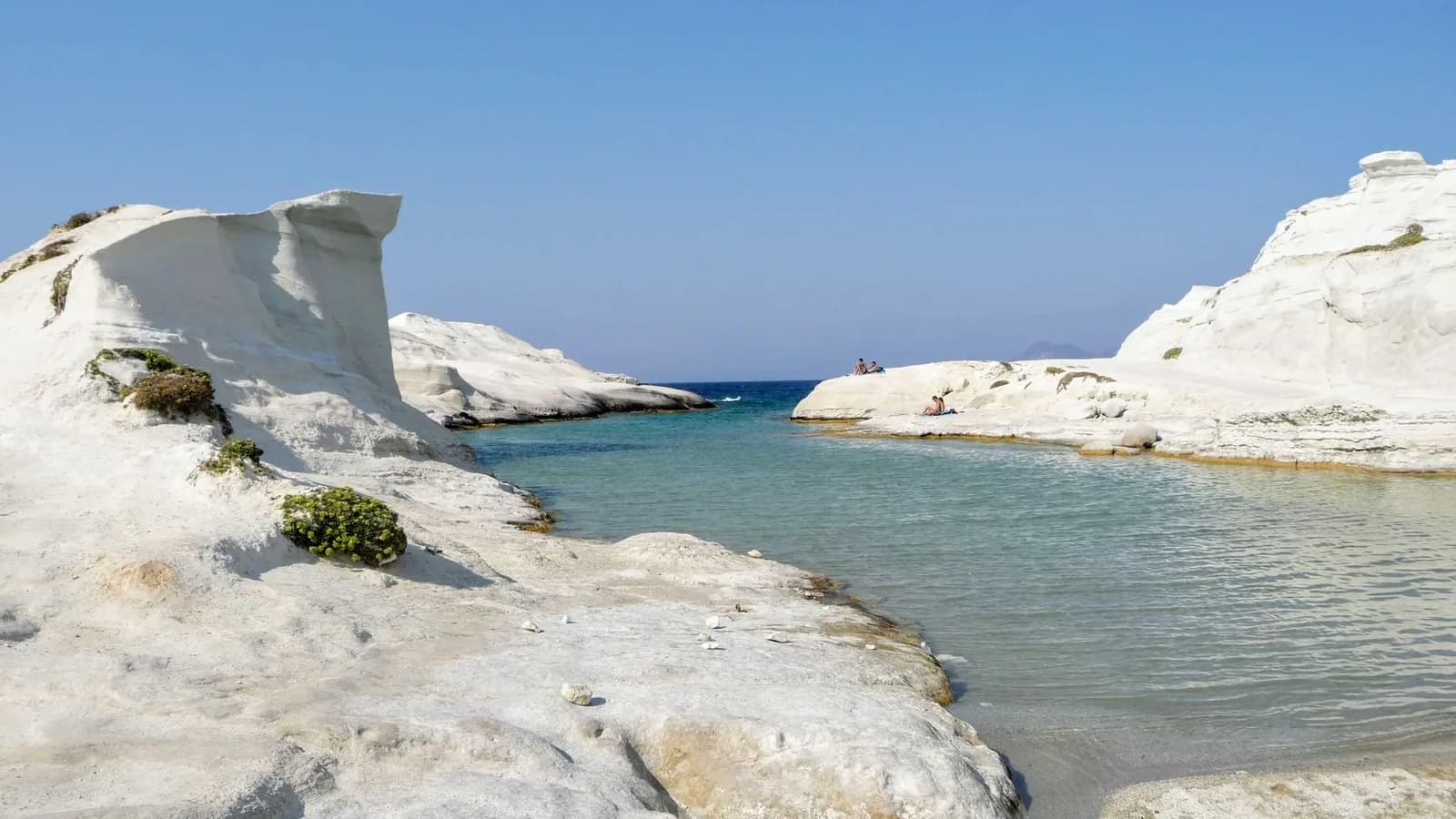
Sarakiniko and Kleftiko did their work on social media and Milos went from a quiet mining island to a name people put on a shortlist next to Mykonos and Santorini. The photographs travel; the timetable does not. Someone who books four nights on Mykonos and three on Milos has bought two islands on opposite branches of the network, and the connection between them runs through Piraeus. That is most of a travelling day in the middle of a week-long trip, and it is discovered late, usually after the hotels are paid for.
There is a second consequence that bites even when your islands are right. The western line simply has fewer sailings than the central one. On the Santorini route a missed or cancelled boat means waiting for the next one, often the same day. Here it can mean tomorrow. Fewer departures also means the good ones fill earlier.
Which islands actually chain with Milos
Settle this before you book anything else. The answer rules out about half the itineraries people arrive with.
Pick a tier to see what chains with Milos
Where can you actually go next from Milos?
These sit on the western line with Milos, which means the boat that brought you from Piraeus is very often the boat that takes you on.
Kimolos
Western Cyclades
- From Milos
- About 20 min from Pollonia
The small local boat crosses from Pollonia, at the north-east corner of Milos, several times a day in summer. Close enough to do as a day trip and cheap enough to do twice.
Sifnos
Western Cyclades
- From Milos
- Roughly an hour and a half
The next stop north on the same line, and the island most people pair with Milos without knowing why it works. Both conventional and high-speed sailings call there.
Serifos
Western Cyclades
- From Milos
- Two hours or so
One stop further north again, with a hilltop Chora that earns the detour. It is on the way back to Piraeus rather than a diversion from it.
Leaving from Piraeus
Piraeus is the port for Milos and the one your ticket will almost certainly name. It is about 40 minutes from central Athens on metro line 1, and the walk at the far end is the part people underestimate: the quays run for kilometres, the gate number on the ticket is the only thing that tells you which stretch, and dragging a suitcase to the wrong one costs a quarter of an hour you do not have. Departures on this line skew early, so give yourself the full hour.
Athens has other ferry ports, and Rafina is the one that causes confusion. It serves Andros, Tinos and Mykonos, it is out near the airport on the opposite side of the city, and operators have occasionally put a seasonal Milos sailing there. Read the departure port on your own booking rather than assuming Piraeus, because the two are more than an hour apart and there is no quick way between them on a summer morning. If you are flying into Greece the same day, work out how you get from the terminal down to the harbour before you pick a sailing, since the metro run across the city is the slow part of the morning. Our country drawn to scale settle where the ports and the two ferry branches actually are, which is the thing to fix before the dates.
Landing at Adamas
The ferry docks at Adamas, at the head of the enormous natural bay that takes a bite out of the middle of Milos. The bay is a flooded volcanic crater, which is why it is so deep and so sheltered, and why the port has been used for three thousand years. As arrivals go it is one of the gentler ones in the Cyclades: Adamas is a real town with tavernas, hire desks, a bus stop and a waterfront to wait on, not a concrete shelf at the bottom of a cliff.
The island behind the port
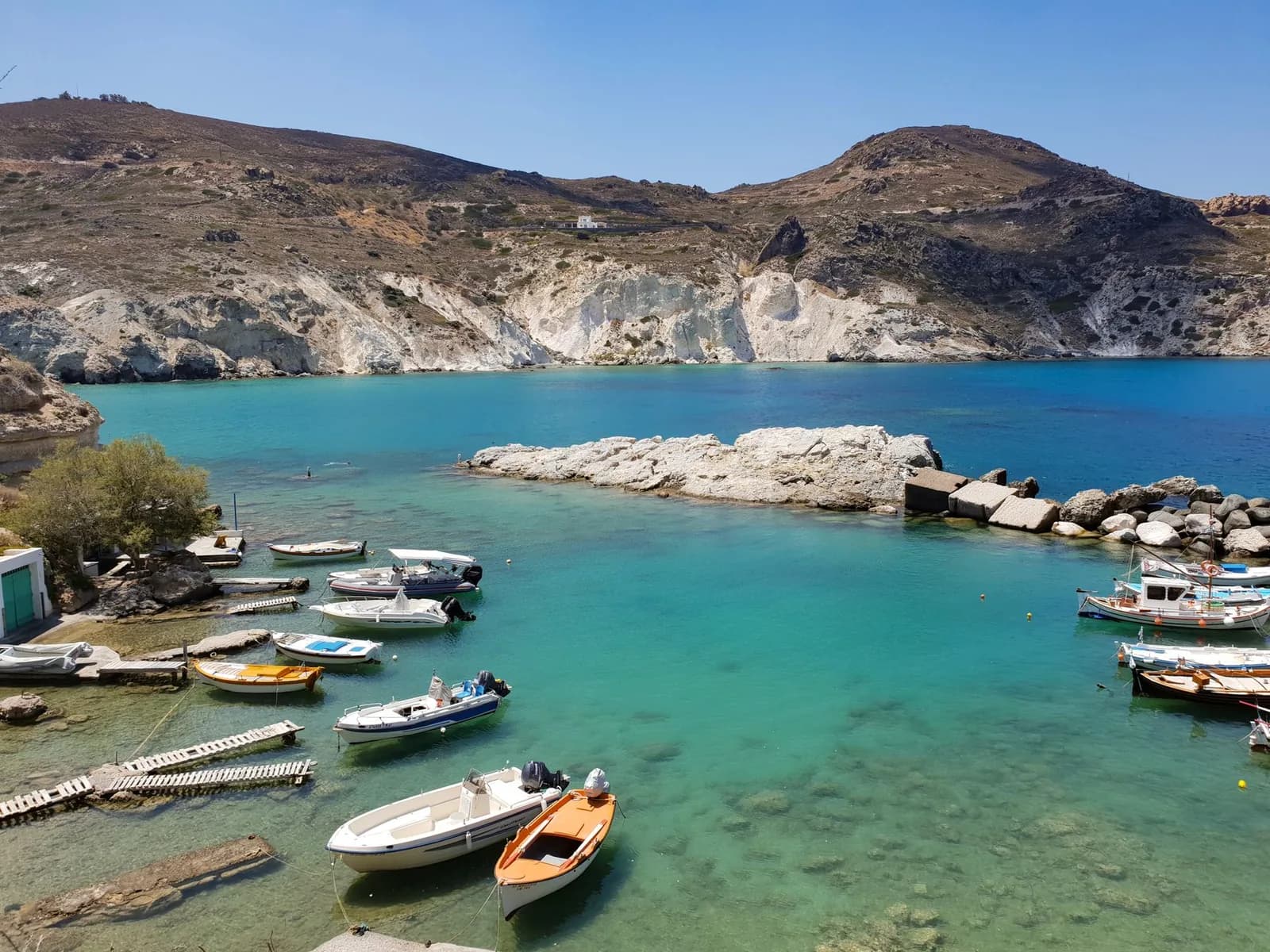
What Adamas is not is central. Milos is a big island by Cycladic standards and a rugged one, the coastline runs for well over a hundred kilometres, and the beaches that put it on your shortlist are scattered around it rather than gathered near the harbour. Plaka, the Chora up on the ridge, is a few kilometres away. Pollonia and the Kimolos boat are at the far north-eastern corner. Buses exist, they run to the main villages, and they run on a timetable built for residents rather than for a day of beach hopping.
Getting around once you land
Without a car or a quad you will see a small fraction of Milos, and that is the practical difference between this island and a compact one like Sifnos. Plenty of the best beaches sit at the end of unsurfaced tracks, the south-west of the island is close to empty, and a hire car booked from the ferry deck on the morning you arrive is a hire car that no longer exists in August. Book it before you sail. Bringing your own vehicle over on the conventional boat works too, though hire agreements in Greece usually forbid taking the car off its island without written permission. Which beach has a road, which needs a dirt track and which can only be reached by boat is set out on our map of Milos.
The same geography decides where you sleep. Adamas is the practical base because the boats and the hire desks are there, Pollonia is the quiet one at the north-eastern corner, and Plaka and Trypiti sit up on the ridge with the view and the evening walk. Which of those villages suits your trip is worth settling before the ferry, because it changes how far you drive every single day.
One corner of the island is closed to vehicles entirely. Kleftiko, the sea caves and white pinnacles on the south-west coast, can only be reached by boat, and no road goes anywhere near it. Day boats leave from Adamas and from Pollonia and take most of a day to round the island, which also happens to be the best way to see a coastline you cannot otherwise get to. The boats are small, the season is short, and they book out in advance.
When the wind stops it
The name for the summer wind here is the meltemi, a dry northerly that owns the Aegean from June into September. On the western line it matters more than elsewhere, because the crossing runs down an exposed channel with no island chain to break the swell. A catamaran that would sail happily between Paros and Naxos can sit in Piraeus with the Milos run struck off the board. The big conventional ships keep going in the same weather, which is the argument for taking the slow one when the forecast turns.
On the western line that matters more than it does elsewhere, because there are fewer boats to fall back on. A cancelled fast sailing to Milos does not always have a same-day replacement, and the same wind that grounds the ferries also cancels the Kleftiko boats, which is how people lose the two things they came for on the same morning. Build in a spare day if the trip is short.
Milos to Athens on the way home
The return runs on the same two boats in reverse, with the same durations, and the Milos to Athens ferry brings you back into Piraeus rather than Rafina in almost all cases. The northbound conventional sailing is the pleasant one, calling at Sifnos and Serifos, and it is a decent way to add a last island to the trip without adding a leg.
A same-day fast ferry is not transport to an international flight, it is a bet on the wind. Fly out of MLO, take the big ship, or come home a day early. On a line with this few departures, one cancellation and a flight out the same afternoon is a combination that ends at an airline desk. For the wider picture, which companies run where and what a crossing costs elsewhere in the Aegean, see our overview of the Greek ferry network.
One last practical note. The Greek fleet publishes its summer in pieces, usually from late winter onwards, so a December search for a July crossing can come back almost empty without anything being wrong. And check the form your ticket takes: a few operators still hand out paper only, redeemable at the quay or at a town agency, while others simply scan a phone. That is a property of the company you booked, not of this line.
Questions people ask about the Athens to Milos ferry
How long is the ferry ride from Athens to Milos?
Around seven hours on a conventional ship out of Piraeus, and somewhere between three hours and three and a half on a high-speed one. The gap is wider than the difference in speed suggests, because the conventional boat calls at Serifos, Sifnos and sometimes Kimolos on the way, so the duration follows the number of stops on your particular sailing rather than the route. Durations and departures are reissued season by season, so read the crossing time on the sailing you are booking rather than an average.
Is it better to fly or take the ferry from Athens to Milos?
Milos has its own airport, MLO, with a short hop from Athens on small turboprops, so the choice is real here and not on most western Cyclades islands. Fly if the crossing would eat a whole day of a short trip and you are travelling light. Sail if you want the vehicle, the cheaper fare, or the western line itself, since the slow boat calls at Sifnos and Serifos on the way. The aircraft are small, seats are limited, and August fills them long before the boats fill up.
What is the best way to get to Milos?
For most people the high-speed ferry from Piraeus: it takes a morning rather than a day, it runs through the whole season, and it lands you in Adamas, which is a real town rather than a quay. Take the conventional ship instead if you have a car, if you get seasick, or if the meltemi is blowing, since the big boats sail in weather that keeps the fast ones in port. Fly when the calendar is tight. What does not work is arriving from Mykonos or Santorini, because those are on the other branch of the network.
Is Milos worth visiting?
Yes, with one condition: you need a way of getting around it. Milos is a volcanic island with a coastline of extraordinary variety, from the bleached rock of Sarakiniko to the sea caves of Kleftiko and the fishing colours of Klima, and it is still less crowded than Santorini or Mykonos. All of that is scattered around a big, rugged island rather than gathered near the port. Visitors who stay put in Adamas and rely on the bus tend to come away wondering what the fuss was about.
Which port in Athens do the Milos ferries leave from?
Piraeus, the big commercial port south-west of the city, about 40 minutes from the centre on metro line 1. Piraeus to Milos is the standard routing and the one to plan around. Operators have run the occasional seasonal sailing out of Rafina, on the other side of Athens near the airport, so read the departure port printed on your own ticket rather than assuming it. Getting that wrong costs you well over an hour in cross-city traffic.
Which companies sail from Athens to Milos?
The western Cyclades line is shared between a conventional operator and the high-speed companies, and the line-up moves from one season to the next. Blue Star Ferries, Zante Ferries, SeaJets and Aegean Speed Lines have all appeared on it in recent years, some with the slow boat and some with catamarans. Book on the vessel type and the crossing time rather than on the name over the door, because that is what decides your day and what decides whether the wind stops you.
