The Ionian islands: choosing one, and getting to it
Six islands down the west coast of Greece, green where the rest of the country is bare, Venetian where the rest is Ottoman, and reached by a set of routes that have nothing to do with Athens.
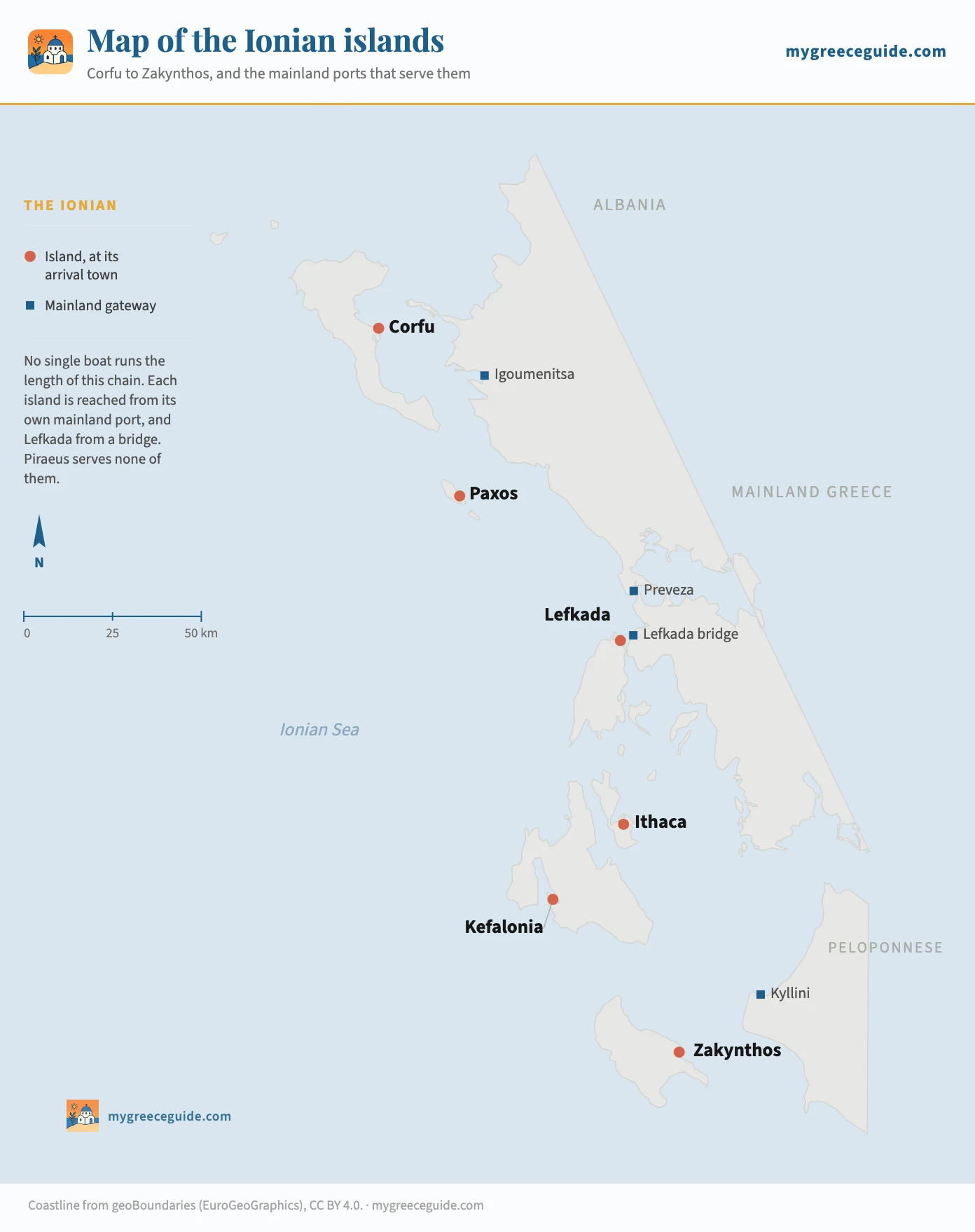
Corfu, Paxos, Lefkada, Ithaca, Kefalonia and Zakynthos hang off the western edge of the country in a line about 200 km long. They look like a chain and they do not work like one: no boat runs down them, nothing sails to any of them from Piraeus, and one of the six is reached by driving across a bridge. Get that straight before you book anything, because it is the thing that most often wrecks an Ionian itinerary built the way a Cyclades one is built.
The group
Why this group is not a second Cyclades
The Cyclades are organised around a single door. You land in Athens, you get to Piraeus or Rafina, and from there the boats that leave the Athens ports fan out across the Aegean, several a day in season, calling at four islands on the way. Nothing in that description applies here. The Ionian is entered from the west coast of the mainland, at three ports that are four to eight hours by road from Athens, and each island is served from its own one.
Look at the map again and it makes sense. These islands sit a few kilometres off the shore they belong to, not out in open water, so the crossing that matters is the short hop from the coast opposite rather than a long run from the capital. Igoumenitsa serves Corfu and Paxos, Kyllini serves Zakynthos and Kefalonia, and Preveza is the airport for Lefkada. The Peloponnese and Epirus are the mainland that counts, which is worth checking against the real distances across mainland Greece before you assume a night in Athens fits into the plan.
The second difference is that most people never touch the mainland at all. Corfu, Kefalonia and Zakynthos each have an airport that fills with direct charters from northern Europe between May and October, and the standard Ionian holiday is a flight straight in and a transfer straight out. That works beautifully in August and collapses in April, when the charters have not started and the only way in is Athens and a long day of driving. If you are still working out how the country divides up, where the six island groups sit relative to each other is the map to start from.
Which island for which trip
The six are not variations on one another. They differ in size by a factor of thirty, and two of them work without a car while the rest do not.
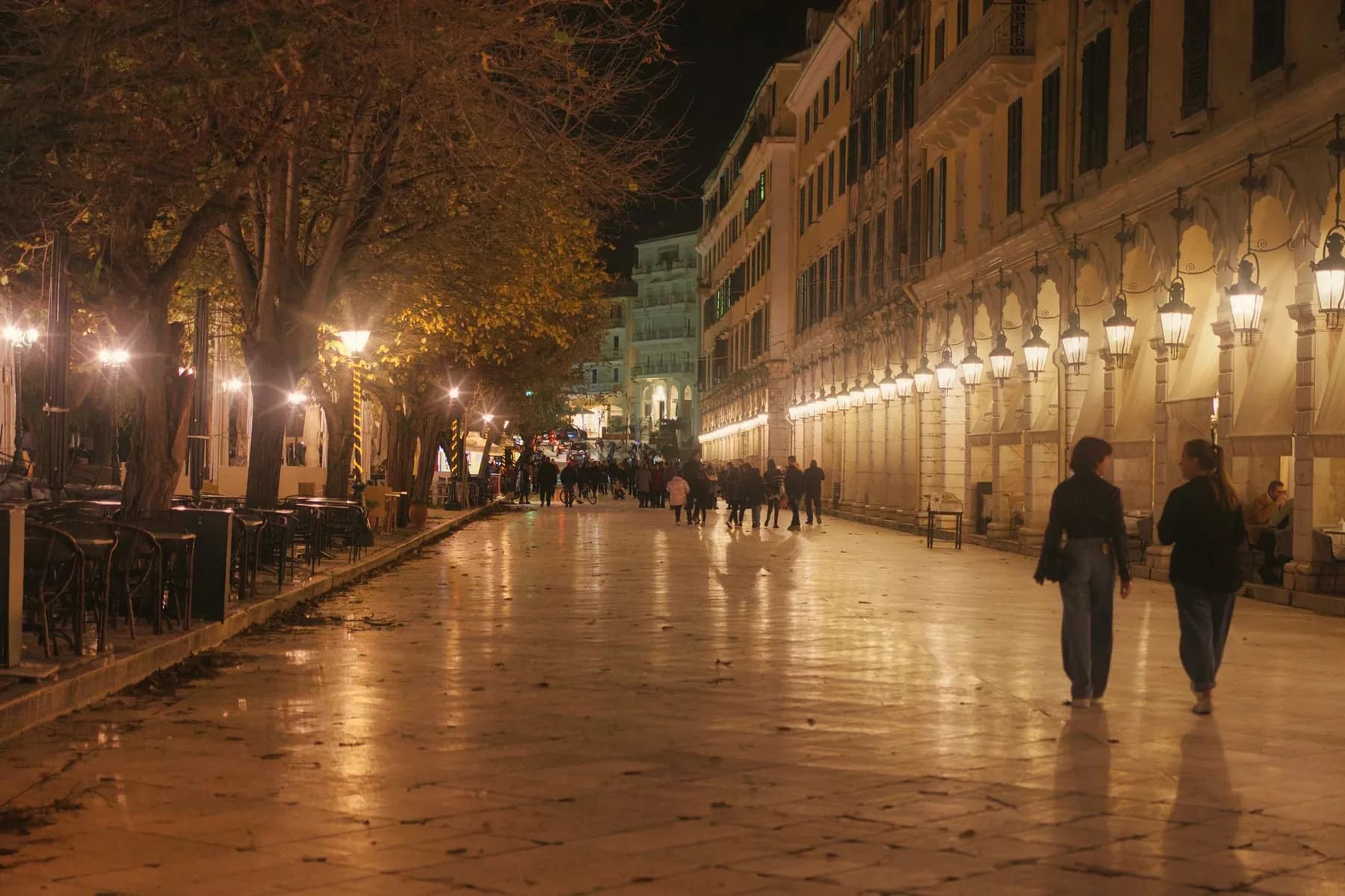
Corfu is the one with a town. A UNESCO old quarter of Venetian shutters and arcades, a year-round population, an airport three kilometres from the old town and a ferry that runs in January, which together make it the only island in the group that is a destination outside summer. It is also the busiest, and the north coast in August is a different holiday from the north-east coast in May. How the island is laid out, coast by coast, decides more about your week here than the hotel does, which is why our Corfu hotels are sorted by coast rather than by stars.
Corfu Town after the charters stop
Kefalonia is the biggest and the emptiest, and the one that rewards driving. A mountain over 1,600 m sits in the middle of it, so the coasts are separate worlds and the distance between two of them is never what the map suggests. Myrtos, the Melissani cave and the fishing villages of the north are spread across an island you cannot see in three days. Everything starts with the transfer: the drive times out of the airport are the reason people end up in the wrong half of it, and which base you pick decides how much of the island you see.
Zakynthos, or Zante, splits hard in two. The south and east are flat, developed and where the resorts are, with Laganas at the loud end of that. The west and north are cliffs, and the famous cove at Navagio sits at the top of them with no road down. It is the easiest of the six to reach from the Peloponnese, and almost every resort sits within half an hour of the runway. The choice of base still matters more here than anywhere else in the group, so it is worth seeing what sits where on Zante before choosing a resort by photograph. How loud each resort is at night, and the hotels in each, are in where to stay on Zakynthos.
Lefkada is the anomaly, and the reason is on the map: it is joined to the mainland. You drive on. The west coast holds the beaches the group is known for, Porto Katsiki and Egremni and Kathisma, all on one road, and the east coast at Nydri is the sheltered side where the boats leave from. It suits a short trip, a trip combined with the mainland, and anyone who would rather not think about ferries.
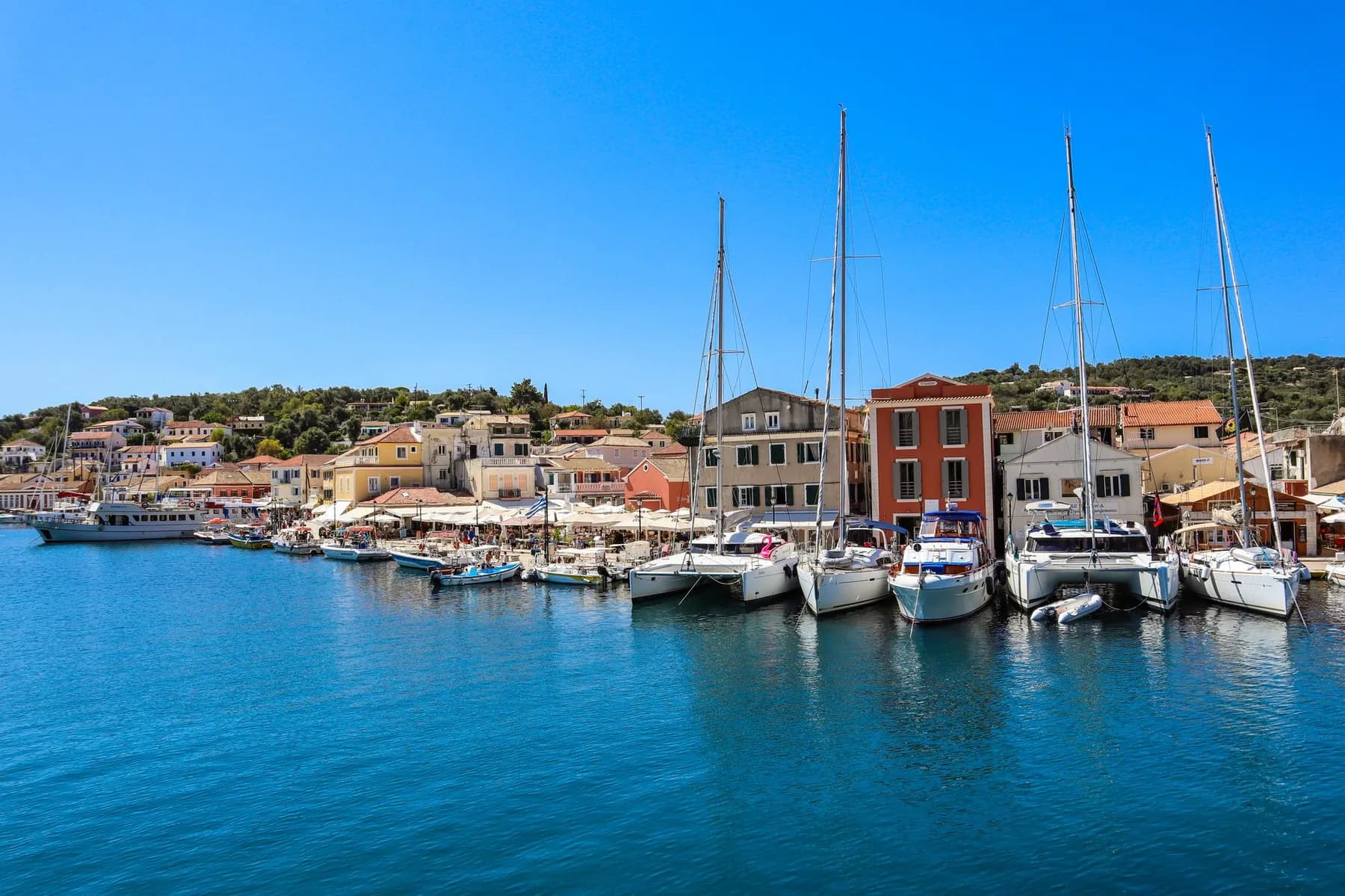
Ithaca and Paxos are the small ones, and both are chosen for what they do not have. Ithaca is a pair of hills joined by an isthmus, with Vathy round its deep harbour and very little else, and it is the quietest of the six. Paxos is smaller again, all olive groves and three harbours, an hour or so from Corfu by boat and full of people who come back to the same house every year. Neither has an airport, and both are reached in two legs.
A Paxos harbour front
How you get to each one
Three routes exist in this group, air, sea and road, and no island has all three. The absences are the useful part: two of the six have no airport and one needs no boat.
There is a fourth way in that no other Greek archipelago has, and the map of the crossings from Italy is where it is drawn: Ancona, Bari, Brindisi and Venice all send ships to this side of the country, and one of them lands on Corfu itself.
Which island, and how do you land on it?
- By air
- Corfu (CFU), on the island, a few kilometres south of the old town. Charter and low-cost routes from across northern Europe from spring to autumn, and a thin year-round link with Athens.
- By sea
- Igoumenitsa, roughly ninety minutes on a conventional ship and much less on a fast one, with sailings through the day and through the winter. Also Bari and Ancona in Italy, and a passenger boat from Saranda in Albania.
- By road
- None. You leave the car at Igoumenitsa or put it on the boat.
The one Ionian island you can reach without planning anything: the crossing is frequent enough to turn up for, and the airport is inside the town rather than an hour from it.
Where island hopping breaks down
There is a real hopping trip in the Ionian and it involves three islands. Lefkada, Ithaca and Kefalonia sit close together and are properly linked, by short crossings out of Nydri and Vasiliki on Lefkada, Sami and Fiskardo on Kefalonia, and Piso Aetos and Frikes on Ithaca. Ionian Group, Levante Ferries and Kefalonian Lines are the names on the timetables. A week across those three works, and it is the one itinerary in the group that behaves the way the Cyclades do. The most reliable leg is the Kefalonia to Ithaca ferry, half an hour from Sami to Piso Aetos and running all year.
Outside that triangle it stops. Corfu is cut off from the rest of the chain by open water and by the absence of any commercial reason to cross it: getting from Corfu to Kefalonia means the boat back to Igoumenitsa and then most of a day driving south through Epirus and into the Peloponnese. Zakynthos is cut off at the other end, with only a short summer link from Pesada in southern Kefalonia, running from two ports that are both a long way from anywhere either island keeps its hotels.
The other thing that catches people is the season. These are not year-round networks. The crossings that vanish first are exactly the ones an ambitious plan depends on, the northern Ithaca links and the Kefalonia to Zakynthos boat, and they thin out from late September. Build a September or May trip around one island and its immediate neighbours, and treat anything else as a bonus you confirm rather than a leg you rely on.
The green islands, and when to go
The Ionian catches the weather coming off the Adriatic, and it shows. The wettest of these islands take several times the rain that falls on a Cycladic one, and almost all of it arrives between November and March. That is why the islands are wooded, why the olive groves are enormous, and why the hills are still green in June when the Cyclades have gone the colour of straw. It is also why a week here in April can be wet, which is not a risk you run in the Aegean.
The upside arrives in summer. The meltemi, the north wind that closes fast ferries in the Aegean for days at a time in July and August, does not blow here. Ionian crossings are short and sheltered and go when they say they will, which is one genuine advantage this group has over the Cyclades and one reason the sailing charter fleet is based at Lefkada and Corfu rather than anywhere further east.
For timing, the shape of the year is set by the charter flights rather than by the climate. June and September are the useful months: the sea is warm, the direct flights are still running, and the roads are not full of coaches. July and August are hot, busy and expensive in the ordinary way. May is lovely and gambling slightly on the weather. From late October the airports go quiet, most resorts shut, and only Corfu carries on as a place you can turn up to.
Why the car counts more here
On a Cycladic island you can usually get by on buses and a boat trip. In the Ionian that is true on Corfu and nowhere else. These islands are mountainous, their beaches are reached down individual spur roads with no coast road joining them, and the bus network is built for residents going to the main town, which is rarely where you want to go. On Kefalonia the mountain in the middle makes buses close to useless; on Lefkada the west coast beaches are strung along a single road that no service runs down at a useful frequency.
There is one rule worth knowing before you book. A car hired in Greece almost always comes with a clause forbidding you to take it off the island without written permission, and it is enforced at the ferry ramp. That matters here more than anywhere, because the Lefkada, Ithaca and Kefalonia triangle looks exactly like a trip you would drive around. Plan on hiring separately on each island, or ask the agency first. Lefkada is the exception that proves it: arriving over the bridge, a mainland rental from Preveza is simply a mainland rental you keep driving.
Questions people ask about the Ionian islands
What are the seven Ionian Islands?
Corfu, Paxos, Lefkada, Ithaca, Kefalonia, Zakynthos and Kythira. The Greek name for the group, Eptanisa, literally means seven islands, and it is a political count rather than a geographical one: the seven were governed together under Venice, then France, then Britain. Kythira is the odd one out, hanging off the southern tip of the Peloponnese, hundreds of kilometres from the rest and reached from Neapoli or Crete. In travel terms the group is six islands, and nobody plans a trip that includes Kythira and Corfu.
What is the best Ionian island to visit?
It depends entirely on how you want to move around. Corfu if you want a town with evenings in it and an easy arrival, and the only one that works without a car. Kefalonia if you want a road trip: it is the largest, the emptiest and the one that rewards driving. Lefkada if you would rather not deal with ferries at all, since you arrive over a bridge. Zakynthos for the postcard coast, with the crowds that come with it. Paxos if the point is to do very little. Ithaca if you want the quietest of the six and do not mind two legs to get there.
Which is the most beautiful Ionian island?
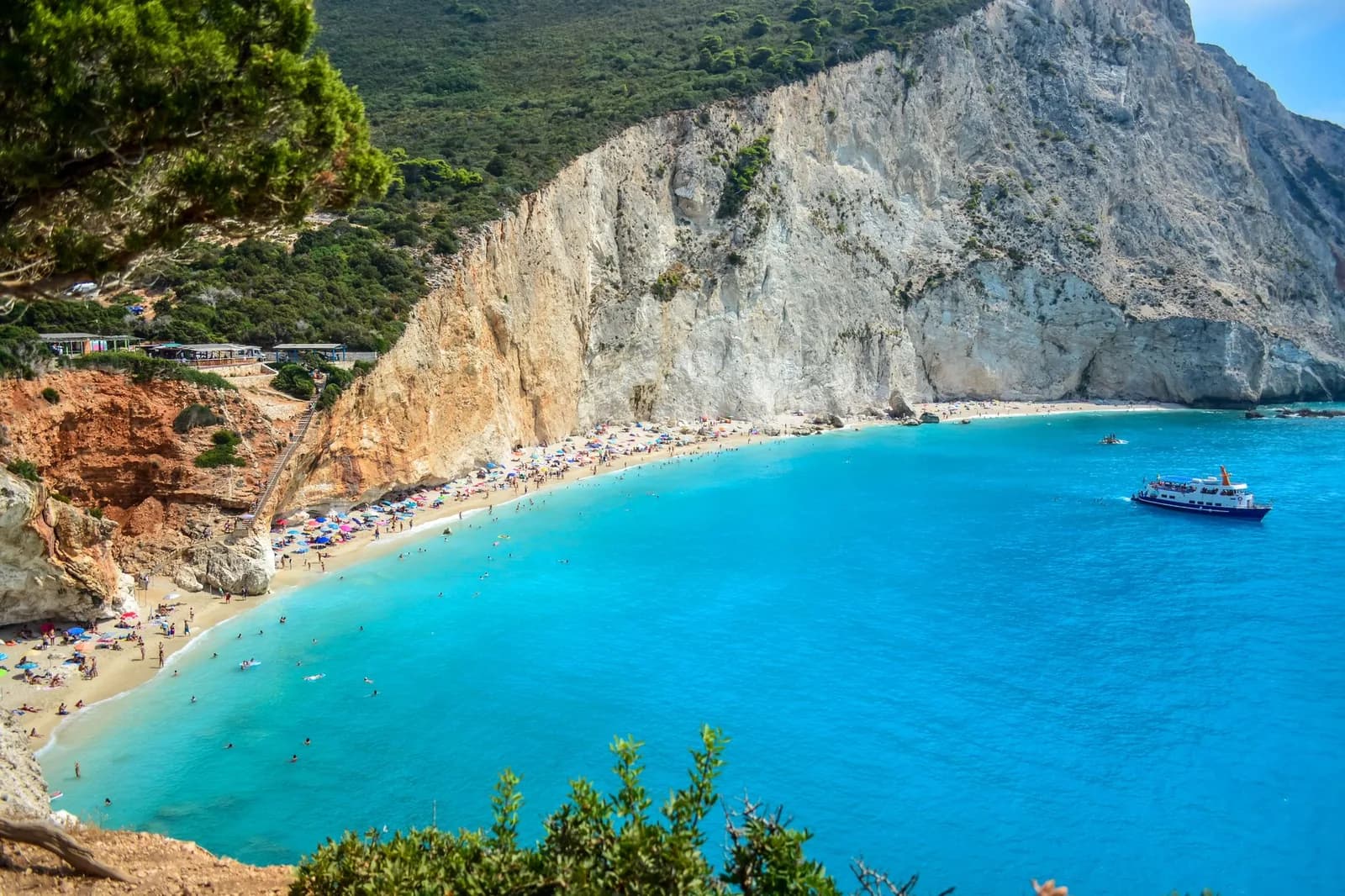
Kefalonia and Lefkada trade the title, for the same reason: both have white limestone cliffs dropping into water that turns an improbable blue, at Myrtos on one and at Porto Katsiki and Egremni on the other. Corfu is the prettiest to walk through rather than to look at, because of the Venetian old town and three million olive trees. Zakynthos has the single most photographed cove in Greece at Navagio and a lot of ordinary resort development elsewhere. Paxos is small-scale and green rather than dramatic.
Is Kefalonia or Lefkada better?
Lefkada is easier and Kefalonia is bigger. Lefkada you drive onto over a bridge from Preveza airport, the west coast beaches are lined up along one road, and you can see most of the island in a few days. Kefalonia needs a flight or a ferry, then a car, then real driving: the mountain in the middle means the distance between two coasts is never what the map suggests. Choose Lefkada for a short trip or one combined with the mainland, Kefalonia when you have a week and want a different bay every day.
Is Corfu or Zakynthos better?
Corfu has more to it. The old town is a UNESCO site with four centuries of Venice in it, the island holds a proper year-round population, and the north-east coast is genuinely quiet. Zakynthos is more concentrated: the south around Laganas is a large and noisy resort strip, and the spectacular parts, Navagio and the Blue Caves, are at the far northern end and mostly seen from a boat. Corfu also has the better winter and shoulder season, because the airport and the ferry keep working when the charters stop.
Can you island hop in the Ionian?
Between the middle three, yes. Lefkada, Ithaca and Kefalonia are linked by short crossings out of Nydri, Vasiliki, Sami, Poros and Piso Aetos, and a week built on those three works. Beyond that it falls apart. There is no boat down the chain from Corfu, so Corfu to Kefalonia means the ferry back to Igoumenitsa and a long drive south, and the summer-only link between Kefalonia and Zakynthos runs from ports that are far from either island's main town. Treat the Ionian as one island plus its neighbours, not as a chain to work down.
What are the Ionian Islands famous for?
For being green, first of all: the group takes Adriatic weather and stays wooded and wet where the Aegean islands burn brown by May. Then for the architecture, which is Venetian rather than Cycladic, because Venice held these islands for centuries and the Ottomans never did. Then for a handful of images that have travelled a long way from the places themselves: Navagio on Zakynthos, Myrtos on Kefalonia, Porto Katsiki on Lefkada. Ithaca is famous for a different reason, as the island Odysseus spent ten years trying to get back to.
