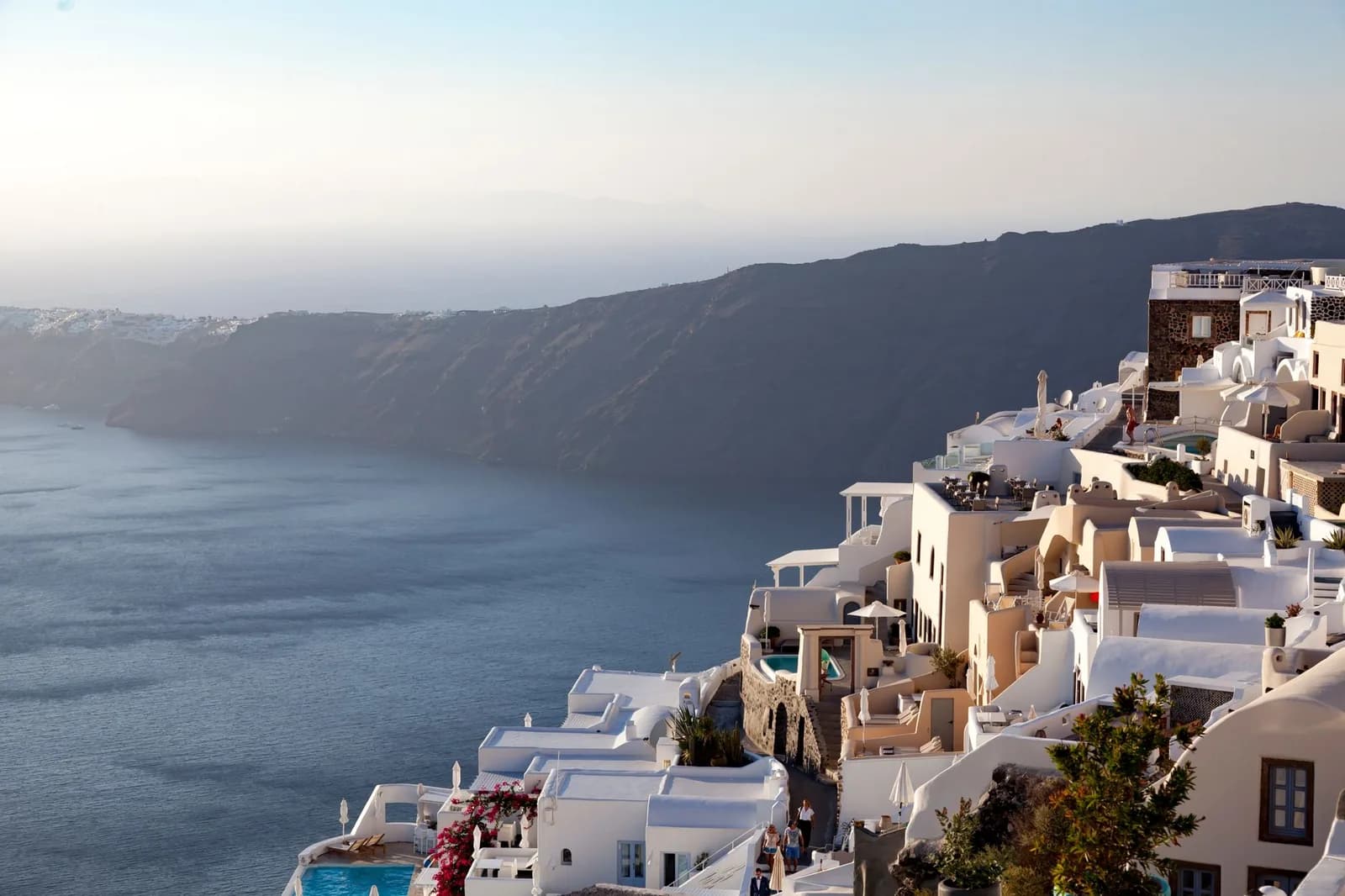
Santorini hotels: you are buying a position, not a room
Two rooms of the same size, ten minutes apart, at wildly different prices. Nothing is broken. On this island the bill follows the caldera view and very little else.
Open two tabs of Santorini hotels and the numbers stop making sense. A plain double with a small bathroom sits several times above a larger room with a balcony, a bigger pool and somewhere to park, on the same island, in the same week. The hotel has almost nothing to do with it. What costs money on Santorini is the ground the terrace stands on. The island is the surviving rim of a collapsed volcano, and roughly four kilometres of that rim can see straight down into the crater. That strip is where the expensive hotels are, and there is no more of it to build.
The price follows the view, and barely anything else
Star ratings mean less here than on any other Greek island. What moves a Santorini rate is a short list: does the terrace face the caldera, is that view blocked by the roof of the hotel below, and is there private water on the terrace. Change one of those and the price moves by a multiple, not by a margin. Leave the rim entirely and it collapses.
Which is why the honest way to shop for a room on this island is backwards. Choose the village first, then the hotel, because the village sets the budget and almost everything else follows from it. The block below is the quickest way through that decision. Our map of Santorini shows the same places laid out against the crater if you want to see why the geography behaves like this.
Start from the priority
What do you want first?
You came for the terrace and the sunset, and you accept that the view is the whole bill.
Imerovigli
Highest point of the rim, between Firostefani and Oia
The widest view on the island, straight down the caldera with Skaros rock in the foreground and Oia along the far edge. Quieter than Oia, and a shade less expensive for the same class of room.
Oia
Northern tip of the crescent
The postcard, and priced accordingly. Every terrace faces the sunset and every path fills with people who came to photograph it, then empties around ten.
The four villages on the rim, north to south
They run in a line along the cliff and they are less alike than the photographs suggest, though all four sell the same view. Oia sits at the northern tip and is the most expensive address in the Cyclades. It is the smallest of the four, a few hundred metres of pedestrian lane above cave houses cut into the pumice, with names like Katikies and Canaves Oia occupying the best of the edge. Every afternoon several thousand people arrive to watch the sun go down from the castle ruin, and every evening around ten the village is quiet again.
Imerovigli is the high point of the rim and has the widest view on the island, out over Skaros rock and up the whole curve of the caldera to Oia. It is residential, has few shops, and the hotels there, Grace Santorini and Astra Suites among them, sell the same product as Oia for a little less noise and usually a little less money. Firostefani, ten minutes further south on the cliff path, is quieter still and cheaper again for the same view, which makes it the most underrated address on the rim.
Fira is the capital and the working end of the rim. Every bus on Santorini starts or finishes at its station, the cable car drops to the old port, and the shops and restaurants stay open when the smaller villages have shut. It is also where the nightlife is concentrated, in a few streets that are loud until late. A caldera room in Fira usually costs less than the same room in Oia and gets you a functioning town in exchange for the postcard.
Seven addresses on the caldera, from the two that define Oia to the ones in Fira and Firostefani that ask half the money for the same horizon.
 Luxury
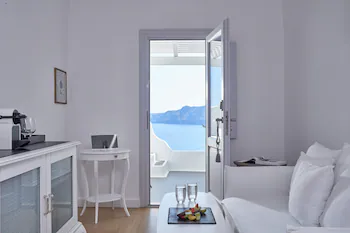
Katikies Santorini
OiaFrom
$547
The hotel most people picture when they picture Santorini: white terraces stepping down the cliff at Oia, with the infinity pool that got copied everywhere else.
- Caldera terraces
- Infinity pool
- Adults oriented
Nightly rate from the Hotels.com catalogue
See availability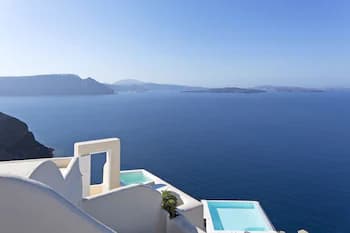 Luxury
Canaves Oia Suites
OiaFrom
$484
The other Oia name, carved into the rock at the edge of the village, with the sunset crowd ten minutes away on foot and not underneath your terrace.
- Cave suites
- Private pools
- In the village
Nightly rate from the Hotels.com catalogue
See availability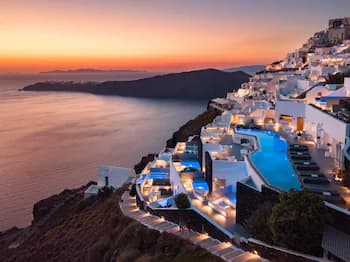 Luxury
Grace Hotel Santorini
ImerovigliFrom
$798
The most expensive bed on the island and arguably the best view on it, on the high point of the rim at Imerovigli. You pay for the angle, not the square metres.
- Highest point of the rim
- Infinity pool
- Adults only
Nightly rate from the Hotels.com catalogue
See availability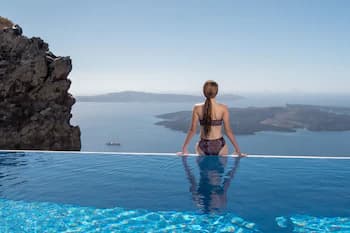 Luxury
Pegasus Suites & Spa
ImerovigliFrom
$258
The same caldera from the same village for a third of the Grace, which is the argument for Imerovigli in one line.
- Caldera view
- Spa
- Imerovigli
Nightly rate from the Hotels.com catalogue
See availability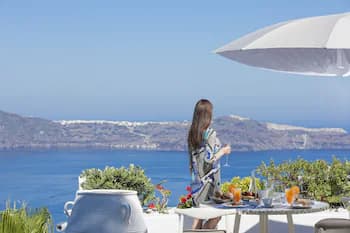 Mid-range
Mill Houses Elegant Suites
FirostefaniFrom
$173
Firostefani is the ten-minute walk from Fira that costs noticeably less, and this is the pick there: suites on the rim with the whole caldera in front.
- Caldera view
- Walk to Fira
- Suites
Nightly rate from the Hotels.com catalogue
See availability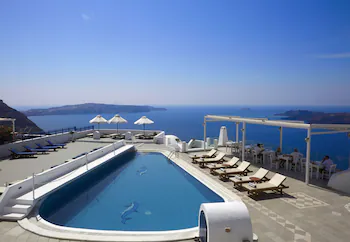 Luxury
Volcano View Hotel Santorini
Above FiraFrom
$272
A large hotel on the rim above Fira with several pools, which is a rarity here: most caldera hotels are ten rooms and one plunge pool.
- Several pools
- Caldera view
- Larger hotel
Nightly rate from the Hotels.com catalogue
See availability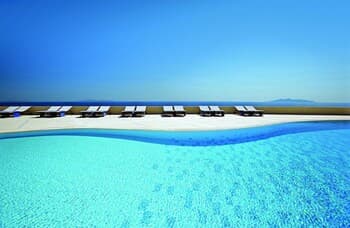 Luxury
The Majestic Hotel
FiraFrom
$189
In Fira itself rather than on the cliff edge, so no caldera from the room and a pool, a car park and a price that reflects both. The sensible base for a first visit.
- In Fira
- Pool
- No caldera view
Nightly rate from the Hotels.com catalogue
See availability
The staircase nobody mentions at booking
This is the part that ruins arrivals, and it is almost never stated on the booking page. The rim villages are built down the face of a cliff, so the road runs along the top and the rooms hang below it. In Oia and in much of Imerovigli that means your hotel has no vehicle access at all: the taxi stops at a car park or a bus turn and the rest is on foot, down steps, in the open. Some hotels are a dozen steps below the lane. Others are two hundred or more.
Nothing about that is a scandal, and the view exists precisely because of it. The problem is arriving at three in the afternoon in August with two suitcases and discovering it. Good hotels on the cliff send a porter to meet you and carry the bags down, and the better ones say so in the confirmation email. If it is not mentioned, write and ask two questions before you pay: how far is the nearest point a car can reach, and how many steps from there. Anyone with a knee problem, a pushchair or a heavy case should read the answer as a deal breaker rather than a detail.
The same logic applies to leaving. Athinios, the ferry port, is a concrete shelf at the bottom of the cliff reached by switchbacks, and transfers out of Oia need to leave far earlier than the distance suggests. If you are arriving by sea, the boat you take from Athens lands you there rather than anywhere convenient, so arrange the pickup before you sail.
Plenty of people reach the island from another one rather than from Piraeus, and the two routes behave very differently on arrival time. The boat up from Heraklion is a long open-sea crossing that gets cancelled when the wind sits in the north, so it is the one to put at the start of a stay rather than the end. The shorter hop down from Mykonos runs several times a day in season and often puts you at Athinios in the middle of the afternoon, which is the worst hour for the switchback road. Either way, tell the hotel which boat you are on before you sail.
Flying changes the arithmetic entirely, because the runway is on the flat eastern side of the island rather than under the cliff. From the terminal you are ten minutes from Kamari, about twenty from Fira and a good forty from Oia in August traffic, and what to expect on the ground when you land is worth reading if you have a rim hotel and an evening arrival.
Every base on the island, side by side
Prices here are ranks, not figures, because a room on Santorini can triple between May and August and any number would be wrong by the time you read it. The order, though, holds all season.
| Village | Position | What you find there | Price rank | Car to the door | Next base along |
|---|---|---|---|---|---|
| Oia | Northern tip of the rim | Cave suites, plunge pools, the sunset crowd | Highest | No, village is pedestrian | Imerovigli, 2 h on the rim path |
| Imerovigli | Highest point of the rim | Wide caldera views, Skaros rock, few shops | High | Rarely, steps down from the road | Firostefani, 20 min on foot |
| Firostefani | On the rim, north of Fira | Same cliff as Fira, none of the noise | Upper mid | Often, some hotels by steps | Fira, 15 min on foot |
| Fira | Middle of the rim, island capital | Bus station, shops, bars, cable car | Mid to high | Yes, except the cliff edge | Firostefani, 15 min on foot |
| Pyrgos | Inland hill, centre of the island | Castle village, views both ways, tavernas | Mid | Yes, up to the old village gate | Fira, 15 min by car |
| Megalochori | Inland, on the Akrotiri road | Wine estates, vaulted houses, quiet squares | Mid | Yes | Fira, 15 min by car |
| Kamari | East coast, under Mesa Vouno | Black sand, promenade, family hotels | Lower | Yes | Perissa, 20 min by car around the rock |
| Perissa | South-east coast, behind Mesa Vouno | Long black beach, budget rooms, bars | Lowest | Yes | Perivolos, 15 min on foot along the sand |
| Perivolos | Continuation of the Perissa beach | Beach clubs, calm water, low-rise hotels | Lower | Yes | Fira, 20 min by car |
The east coast, where the same hotel costs a fraction
Cross to the far side of the island, fifteen minutes by car, and the market changes entirely. Kamari, Perissa and Perivolos sit on the gentle outer flank of the volcano, where the land actually reaches the sea and the beaches are long strips of black sand and dark pebble. The same category of hotel here costs a fraction of what it costs on the rim, and it usually comes with a larger room, a proper pool and a car park. What it does not come with is the caldera.
The three run together but are not interchangeable. Kamari is the most organised, with a paved promenade of tavernas behind the beach and the airport a few minutes away, which also means aircraft overhead. Perissa, on the other side of the Mesa Vouno headland, is cheaper and younger in feel. Perivolos is the southern continuation of the same beach and the most comfortable of the three, with beach clubs and the calmest water. All of them need a bus or a car in the evening if you want the sunset, and the last bus back from Fira leaves earlier than people expect.
Four on the black sand, where the same standard of room costs a fraction of the rim and the sea is something you swim in rather than look at.
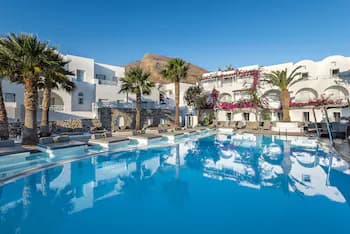 Luxury
Santorini Kastelli Resort
KamariFrom
$162
Five minutes from Kamari beach with a proper pool and grounds, at a third of what the rim charges. The straightforward family answer.
- Near Kamari beach
- Pool and grounds
- Family
Nightly rate from the Hotels.com catalogue
See availability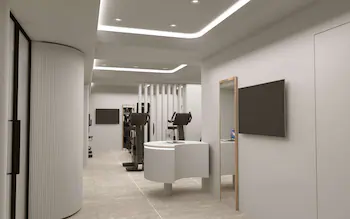 Luxury
Radisson Blu Zaffron Resort
KamariFrom
$241
The newest big hotel on this coast, a five-minute walk from the beach, for people who want a known standard rather than a cave suite.
- Walk to the beach
- Large pool
- Recent build
Nightly rate from the Hotels.com catalogue
See availability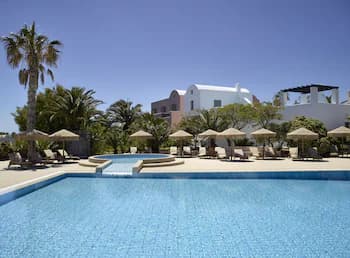 Luxury
9 Muses Santorini Resort
PerivolosFrom
$119
A minute from the sand at Perivolos, the long black beach south of Perissa, and the best value on this list by a distance.
- On Perivolos beach
- Pool
- Value
Nightly rate from the Hotels.com catalogue
See availability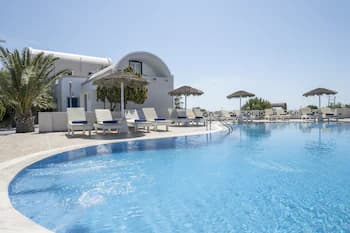 Mid-range
Bella Santorini
PerivolosFrom
$124
By the sea at Agios Georgios, at the quiet end of the same beach, where the beach bars thin out and the prices follow.
- By the sea
- Quiet end
- Value
Nightly rate from the Hotels.com catalogue
See availability
Pyrgos and Megalochori, the compromise nobody mentions
Between the cliff and the beach there is a middle of the island that almost no hotel guide bothers with, and it is where a lot of returning visitors end up. Pyrgos is the highest village on Santorini, a spiral of white houses wound around a Venetian castle, with a view over the vineyards to both coasts and down to the caldera in the distance. It has real tavernas at village prices, no coach traffic, and a car can reach almost every door.
Megalochori, on the road down towards Akrotiri, is flatter and quieter again: vaulted captains' houses, a small square with bell towers, and the island's wine estates within walking distance. Vedema, one of the older luxury properties on Santorini, is built into an old winery there and never gets mentioned in caldera roundups because it has no caldera view. Both villages sit ten to fifteen minutes from Fira and about the same from the beaches, which is the whole argument for them. You give up the terrace and you get the island back.
Four in the villages in the middle, where you get the island the rim does not show you, and a car park.
 Luxury
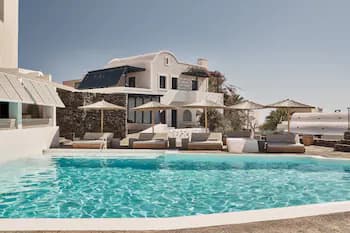
Vedema, a Luxury Collection Resort
MegalochoriFrom
$297
A fifteenth-century winery turned resort in Megalochori, with no caldera view and a level of service the rim rarely matches. The counter-argument to the whole caldera premium.
- Old winery
- No caldera view
- Full resort
Nightly rate from the Hotels.com catalogue
See availability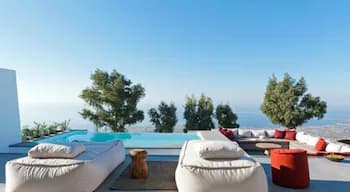 Luxury
Santorini Heights
PyrgosFrom
$458
In the historical quarter of Pyrgos, the hill village with the island's best inland view, fifteen minutes from both coasts.
- Historic quarter
- Hill village
- Between the coasts
Nightly rate from the Hotels.com catalogue
See availability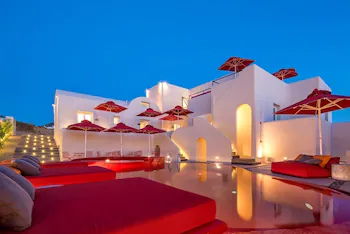 Luxury
Art Hotel Santorini
PyrgosFrom
$167
Cave houses in Pyrgos three minutes from Santo Wines, which is where people drive for the sunset when Oia is full.
- Cave houses
- Near Santo Wines
- Quiet
Nightly rate from the Hotels.com catalogue
See availability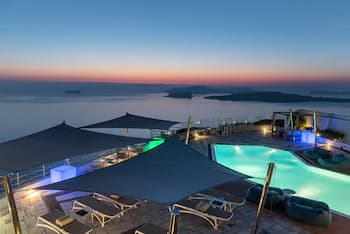 Mid-range
Caldera's Dolphin Suites
MegalochoriFrom
$149
Suites on the edge of Megalochori with a pool, at the price the east coast charges and with the villages on your doorstep.
- Pool
- In a village
- Parking
Nightly rate from the Hotels.com catalogue
See availability
Scores, review counts and photos are Booking.com data checked in September 2026, and the buttons open the property on Hotels.com. Rates move with the dates, so check them there.
The private infinity pool is the actual product
There are no beaches on the caldera side. The water is a few hundred metres below the terrace and reachable only by cable car, by donkey or by the steps down to the old port, so a rim hotel that wants you to swim has to put the water on the cliff itself. That is why the plunge pool cut into a terrace has become the thing this island actually sells, and why the upgrade from a room with a view to a room with a pool costs what it does.
What you are paying for
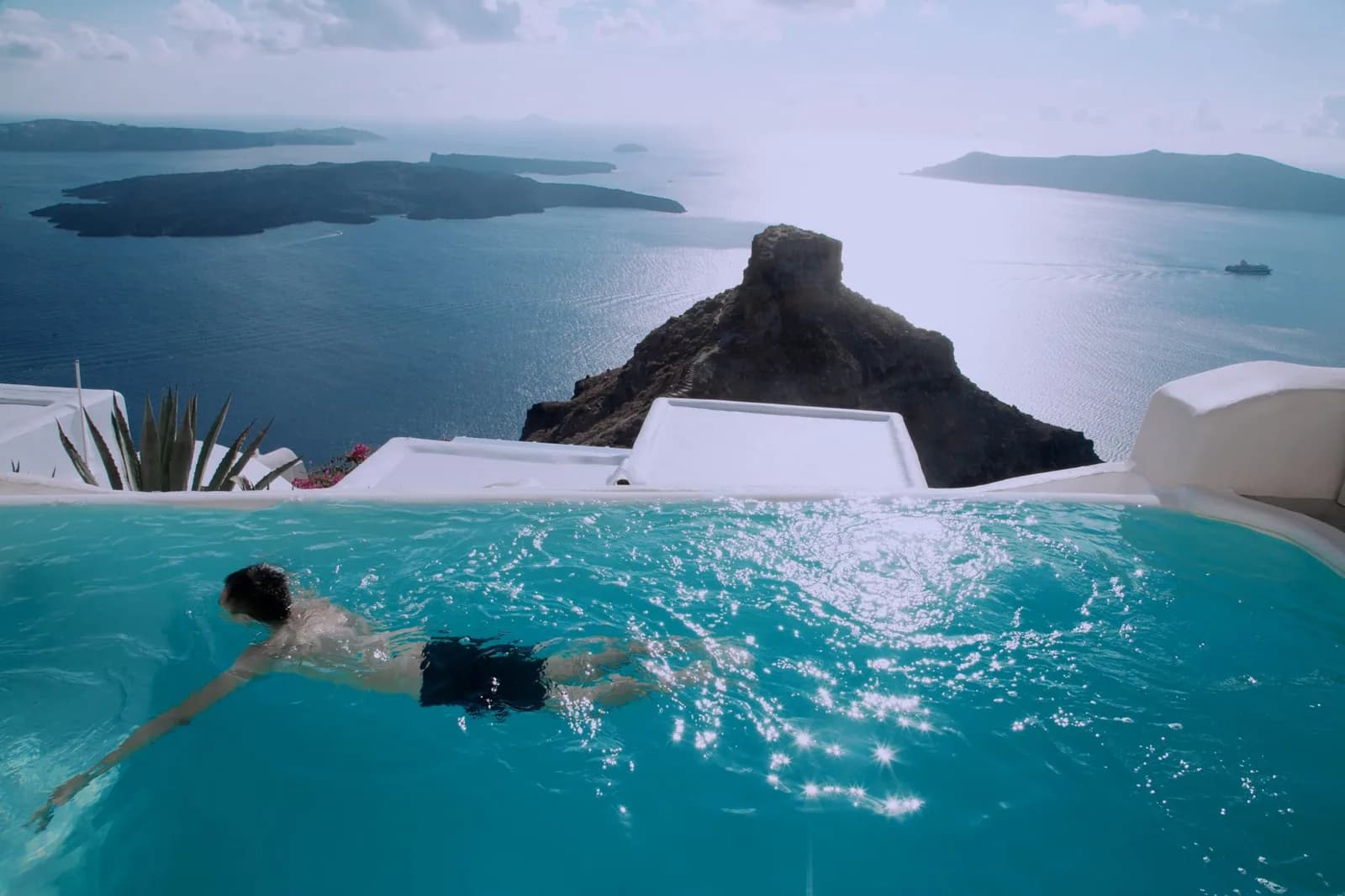
Read those listings sceptically. The word pool covers a heated tub for two as easily as something you can take three strokes in, and the photograph is always shot from the one corner of the terrace where no roof intrudes. Guest photographs in the reviews are more honest than the hotel gallery. Ask whether the pool is shared with the suite next door and whether it is heated, because the caldera is windy and the water is cold outside high summer.
When you book matters more than where you book
Santorini has a small number of rooms on the rim and no way to add more, since you cannot build outwards on a cliff. Demand for those rooms is concentrated into July and August and into a honeymoon market that books far ahead, so the good caldera suites for high summer go months in advance, often to people who stayed before. The east coast has far more capacity and holds availability much later.
Moving your dates to late May, early June or the second half of September changes the bill more than moving village does, and the island in those weeks is warm and walkable instead of gridlocked. Late October is cheaper again, though hotels on the rim start closing and the sea has gone cold. If you are set on a caldera room in August, book it first and build the trip around it, because it is the only part of a Santorini holiday that genuinely sells out.
Questions people ask about Santorini hotels
What is the best place to stay in Santorini?
It depends on what you refuse to give up. For the view, the rim villages of Oia, Imerovigli, Firostefani and Fira, in roughly that order of price. For a beach you can walk to before breakfast, the east coast at Kamari, Perissa or Perivolos, where the same class of hotel costs a fraction of the rim. For quiet and a shorter bill without giving up character, the inland villages of Pyrgos and Megalochori. For a first visit with only two or three nights, Fira is the safest answer, because it has the view, the bus station and somewhere open to eat after ten. There is no village that does all of it.
What is the nicest part of Santorini to stay in?
If nicest means the most beautiful place to wake up, Imerovigli, because it stands at the highest point of the rim and looks across Skaros rock and the whole curve of the caldera to Oia. Oia is the more famous version of the same thing and fills with several thousand day visitors every afternoon, which Imerovigli does not. If nicest means the pleasantest village to live in for a week, the answer is Pyrgos: a spiral of white houses around a Venetian castle, tavernas at village prices, no coach traffic, and a car that can reach almost every door.
Where to avoid staying in Santorini?
Three places catch people out. Any cliff hotel in Oia or Imerovigli that you have not checked for stair access, because the road stops at the top and the rooms hang below it, and reaching your door can mean well over two hundred steps in the open with your luggage. The streets immediately above the bars in central Fira, which are loud until very late. And an isolated hotel out towards Akrotiri or Vlychada with no car booked, since the buses are built around Fira and a taxi at eleven at night on this island is a rumour rather than a plan. Also read the words caldera side carefully: a room can be on the rim and still look sideways at the hotel below it.
Do Santorini hotels have private pools?
Most of the hotels on the caldera rim now offer at least a few suites with a private plunge pool cut into the terrace, and on this island it has become the standard upgrade rather than an unusual one. There is a reason for that: there are no beaches on the caldera side, the sea is a couple of hundred metres below the terrace, so a rim hotel that wants you to swim has to put the water on the cliff itself. Read the listings sceptically. The word pool covers a heated tub for two as easily as something you can take three strokes in, the photograph is always shot from the one corner where no roof intrudes, and some pools are shared with the suite next door.
Is it better to stay in Oia or Fira?
Oia if the trip is about the setting and you do not mind that everything costs more and the village fills with day visitors each afternoon. Fira if you want to be able to do things: it is the island's capital, every bus route starts there, the shops and restaurants stay open, and the cable car runs down to the old port. Fira is also noisier, so book on the caldera side of the pedestrian street and not above the bars. A caldera room in Fira usually costs less than the same room in Oia and gets you a functioning town in exchange for the postcard.
Why are hotel prices on Santorini so high?
Because of what the building is standing on. The island is the surviving rim of a collapsed volcano, and only about four kilometres of that rim can see straight down into the crater. Every hotel on that strip is cut into a cliff, so each room is a small construction project, and there is almost no rim left to build on. You are paying for the terrace and the view rather than for the bed, which is why the price falls hard the moment you turn the same room inland or move to the east coast. Your dates move the bill as much as your village does: late May, early June and the second half of September are a different market from the first fortnight of August.
We do the same arithmetic for every island in what a room actually costs elsewhere.
