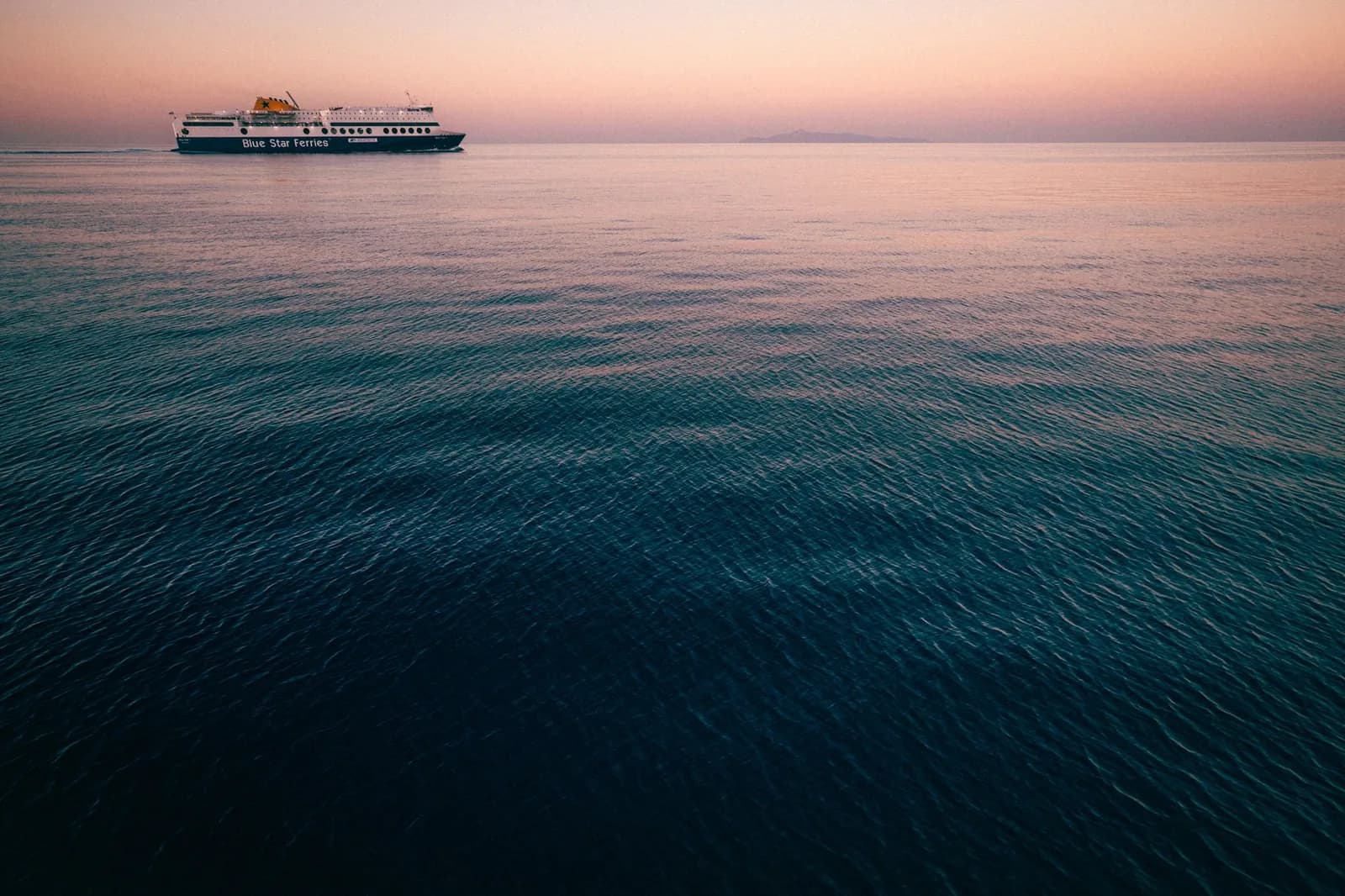
Blue Star Ferries: routes, cabins, fares and the SeaJets question
The big blue-and-white ships out of Piraeus are the slow option, the cheap option and, when the wind gets up, often the only one still sailing. Here is where they go and when they are the right boat.
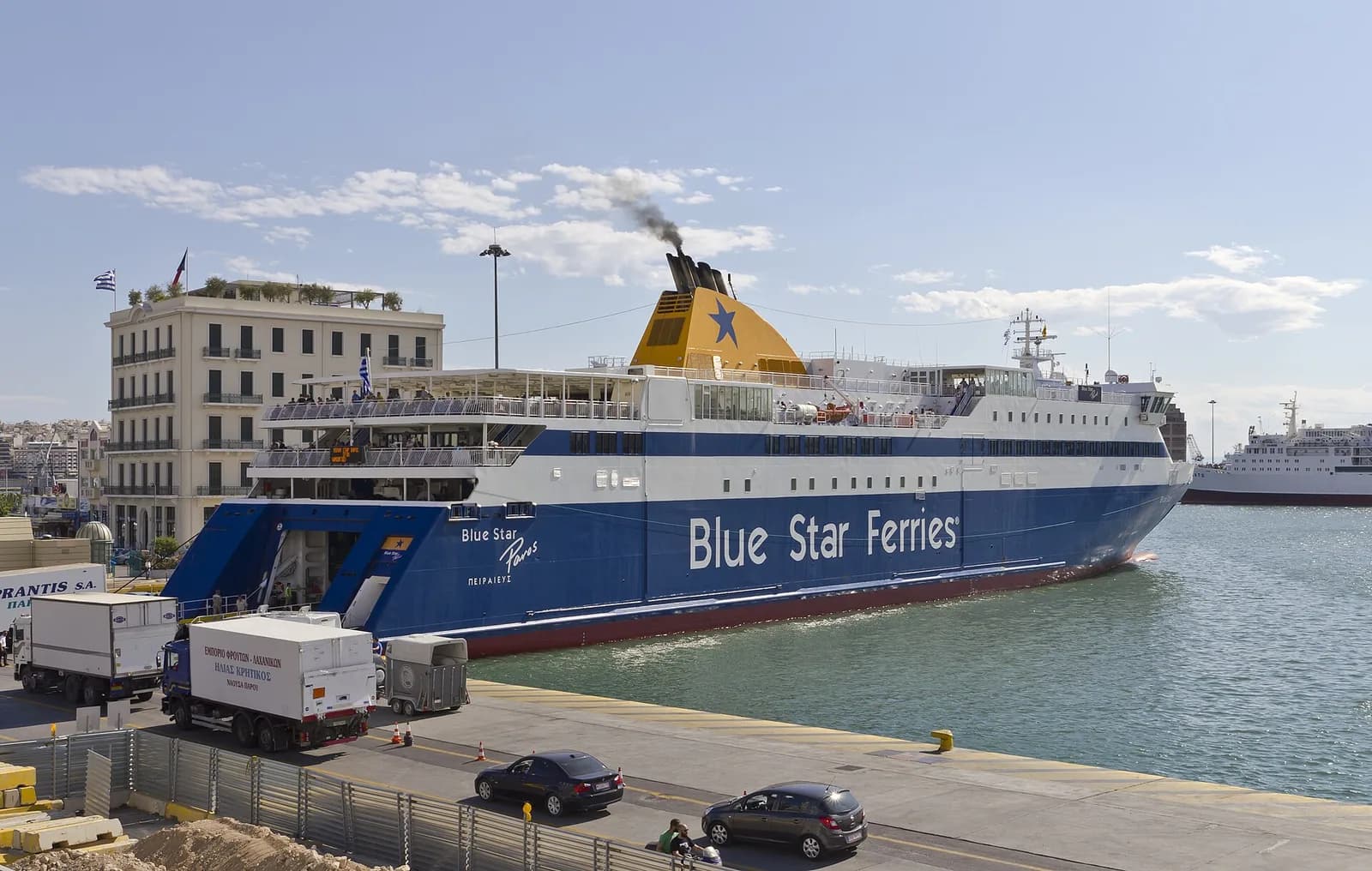
Blue Star Ferries is one of the main conventional ferry operators in the Aegean, with about nine big car ferries sailing out of Piraeus to the Cyclades, Crete, the Dodecanese and the North Aegean. It belongs to Attica Group, alongside Superfast and Hellenic Seaways. Its ships are slower than the SeaJets catamarans, cheaper, much steadier in a strong wind, and the only ones of the two with cabins for the overnight routes. For a broader look at every company and port, start with our guide to Greek ferries.
Blue Star Ferries routes from Piraeus
Almost everything Blue Star runs starts at Piraeus, the main port of Athens, 40 minutes from the centre on metro line 1. The Cyclades lines are daytime sailings that stop at several islands in turn, so the same ship serves Paros, Naxos, Ios and Santorini in a single run. The routes to Crete, Rhodes and the North Aegean are night crossings, and those are the ones that set Blue Star apart: no fast boat covers them.
| From Piraeus to | Crossing | Sails | Worth knowing |
|---|---|---|---|
| Paros | About 4 h | Day, twice daily in summer | First stop on the main Cyclades line |
| Naxos | About 5 h to 5 h 30 | Day, twice daily in summer | Usually via Paros |
| Santorini | About 7 h 45 to 8 h | Day, most days of the week | Calls at Paros, Naxos and Ios on the way |
| Syros, Tinos, Mykonos | About 5 h to Mykonos | Day | The northern Cyclades line |
| Crete (Heraklion, Chania) | About 8 h 45 | Overnight, all year | Run inside the Attica group with its sister brands |
| Rhodes and Kos | About 18 h to Rhodes | Overnight, all year | Calls at Patmos, Leros and Kos on the way |
| Chios and Lesvos | Overnight | Overnight, all year | The North Aegean line |
Two things to read before you trust a timetable. First, the times above are typical rather than fixed: a sailing that calls at four islands takes longer than one that calls at two, so check the duration on your own departure. Second, Blue Star moves its ships around from one season to the next, and the summer timetable is often loaded only in spring. The Crete and Dodecanese routes run all year; the Cyclades lines thin out sharply from November to March. Lesser islands such as Anafi, Kasos or Donoussa are also on the network, but on longer multi-stop lines that sail a few times a week.
Blue Star Ferries vs SeaJets: which one to book
Most people searching for Blue Star are really asking this. The two companies sell opposite products on the same water. Blue Star runs big ro-pax ships: you walk around, sit on an open deck, eat in a cafeteria, and arrive a few hours later than you would have on a catamaran. SeaJets runs high-speed catamarans: you sit in an assigned seat in an enclosed saloon and get there in roughly half the time, for roughly twice the money.
| Blue Star Ferries | SeaJets | |
|---|---|---|
| The boat | Large conventional ro-pax ship, open decks, car garage | High-speed catamaran, enclosed aircraft-style saloon |
| Piraeus to Naxos | About 5 h to 5 h 30 | About 3 h to 3 h 30 |
| Piraeus to Santorini | About 8 h | About 5 h |
| Fare | The cheaper of the two, often by close to half | Roughly double for the same route and date |
| In a meltemi | Usually sails, with a steadier ride | First to be held in port, rough when it does sail |
| Cars | Carried on every sailing | On some vessels only, limited space |
| Overnight routes and cabins | Yes: Crete, Rhodes, Chios and Lesvos | No, daytime island hopping only |
| Pick it if | You get seasick, carry a car, fly home soon after, or sail at night | Time is short, the forecast is calm and the budget allows |
The row that matters most is the weather one. Through July and August the meltemi, a dry north wind, blows hard across the Cyclades, sometimes for days. The port authority keeps light high-speed craft in harbour well before it stops the large ferries, and when the catamarans do sail in a swell, the ride is rough enough that a good share of the cabin spends it with a paper bag. A Blue Star ship rolls too, but far less, and it usually leaves on time when the fast boats have been cancelled.
None of this makes SeaJets the wrong choice. On a calm day, with a short trip and a tight plan, saving three hours between Piraeus and Santorini is worth paying for, and the fast boats run island-to-island links that Blue Star does not. But if you get seasick, have a car, are travelling with small children, or need to be back in Athens for a flight, the slower boat is the safer one. On the long run to Santorini in particular, that trade is worth thinking through before you book.
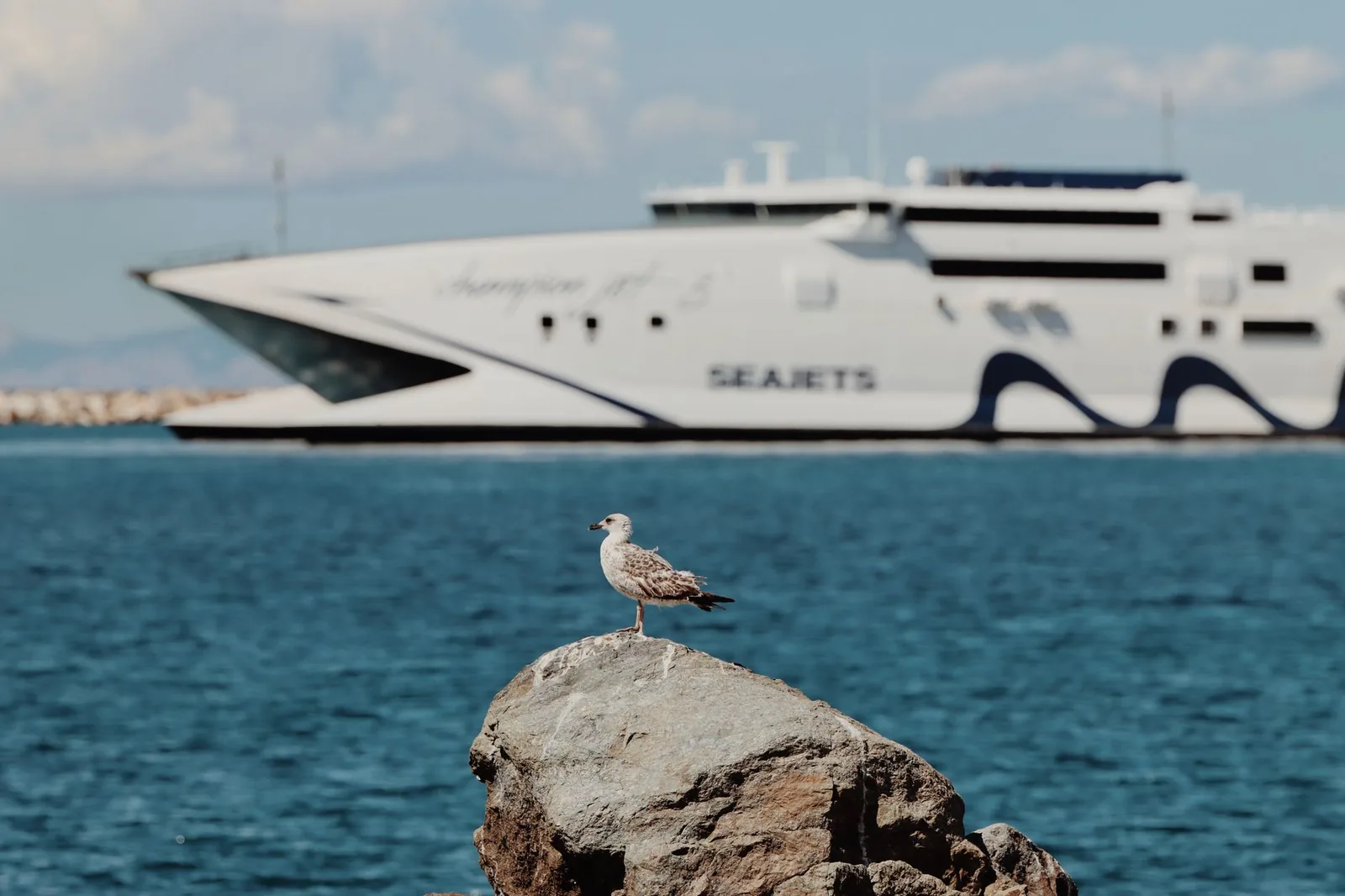
On board a Blue Star ferry: deck, seat or cabin
Every Blue Star ticket is sold in one of three broad classes, and the choice matters more than the price difference suggests.
Deck and economy tickets
The cheapest ticket, sold as economy or deck class, gets you on the ship and nowhere in particular. You can sit in the indoor lounges, the cafeteria or out on the open decks, but nothing is reserved. On a daytime Cyclades crossing outside August, that is fine and most people spend the trip outside anyway. On a full summer sailing, the indoor seats go within minutes of boarding.
Air-type seats
An air-type seat is a numbered, reclining armchair in a dedicated saloon, like an aircraft cabin with more legroom. It is the right ticket for a long day crossing in peak season, when you want to be sure of a seat indoors. It is not a bed: on an overnight route it is a long night upright.
Cabins
Cabins are sold by the berth or for the whole room, with or without a window, and usually with a private bathroom. They exist on the Cyclades ships too, where some travellers book one just to rest on the eight hours to Santorini, but they are really built for the night routes.
Blue Star Ferries cabins on the overnight routes
On the overnight sailings to Crete, Rhodes, Chios and Lesvos, book the cabin first and worry about the price second. A crossing of eight hours to Heraklion or nearly eighteen to Rhodes on a deck ticket means a night on a lounge bench under the lights. Four people sharing a four-berth cabin pay something close to a hostel bed each, and they save a hotel night at the same time.
Cabins come as inside (no window) and outside (with a porthole or window), with two to four berths. If you are travelling alone you can book a single berth in a shared cabin instead of the whole room. They are also the first thing to sell out: Greek families book cabins on the August crossings months in advance, well before the deck tickets go. If the crossing to Crete is on your list, our page on the overnight ferry to Crete covers which of the two ports to land at.
Blue Star Ferries fares and discounts in 2026
Greek ferry fares change with the season, the route and how early you buy, so any single price printed on a guide page is already out of date. What holds is the order of magnitude: on the Cyclades routes a Blue Star deck ticket costs roughly half the SeaJets fare for the same trip, a cabin costs a good deal more than a seat, and a car costs about as much again as a passenger. For a US budget, think tens of dollars for a deck ticket to the nearer Cyclades, and well over a hundred for a cabin to Crete.
The discounts that are worth knowing about, as listed on Blue Star's site in October 2026:
- Super Economy fares from €20 per person on the Cyclades, Dodecanese, North Aegean and Crete routes, in limited numbers and mostly on less busy sailings.
- Seasmiles, the free loyalty programme of Attica Group, open to adults. Members were offered 10 % off passenger fares and 20 % off vehicles, and points add up across Blue Star, Superfast and Hellenic Seaways.
- Children under five travel free, but they still need a free ticket issued at the same time as an adult's. With their own seat or berth, they pay half.
- Return discounts on cars and some economy fares appear as seasonal offers, so check the offers page before buying a one-way ticket twice.
Discounts for students, large families and passengers with disabilities also exist, but the percentages depend on the route and the documents you can show, so ask at booking.
Booking Blue Star Ferries: direct or through Ferryhopper
You can buy a Blue Star ticket on bluestarferries.com, in its app, at a port agency, or through an aggregator such as Ferryhopper. They all sell the same seat on the same ship. What differs is the price you see, how you handle a change, and how easily you can compare.
Booking direct is sometimes cheaper. Super Economy fares and Seasmiles discounts are Blue Star's own and do not always show up elsewhere, and if a sailing is cancelled or you want to change your date, you deal with the company that runs the ship rather than with an intermediary. Blue Star's support line is +30 210 8919800, from 8 am to 10 pm Greek time.
An aggregator is more useful when Blue Star is not the only option. On Piraeus to Naxos, for example, three or four companies sail on the same day, and their own websites ignore each other. A comparison site shows them side by side and books several legs of an island hop in one go.
Blue Star Ferries cancellation and refund rules
These are Blue Star's own 2026 conditions. A reseller may add its own fees on top, so read its terms too. High season runs from 3 to 19 April and from 28 May to 13 September 2026.
| High season 2026 | Cyclades, Dodecanese, North Aegean | Piraeus to Heraklion or Chania |
|---|---|---|
| 14 days or more before | Free cancellation | Free cancellation |
| 7 to 14 days before | 75 % refunded | 75 % refunded |
| Under 7 days | 50 % refunded, up to 12 h before | 50 % refunded, up to 3 h before |
| Until departure | 50 % refunded, no change of date | 50 % refunded, no change of date |
| After departure | Nothing back | Nothing back |
Outside those dates the rules are much looser: on the island routes you can cancel free of charge up to three days before departure, and on the Crete routes up to one hour before. The Saronic routes have their own, shorter grid. Tickets bought online or in the app are cancelled through the Help Center on Blue Star's site.
Blue Star Ferries check-in and e-tickets
Web check-in opens 48 hours before departure and closes two hours before. Once done, the e-ticket arrives by email and in the app, and you board by showing it on your phone with your passport or ID card. There is no need to collect a paper ticket at the port, which was not always the case with Greek ferries and still is not with some companies.
Blue Star's conditions ask you to be at the embarkation area at least one hour before departure, whether you are on foot or driving. At Piraeus, take that as the bare minimum. The port stretches over several kilometres, the gates for the Cyclades, Crete and Dodecanese are far apart, and in summer the car queue starts long before boarding. Blue Star publishes a port map of Piraeus showing which gate each line sails from. Our page on the Athens to Paros crossing shows how much margin to leave between the metro and the gate.
Blue Star Ferries luggage allowance
Luggage travels free up to 50 kg or one cubic metre per passenger, which is far more than any airline allows and more than anyone actually carries. On the Cyclades ships, large cases go in luggage racks near the entrance or on the car deck, and you leave them there for the crossing: pack what you need for the trip in a small bag.
On a multi-stop route, half the ship heads for the luggage racks twenty minutes before Paros or Naxos. Get there early. Valuables can be handed to the chief purser for safekeeping during the crossing.
Travelling with pets on Blue Star Ferries
Blue Star is one of the more pet-friendly operators. The animal travels free, but you must declare it when you book, with its health booklet or pet passport and microchip number, and say whether it weighs more or less than 10 kg. Each passenger can bring up to five animals.
- Pet cabins take up to two animals and are booked in advance. They are the only cabins where a pet may stay.
- Kennels are available on board, also by reservation.
- Outside decks are allowed, with the dog on a lead and muzzled.
- Not allowed: ordinary cabins, indoor lounges, bars and restaurants.
The exception is the company's high-speed vessels, which only accept animals up to 10 kg, in a carrier. Pet cabins are few, so book them as soon as your dates are fixed, especially on the overnight routes.
Taking a car on Blue Star Ferries
Every Blue Star ship has a garage deck, so a car, campervan or motorbike is routine rather than a special request. Book the vehicle with the ticket, because in August the car decks fill well before the passenger places. Two rules people miss: electric and hybrid cars must be declared and board with no more than 40 % battery charge, and LPG vehicles with their tank no more than half full.
If the car is a rental, check the contract before booking: most Greek hire companies do not allow their vehicles off the mainland or off the island they were rented on. Dropping the car in Athens and renting another on arrival is often simpler, and arriving in Naxos or Paros, there are hire desks within walking distance of the ramp.
The Blue Star Ferries fleet
Blue Star runs about nine conventional passenger ferries, all under the Greek flag. Sources differ slightly on the exact count because Attica Group is renewing its fleet and moving ships between its brands in 2026. The ships you are most likely to board:
- Blue Star Delos, Blue Star Naxos, Blue Star Paros and Blue Star Patmos, the workhorses of the Cyclades lines. Delos and Patmos are the newest of the fleet, delivered in the early 2010s.
- Blue Star 1 and Blue Star 2, the two larger ships from 2000, mostly on the long routes to the Dodecanese and the North Aegean.
- Blue Star Chios, Blue Star Myconos and Diagoras, which cover much of the longer multi-stop lines, including the Dodecanese and the smaller islands.
The ship assigned to a route changes from season to season, and the name is printed on your ticket. To see where a ship is right now, search its name on a live vessel tracker such as MarineTraffic.
Questions people ask about Blue Star Ferries
Are Blue Star Ferries in Greece good?
For what they are, yes. They are large, slow, well-kept conventional ships that run to a timetable you can mostly rely on, carry cars, and keep sailing in winds that keep the fast catamarans in port. They are not quick and they are not glamorous: on a summer day the decks are full, the cafeteria queue is long and the crossing to Santorini takes most of a day. If you judge them as a reliable, cheap way across the Aegean, they are the operator most Greeks and most repeat visitors default to.
Are SeaJets or Blue Star Ferries better?
They sell opposite things, so it depends on what you need. SeaJets is faster, often by close to half, and costs roughly twice as much. Blue Star is cheaper, steadier, carries cars on every sailing and is far less likely to be cancelled when the meltemi blows in July and August. Take Blue Star if you get seasick, travel with a car, fly home within a day of the crossing or sail overnight. Take SeaJets on a calm day when time is the constraint.
How long is the Blue Star ferry from Athens to Santorini?
About seven hours 45 minutes to eight hours from Piraeus, because the ship calls at Paros, Naxos and Ios on the way. A high-speed boat does it in around five. If eight hours sounds long, consider breaking the trip at Paros or Naxos rather than paying for speed.
Is it cheaper to book Blue Star Ferries direct?
Sometimes. Blue Star's own site runs promotional fares, Super Economy seats and Seasmiles member discounts that resellers do not always show, and changes or refunds are simpler when you deal with the operator. An aggregator like Ferryhopper is more useful when you are comparing Blue Star with the other companies on the same route, or booking several legs at once. Check both before paying.
How early should I arrive for a Blue Star ferry?
Blue Star's conditions require you to be at the embarkation area at least one hour before departure, on foot or with a car. At Piraeus in summer, aim for well before that: the port is large, the gates are far apart and the car queues are long. Web check-in opens 48 hours before departure and closes two hours before.
Can I bring my dog on Blue Star Ferries?
Yes. The animal travels free but must be declared when you book, with its health booklet or pet passport and microchip number. Dogs can stay on the outside decks on a lead and with a muzzle, in a kennel, or in one of the pet cabins, which take up to two animals and are booked in advance. They are not allowed in ordinary cabins, lounges, bars or restaurants. On Blue Star's high-speed vessels only animals up to 10 kg in a carrier are accepted.
Does the Blue Star Line still exist?
Two different companies share the name. Blue Star Line was a British cargo and passenger shipping line that disappeared as an independent company at the end of the 1990s. Blue Star Ferries is the Greek ferry operator, part of Attica Group, and it is very much in business, running the main routes from Piraeus to the Cyclades, the Dodecanese, the North Aegean and Crete.
Where is the Blue Star 1 ferry now?
Ship positions change every hour, so use a live vessel tracker such as MarineTraffic or VesselFinder and search for the ship's name. Blue Star 1 and Blue Star 2 are the two older, larger ships of the fleet and have mostly worked the long overnight routes to the Dodecanese and the North Aegean, but the company reassigns ships from season to season.
