Greek ferries: who runs them and where they leave from
Blue Star and SeaJets both sell you a ticket to Santorini and they are almost opposite products. Athens has three ferry ports, not one. And the boat that gets cancelled is never the one you expected.
Greek ferries look like one system from the outside and behave like several. A dozen companies share the Aegean, they do not sell each other's tickets, and two boats leaving for the same island an hour apart can differ by three hours and a lot of money. Start with who runs what.
The companies, side by side
Every name below is an operator, meaning it owns boats and crews them. The differences that decide your day are in the last three columns.
| Company | Boats | Vehicles | In a strong meltemi | Mainly runs |
|---|---|---|---|---|
| Blue Star Ferries | Large conventional ships | Yes | Sails | Piraeus to the Cyclades and the Dodecanese |
| SeaJets | High-speed catamarans and monohulls | On the big craft only | First to cancel | Piraeus and Rafina to the Cyclades, Crete to Santorini |
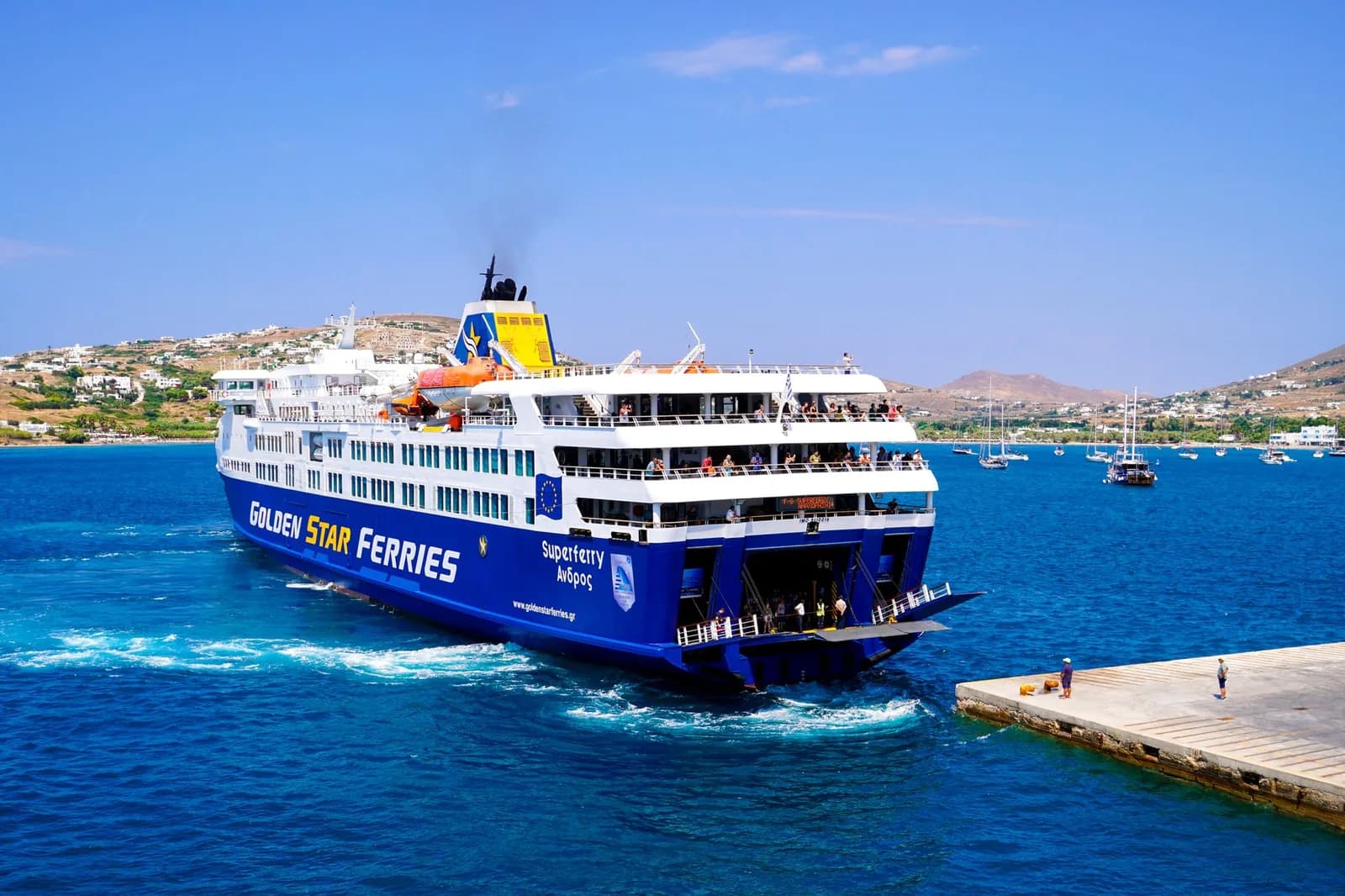
| Golden Star Ferries | Both, depending on the sailing | Yes | Depends on the boat | Rafina to Andros, Tinos, Mykonos and beyond |
| Fast Ferries | Conventional, despite the name | Yes | Sails | Rafina to Andros, Tinos and Mykonos |
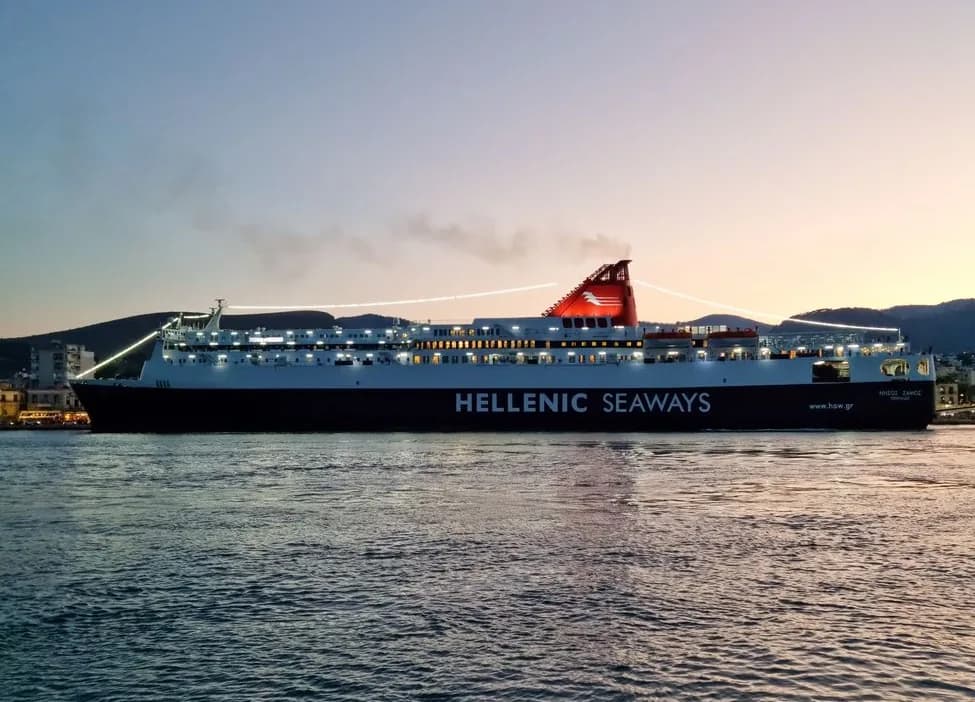
| Hellenic Seaways | Conventional ships and Highspeed craft | On the conventional ships | Depends on the boat | Cyclades, Sporades, Saronic Gulf, north Aegean |
| Aegean Speed Lines | High-speed | No | Cancels | Piraeus to Milos, Sifnos, Serifos and Kimolos |
| Minoan Lines | Overnight ships with cabins | Yes | Sails | Piraeus to Heraklion, and the Adriatic |
| ANEK and Superfast | Overnight ships with cabins | Yes | Sails | Piraeus to Chania, and the Adriatic |
Blue Star is the one most people should default to. The ships are large, they carry vehicles without ceremony, the deck fare is the cheapest way to cross the Aegean, and there is a real outdoor deck to stand on. The cost is time: figure on roughly double what a catamaran takes on the same water. On a night sailing to Crete or Rhodes that is an advantage rather than a penalty, because you sleep through it and arrive at breakfast. Routes, cabins, pets and refund rules are on our Blue Star Ferries page.
SeaJets sells the opposite trade. The high-speed craft cut the crossing close to half, which on a week's holiday is a genuine day recovered. In exchange you pay a good deal more, you sit in an aircraft-style cabin with the windows salted over, and on many of the boats there is nowhere outside to go. They also ride hard in a swell, and they are the first sailings pulled when the wind gets up. Anyone prone to seasickness feels the difference within twenty minutes.
The rest sit between the two. Golden Star and Hellenic Seaways run both kinds of boat, so the company name tells you nothing until you check which vessel is on your sailing. Fast Ferries, despite the name, runs conventional ships out of Rafina. Minoan, ANEK and Superfast are the overnight operators to Crete, with cabins worth booking rather than a reclining seat.
A conventional ship
Ferryhopper is not a ferry company
It gets searched more than any operator, which suggests a lot of people think they are booking a boat called Ferryhopper. They are not. It is an aggregator: it pulls the timetables of the Greek operators into one search and sells you their tickets, the way a flight comparison site sells seats on planes it does not own. Direct Ferries and a handful of others do the same job.
That is worth something on this market specifically. Four companies might serve your route, none of their websites acknowledges the other three, and only a combined timetable shows you that the sailing you want leaves from a different port. Aggregators also handle the Greek payment pages and the paper-ticket rules better than some operator sites manage in English.
What an aggregator cannot do is influence the boat. Cancellations, refunds, rebooking and the rules about vehicles all belong to the operator, and going through a middleman sometimes adds a day to getting your money back. Booking direct with the operator is usually marginally cheaper and marginally faster when something goes wrong. Comparing on an aggregator and then deciding where to buy is the sensible order.
Which port you leave Athens from
Athens has three ferry ports and they are nowhere near each other. Booking the right boat from the wrong port is the single most common mistake on this route, and it is not recoverable on the morning of departure.
Piraeus is the big one, at the end of the metro line, and it is not a quay but a ring road around a harbour with numbered gates from E1 to E12. Crete goes from one end, the Cyclades from another, the Saronic islands from a third (for Poros, the Athens to Poros ferry guide also covers the road route via Galatas), and walking between the far gates takes longer than you think with a suitcase. Your ticket carries the gate number. A free shuttle bus circles the port, and the metro station sits by gate E7, which is not where most island boats leave from.
Rafina is a small port on the east coast, about half an hour from the airport and an hour from central Athens by bus. It is closer to the northern Cyclades than Piraeus is, so the crossing to Andros, Tinos and Mykonos is shorter from here. Andros has no service from Piraeus at all. If you land in the afternoon and want an island the same evening, Rafina is usually the answer.
Lavrio is further down the same coast, quiet, and mostly there for Kea. It also handles some Kythnos sailings and a few long runs to the northern Aegean. Nothing about it is convenient unless Kea is where you are going.
33 of 33 destinations
- Santorini
- PiraeusAlso served from Rafina in summer, and from Crete
- Mykonos
- Piraeus or RafinaRafina is the shorter crossing of the two
- Paros
- Piraeus or RafinaParikia is the main port, Naoussa is not a ferry port
- Naxos
- Piraeus or RafinaOne of the busiest island ports in the Cyclades
- Ios
- PiraeusOn the same line as Santorini
- Milos
- PiraeusWestern Cyclades line, with Sifnos and Serifos
- Sifnos
- PiraeusWestern Cyclades line
- Serifos
- PiraeusWestern Cyclades line
- Folegandros
- PiraeusFewer sailings, and almost none in winter
- Amorgos
- PiraeusTwo ports on the island, Katapola and Aegiali
- Syros
- PiraeusThe administrative capital of the Cyclades
- Tinos
- Rafina or PiraeusRafina has far more departures
- Andros
- RafinaNot served from Piraeus at all
- Kea
- LavrioLavrio only, and closer to the airport than Piraeus
- Kythnos
- Lavrio or PiraeusSplit between the two ports
- Crete
- PiraeusOvernight ships to Heraklion and Chania
- Rhodes
- PiraeusA long overnight run down the Dodecanese
- Kos
- PiraeusSame Dodecanese line as Rhodes
- Patmos
- PiraeusDodecanese line, also reached from Kos
- Chios
- PiraeusNorth-east Aegean, overnight
- Lesvos
- PiraeusNorth-east Aegean, overnight
- Samos
- PiraeusNorth-east Aegean, overnight
- Aegina
- PiraeusSaronic Gulf, sailings all year and all day
- Hydra
- PiraeusSaronic Gulf, high-speed only, no cars on the island
- Poros
- PiraeusSaronic Gulf, an easy day trip
- Spetses
- PiraeusSaronic Gulf, also reached from Kosta in the Peloponnese
- Corfu
- IgoumenitsaIonian side of the country, nothing sails there from Athens
- Kefalonia
- Kyllini or PatrasIonian, reached from the west coast
- Zakynthos
- KylliniIonian, reached from the west coast
- Lefkada
- No ferry neededJoined to the mainland by a bridge
- Skiathos
- Volos or Agios KonstantinosSporades, north of Athens by road
- Skopelos
- Volos or Agios KonstantinosSporades
- Alonissos
- Volos or Agios KonstantinosSporades
Two groups never appear in that list under Athens. The Ionian islands sit on the other side of the country and are reached from Igoumenitsa, Patras or Kyllini, or from Italy: the map of the Adriatic crossings draws which boats come over from Ancona, Bari and Venice, and it is why a Corfu trip is planned around a different airport entirely. The Sporades leave from Volos and Agios Konstantinos, three to four hours north of Athens by road, so picking a base on Skiathos is a decision about that drive rather than about Piraeus. If you want to see how far apart these places actually are, the maps put every island at its real coordinates.
Fast boat or big ship
Crossing times move with the season, the vessel and the number of stops, so treat any figure you read as an order of magnitude and check the actual sailing. As a rule of thumb, a conventional ship from Piraeus reaches the near Cyclades in something over three hours and the far ones in something over seven, while a high-speed craft on the same water takes roughly half that. Crete and the Dodecanese are overnight runs whichever boat you take. Which of the near islands you point at is a separate question, and the order you visit them in matters more than the distance.
The stops matter more than the top speed. A boat calling at four islands before yours can take longer than a slower one going direct, and the timetable is where you see it. So is the arrival time: a fast boat that lands you at eleven at night on an island with no bus service has not saved you anything.
The season, and the wind that runs it
Most island routes run from roughly April to October, thicken through July and August, and thin out sharply after the middle of September. Winter service exists on the big lines, Crete and Rhodes and the Saronic islands among them, but a smaller Cycladic island can drop to a handful of sailings a week and the high-speed boats disappear from the timetable altogether. Next summer's schedules are published in stages through the late winter and early spring, so a trip planned very early only ever sees part of the picture.
Then there is the meltemi. It is a dry north wind that blows down the Aegean in summer, strongest in July and August, and it can hold for days. Big ships sail through most of it. Catamarans do not, and when the port authority decides the sea is too rough, the fast sailings go first while the conventional ones keep running. That decision arrives the evening before or the morning of departure, never a week ahead, so no booking site can warn you.
The way to absorb that is structural, not clever. Leave a full day between your last ferry and your flight home. Sleep in Athens the night before you fly rather than on the island. And if the forecast is already ugly when you book, the slower boat is the one that gets you there.
Taking a car on board
Conventional ferries take vehicles, most high-speed craft do not, and vehicle space sells out long before deck seats in August. You load through the stern ramp, an officer waves you into a slot, and the vehicle deck is sealed for the crossing, so anything you want during the trip comes up with you. Arrive earlier than the foot passengers are told to.
The part that catches people out is the hire car. Greek rental contracts routinely confine the vehicle to the island it was collected on, and putting it on a ferry without written permission voids the insurance and can be treated as theft of the vehicle. Some companies allow it for a fee and a signed authorisation, many refuse. Ask before you book anything, and get the answer in writing rather than over the counter.
In practice, hopping between islands with one car is rarely worth it anyway. The vehicle fare on a Cycladic crossing costs more than the passenger, you pay for it again on the way back, and you spend the crossing worrying about a car you cannot reach. Dropping the car before the boat and picking up another at the other end is usually cheaper and always simpler.
Tickets, boarding and what deck class means
Most operators now issue an e-ticket you can board with, but a few still want the booking exchanged for a paper ticket at a port office or an agency before you get on. The confirmation says which, and it is the line worth reading twice, because the office queue at Piraeus in August is not a five minute affair.
Deck class on a conventional ship gets you aboard with the run of the public areas and no reserved seat, which is fine for a few hours in good weather and grim on a full August sailing. Numbered seats cost a little more and are worth it on anything over three hours. On the overnight runs to Crete, take a cabin. High-speed craft sell numbered seats only, so the question does not arise, and the seat you get is the seat you paid for.
Luggage travels with you or on racks by the door, unweighed and unlabelled, which is one of the few things easier than flying. Boarding closes well before departure and the ships do leave on time in high season, whatever their reputation suggests. Being at the gate half an hour early costs nothing; being ten minutes late costs the ticket.
Route by route
The general rules stop being useful once you have a specific crossing in mind. Each of these covers one route: who sails it, how long each boat takes, which port you arrive at and what happens when it is cancelled.
- Athens to Aegina Ferry (Piraeus): Times, Prices, Gate E8Piraeus to Aegina takes 40 minutes by fast boat or 1 h 10 on the car ferry, from about €9. Which to take by time of day, gate E8, and the last boat back.
- Athens to Crete Ferry: The Overnight CrossingThe night boat from Piraeus to Heraklion or Chania, why you book a cabin rather than a seat, and how to avoid landing 2 h 20 from your hotel.
- Athens to Hydra Ferry: Times, Prices and Wind CancellationsPiraeus to Hydra takes 1 h 05 to 2 h 20 on fast boats only, from about €28. Gate E8, the three companies, and what to do when the wind stops them.
- Athens to Milos Ferry: Times, Boats and the LineHow long Piraeus to Milos takes on the slow and fast boats, why Milos sits on the western line, and which islands it really connects to.
- Athens to Mykonos Ferry: Piraeus or Rafina?Most fast ferries to Mykonos leave from Rafina, not Piraeus. Compare the two Athens ports, crossing times, operators and what the meltemi does in summer.
- Athens to Naxos Ferry: Times, Boats and the PortAround 5 hours on a Blue Star from Piraeus, 3 h 30 on a fast boat, and a port that lands you at the foot of the Chora. What to book, and why.
- Athens to Paros Ferry: Times, Boats, ConnectionsPiraeus to Paros in about four hours on the slow boat or three on the fast one, why the price gap rarely pays, and where you sail on to next.
- Athens to Poros Ferry: Times, Prices, or Drive via GalatasPiraeus to Poros: about an hour by fast catamaran from €24.50, or 2 h 35 on the car ferry. Or drive to Galatas and cross in five minutes.
- Athens to Santorini Ferry: Which Boat, and WhenThe slow Blue Star crossing, the fast SeaJets one and the flight, compared honestly, plus what Athinios port is really like when you land.
- Blue Star Ferries: Routes, Cabins, Fares vs SeaJetsWhere Blue Star sails from Piraeus, how it compares with SeaJets, what a cabin gets you, and the 2026 rules on luggage, pets, check-in and refunds.
- Crete to Santorini Ferry: How Long and How FragileFast ferries link Heraklion to Santorini in about two hours, in season only. How long it really takes, why it cancels, and what to do when it does.
- Kefalonia to Ithaca (Ithaki) Ferry: Sami or Fiskardo?Sami to Piso Aetos in 30 min from €3.50, all year. Fiskardo to Frikes in summer only. Which port to pick, and why Ithaca without a car is a trap.
- Mykonos to Naxos Ferry: Times, Prices and Wind CancellationsMykonos to Naxos: 35 min to 1 h 25, from about €30, up to nine boats a day. Which ones the meltemi stops, and how the loop to Santorini works.
- Mykonos to Santorini Ferry: Times, Ports, Plan BOnly fast ferries run Mykonos to Santorini, two to three hours. What the meltemi does to the schedule, which ports you use, and what to do if it cancels.
- Santorini (Thira) to Ios Ferry: Times and Day TripsSantorini to Ios takes 35 minutes by jet, 1 h 15 on the slow ferry. Every sailing, the ones that make a day trip work, and the ones that leave you stranded.
Questions people ask about Greek ferries
Which ferries are best in Greece?
It depends on what you are protecting, because the two kinds of boat are almost opposite products. Blue Star Ferries and the other conventional operators run large ro-pax ships: slower, cheaper, with open decks, a canteen and room to move, and steady enough to keep sailing when the sea gets up. SeaJets and the other high-speed companies run catamarans that roughly halve the crossing for a good deal more money, seat you in an enclosed aircraft-style cabin, and are the first sailings pulled when the wind blows. If you get seasick, carry a car, or travel on the day you fly home, the big ship is the better boat. If a short trip is being eaten by the crossing and the forecast is calm, take the fast one.
What are the ferries available between the Greek islands?
Three kinds, and they do different jobs. Conventional car ferries link the main islands to Piraeus, Rafina or Lavrio and carry vehicles. High-speed catamarans run the same water in roughly half the time, mostly in season, and often refuse vehicles. Then there are small local boats, like the Small Cyclades line out of Naxos or the Antiparos shuttle, which exist for the islanders and follow their own logic. The operators to know are Blue Star, SeaJets, Golden Star, Fast Ferries and Hellenic Seaways in the Aegean, and Minoan, ANEK and Superfast on the overnight runs to Crete.
What is the best website for ferries in Greece?
There is no single official site, because no one company runs the network. Ferryhopper and Direct Ferries are aggregators: they pull the operators into one timetable and sell you their tickets, which is genuinely useful on a route served by four companies whose own websites ignore each other. Booking direct with the operator is usually marginally cheaper and faster to sort out when something goes wrong, since cancellations, refunds and vehicle rules belong to the company rather than the middleman. Comparing on an aggregator and then deciding where to buy is the sensible order.
Where do you find Greek ferry schedules?
On the operator's own site or through an aggregator, and only once the season has been loaded. Greek timetables are published season by season rather than a year ahead, in stages through late winter and early spring, so planning in December for July often means the sailings simply do not exist yet. That is normal and not a sign the route has changed. Once they open, book early for July and August, and book a vehicle space as soon as your dates are fixed, because the car deck fills long before the deck seats do.
Which islands can you reach by ferry from Athens?
The whole Aegean, from three different ports. Piraeus covers the Cyclades, Crete, the Dodecanese, the Saronic islands and the north-east Aegean. Rafina is closer to the northern Cyclades and is the port for Andros, Tinos and most fast sailings to Mykonos. Lavrio exists mainly for Kea. Two groups are not reachable from Athens at all: the Ionian islands sail from Igoumenitsa, Patras or Kyllini on the other side of the country, and the Sporades from Volos or Agios Konstantinos, several hours north by road.
Do Greek ferries get cancelled often?
The fast boats do, and mostly for one reason. The meltemi is a dry north wind that blows down the Aegean in summer, hardest in July and August, and a catamaran that cannot take the swell stays in port. The big conventional ships sail through most of it. Cancellations usually come the evening before or the morning of departure, from the port authority rather than the company, which is why nobody can promise you anything in advance. The practical rule is to keep a whole day between your last ferry and your flight home.
