Greece airports: which one, and what the code means
Around forty civil airports, one real hub, and a European network that mostly switches off in November. Which one you land at decides your transfer, your ferry and sometimes your whole itinerary.
Greece runs about forty civil airports for a country smaller than England, and the reason is geography rather than generosity. A large share of the population lives somewhere a road cannot reach. What that produces is a wheel: Athens at the centre, thirty-odd spokes going out to islands, and very little running between the rims.
Every airport worth knowing, in one table
Codes first, because a booking page shows you three letters and assumes you know them. The last two columns are the ones that change a trip: how far the airport actually is from the town people mean when they say the island's name, and whether anything flies there directly from Europe once the summer ends.
| Code | Island or city | Airport | To the main town | Direct from Europe |
|---|---|---|---|---|
| ATH | Athens | Eleftherios Venizelos | 33 km to Syntagma, about 40 min by metro | All year |
| SKG | Thessaloniki | Makedonia | 15 km to the centre, about 30 min | All year |
| HER | Heraklion, Crete | Nikos Kazantzakis | 5 km to the centre, about 15 min | All year |
| CHQ | Chania, Crete | Ioannis Daskalogiannis | 14 km to Chania town, about 25 min | All year |
| RHO | Rhodes | Diagoras | 14 km to Rhodes Town, about 20 min | All year |
| CFU | Corfu | Ioannis Kapodistrias | 3 km to Corfu Town, about 10 min | All year |
| JTR | Santorini | Santorini National | 6 km to Fira, about 15 min. Oia is 20 km | April to October |
| JMK | Mykonos | Mykonos Island National | 4 km to Mykonos Town, about 10 min | April to October |
| KGS | Kos | Hippocrates | 24 km to Kos Town, about 30 min | April to October |
| ZTH | Zakynthos | Dionysios Solomos | 5 km to Zakynthos Town, about 10 min | April to October |
| EFL | Kefalonia | Anna Pollatou | 9 km to Argostoli, about 15 min | April to October |
| PVK | Preveza, for Lefkada | Aktion | About 20 km to Lefkada town, 30 to 40 min | April to October |
| JSI | Skiathos | Alexandros Papadiamantis | 3 km to Skiathos Town, about 10 min | April to October |
| KLX | Kalamata, Peloponnese | Kalamata International | 9 km to the centre, about 15 min | April to October |
| AOK | Karpathos | Karpathos Island National | 13 km to Pigadia, about 20 min | April to October |
| SMI | Samos | Aristarchos of Samos | 17 km to Vathy, about 25 min | April to October |
| MJT | Mytilene, Lesvos | Odysseas Elytis | 8 km to Mytilene, about 15 min | April to October |
| JKH | Chios | Chios Island National | 4 km to Chios Town, about 10 min | Athens and domestic only |
| PAS | Paros | Paros National | 11 km to Parikia, about 15 min | Athens and domestic only |
| JNX | Naxos | Naxos Island National | 3 km to Naxos Town, about 10 min | Athens and domestic only |
| MLO | Milos | Milos Island National | 5 km to Adamas, about 10 min | Athens and domestic only |
| JSY | Syros | Syros Island National | 3 km to Ermoupoli, about 10 min | Athens and domestic only |
22 of 22 airports. Transfer times are for a car in normal traffic, and stretch in August.
Athens is the hub, and everything else is a spoke
ATH is the only Greek airport that works like a hub, and understanding that saves a lot of confused searching. It takes the long-haul arrivals, it holds the domestic network that fans out to the islands, and it sits on a metro line that reaches Syntagma in about forty minutes. Thessaloniki, SKG, is a real international airport and the right way into Halkidiki and the north, but it is not a second island hub. It flies all year to Crete, Rhodes and the islands of the north Aegean, and only in summer to a handful of Cyclades.
Everywhere else is a spoke, and a spoke exists on somebody else's timetable. Rhodes, Corfu, Heraklion and Chania are busy enough to carry European traffic through the winter, thinly. The rest fill up with charters and low-cost routes for the season and then go quiet. An island airport with twenty European destinations in July can have none at all in December, while still running its three flights a day to Athens.
The practical consequence is the same one that catches people out with boats. Island to island flights barely exist. A handful run in summer, Rhodes to Kos, Heraklion to Rhodes, Crete to Thessaloniki, but two islands within sight of each other usually have no air link whatsoever. If your plan involves more than one island, the network you are actually using is the ferry network, and the plane is only there to get you in and out of the country.
The codes nobody explains
Greek IATA codes are unusually unhelpful, because a lot of them were assigned to a place name that English speakers never use. JTR is Santorini, from Thira, the island's actual Greek name. JMK is Mykonos. HER is Heraklion and CHQ is Chania, which are both on Crete and 140 km apart. RHO is Rhodes, CFU is Corfu from Kerkyra, EFL is Kefalonia, ZTH is Zakynthos, and KGS is Kos.
Two of them are traps rather than curiosities. PVK is not on Lefkada. It is Aktion, on the mainland near Preveza, and Lefkada is joined to the coast by a causeway and a floating bridge, so the island has no airport of its own and never needed one. Anyone searching for a Lefkada airport finds nothing and concludes the island is unreachable, which it is not. The other is ZTH, marketed everywhere as Zante: same island, different name, same runway.
The smaller Cycladic strips follow the J pattern too, which is worth knowing when a flight search returns something you do not recognise. JNX is Naxos, JSY is Syros, JSI is Skiathos, JKH is Chios. Paros is PAS and Milos is MLO, both of them small terminals that mostly see domestic turboprops. If you want to see how far apart any two of these places really are, the maps put every island at its real coordinates.
The islands with no airport at all
Plenty of the islands people specifically want to see have no runway at all. Ios, Sifnos, Serifos, Folegandros, Amorgos, Koufonisia, Antiparos, Hydra, Spetses, Poros and Symi are all in that group, and in several cases the island is too small or too steep to ever get one. Hydra goes further and bans cars as well, which is a large part of why it looks the way it does.
None of that makes them hard to reach. It makes them a two-stage journey: a flight into Athens or a neighbouring island, then a boat. Ios sits on the same Piraeus line as Santorini. Sifnos and Serifos share the western Cyclades line with Milos. Hydra, Poros and Spetses are Saronic islands, close enough to Athens to be day trips. Amorgos is the long one, and worth the effort for exactly that reason.
Paros and Milos sit in an awkward middle category that trips up a lot of planning. Both have an airport and both are served from Athens all year, but only by small turboprops: the runways are too short for the jets that bring Europeans to Mykonos and Santorini, and Paros airport also shuts at dusk, which rules out an evening connection. Treat them as ferry islands with a useful backup runway rather than as places you can fly into from abroad.
Corfu, CFU
Two airports, or somebody else's
Crete is the one island where the choice is genuinely consequential. The island is 260 km end to end, and its two airports are at opposite ends of the part you will be staying in. Heraklion, HER, is the busier one, and it is the correct answer for Knossos, Malia, Agios Nikolaos, Elounda and the whole east. Chania, CHQ, is smaller and far less stressful to leave, and it is the correct answer for Chania town, Rethymno, Elafonissi and Balos. Book the wrong one and you have added a two to three hour drive at each end of the holiday.
Lefkada uses Preveza, PVK, and the drive from the terminal to the island is short but the bridge is the only way on, so it queues in August. Halkidiki uses Thessaloniki. Meteora, Delphi and most of the mainland archaeology use Athens, and so does the whole Peloponnese unless Kalamata, KLX, happens to have a seasonal route from your city, which is worth checking because it removes a three hour drive.
For everything else the rule is simpler than it looks. If the island is big enough to have resorts you have heard of, it probably has a runway. If it is a name you found on someone else's photograph, it probably does not, and the question to ask is which line the boat runs on rather than which airline flies there.
The transfer nobody budgets for
An island airport being on your island does not mean it is near where you sleep, and this is the single most reliable source of unpleasant surprise in a Greek holiday. Santorini airport is a quarter of an hour from Fira and closer to three quarters from Oia once the sunset traffic starts. Kos airport is at Antimachia, in the middle of the island, roughly half an hour from Kos Town and about the same again from Kefalos at the far end. Heraklion to Elounda is over an hour.
Public transport off these airports ranges from decent to nonexistent. Athens has a metro and a 24 hour express bus. Heraklion, Chania and Corfu have real bus links into town, and so does Rhodes, though only up its own west coast. On the smaller islands you get a taxi rank that empties within minutes of a flight landing, and after the last arrival of the evening it may not refill. Prebooked transfers and hire cars solve this; hoping solves it less often.
Whether you need a car at all is decided by the island rather than by taste. Santorini, Mykonos and Rhodes Town work fine without one. Crete, Rhodes beyond the town, Kefalonia, Naxos and Corfu are large enough that not having a car means seeing a fraction of them. Where you do want one, collecting it at the airport is almost always cheaper than having it delivered, and in high season the island fleets are genuinely finite.
What happens in winter
The European season runs roughly April to October and thickens sharply through July and August. Direct routes from northern Europe to the islands are built around that curve, they appear in the spring, and they come off the schedule again in the autumn without much notice. Next summer's flights go on sale in stages over the winter, so a trip planned very early only ever sees part of what will eventually exist.
Out of season, almost every island journey becomes a connection through Athens. That is not a disaster, and the domestic flights keep running to most island airports all year, but it changes the arithmetic. A four hour direct flight in July turns into a flight plus a wait plus a second flight in February, and the last domestic departure of the day is early enough that a delayed arrival into Athens can strand you overnight.
Two habits absorb most of the risk. Leave real time between a connecting flight and the one before it, especially on the way home, because a missed domestic leg out of an island with three departures a day is not a same-day problem to solve. And if you are combining a flight with a boat, put the night in Athens between them rather than trusting a morning ferry to land in time for an afternoon departure.
Airport by airport
General rules stop helping once you know which terminal you are landing in. Each of these covers one airport: what the arrivals hall is like, how you get out of it, what the transfer really costs in time, and which mistake people make there.
- Athens Airport: Metro, Buses and Ferry ConnectionsAthens International Airport is 33 km east of the centre. How the metro, the X95 bus and taxis compare, and why Rafina beats Piraeus for a same-day ferry.
- Chania Airport (CHQ): The Guide to Crete's WestChania International Airport CHQ sits 14 km from town on Akrotiri. What it serves, how long everything takes, and when Heraklion is the better bet.
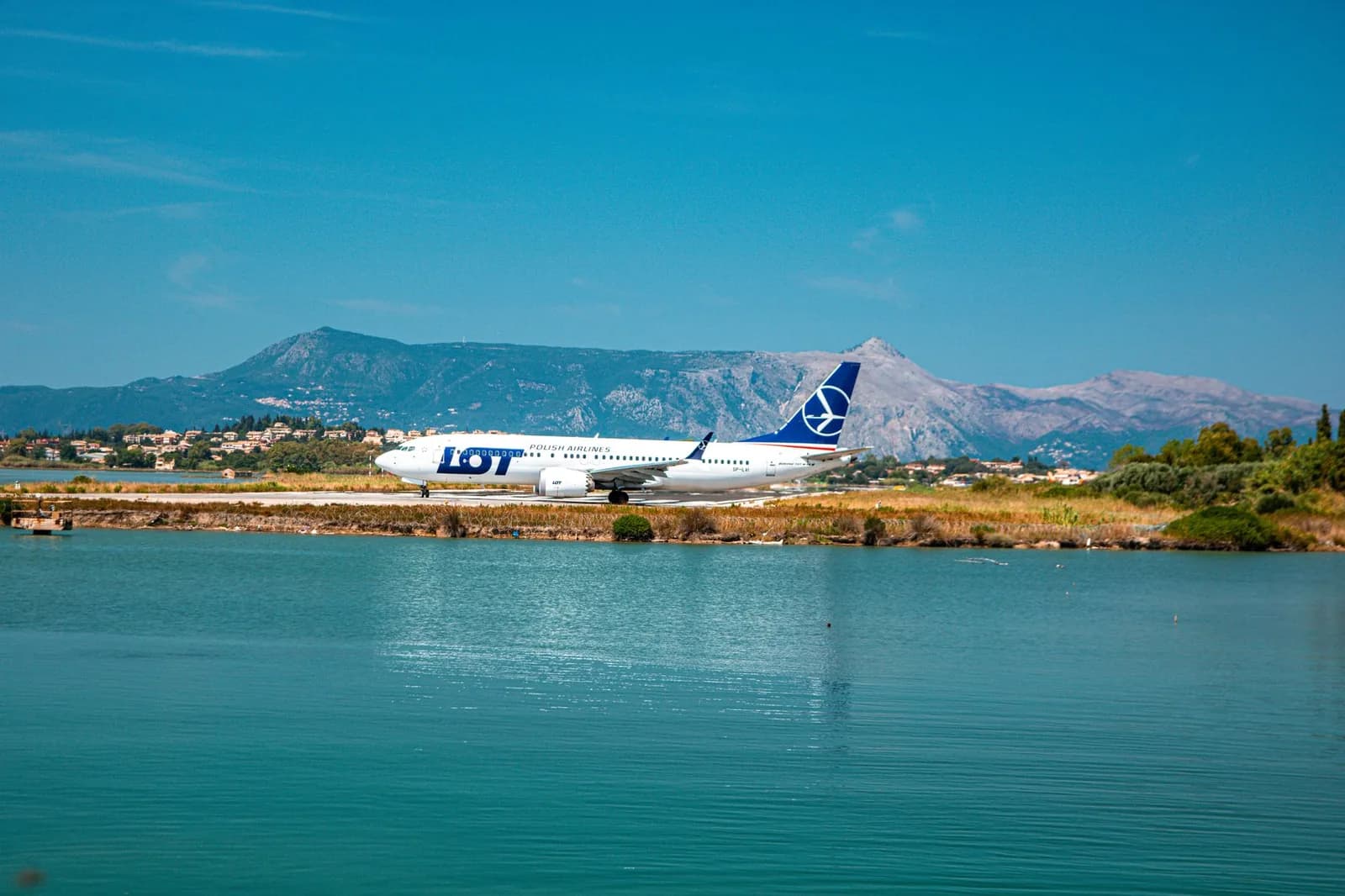
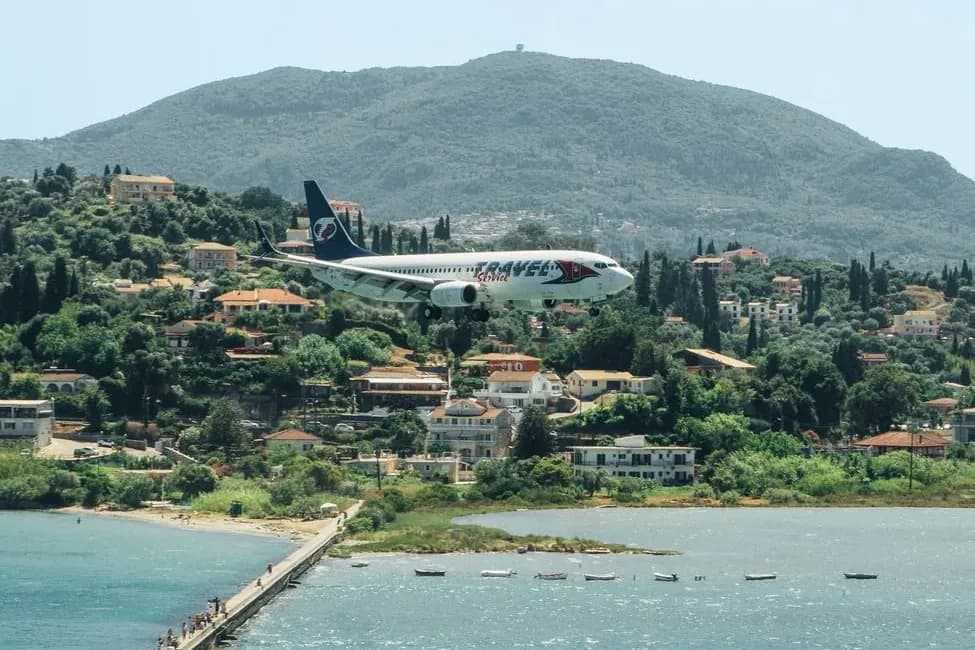
- Corfu Airport (CFU): Bus 15, Taxis and the Walk to TownCorfu airport is 3 km from the old town. Bus 15, taxi fares to every resort, the walk in, the ferry port, and the runway closure in January 2027.
- Heraklion Airport (HER), Crete: Transfers and Car HireWhere Heraklion airport sits on Crete, the drive to Chania, Rethymno and Malia, the bus into town, and when to fly into CHQ instead.
- Kefalonia Airport (EFL): Transfers and Drive TimesKefalonia airport sits 9 km south of Argostoli, not inside it. Drive times to every resort, why the island needs a car, and when the flights stop.
- Kos Airport (KGS): Where It Is and Transfer TimesKos airport sits at Antimachia in the middle of the island, 24 km from Kos Town. Transfer times to every resort, the bus reality and the winter gap.
- Mykonos Airport (JMK): Buses, Taxis and TransfersJMK sits inland, 3.5 km from the Chora. The airport bus runs hourly until 22:15, the island has about thirty taxis, and that is the whole problem.
- Paros Airport (PAS): Fly or Ferry from Athens?PAS takes turboprops from Athens and nothing else, and it shuts at dusk. When the 45 minute flight beats the ferry, and how to get off the terminal.
- Rhodes Airport (RHO): Transfers, Taxis and the Lindos RunRHO is 20 minutes from Rhodes Town and over an hour from Lindos. Taxi fares to every resort, and why two bus companies make the coast a three-hour ride.
- Santorini Airport (JTR): Transfers to Fira and OiaSantorini Thira National Airport sits on the east coast, 6 km from Fira. Transfer times to every village, why flights are delayed, and when to leave.
- Thessaloniki Airport (SKG): To the City and HalkidikiHalkidiki has no airport: SKG is it. The 01X bus, the fixed taxi fare, two buses to Kassandra, and why Sithonia is two hours from the runway.
- Zante Airport (ZTH): Zakynthos Transfers and BusesZante airport is 10 minutes from Laganas and shut to flights from 22:00 for the turtles. Drive times to every resort, and why the bus fails most arrivals.
Questions people ask about Greek airports
How many airports are there in Greece?
Around forty are open to civil traffic, which is a lot for a country of this size and entirely explained by the islands. Roughly two thirds of them sit on an island, and most handle a few domestic flights a day plus a burst of European charters in summer. Only a handful, Athens and Thessaloniki above all, work at the same intensity in January as in July.
How many international airports does Greece have?
Fifteen or so carry the international designation, which in Greek practice means the airport is equipped to clear passengers arriving from outside the country rather than that it flies worldwide. Athens, Thessaloniki, Heraklion, Chania, Rhodes, Corfu, Kos, Zakynthos, Kefalonia, Mykonos, Santorini, Skiathos, Samos, Lesvos, Preveza and Kalamata are the ones a European booking will offer you. Outside Athens almost all of that international traffic is seasonal, so the same airport can be international in July and effectively domestic in January.
What is the main airport in Greece?
Athens International, code ATH, officially Eleftherios Venizelos. It is the only Greek airport that behaves like a hub: long-haul arrivals, the full domestic network fanning out to the islands, and a metro line into the city. Thessaloniki is the other big mainland airport and the one for northern Greece and Halkidiki, but it is not a substitute for connections to most islands.
Which airport in Greece should I fly into?
The one nearest the bed you have booked, and for most trips that is not Athens. If your holiday is a single island with a runway, fly to that island and skip the capital entirely. If it is Athens, Delphi, the Peloponnese or a mainland road trip, fly to ATH. If it is more than one island, fly to whichever of them has the best fare from home and use the boat between them, because the flight back through Athens costs more time than the crossing. The one case where the choice is genuinely difficult is Crete, which has two airports at opposite ends of a very long island.
Which airport do you fly into for Santorini?
JTR, Santorini National, about 6 km from Fira on the east side of the island. There is no second option. Between roughly April and October a lot of European cities have a direct seasonal flight in; outside those months you connect through Athens, or you take the ferry. Remember that Oia, where most people are actually staying, is another 20 km beyond Fira on roads that clog badly at sunset.
Which Greek islands have their own airport?
About thirty do. The big ones are Crete with two, Rhodes, Corfu, Kos, Zakynthos, Kefalonia, Santorini, Mykonos, Skiathos, Lesvos, Samos and Karpathos. Smaller strips serve Paros, Naxos, Milos, Syros, Chios, Ikaria, Kalymnos, Leros, Astypalaia and a few others, mostly with domestic aircraft only. Ios, Sifnos, Serifos, Folegandros, Amorgos, Hydra, Spetses and Symi have none, and they are reached by boat from Athens or from the island next door.
