Corfu airport: three kilometres from town, an hour from Kavos
CFU is so close to the old town that you can walk out of it. For Corfu Town that is about as easy as a Greek arrival gets. For Sidari, Kassiopi or Kavos it changes very little.
Ioannis Kapodistrias International Airport, code CFU, sits on a strip of land between the Chalikiopoulou lagoon and the sea, 3 km south of the old town of Corfu. If you are staying in town, you are ten minutes and a €1.30 bus ticket from your bed. If you are staying almost anywhere else, the island runs 60 km from end to end and the figures below matter a lot more than the ones on the airport's own website.
Where Corfu airport actually is
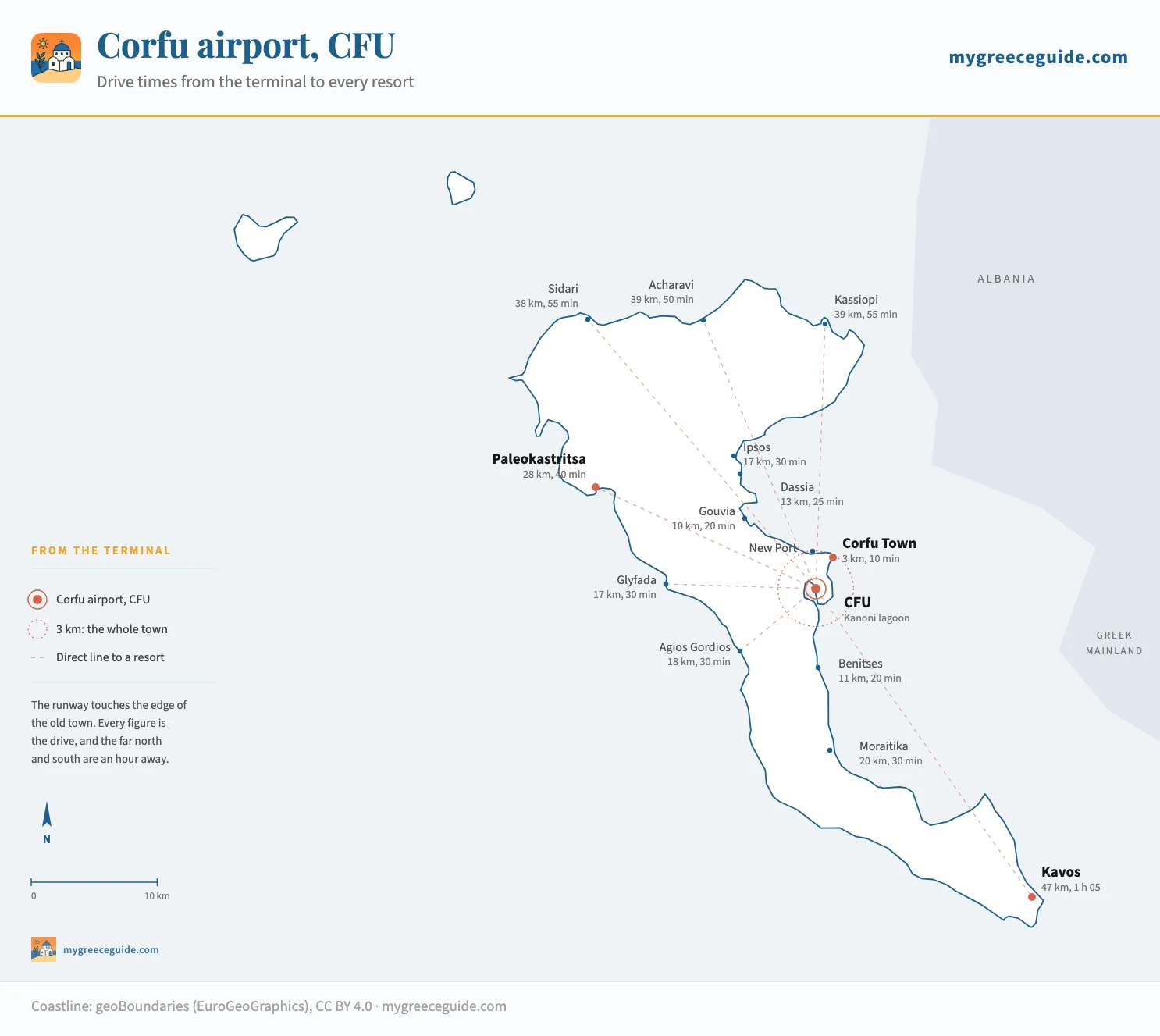
The runway was laid along the Kanoni peninsula, the tongue of land that closes off the lagoon south of the town. Its northern end is practically in the suburbs, which is why the terminal, the intercity bus station and San Rocco Square fit inside a few minutes of each other. It is also halfway down the east coast, so the island unrolls in two directions from the terminal: the north coast resorts about 50 minutes one way, Kavos an hour the other.
Position
How long the transfer takes, resort by resort
Taxi figures are daytime ranges on the meter with the airport supplement, because Corfu has no fixed fare board at the rank. Agree the price before you leave. The last column is the one to read first if you had planned on the bus.
| From CFU to | Distance | By car | Taxi, by day | By bus |
|---|---|---|---|---|
| Corfu Town | 3 km | 10 min | 15 to 20 € | Blue 15, direct to San Rocco Square |
| New Port | 5 km | 15 min | 15 to 20 € | Blue 15, it ends at the port |
| Benitses | 11 km | 20 min | 20 to 25 € | 15 into town, then a blue city bus back south |
| Gouvia | 10 km | 20 min | 20 to 25 € | 15 into town, then a blue city bus north |
| Dassia | 13 km | 25 min | 25 to 30 € | 15 into town, then a blue city bus north |
| Ipsos | 17 km | 30 min | 30 to 35 € | 15 to the green bus station, then a green bus |
| Glyfada | 17 km | 30 min | 30 to 35 € | 15 to the green bus station, a few runs a day |
| Agios Gordios | 18 km | 30 min | 30 to 35 € | 15 to the green bus station, nothing late |
| Moraitika | 20 km | 30 min | 30 to 40 € | 15 to the green bus station, then the south line |
| Paleokastritsa | 28 km | 40 min | 45 to 55 € | 15 to the green bus station, then 45 min more |
| Sidari | 38 km | 55 min | 55 to 65 € | 15 to the green bus station, then over an hour |
| Acharavi | 39 km | 50 min | 55 to 65 € | 15 to the green bus station, then over an hour |
| Kassiopi | 39 km | 55 min | 60 to 70 € | 15 to the green bus station, then the coast road |
| Kavos | 47 km | 1 h 05 | 70 to 80 € | 15 to the green bus station, then close to 1 h 30 |
Only one bus touches the airport, and it goes into town. The green intercity buses that serve the resorts start from their own station on Eptanisou, which the 15 passes on its way in. Every resort in that table is therefore a change of bus with your luggage, and the green timetable thins out sharply in the evening. The map and hotel guides show how the island splits into coasts, and that is the decision that sets your transfer.
Into Corfu Town: walk, bus 15 or taxi
You can walk it. Very few airports let you say that, and from CFU it is 30 to 40 minutes to the old town. The catch is the route: most of it runs along the main road north past the lagoon, with traffic and little shade, and in July the heat by eleven in the morning makes it a bad idea with anything that has wheels. With a backpack and an evening landing it is a pleasant way to arrive.
The blue bus number 15 is run by Astiko KTEL, the city bus company. Its stop is in front of the terminal, on your left as you come out of arrivals. It runs to the green bus station, then San Rocco Square, which is the hub for the old town, and ends at the new port behind the ferry ticket offices. Expect roughly one bus an hour, fewer at weekends and nothing late at night. New fares came in on 20 March 2026: €1.30 with a ticket bought in advance at a kiosk, a little more from the driver. A new timetable started on 14 September 2026, so check the times on the Astiko KTEL site before you rely on a particular departure.
The taxi rank is outside arrivals and waits for every flight. The meter to the old town comes to roughly 15 to 20 € by day with the airport supplement, plus a small charge for bags over 10 kg. From midnight to five in the morning the night tariff applies, which explains the higher figures people post online. Uber does not operate on Corfu.
Where the walk ends
Which option to take for where you are staying
The answer flips completely between the old town, where walking is on the table, and the north coast, where the bus is two changes and a whole morning. Pick your area.
Where are you staying on Corfu
Town and next door
Further out
Corfu Town
The old town, Garitsa and the streets around the port
- On foot30 to 40 min, mostly beside a main road. Fine with a backpack, grim with a suitcase in JulyWorkable
- BusBlue 15 from outside arrivals, roughly hourly, €1.30 from a kioskTake this
- Taxi15 to 20 € by day, 10 min, straight to the doorWorkable
- Hire carThe old town is a maze of one-way lanes and parking is scarceNot worth it
The bus drops you at San Rocco Square, a ten-minute walk from most old town hotels. Take the taxi if your room is inside the old town, because the lanes that the bus cannot enter are exactly the ones you would be dragging luggage through.
Hiring a car at the airport
From Corfu Town or the coast just north of it you can have a good week without a car, because the blue city buses cover that stretch and the old town is on foot anyway. From the north-east coast or the west, a car is close to essential. Kalami, Agni, the beaches around Paleokastritsa and the hill villages have little or no bus service, and a taxi there and back for dinner costs what a day of car hire does.
Collect it at the terminal rather than paying for a transfer first, and take the smallest car you can live with: the lanes to the north-east coves were never widened. If you are still choosing a base, our Corfu hotels, sorted by coast say plainly which areas need one.
The landing over the lagoon at Kanoni
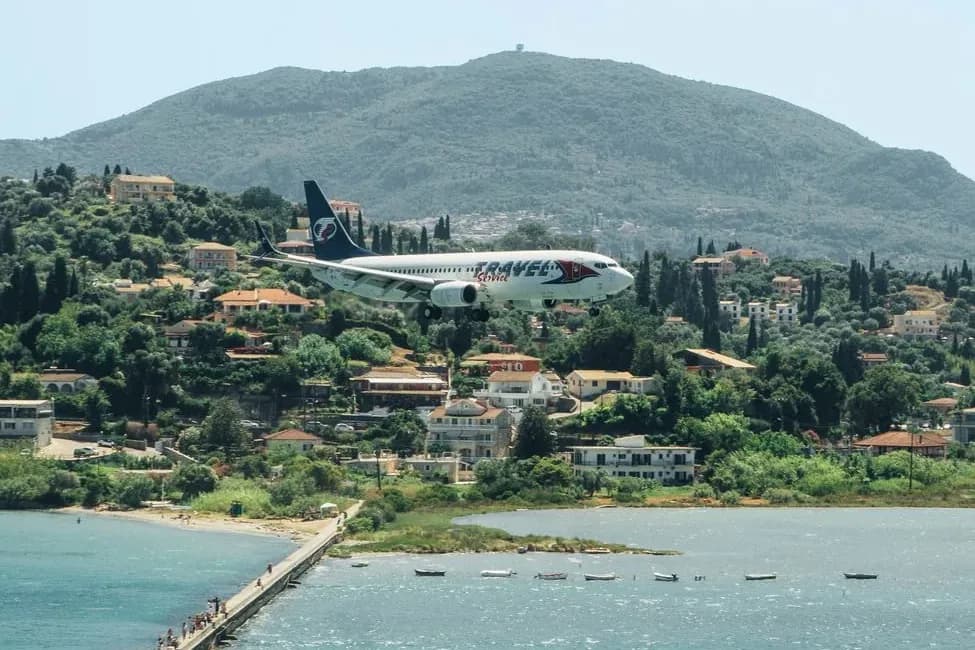
Corfu has one of the most photographed approaches in Europe, and the reason is the ground rather than the aircraft. The 2,373 metre runway fills the strip of land between the Chalikiopoulou lagoon and the sea, with hills close on both sides. Aircraft landing from the south cross the mouth of the lagoon a few dozen metres above the causeway that links Kanoni to Perama, right beside Vlacherna monastery and the islet of Pontikonisi.
That footbridge is where the spotters stand, and in summer there are a lot of them. It is a ten-minute taxi from town or a walk down from the Kanoni viewpoint, and the café above it has the famous view. For the question people type into search engines, it is a demanding approach rather than a dangerous one. In Greece the title of hardest landing usually goes to Skiathos, whose runway starts at the edge of the road.
On final approach
The ferry port is ten minutes away
Corfu is the rare Greek island where you can land and be on a boat within the hour. The new port is on the far side of the old town, about 5 km from the terminal, and bus 15 ends there. From it the Igoumenitsa ferries cross to the mainland in 1 h 10 to 1 h 30, all year and every hour or two in summer, which is how anyone continuing by road to Epirus, Parga or the rest of Greece leaves the island.
Hydrofoils and car ferries also run to Saranda in Albania, about thirty minutes by the fast boat, and in summer there are sailings to Italy: Brindisi and Bari in well under half a day, Ancona close to a full one. The map of the crossings from Italy shows why Corfu is the one Ionian island those ships reach directly. For Paxos, check which port your boat uses, since the year-round service leaves from Lefkimmi in the south of the island.
The January 2027 closure and the new border checks
From 20 to 28 January 2027 no flights will use Corfu airport. Fraport Greece, which has run CFU under concession since 2017, is rebuilding the runway, and only emergency helicopters will operate while the work goes on. The airport has closed for runway works in previous winters too. If your trip falls in that week, the fallback is to fly to Preveza or Ioannina on the mainland and take the ferry from Igoumenitsa.
The other change is already here. The EU Entry and Exit System has been fully in force since 10 April 2026, and the summer flexibility that allowed Greek airports to pause biometric registration at busy times ended on 6 September. Anyone from outside the EU, including every British passenger, is photographed and fingerprinted on their first crossing. Britain is CFU's biggest market by a wide margin, so this is the queue that matters on departure, and the airport asks non-Schengen passengers to arrive when check-in opens. Sites offering to pre-register you for a fee are selling nothing: the process happens at the booth and costs nothing.
One terminal, one runway, and more than four million passengers
CFU carried 4.34 million passengers in 2024 and more than 4.6 million in 2025, through a single terminal remodelled by Fraport Greece after 2017, with a further extension announced at the end of 2025. Landside there are car hire desks, ATMs, a café and the bus stop. Airside there is duty free, a handful of food outlets and the Goldair Handling Lounge on the first floor of the non-Schengen area, open to Priority Pass members from late March to October. Wi-Fi is free.
The two car parks, P1 and P2, charge the same: the first twenty minutes are free, then €3 for an hour and €16 for a full day or two. There is only one airport on the island, and it takes its name from Ioannis Kapodistrias, a Corfiot born in 1776 who became Foreign Minister of Russia, helped shape the Swiss federal settlement, and was one of the founding figures of the modern Greek state.
Winter flights, and getting here from the US
The European charters leave the schedule through October and come back in spring. Athens keeps its connection all year, and some British routes now carry on through the winter. Corfu Town has a year-round population and a working old town, so unlike most island airports this one never goes fully quiet, and the ferry from Igoumenitsa runs in January too.
Nothing flies non-stop from North America. From the US the usual route is a flight to Athens and the domestic hop, about an hour, or a summer connection through London, Frankfurt, Munich or Rome. If Corfu is one stop on a longer trip, the guide to the Ionian islands sets it against its neighbours, and the other entry points into the country are on the airports hub.
Questions people ask about Corfu airport
Are there two airports in Corfu?
No. Corfu has one airport, Ioannis Kapodistrias International, code CFU, with one terminal and one runway on the edge of Corfu Town. Search results sometimes suggest Preveza or Ioannina as well, but both are on the Greek mainland, and reaching Corfu from either means a drive to Igoumenitsa and an hour or more on the ferry.
Which airport do you fly to for Corfu?
Corfu International Airport, CFU, which appears on some booking sites as Kerkyra, the Greek name for the island. It is the only way onto the island by air. Between April and October it takes direct flights from most of northern Europe, with Britain the largest market by far. Outside those months most routes go through Athens.
How far is Corfu airport from Corfu Town?
About 3 km by road to the old town, around ten minutes by car, and closer as the crow flies. It is near enough to walk, 30 to 40 minutes, but most of the way runs beside a main road with no shade, so it works with a backpack and not with two suitcases in August. The blue city bus number 15 and the taxi rank outside arrivals cover the same distance in ten to twenty minutes.
Is there a bus from Corfu airport to Corfu Town?
Yes, the blue city bus number 15. It stops in front of the terminal and runs to the intercity bus station, San Rocco Square and the new port, roughly once an hour and less often at weekends. Since March 2026 a ticket costs €1.30 bought in advance at a kiosk, a little more from the driver. No green intercity bus serves the airport, so for any resort you ride the 15 to the green bus station and change there.
How much is a taxi from Corfu airport to Corfu Town?
Expect roughly 15 to 20 € by day on the meter, including the airport supplement, and more with several bags. Corfu publishes no fixed fare board at the rank, so ask for the price before you set off. Between midnight and five in the morning the higher night tariff applies, which is the main reason people quote anything up to 30 €.
What are the current problems at Corfu airport?
Two things to know in 2026 and 2027. The runway is being rebuilt, and all flights are suspended from 20 to 28 January 2027, with only emergency helicopters operating. And the EU Entry and Exit System has been fully in force since April 2026, so passengers from outside the EU, the British included, are photographed and fingerprinted at the border. The airport now asks those passengers to arrive when check-in opens.
Is Corfu airport hard to land at?
It is one of the more demanding approaches in Greece, though Skiathos usually gets the title of hardest. The runway is squeezed onto a strip of land between the Chalikiopoulou lagoon and the sea, with hills close by on both sides, and aircraft landing from the south pass low over the Kanoni causeway. It is safe and busy, with more than four million passengers a year, and the approach is precisely what makes it a favourite with plane spotters.
Is Corfu airport very big?
No. It has a single terminal and a 2,373 metre runway, and it is compact enough that you can walk from the aircraft to the taxi rank in minutes. It is busy for its size though: 4.34 million passengers in 2024 and more than 4.6 million in 2025, almost all of them between May and October, which is why departures on summer weekends feel crowded.
How do I get to Corfu from the USA?
With at least one connection, since no airline flies non-stop from North America to Corfu. The usual route is a flight to Athens and the domestic connection, about an hour in the air, which runs all year. In summer you can also connect through London, Frankfurt, Munich, Rome or another European hub with a direct seasonal flight. A few travellers combine a trip to southern Italy with the ferry from Bari or Brindisi.
