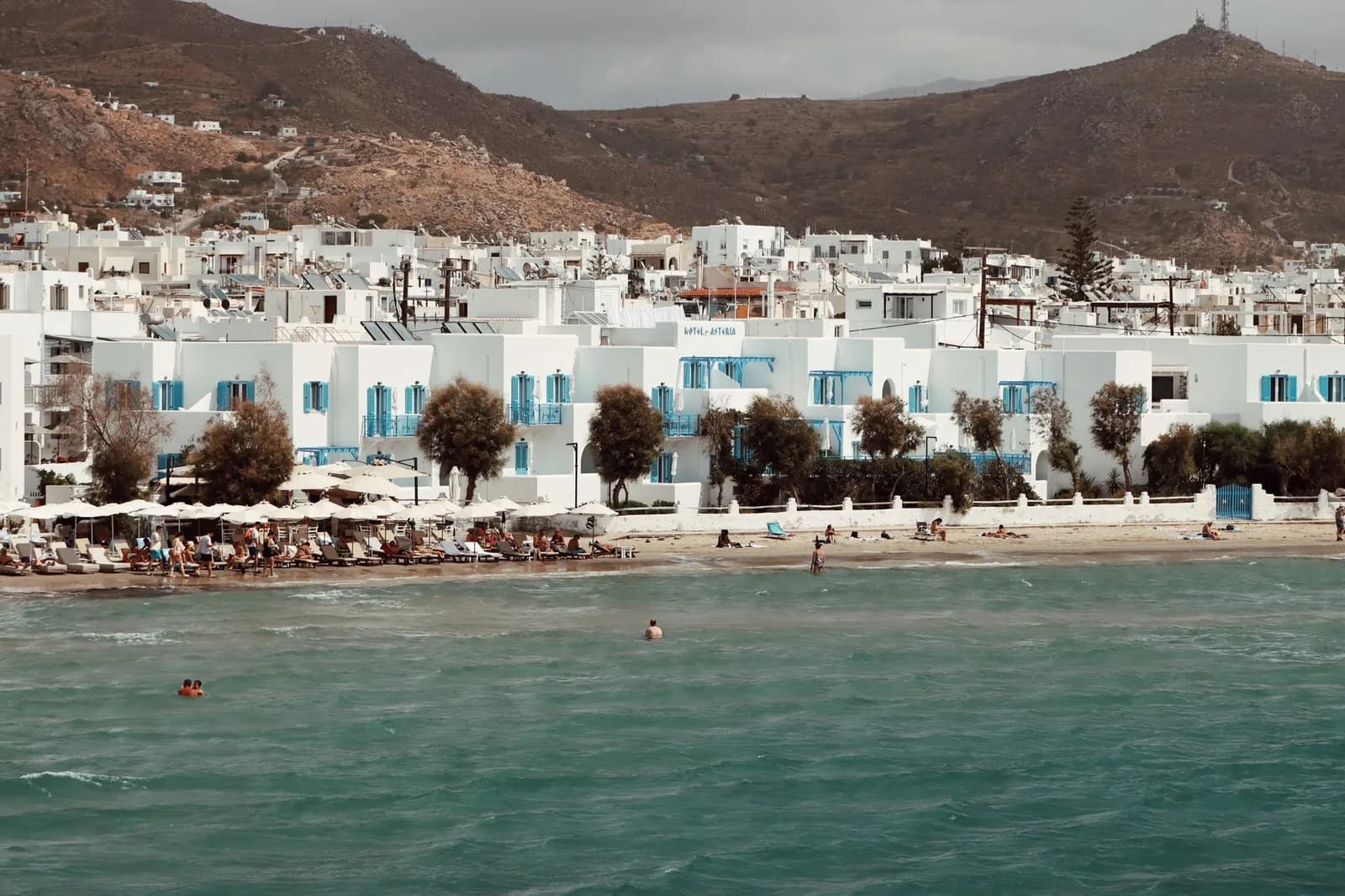
Hotels in Naxos: the island where the same sea costs less
Naxos is the largest of the Cyclades, it has farmland, and it never had to live on tourism alone. That is the reason a room here costs so much less than the same room on Santorini, and the reason the choice of area matters more than the choice of hotel.
Almost every hotel on Naxos is in one of four places: the Chora around the port, the run of sand going south down the west coast, a village up in the mountains, or the windy headland at Mikri Vigla. Pick the wrong one and you spend the week driving. Pick the Chora and you may not need a car at all, because the ferry lands you in the middle of the town rather than at the bottom of a cliff road.
Why hotels in Naxos cost less than the islands either side of it
This is geography before it is anything else. Naxos is the biggest island in the Cyclades and the only one with a real interior: mountains, springs, terraced fields, olive groves, herds of goats, potatoes and citrus and cheese that leave the island on the same ferries the visitors arrive on. Farming here was a living long before anyone flew to Greece for a holiday, and it still is.
Santorini and Mykonos have none of that. Both are small and dry, and on both the visitor season is close to the whole economy. When rooms are the only crop, the price of a room goes wherever the market will let it go. On Naxos the pressure never built the same way, and the result is an island where the most expensive addresses still land under what a modest room fetches in Oia in August. The sea is the same Aegean. The beaches are longer, and there are more of them.
Which part of the island suits your trip
Start from what you actually want out of the week rather than from a list of hotels. On an island this size, the area decides how the days work.
Start here
Then the decision is made for you. Stay in the Chora, where the ferry ties up, and let the bus station on the waterfront handle the rest of the island.
Naxos Chora
Around the harbour, under the Kastro. From the ferry: on foot, with your bag.
Bakeries, ferry agencies, the bus terminal, the beach at Agios Georgios and a hundred tavernas are all inside a twenty minute walk. The lanes of the old town are stepped and no car reaches most of them, which is a nuisance for ten minutes and a pleasure for a week.
Agios Georgios
The town beach, south end of the Chora. From the ferry: about 10 minutes on foot.
Shallow, sandy and still in town. You lose the old town lanes outside the door and gain a beach you can walk to before breakfast.
The areas side by side
Distances on Naxos are deceptive. The island is about the size of Malta, the roads through the middle are slow and beautiful, and half an hour on the map is a real half hour. The island map carries the drive from the Chora under every place name if you want the times before you pick an area.
| Area | From the port | Beach | Car needed | Where prices sit |
|---|---|---|---|---|
| Naxos Chora | On foot from the ramp | Agios Georgios, 10 min walk | No | Wide range, from cheap rooms to the smartest addresses on the island |
| Agios Prokopios | 10 to 15 min, bus or car | Sand, organised, busy | Not essential in season | The island's mid range, and its peak-season squeeze |
| Agia Anna | About 15 min, bus or car | Sand, small harbour | Not essential in season | Slightly under its neighbour |
| Plaka | About 20 min by car | Dune sand, kilometres of it | Strongly advised | Studios and small hotels, below the Chora |
| Mikri Vigla | About 25 min by car | Two bays, one windy, one calm | Yes | Low-rise, mid range |
| Kastraki | About 30 min by car | Sand, almost empty | Yes | The cheapest coastal rooms |
| Halki and the Tragea | About 25 min by car | None, you drive to the sea | Yes | Guesthouses, well under the coast |
| Apiranthos | About 40 min by car | None, mountain village | Yes | The lowest on the island |
Journey times are the usual drive rather than a promise, and the bus timetable thins out sharply either side of the summer. The price column compares the areas with each other, not with the rest of Greece: even the most expensive corner of Naxos stays below what the equivalent room costs on a caldera.
Naxos Chora, where the boat puts you down
Everything in the Chora happens within about four hundred metres of the water. The berth where the boats tie up is on the seafront itself, the Kastro is on the hill directly above it, and the Portara is a short walk north along a causeway. The distance between the ferry ramp and a room in the old town is a walk you can do with a bag in each hand, and that single fact rearranges the first half day of a trip. On the two islands most people book instead, the port is a place you leave as fast as you can: Athinios is a concrete shelf under the caldera with a hairpin road above it, and the New Port on Mykonos is a bus ride from anything.
The whole transfer
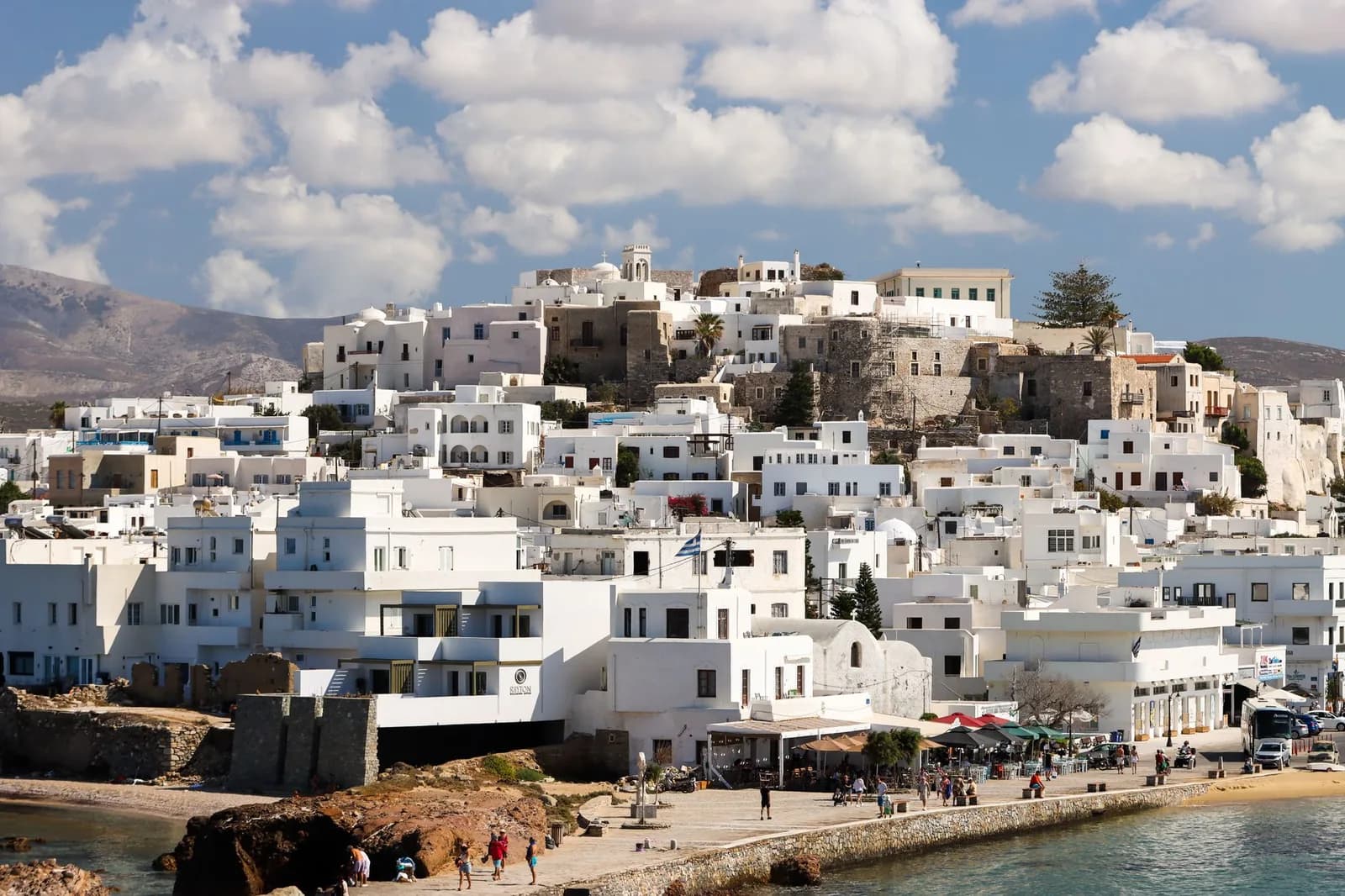
Staying in town buys you the two things that are hardest to get anywhere else on Naxos: dinner without a drive, and the bus terminal on your doorstep. The island network leaves from the waterfront, and in season it runs down the west coast often enough that a beach day needs no planning. What the Chora gives up is space. Rooms inside the old town are small, the lanes are stepped, and a suitcase with wheels is the wrong luggage. Nothing new can be built inside the Kastro, so the number of beds up there is fixed and they go early. Grotta, on the north side, and Agios Georgios, on the town beach, are the two edges of town where the buildings are newer and the rooms are larger.
Five in the Chora, where the ferry puts you down and where the island keeps its evenings.
 Mid-range
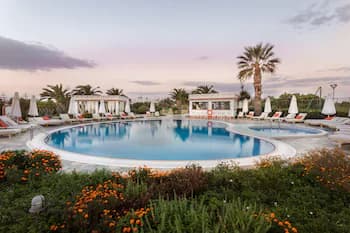
Porto Naxos Hotel
Agios Georgios, ChoraFrom
$112
On Agios Georgios, the town beach, ten minutes on foot from the port and the Kastro. The base that needs neither a car nor a bus.
- On the town beach
- Walk to the port
- Pool
Nightly rate from the Hotels.com catalogue
See availability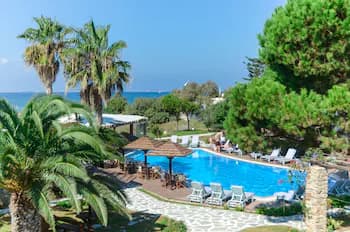 Mid-range
Alkyoni Beach Hotel
Agios GeorgiosFrom
$128
The same beach at the quieter end, family-run, with the shallow water that makes Agios Georgios work for small children.
- Shallow water
- Family run
- Walk into town
Nightly rate from the Hotels.com catalogue
See availability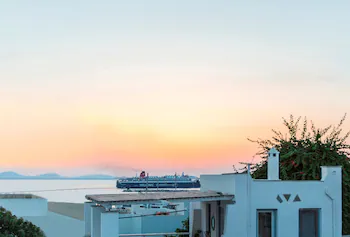 Mid-range
Castle Mansions
Naxos TownFrom
$86
Inside the Venetian Kastro, in the lanes above the port, which is the one address here with actual history in the walls.
- In the Kastro
- Venetian building
- No car access
Nightly rate from the Hotels.com catalogue
See availability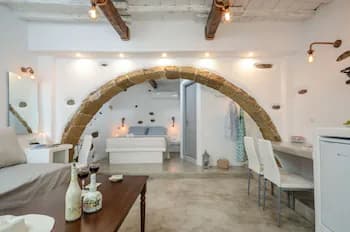 Mid-range
Venetian Suites
Naxos ChoraFrom
$91
Suites in the old town at a price the Cyclades rarely offer for this kind of location.
- Old town
- Suites
- Value
Nightly rate from the Hotels.com catalogue
See availability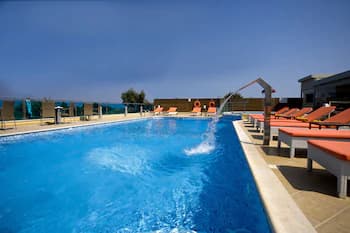 Mid-range
Princess Of Naxos
Naxos TownFrom
$79
The cheapest decent bed in the Chora, five minutes from the waterfront. No view, no pool, and the whole town on your doorstep.
- Value
- Central
- No pool
Nightly rate from the Hotels.com catalogue
See availability
The west coast: Agios Prokopios, Agia Anna and Plaka
South of the Chora the coast turns into one long belt of pale sand, broken by low headlands and facing straight into the sunset. Three names carry most of the island's beach accommodation, and they sit in a line, each one a step further out and a step quieter than the last.
Agios Prokopios comes first, a few kilometres from town, and it is the busiest beach on Naxos: sun beds in rows, water sports, a street of restaurants behind the sand, and the largest concentration of hotels outside the Chora. Agia Anna is the next bay south, close enough to walk between the two, with a small fishing harbour, tavernas built on the sand and fewer big buildings. Plaka begins where Agia Anna stops and simply keeps going, four kilometres of dune backed by low cedars, with beach bars spaced far enough apart that you can choose to be near one or not. The further south you go, the more the last bus back becomes the thing that shapes your evening.
One thing to know before you book a west coast room in high summer: this coast is exposed. When the meltemi blows through July and August it comes down the Aegean from the north and it reaches the sand, which is glorious if you sail and tiring if you were planning to read under a parasol. The beaches at the north end of the strip get more shelter than the open stretch at Plaka. If your dates are fixed and the wind is a worry, the crossing from Athens is worth reading first, because the same wind decides which boats sail.
Five on the west coast, on the run of sand that starts at Agios Prokopios and does not really stop.
 Luxury
Naxos Island Hotel
Agios ProkopiosFrom
$146
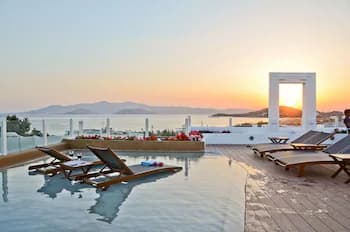
Above Agios Prokopios with the bay below it, the most complete hotel on this coast, and still under what Paros charges for less.
- Above the beach
- Pool and spa
- Sea views
Nightly rate from the Hotels.com catalogue
See availability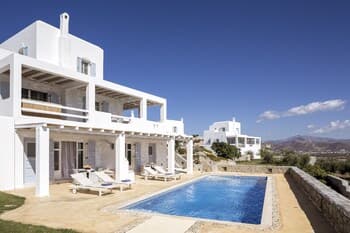 Luxury
Naxian Collection
Agios ProkopiosFrom
$219
Villas with private pools on the hill behind the beach, for people who want the west coast without a hotel corridor.
- Private pools
- Villas
- Hillside
Nightly rate from the Hotels.com catalogue
See availability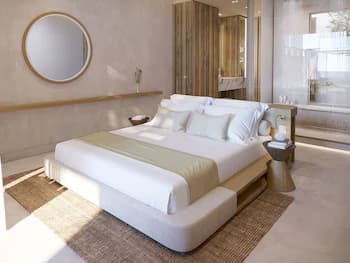 Luxury
Avgoustos Suites
Agia Anna, adults onlyFrom
$232
Adults only at Agia Anna, the fishing end of the same beach, a walk from the tavernas on the water.
- Adults only
- Agia Anna
- Walk to the tavernas
Nightly rate from the Hotels.com catalogue
See availability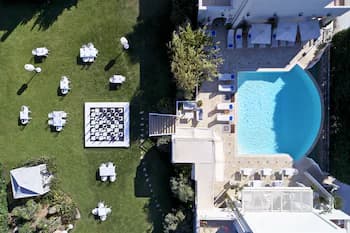 Mid-range
Lagos Mare Hotel
Agios ProkopiosFrom
$90
A small boutique hotel a few minutes back from the sand, and the value pick of this coast.
- Boutique
- Near the beach
- Value
Nightly rate from the Hotels.com catalogue
See availability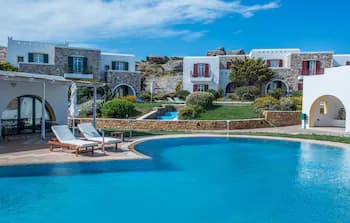 Mid-range
Naxos Palace Hotel
Agios ProkopiosFrom
$51
The cheapest proper hotel with a pool on the west coast, which on Naxos still means walking distance to a very good beach.
- Pool
- Value
- Walk to the beach
Nightly rate from the Hotels.com catalogue
See availability
Halki, Apiranthos and the case for sleeping inland
Nobody comes to the Cyclades for the mountains, and Naxos is the island that changes their mind. The road from the Chora climbs into the Tragea, a valley of olive groves with Byzantine chapels standing in the fields, and Halki is in the middle of it: neoclassical houses, a distillery still making kitron from citron leaves, and a pace that has nothing to do with the coast. Further up, Apiranthos is built out of marble on the slope of Mount Fanari, with its own dialect and a view down the valley to the sea.
Rooms up here are guesthouses rather than hotels, they cost less than anything on the water, and they are cool at night in August when the coast is not. What you give up is the swim, which is now half an hour of hairpins away. For a week of pure beach that is the wrong choice. For a second visit, for a shoulder season trip, or for anyone who has already worked out that Cycladic villages are more interesting than Cycladic resorts, it is the best value on the island.
Mikri Vigla, if the wind is the point
Keep going south past Plaka and the coast ends in a rocky headland with a beach on either side. The north face takes the meltemi head on and has been a kite and windsurf spot for decades, with schools operating from the sand through the summer. The south face, in the lee of the same rock, is calm enough to swim on the days the other one is unusable. That double aspect is why Mikri Vigla works when the rest of the west coast is being sandblasted. Accommodation is low-rise and spread out, a car is not negotiable, and the nearest proper supermarket run is a drive.
Three at the windy end, where the kitesurfers are and the coast turns to dunes and cedar.
 Mid-range
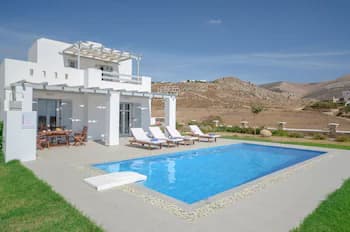
Natura Villas
Mikri ViglaFrom
$171
On the headland at Mikri Vigla, between the two bays, one flat and one for the wind. The base for a week on the water.
- Between two bays
- Kitesurfing
- Villas
Nightly rate from the Hotels.com catalogue
See availability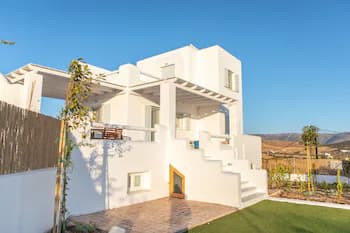 Luxury
Naxian Resort
PyrgakiFrom
$219
At Pyrgaki, the last beach on the south-west coast, past the cedar forest at Alyko. Nothing beyond it but the road back.
- End of the coast
- Quiet
- Near Alyko
Nightly rate from the Hotels.com catalogue
See availability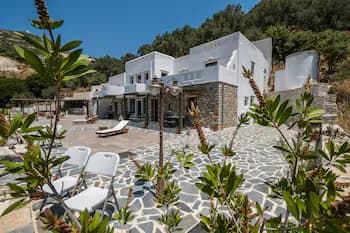 Mid-range
ELaiolithos Luxury Retreat
Above Moni, inlandUp on the road to Chalki, in the mountain villages, with the whole island below it. The answer to the case for sleeping inland.
- Inland
- Mountain views
- Retreat
Check live prices and availability
See availability
Scores, review counts and photos are Booking.com data checked in September 2026, and the buttons open the property on Hotels.com. Rates move with the dates, so check them there.
When to book, and what changes out of season
August is the month that punishes late decisions, and the Chora runs out before the beach strip does for the simple reason that the old town cannot grow. Book the town early or accept a room on the edge of it. Everywhere else on the island, the pressure eases as soon as you step outside the middle of the summer, and June and September are the two months where Naxos is at its best and still fully open.
By late October the west coast starts closing. Beach hotels shut, the buses drop to a skeleton service, and a lot of the tavernas outside town put the chairs away until spring. Naxos keeps working through the winter because of the farms, so the Chora stays alive in a way that Santorini does not, but a January room on a beach at Plaka is not a thing you can book. Our island plans show how the areas sit against each other, which is the comparison to make before you commit to one.
Questions people ask about staying on Naxos
Where is the best place to stay on Naxos?
Naxos Chora for a first visit, and for anyone arriving without a car. The ferry docks on the waterfront, the old town climbs straight up behind it, the island bus terminal is on the same quay, and the town beach is a ten minute walk from the lanes. If the trip is mainly about swimming, Agios Prokopios and Agia Anna put you on the sand with a frequent bus back into town. Plaka is quieter again, Mikri Vigla is for the wind, and the mountain villages of Halki and Apiranthos are the cheapest and the coolest at night. Everything past the main beach strip effectively needs a car.
Is it better to stay in Naxos Town or on the beach?
Naxos Town if you want dinner without a drive and the boats on your doorstep, the beach if the point of the week is swimming. The Chora is the only base on the island where you never need to plan a journey, and Agios Georgios, its own town beach, is close enough that the two are not really a choice. Further south the sand gets better and the evening gets emptier, and the last bus back from Plaka is the thing that ends up shaping your day. Rooms in the old town are small, the lanes are stepped, and nothing new can be built inside the Kastro, so the beds up there are fixed in number and go early.
What are the best hotels in Naxos?
There is no agreed list, and the honest answer is that on Naxos the address does more work than the property. The beachfront hotels along Agios Georgios and Agios Prokopios are the ones people mean when they say a hotel on Naxos, and they are mid-sized, low-rise and built on the sand rather than above it. The smartest rooms are studios and small hotels in the Chora and a handful of newer properties spread out towards Plaka and Mikri Vigla. Shortlist by area first, then read the last few months of guest reviews rather than the overall score, since the complaints that matter here are about the walk to the sand, road noise on the beach strip and how the meltemi hits the west coast.
Which is nicer, Paros or Naxos?
Paros is the more polished of the two and Naxos is the more substantial. Paros has Naoussa, which is the better evening, the better restaurants and the higher bill, and it is the stronger base for island hopping because more ferry lines call at Parikia. Naxos has the bigger beaches, the mountains, real villages that are not there for visitors, and consistently lower room rates for the same category. If you want to eat well and be seen doing it, Paros. If you want a long sandy coast, a walkable port town and a week that costs less, Naxos.
What is better, Mykonos or Naxos?
They are barely competing for the same trip. Mykonos sells nightlife, beach clubs and an address, and its hotels are priced accordingly, with the added friction that the new port is a bus ride from anywhere you would want to sleep. Naxos is the largest of the Cyclades, it has farmland and mountains as well as beaches, and it never had to live on tourism alone, which is exactly why a room costs so much less. For a party or a scene, Mykonos. For a family, a longer stay, or anyone who wants to walk off the ferry and into their hotel, Naxos.
Are there all-inclusive or resort-style hotels on Naxos?
Very few, and that is the character of the island rather than an oversight. Naxos never took the charter traffic that built the big resorts on Rhodes, Kos and Crete, so what it has instead is beachfront hotels of thirty to eighty rooms, studios and apartments with kitchenettes, and family-run rooms to let in the villages. Breakfast is usually included and dinner is not, which suits an island where the tavernas along the beach strip and up in Halki are a large part of the reason to come.
