Greece hotels: the price is geography, not stars
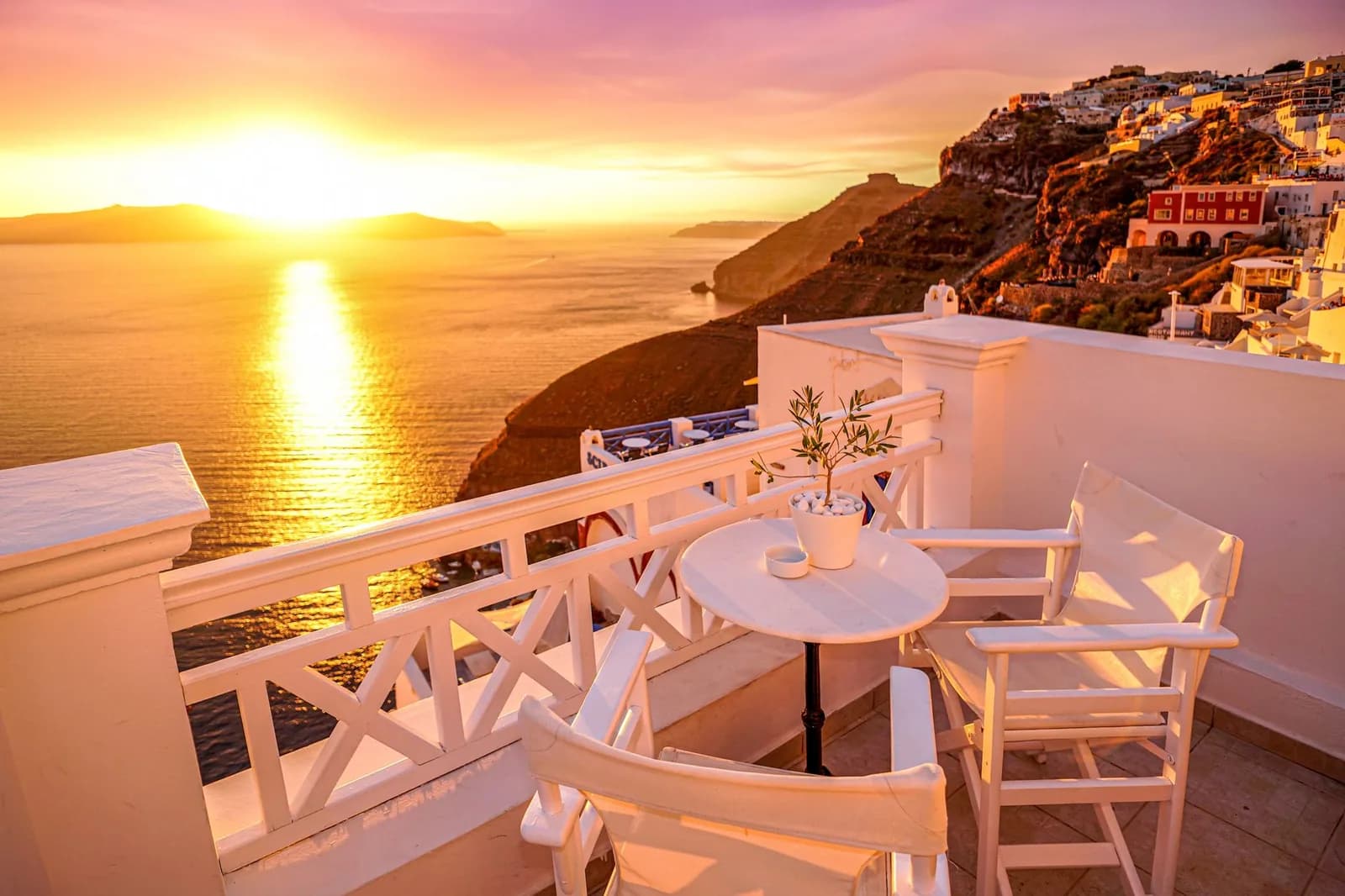
A caldera terrace on Santorini costs several times what the same room costs on Naxos, two hours away across the same sea. Here is what you are actually buying when you pay it.
Greek hotels are priced by where they stand, and only then by what they contain. Two rooms of the same size, with the same bed and the same shower, can differ by a factor of several depending on which island they are on and which way the terrace faces. That is the whole market in one sentence, and it is worth understanding before you look at a single listing.
The islands, side by side
Grouped by what the money is actually buying rather than by a nightly rate, because rates move every week and the reason behind them does not. The second column is the one to read.
| Island | What the price is for | When it peaks | How you arrive |
|---|---|---|---|
| You are paying for the viewThe dearest rooms in the country | |||
| Santorini | A caldera terrace. The same room turned inland costs a fraction of it, on the same island, in the same building | Peaks around the sunset months, June to September, and stays expensive into October | Direct flights to JTR in season, otherwise Athens then a ferry |
| Mykonos | Proximity to the beach clubs and to the old town. The premium is on the address rather than the view | A sharp July and August peak, quiet either side of it | Direct flights to JMK in season, or a fast boat from Athens |
| You are paying for the resortThe widest range on the market | |||
| Crete | Everything from a family studio to the all-inclusive belt around Elounda. The island is long enough to hold both | The longest season in Greece, with hotels open either side of summer | Two airports, Heraklion and Chania, both flown all year |
| Rhodes | Package resorts on the east coast, medieval old town rooms in Rhodes Town itself. Two different products | April to October, with charter traffic setting the price | Direct flights to RHO, all year from a few cities |
| Corfu | A green island with a long resort coast, and a Venetian old town that prices like a city | May to October, wettest of the big islands either side | Direct flights to CFU, ferries from the west coast of the mainland |
| Kos | Large beachfront resorts, often cheaper per night than a small room in the Cyclades | Charter season, roughly May to October | Direct flights to KGS, or the Dodecanese ferry line |
| Zakynthos | Resort rooms in the south, quiet coast in the north. The two halves barely share a price list | A short, dense season built around the charters | Direct flights to ZTH, ferries from Kyllini |
| You are paying for the roomWhere the value sits | |||
| Naxos | A room on the beach rather than above a cliff. The best ratio of sand to money in the Cyclades | June to September, with real availability outside August | Ferry from Athens, or a small domestic airport |
| Paros | Village rooms and small hotels, though Naoussa has drifted upmarket and now prices closer to the tier above | A long Cycladic season, busiest in August | Ferry from Athens or Rafina, plus a domestic airport |
| Milos | A volcanic coast that photographs like Santorini for a good deal less, with fewer beds to go round | Shorter than its neighbours, and it sells out early | Ferry on the western Cyclades line, plus a small airport |
| Skiathos | Pine and sand rather than whitewash, and a beach count no Cycladic island can match | A short northern season, roughly late May to September | Direct flights to JSI in summer, ferries from Volos |
| Sifnos | Small family hotels and a food reputation that costs nothing to enjoy | June to September, and genuinely quiet in the shoulder | Ferry only, on the western Cyclades line |
| Ios | Two markets on one island: cheap beds for the night crowd, and quiet hotels a bay away from them | July and August carry the island | Ferry only, on the Santorini line |
| You are barely paying at allThe cheapest beds in the country | |||
| Amorgos | Distance. Nothing costs much here because getting here costs a day | A brief summer, and half the island shuts outside it | Ferry only, and a long one |
| Karpathos | Wind, empty beaches and a mountain village that has not been renovated for anyone | Summer only, and windy through it | A small airport, plus a slow ferry down the Dodecanese |
| Ikaria | Rooms rather than hotels, and an island that does not organise itself around visitors | July and August, loosely | Ferry from Athens or Samos, plus a domestic airport |
| Chios and Lesvos | Proper towns with year-round hotels, priced for Greeks rather than for holidays | Open all year, unusually for islands | Overnight ferries from Athens, plus domestic flights |
Levels are relative to each other, not to a figure. What a room costs in Greece moves with the week, the weather and the exchange rate, and any number printed here would be wrong by the time you read it.
What the view costs, and where
On Santorini the caldera is not a feature of the hotel, it is the product. The cliff towns of Fira, Imerovigli and Oia sit on the rim of a flooded volcano, the buildings are cut into the rock in terraces, and every one of those terraces looks west over the water at the thing several million people a year come to photograph. Building there is slow, expensive and largely finished, because there is not much rim left. The result is the steepest price gradient in Greece, and it runs over a distance of about two hundred metres.
Walk back three streets from the edge in Fira and the same class of room drops sharply while the island stays exactly where it was. Go down to Perissa or Kamari on the black sand side and it drops again. You lose the terrace and you gain a beach, a car park and somewhere to eat that is not charging rim prices. Nothing else about your holiday changes. The sunset is still visible from the public paths, which is where most of the crowd watches it anyway.
Mykonos charges a similar premium for something different. There is no single view to buy, so the money goes on the address instead: walking distance to the old town, or a private strip of the south coast within reach of the beach clubs. It is the one Greek island where a hotel can price like a resort in the western Mediterranean, and the July and August peak is sharp enough that the same room in late May can look like a different property altogether.
The same sea, two hours away
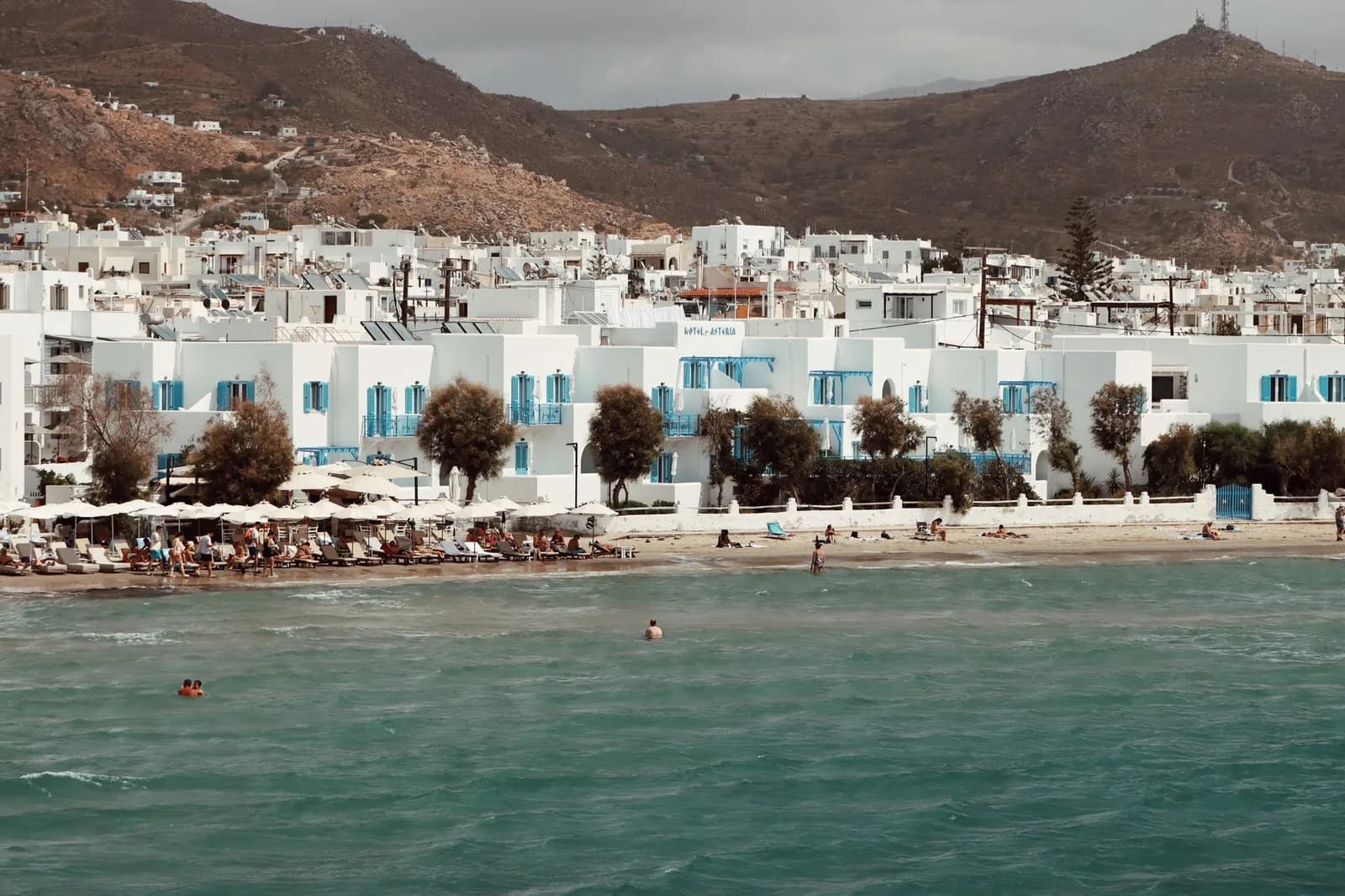
The Aegean does not get bluer as the room gets dearer. Naxos, Paros and Milos sit on the same ferry lines as Santorini, in the same archipelago, and their hotels are priced in a completely different band. Naxos is the clearest case. It has a long town beach and a run of sandy bays down the west coast, its hotels stand on the sand rather than on a cliff, and it can put you a few steps from the water for what a windowless inland room costs on the rim.
Milos does the volcanic scenery that people actually associate with Santorini, in the form of white rock coves and a coloured coastline, and it is smaller and quieter about it. The catch is supply: there are far fewer beds on Milos than on Naxos, so the island sells out early and the price rises less because of demand than because there is nothing left. Sifnos is similar and adds the best food reputation in the Cyclades. Choosing between them is really choosing which islands to string together over a week, because the boat that links two of them will not link the other two.
Outside the Cyclades the arithmetic shifts again. Skiathos trades whitewash for pine forest and has more beaches than any island its size in Greece. Kos and Rhodes can be cheaper per night than any of them, because the large resorts on the charter coasts run on volume and sell rooms by the thousand. Whether that suits you is a question of taste rather than budget, and it is the rare corner of this market where paying less does not mean staying somewhere smaller.
Naxos, Agios Georgios
Distance is a price, and it is measured in metres
Listings on every booking site say the same thing: close to the beach, near the centre, walking distance from the port. On a Greek island those phrases are doing a lot of work. The gap between a hotel on the sand and one four hundred metres inland is a real price difference and a real holiday difference, because that four hundred metres is uphill, unshaded and covered twice a day in August heat with a towel and a toddler.
The second distance is to the port, and it matters more than people expect. Ferry arrivals land at odd hours, the taxi rank at a small island port empties within minutes of a boat docking, and a hotel that is a ten minute walk from the quay saves you an argument at midnight. The same applies at airports, where the transfer is often longer than the island's size suggests. The airport guides give the real transfer times, and the ferry pages tell you which port you actually arrive at, which is not always the one nearest the town you booked.
The third is the one people discover too late. On a big island, the wrong end of it costs you days. Crete is two hundred and sixty kilometres long, so a hotel booked near Chania while your plans are in the east means several hours of driving each way. Rhodes has the same problem on a smaller scale between the old town and the southern beaches. Put the island on a map before you commit to a village name, because a drawing of the island makes its size obvious in a way a listing address never does.
The season sets the rate more than the hotel does
Greek island hotels earn their year in about six months, so the curve is steep by necessity rather than by greed. Prices climb from a low base in April and May, rise through June, hit their peak in the last week of July and hold it through August, then fall away quickly after the middle of September. The same room in the second week of September and the second week of August is frequently a different amount of money for warmer sea and a quieter beach.
The island moves with the price. In August everything is open, everything is full, and the ferries and the restaurants are working at capacity. In May the sea is still cold, some of the beach tavernas have not opened, and the boat timetables are thinner. The shoulder weeks in June and late September are where most people find the trip they thought they were booking, and they are cheaper for the same reason they are better.
Outside the season the question stops being what a room costs and becomes whether there is one. A large share of island hotels shut completely from around November to March, beach properties first. Crete, Rhodes and Corfu keep enough open to make a winter trip work, the north Aegean towns run all year because they serve residents, and a small Cycladic island in February may have a single place taking bookings.
Stars, studios and what the categories mean
The Greek star rating measures facilities, not quality. It counts lifts, restaurants, room sizes and reception hours, which is why a four star built in the eighties and never touched since outranks a three star that was stripped back to the walls last winter. Recent guest reviews tell you far more, and a photograph of the actual room tells you more still than the photograph of the pool that leads the listing.
The words that matter more on the islands are the ones next to the price. A studio is a room with a kitchenette and no breakfast. An apartment adds a separate bedroom. Rooms to let, still signposted everywhere, means a family property with a handful of units and no reception desk, which is the cheapest way to sleep near a Greek beach and often the friendliest. None of these are hotels in the classification sense, and all of them appear alongside hotels in the same search results.
Two practical details catch people out. Air conditioning is sometimes charged separately or metered on the older properties, so it is worth checking rather than assuming. And a lot of island buildings are on slopes with steps and no lift, which is exactly the charm you came for until you are carrying a suitcase up forty of them in the dark.
When to book, and what to book first
Small islands run out of rooms long before big islands run out of price. Milos, Sifnos, Folegandros and Amorgos have a bed count you could write on one page, so for July and August they are booked out months ahead and the last rooms are the worst ones at the highest rates. Crete, Rhodes, Kos and Corfu have tens of thousands of beds between them and behave like a normal market, where a late booking sometimes finds a bargain.
Order matters when you are hopping. Fix the hotels on the small islands first, then the ferries between them, then the big island at either end, because the boat timetable will bend around the room and the room will not bend around the boat. If your route runs through two islands and a flight home, leave the night before the flight in a town with an airport rather than trusting a morning crossing.
Island by island
General rules stop being useful once you know which island you are going to. Each of these covers one place: which parts of it are dear and why, where the same money buys more, what the walk from the port is like, and the mistake people make when they book there.
- Best Hotels in Kos, Greece: Where to Stay, Area by AreaKos Town, Lambi, Psalidi, Tigaki, Mastichari, Kardamena or Kefalos: the best hotels in each area of Kos, and how far a bike gets you from every one.
- Best Hotels in Rhodes: Ixia, Lindos or FalirakiWhere to stay on Rhodes island: Ixia and the windy west coast, Faliraki, Lindos, Kiotari and Rhodes Town, what each resort suits and where the sand is.
- Corfu Hotels: The Best on Each Coast, and Where to AvoidHotels in Corfu by coast: the old town, the Dassia resort belt, the quiet north-east, the west, the north and Kavos. Who each suits, and where not to stay.
- Crete Hotels: Which Part of the Island to Stay InCrete is 260 km long, so booking a hotel is really a choice of region. The four bases, what each one reaches in an hour, and which airport to fly into.
- Hotels in Ios Island: Near the Party, or Out of EarshotChora, Mylopotas, Gialos, Koumbara or Manganari: how loud each part of Ios is at night, how you get home at 4am, and the hotels in each.
- Hotels in Naxos: Where to Stay on the IslandThe Chora, the west coast beaches or a mountain village. Where to stay on Naxos, how far each area is from the port, and where a car stops being optional.
- Hydra Hotels: Where to Stay, Counted in Steps from the PortNo cars on Hydra, so your hotel decides the climb. Each area and hotel with minutes and steps from the port, plus mule, water taxi and ferry prices.
- Milos Hotels: Where to Stay on the IslandAdamas, Pollonia, Plaka or the south coast beaches: how each base on Milos changes your days, and why the island barely works without a car.
- Mykonos Hotels: The Best in Every Area, and PricesHotels on Mykonos by area: Mykonos Town, Ornos, Platis Gialos, Elia and the party coast. What each one has, what August costs, and prices in one click.
- Paros Hotels: Where to Stay, Parikia or NaoussaParikia is the port and the cheaper half of Paros, Naoussa the smart village. Where to stay on Paros island, plus the beaches and the airport end.
- Santorini Hotels: Which Village, and What It CostsOn Santorini the price follows the caldera view. How Oia, Imerovigli, Fira, Kamari and the inland villages compare, and the stairs nobody warns you about.
- Skiathos Hotels: Where to Stay on the IslandWhich part of Skiathos to book: the town, Koukounaries, Agia Paraskevi or Troulos, how far each is from the port and the runway, and when you need a car.
- Where to Stay in Kefalonia: Every Base, ComparedArgostoli, Lassi, Sami, Skala, Fiskardo and Assos, with the real drive times to Myrtos and Melissani from each, the hotels in every one, and where not to stay.
- Where to Stay in Zakynthos (Zante): Every Resort, ComparedLaganas, Kalamaki, Tsilivi, Argassi, Vasilikos, Alykes, Keri and Zante Town: how loud each is at night, how far from Navagio, and the hotels in each.
Questions people ask about hotels in Greece
Which part of Greece is best to stay in?
It depends on how much of the country you want to see from one bed. Athens and the Peloponnese work for a first trip built around sites and towns, with no ferry to catch and hotels priced like a normal European city. Crete, Rhodes and Corfu are large enough to hold a whole holiday on their own, with long seasons and every category of hotel. The Cyclades are the postcard, and there the choice narrows to one island at a time: Santorini for the caldera, Naxos and Paros for beaches and better value, Milos for the coastline. The Sporades and the Ionian trade whitewash for pine forest and greener water.
What is the average cost of a hotel stay in Greece?
There is no useful average, and quoting one is how people end up disappointed. The same category of room varies by a multiple depending on four things: which island it is on, whether the terrace faces the caldera or the sea or a car park, how many metres it stands from the sand, and which week of the season you arrive in. A room on a small Cycladic island in mid-August and the identical room in late May are effectively two different products. Work out the island and the week first, because those decide the bill far more than the hotel does.
What is the best month to go to Greece?
June and September, on almost every measure that matters for a hotel. The sea is warm, everything is open, the ferries run their full timetables, and rooms cost a good deal less than they do at the peak in late July and August. May is beautiful and quieter still, but the sea is cold and some beach tavernas have not opened. October works in the south, especially on Crete and Rhodes, where the season runs latest. From November to March a large share of island hotels simply shut.
What does a five star hotel in Greece actually mean?
Less than the number suggests. The Greek classification counts facilities and room sizes rather than service or upkeep, so a five star built decades ago and never refurbished holds its rating while a small hotel that was stripped back to the walls last winter sits two categories below it. The genuinely high-end properties in Greece cluster in a few places: Elounda in eastern Crete, the Athenian Riviera, parts of Mykonos, Costa Navarino in the Peloponnese, and the caldera rim on Santorini. Read the recent guest reviews and look at the location on a map before you read the stars.
Are all-inclusive hotels worth it in Greece?
On the big charter islands, often yes. Rhodes, Kos, Corfu and the north coast of Crete have large resorts built for it, they are isolated enough that leaving for dinner means a drive, and the format does what it is meant to do for families. In the Cyclades it rarely makes sense. The islands are small, the villages are the reason you came, and eating in the hotel every night on Naxos or Paros means missing the part of the holiday people remember. As a rule, the further your hotel is from a village you would want to walk to, the better all-inclusive looks.
Where can you find cheap hotels in Greece?
Off the famous islands, and off the peak weeks. Naxos, Paros outside Naoussa, Sifnos, Karpathos, Lesvos, Samos and most of the mainland all price in a different band from Santorini and Mykonos while sitting on the same sea. The categories matter too: a studio or an apartment comes with a kitchenette and no breakfast and costs less than a hotel room, and rooms to let, the family properties still signposted in every village, are the cheapest way to sleep near a Greek beach. Moving your dates a fortnight either side of August usually saves more than changing island does.
Are hotels in Athens cheaper than on the islands?
Almost always, and by a wide margin in summer. Athens prices like a normal European capital, it has thousands of rooms, and it has no ferry premium and no six month season to recover its costs in. A central Athens hotel in August generally costs less than a modest room on a fashionable island in the same week, and it comes with a lift, air conditioning that is included, and a metro line. The islands are dear because everything on them, including the staff, arrives by boat.
