Athens to Paros by ferry: the crossing, and what it opens up
Four hours on the slow boat, three on the fast one, and a price gap wider than the time it buys. The bigger point is where you can sail next: almost every Cyclades line calls at Paros.
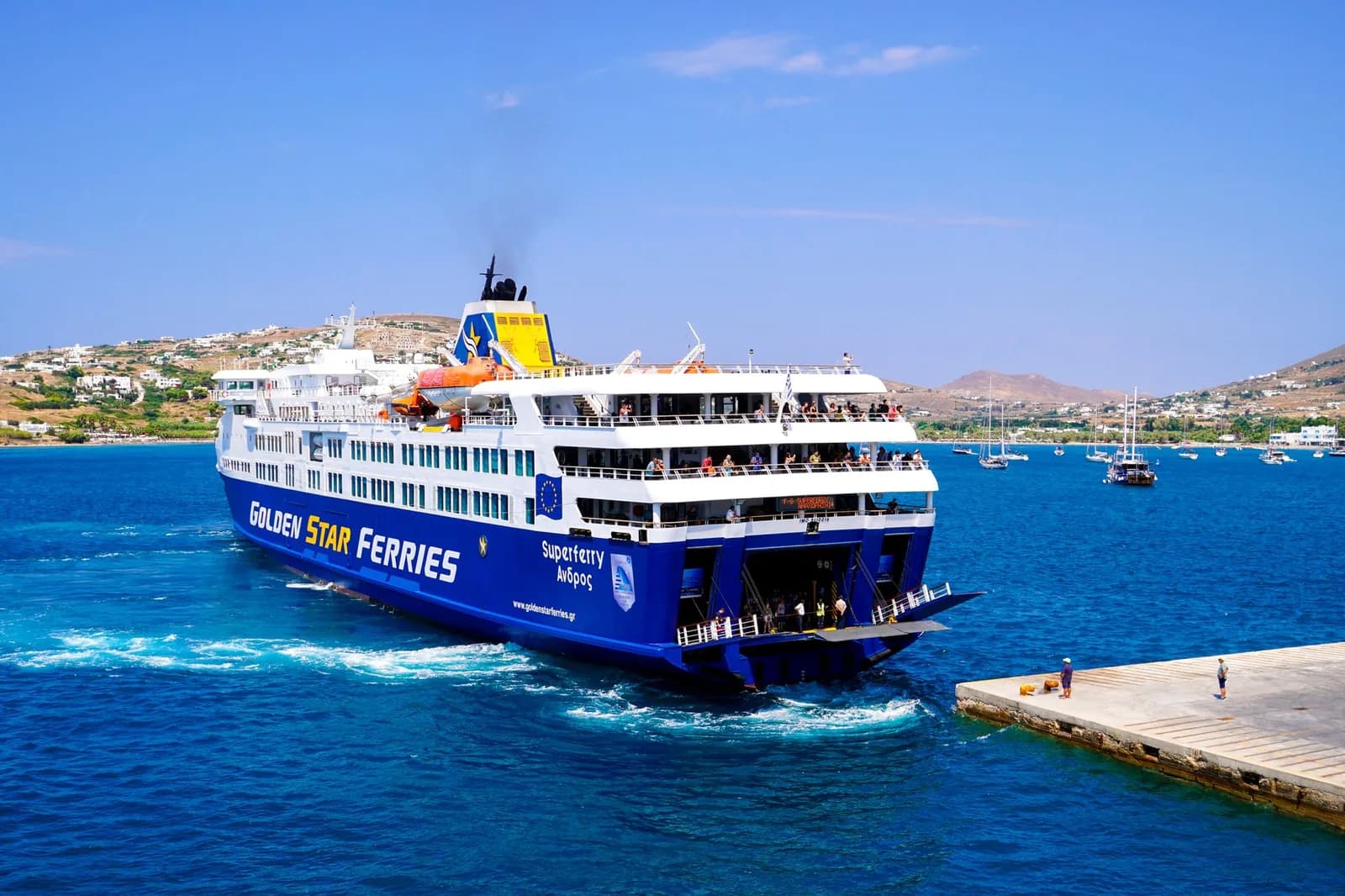
Every ferry from Athens to Paros leaves from Piraeus and lands at Parikia, the island capital. A conventional Blue Star ship takes about four hours, a high-speed vessel about three, and the route runs all year rather than just in summer. What makes Paros worth more than a stopover, though, is what happens after you land. It sits in the middle of the main Cyclades line, so the boats that call here are on their way somewhere else, and that is the whole argument for basing an island hopping trip on it.
Ferry, fast ferry or flight
Paros has an airport, which most route guides leave out of the comparison entirely. It belongs in it, even though the answer here is usually a boat. If you are landing at Athens airport rather than starting from the city, the sums change, and the flight to Paros airport is often the quicker way over.
| Option | Who runs it | Typical journey | Relative cost | Vehicles | In bad weather |
|---|---|---|---|---|---|
| Conventional ferry | Blue Star Ferries, Golden Star | About 4 h from Piraeus | The cheapest of the three | Yes, on every sailing | Sails in almost anything |
| High-speed ferry | SeaJets, Fast Ferries and others | About 3 h from Piraeus | Roughly double the conventional fare | On some vessels only | First to be cancelled in wind |
| Flight | Domestic hops to Paros airport (PAS) | About 40 min in the air | Varies widely, few seats | No | No sea to worry about, but no flights after dusk |
Durations depend on how many islands your sailing calls at, and fares swing hard between the shoulder season and August. Treat the columns as relative, then check the operator for the dates you actually want.
How long the crossing really takes
The four hour figure for a conventional sailing is a good working number, but it moves with the itinerary rather than the ship. Most of the variation on this route comes from how many islands your boat calls at, not from how fast it goes. A service that runs Piraeus to Syros to Paros is a longer morning than one that comes straight down, and the operator sells both under the same route name. Read the stops on the ticket, not just the departure and arrival times.
The other thing the timetable hides is the land end. Getting out of Athens takes longer than the crossing's start time suggests: 40 minutes on metro line 1, then a walk along the waterfront to whichever numbered gate your boat is using, then the margin you want in front of departure. On a seven o'clock sailing that arithmetic has you leaving the hotel in the dark. Check where the harbour actually sits below the city before you pick a neighbourhood for the last night, because half of central Athens is a straight metro ride from the gates and half of it is not.
The other approach is to skip the city altogether. If you land in the afternoon and sail the next morning, working out what the connections out of the airport really cost you in time is more useful than shaving an hour off the crossing, since the metro run in from the east side of Attica is longer than most people budget for.
When the fast boat actually pays
On the long southern crossings the high-speed premium buys you a real chunk of a day. Here it does not. The fast ferry to Paros typically costs around double the conventional fare to save you roughly an hour, and that ratio is worse than on almost any other Cyclades route out of Piraeus. It is the single most useful thing to know before you book this particular leg.
There are still cases where the hour matters. A late afternoon arrival that would otherwise land you at Parikia after dark, a one night stop, a connection you are trying to catch onto another island the same evening. Outside those, the conventional ship is the better place to spend the morning: open decks, a canteen, room to move, and the Cyclades sliding past instead of an airline seat with the blinds down. Deck class is the cheap fare and it does not reserve you a seat, so pay the small supplement for a numbered one on any August sailing.
You land at Parikia, not Naoussa
Paros has two famous harbours and only one of them takes ferries. Parikia, on the west coast, is the island capital and the ferry port. Naoussa, on the north coast, is the whitewashed fishing harbour that fills the photographs, and it handles small excursion boats and nothing larger. People book a hotel in Naoussa, see a harbour in the pictures, and assume the boat from Athens will drop them at the door.
The harbour that is not the port
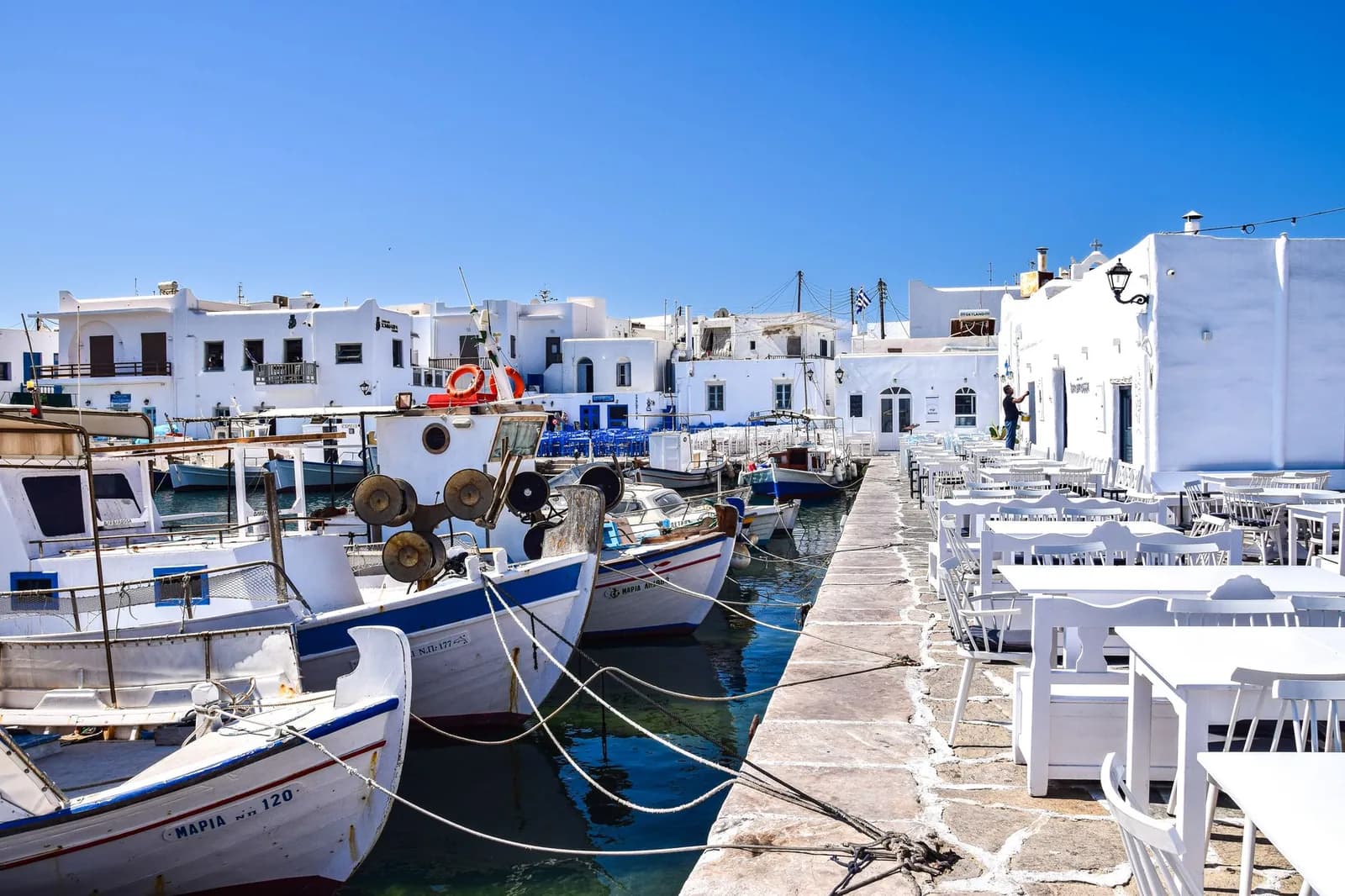
Parikia itself is more useful than its reputation suggests. The ferry quay sits at the edge of the town rather than out in a bay, so you step off the ramp into a place with buses, taxis, car hire desks, a supermarket and somewhere to eat. Buses to Naoussa, Pounta and the southern beaches leave from the terminal beside the port, and they are timed loosely around the main arrivals. Taxis are few in number on Paros, and after a big evening boat they go quickly, so a transfer booked ahead is worth it if you are landing late.
Which of the two towns you sleep in changes the trip more than the boat you took to get here does, and it is largely a question of budget: the port end is the cheaper half of the island and the north coast is where the prices go once the season opens.
Paros is the crossroads of the Cyclades
This is the part that changes how you plan a trip. The main Cyclades ferry line runs from Piraeus down through the islands, and Paros is where it crosses everything else. Boats heading south to Naxos, Ios and Santorini stop here, and so do boats heading north to Mykonos, Tinos and Syros. Several western Cyclades islands are reachable directly in season. From no other island in the group can you sail to as many others without going back to Athens first.
What that buys you is a loop instead of a series of return trips. Base yourself on Paros for a week and Naxos becomes an outing, Mykonos becomes an overnight, and Santorini stops being a separate holiday. Pick where you want to go next and the connections look like this.
Choose a direction and the onward hops follow
Where do you go after Paros?
The main Cyclades line runs down through Paros, and the boats that stop here are the same ones going on to the big southern islands.
Naxos
- Hop
- Well under an hour
- Runs
- Several sailings a day in summer
The shortest useful hop in the Cyclades. Close enough that people day trip it, though the island deserves longer.
Ios
- Hop
- Around one to two hours
- Runs
- Daily in season, thinner in shoulder months
Conventional boats call here on the run down to Santorini, so it costs you a stop rather than a detour.
Santorini
- Hop
- Roughly two to four hours
- Runs
- Daily in season, several times a day in August
The wide spread is the boat, not the distance. A high-speed vessel that skips Ios is a different journey from a conventional one that does not.
Durations are typical rather than scheduled, and the sailings behind them are republished every season. Check the operator for your own dates before you build an itinerary on any of them.
Once the hops are that short, the question stops being which boat and becomes which island you sleep on. The three that most Paros itineraries reach for are not interchangeable. Which corner of Naxos to sleep in is the easy one, since the ferry ties up in the middle of the town and half the rooms are a walk from the ramp. What a caldera view adds to the bill is the reason a lot of people end up doing Santorini as two nights rather than a week. And picking a base on Milos decides whether you need a hire car there, because the beaches are scattered around a large bay and the bus network is thin. Settle those three and the ferry legs arrange themselves.
The Antiparos shuttle
Antiparos sits a few hundred metres off the west coast and functions almost as an annexe of Paros. A small car ferry runs across from Pounta continuously, all day and all year, and the crossing takes a few minutes. There is no timetable worth planning around: you drive down, join the queue, and go. In summer a slower passenger boat also runs direct from Parikia, which suits you if you are on foot and staying in town.
Pounta is roughly 20 minutes from Parikia by road, and buses connect the two. Worth knowing if you are weighing up a hire car: taking one across is routine on this shuttle, unlike on the long crossings, though the rental agreement still has to allow it in writing.
What the wind does to the timetable
A dry northerly called the meltemi runs down the Aegean from roughly June to September and peaks in the two months everybody travels, which is why a Greek ferry timetable is a statement of intent rather than a promise. Port authorities, not the companies, decide when a vessel sails, and high-speed craft are held in harbour long before conditions become genuinely rough. Conventional ships sail through most of what stops them. Cancellations arrive the evening before or the morning of departure, and in peak season the rebooking can be the following day.
Paros is better placed than most islands when that happens, because the volume of traffic through Parikia means there is usually another boat. That is a cushion, not a guarantee. In August a cancelled sailing releases several hundred people onto a timetable that was already full.
Paros to Athens on the way back
The return runs on the same boats in reverse, at similar durations, and the fares are broadly comparable. What differs is the risk. Going out, a cancelled fast ferry costs you an afternoon. Coming back, it can cost you a flight. Never plan to take a high-speed ferry from Paros to Piraeus on the morning of an international departure. Come back the day before, take the conventional ship, or fly from Paros airport.
Departures from Parikia are less predictable than arrivals in one respect. Boats calling at several islands run late by the time they reach Paros, and a sailing scheduled for the middle of the day can turn up an hour behind it. Nobody announces this far in advance, so the practical answer is to be at the quay on time anyway and expect to wait rather than the reverse.
Booking the crossing
The summer schedule is published in stages, not a year in advance, which is why a December search for a July date can come back with almost nothing on it. Nothing is wrong. Once the sailings appear, August weekends go quickly, and vehicle spaces sell out well before passenger seats do, so book the car first if you are bringing one.
Look at what your confirmation actually is. A handful of Greek companies still want it exchanged for a printed boarding pass, either at the quay or at one of their agencies in town, while the rest let you board off a phone screen. Which camp you fall into depends on who you booked with, not on where you are going, and a gate at Piraeus thirty minutes before departure is the wrong place to discover it. Which Athens port serves which island, and how the companies differ, is set out on our page that sorts the ports out.
Questions people ask about the Athens to Paros ferry
How long is the Athens to Paros ferry?
Roughly four hours on a conventional ship and roughly three on a high-speed one, leaving from Piraeus. The gap is smaller than people expect because a large part of any Paros sailing is time spent stopping, and both boat types call at Syros or Mykonos on some services. Timetables are reissued each season, so check the operator for your own dates rather than planning around a fixed figure.
Is it better to ferry or fly from Athens to Paros?
The ferry, for most trips. Paros does have an airport and the flight is short, but it takes small aircraft, the rotations are few, and once you add the trip out to Athens airport and the wait at the gate the saving mostly disappears. The boat also leaves from a port you can reach on the metro and lands you in the island capital rather than out in the fields on the south side. Flying earns its place when you land in Athens too late for the last sailing, or during a windy spell when the fast ferries are being held in harbour.
Is it worth going to Paros, Greece?
If you are island hopping, it is the most useful island in the Cyclades to spend time on. It has the position, since almost every boat on the main line calls here, so you can reach Naxos, Mykonos, Ios, Santorini and several western islands without doubling back to Athens. It also has two very different towns in Parikia and Naoussa, proper beaches, a mountain interior and prices below Santorini and Mykonos. What it does not have is a single postcard image, which is why it gets skipped by people planning a first trip from photographs.
Can you take a car on the ferry from Athens to Paros?
Yes, on the conventional ships and on some high-speed vessels, and the vehicle deck sells out well before the passenger seats in August, so book it as soon as your dates are fixed. The catch is a rented car. Almost every Greek hire agreement ties the vehicle to the island where you picked it up, and sailing it off that island without a signed authorisation leaves you uninsured. Settle that in writing before you book anything. Dropping the car in Athens and picking up another on Paros is usually cheaper than paying the vehicle fare both ways.
Which port does the ferry arrive at on Paros?
Parikia, the island capital, on the west coast. This catches people out because Naoussa, on the north coast, is the harbour on every postcard and the one most visitors picture. Naoussa is a fishing port with excursion boats, not a ferry terminal. If your hotel is in Naoussa, budget around 20 minutes by road from Parikia to reach it.
Is the fast ferry to Paros worth the extra money?
Less often than on the longer Cyclades routes. The high-speed boat saves you around an hour on this crossing while typically charging about double, so the value depends entirely on what that hour is worth to you on the day. On a short trip with a late arrival, it can be. On the way out at the start of a week, the conventional ship is a better deck to spend the morning on.
Do ferries from Athens to Paros get cancelled?
The fast ones do, mostly in July and August, when the north wind is at its strongest. A catamaran is grounded by the harbourmaster long before a ship of any size would be troubled, and in high season the sailing you are moved onto can be the following day. Conventional vessels run through most of what stops them, which is the case for putting a leg you cannot afford to lose on a big boat.
