SeaJets: fleet, routes, seat classes and how to book
The fast catamarans out of Piraeus and Rafina halve the crossing to the Cyclades. Here is which boat runs where, what each seat gets you, and the rules that bite when the wind comes up.
SeaJets is the largest high-speed ferry operator in the Aegean. Its catamarans leave Piraeus, Rafina and Lavrio for the Cyclades, and in season they link Crete with Santorini and the islands with each other. It is the fast, expensive option: about five hours from Piraeus to Santorini instead of eight, in an assigned seat inside a closed saloon, and it is the first company to stay in port when the meltemi blows. If you are still choosing an operator, our guide to Greek ferries puts them all side by side.
SeaJets routes from Piraeus, Rafina and Lavrio
SeaJets works the busiest water in Greece. Almost every boat goes to at least one of the big Cyclades, and the network fans out from three Athens ports. The boats on each line change from one season to the next and sometimes mid-season, so read the table as the shape of the network in summer 2026, and trust the vessel name on your ticket over any list.
| Leaving from | Islands served | Boats seen on the line in 2026 |
|---|---|---|
| Piraeus | Syros, Tinos, Mykonos, Paros, Naxos, Ios, Santorini, on to Heraklion in season | Champions League Jet 1 and 2, Eurochampion Jet 2 |
| Piraeus (western line) | Serifos, Sifnos, Milos | Champion Jet 2 |
| Rafina | Andros, Tinos, Mykonos, then Paros and Naxos on some sailings | Eurochampion Jet, Champion Jet 3, the conventional SuperStar |
| Lavrio | Lemnos, Agios Efstratios and Kavala, on a conventional ship | Aqua Blue |
| Crete | Heraklion or Rethymno to Santorini, then onwards in the Cyclades | Champions League Jet, Elite Jet |
| Between the islands | Paros, Mykonos, Santorini, Milos, Sifnos and the small Cyclades | Super Jet, Super Jet 2 and the smaller passenger-only cats |
The Piraeus line: Mykonos, Paros, Naxos and Santorini
The flagship route leaves Piraeus in the morning and drops passengers at Syros, Tinos, Mykonos, Paros, Naxos and Santorini, some days continuing to Heraklion. Not every sailing calls everywhere, which is why two departures to Santorini on the same day can differ by an hour. Piraeus is the port to pick if you are staying in central Athens: it is on the metro, and our Piraeus port guide shows which gate the fast boats use. For the full run south, see Athens to Santorini by ferry.
Rafina: the short way to Mykonos and Tinos
Rafina, on the east coast of Attica, is closer to the northern Cyclades than Piraeus. The fast crossing to Mykonos from Rafina takes about 2 h 15 to 2 h 45, a little less than from Piraeus, and SeaJets runs several of its Andros, Tinos and Mykonos sailings from there. The catch is the access: Rafina has no metro and is about an hour from the centre by KTEL bus. It suits people landing at the airport, which is about half an hour away. The trade-off is laid out in Athens to Mykonos: Piraeus or Rafina.
Lavrio, Crete and the island-to-island hops
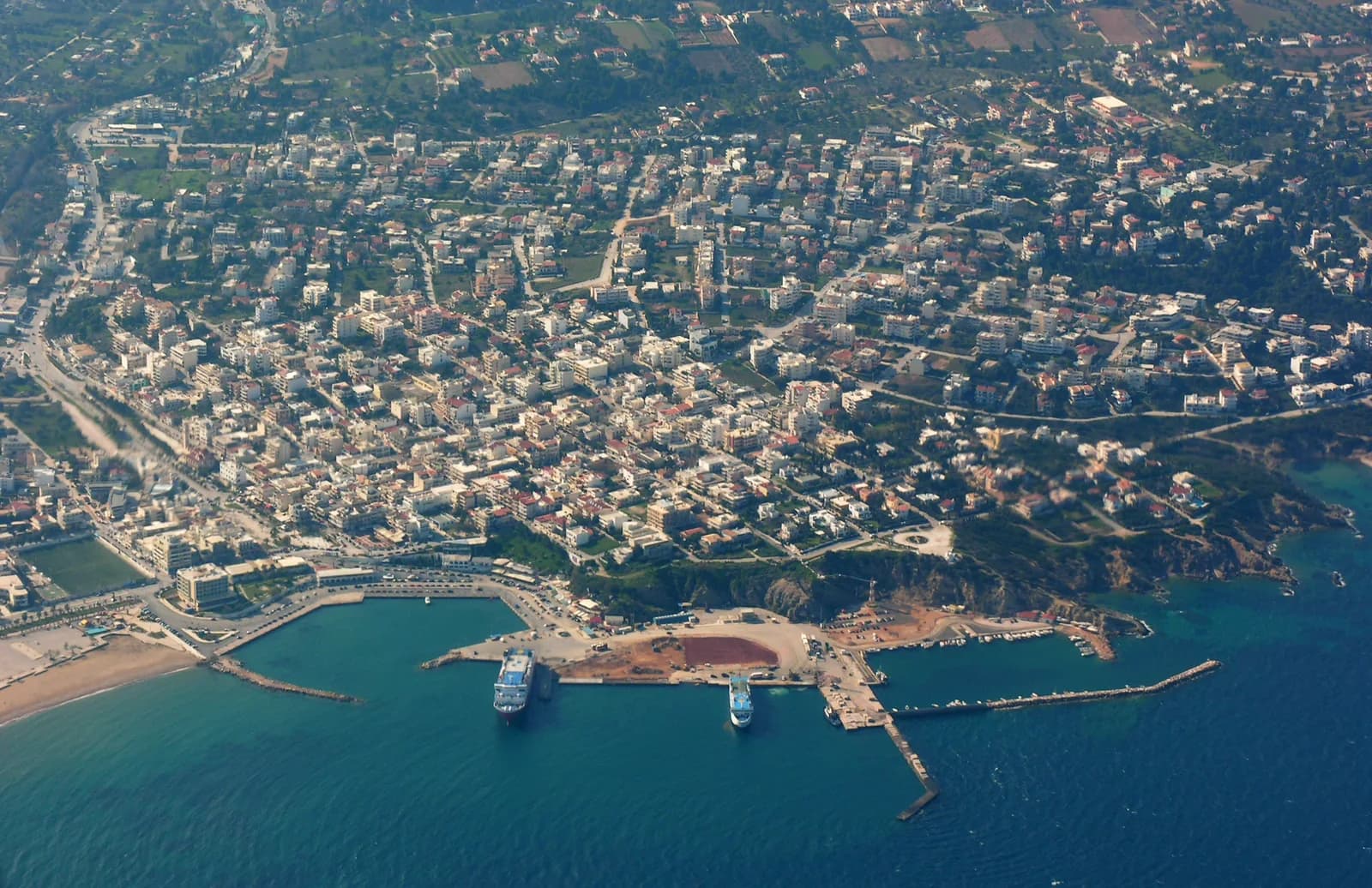
From Lavrio, the third Athens port, SeaJets runs a conventional ship rather than a catamaran, to Lemnos and the North Aegean. In the south, Champions League Jet and Elite Jet have linked Heraklion and Rethymno with Santorini in summer. That crossing is seasonal and stops for the winter, as explained in our page on Crete to Santorini. Between the islands, the small Super Jet catamarans carry foot passengers on short legs like Paros to Mykonos or Milos to Sifnos, which is where SeaJets is often the only direct option.
The SeaJets fleet: WorldChampion Jet, Champion Jet, Naxos Jet
SeaJets owns close to thirty vessels, most of them high-speed catamarans built between the early 1990s and 2007. They look alike from the quay, but they are not the same boat. Size matters at sea: a 110-metre catamaran rides a swell far better than a 40-metre one, and the bigger ones carry cars.
| Vessel | Type | Built | Knots | Passengers / cars |
|---|---|---|---|---|
| WorldChampion Jet | Catamaran, 84 m | 2000 | 50 | 1,055 / 215 |
| Champions League Jet 1 and 2 | Catamaran, 88 m | 2007 | 45 | 1,200 / 225 |
| Tera Jet 2 | Catamaran, 112 m | 2007 | 40 | 1,350 / 280 |
| Eurochampion Jet and Jet 2 | Catamaran | 1998 | 43 | 1,000 / 200 |
| Olympic Champion Jet | Catamaran | 2005 | 43 | 1,160 / 117 |
| Hyperspeed Jet 4 | Catamaran | 2000 | 40 | 1,050 / 188 |
| Champion Jet 1, 2 and 3 | Catamaran | 1996-97 | 40 | 1,000 / 200 |
| Speedrunner Jet, SuperRunner Jet | Monohull | 1998-99 | 40 | About 800 / 160 |
| Elite Jet | Catamaran | 1996 | 35 | 670 / 150 |
| Naxos Jet | Catamaran | 1991 | 32 | 700 / 75 |
| Caldera Vista | Catamaran | 1991 | 30 | 700 / 75 |
| Super Jet, Super Jet 2 | Small catamaran | 1990s | - | About 390, no cars |
Figures come from the company's fleet list as reproduced in March 2026. Other sources give different capacities for the same boat (WorldChampion Jet is listed at anything from 1,055 to 1,310 passengers), so treat them as orders of magnitude.
WorldChampion Jet, the flagship
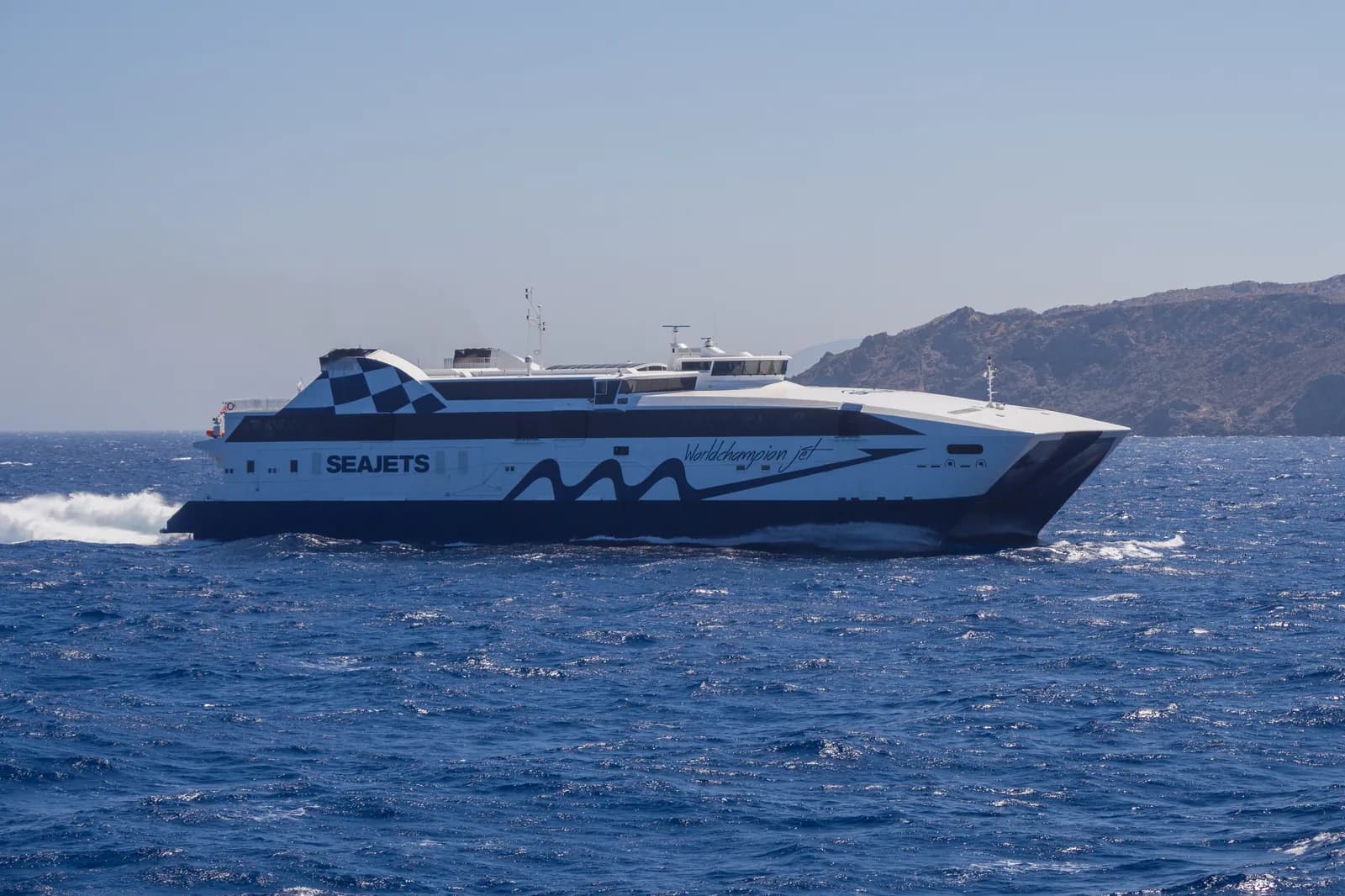
The 84-metre Austal catamaran is the fastest boat in the fleet, at around 50 knots, and was named Ship of the Year at the 2019 Lloyd's List Greek Shipping Awards. It carries more than a thousand passengers and around two hundred cars, has numbered seats in several classes, and usually works the long run from Piraeus to the southern Cyclades.
Champions League Jet, Eurochampion Jet and Champion Jet
These are the boats most visitors end up on. The two Champions League Jets, 88 metres and 45 knots, carry the main Piraeus to Santorini line. The Eurochampion Jets share the Piraeus and Rafina lines. Champion Jet 1, 2 and 3 are older, 40-knot catamarans from the mid-1990s that cover routes like Piraeus to Milos and the weekend Rafina to Naxos run. On all of them you sit inside, in rows of aircraft-style seats, with a café counter and a luggage area by the entrance.
Naxos Jet, Super Jet and the smaller boats
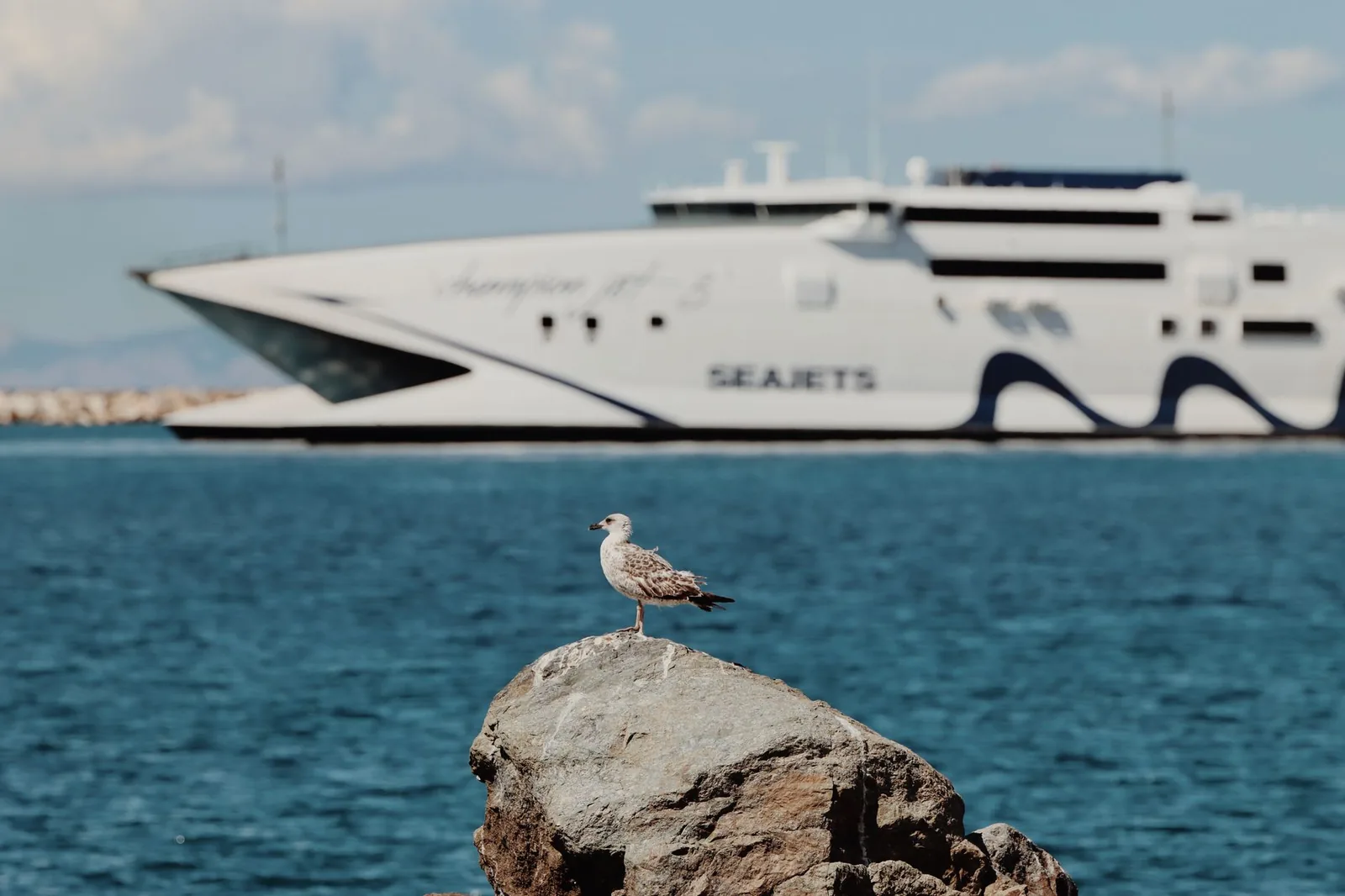
Naxos Jet, Caldera Vista and Elite Jet are older and slower, around 30 to 35 knots, and mostly fill in on shorter or seasonal lines. The Super Jet and Superspeed Jet craft are small passenger-only catamarans of under 400 seats. They are the ones to avoid on a windy day if you get seasick: a short hull pitches hard in the kind of swell a big catamaran barely notices. SeaJets also owns a few conventional ferries, SuperStar on Rafina to the northern Cyclades among them, which run at normal speed and carry their own open decks.
SeaJets seat classes: Economy, Business, VIP and Platinum
On a SeaJets catamaran you cannot walk out on deck, so the seat is the whole journey. Every ticket includes a numbered seat in an air-conditioned saloon. What changes with the class is where that seat sits, how wide it is and how busy the room is around it.
- Economy is the main saloon: rows of reclining aircraft-style seats and a snack bar. It fills completely on summer sailings.
- Business is listed on a few boats only, Naxos Jet among them: a separate area with fewer, wider seats.
- VIP or Platinum, depending on the boat, is a smaller lounge with wider seats and fewer passengers. WorldChampion Jet, the Champion Jets and Elite Jet all have one.
The names and the exact layout change from one vessel to another, and travellers report Platinum seats on some boats that are hardly different from Economy. Before paying extra, look at the seat map shown at the booking stage, which is drawn for the actual boat. One rule is fixed in the general terms: children under five travel free on an infant seat, except in Platinum, where they need a paid seat.
SeaJets luggage allowance
The general terms allow up to 50 kg or one cubic metre of luggage per passenger, included in the fare. There is no limit on the number of bags and no charge for a large suitcase. What the terms do say is that SeaJets is not liable for anything you have not handed in at the purser's office against a receipt, which is how the crew treat valuables.
On board, cases do not travel with you. They go on racks or in a luggage hold near the ramp, and at a busy island stop everyone grabs theirs at once. Keep passports, medication and chargers in a small bag at your seat, and tie something visible to the suitcase so you can find it fast when your island is called.
How to book SeaJets tickets
SeaJets tickets are sold on seajets.com, in the company's app, at port agencies and through comparison sites. Tickets are in the passenger's name: you will be asked for name, sex, nationality and date of birth, and the crew check ID at boarding. Give a mobile number that works in Greece, because that is where SeaJets sends a text if your sailing is cancelled.
On most routes SeaJets is not the only company. Between Athens and Naxos, for instance, Blue Star, Golden Star and SeaJets all sail the same day, and each operator's website ignores the others. A comparison site is the quickest way to see them side by side, or to book an island hop with legs on different companies in one go.
SeaJets discounts: mostly for Greek card holders
Competitor sites list student, large-family and disability discounts on SeaJets. They exist, but the 2026 terms say plainly that they require Greek documents and do not apply to visitors or foreign residents: a Greek university student card, a Greek large-family card, a Greek disability certificate. The discounts that do apply to everyone are the ones by age. Children from 5 to 10 pay half in every seat class, under-fives travel free on an infant seat, and discounts never stack. SeaJets also runs a loyalty scheme, Sea Club, whose points convert into tickets.
SeaJets check-in and boarding
SeaJets offers online check-in on e-tickets, and the boarding pass then shows on your phone. The window opening and closing times quoted around the web differ, so go by the confirmation e-mail of your booking rather than a generic rule. A ticket bought through a reseller is checked in on the reseller's site or app.
The general terms set the time at the quay: passengers at least 30 minutes before departure, vehicles 60 minutes. At Piraeus in summer, count more, because the fast boats leave from the far gates and the walk from the metro is long. Fast boats run to a tight turnaround: if a ramp is up, it does not come down again for a late passenger.
SeaJets cancellation policy and refunds
These are the SeaJets general terms in force in October 2026. The refund depends only on how far ahead you cancel, and only the agency that issued the ticket can cancel it: SeaJets itself for a booking on seajets.com, the reseller for a booking elsewhere.
| You cancel | SeaJets refunds |
|---|---|
| 14 days or more before | 100 % refunded |
| 7 to 14 days before | 75 % refunded |
| 12 hours to 7 days before | 50 % refunded |
| Less than 12 hours before | Nothing back |
| After departure | No cancellation, change or open date |
For a booking made on seajets.com, the cancellation request goes by e-mail, with all the booking details, at least one business day before the deadline you are aiming for. A ticket already printed has to be returned to the company or the central port agent. Refunds are paid within a year, by the issuing agency.
The SeaJets Full Fare Refund Guarantee
Since October 2025 SeaJets sells an optional cover, run by Wallbid, that refunds the whole fare if you cannot travel for one of the reasons listed in its terms. It is added at booking and costs 9.93 % of the total booking amount. Read the list of covered reasons before buying: it pays out only on those, and a travel insurance policy may already pay out for the same events.
Changing a SeaJets ticket to an open date
Rather than cancel, you can turn a ticket into an open-date ticket, up to 12 hours before departure (4 hours on SeaJets' conventional ships). It stays valid for a year on any SeaJets route, with the fare difference to pay if the new trip costs more. The catch: an open-date ticket can never be refunded afterwards.
When SeaJets cancels for weather
When the port authority bans sailings in strong wind, or the company pulls a crossing, SeaJets refunds the ticket value and nothing more. The hotel night you lose on the island or the missed flight are your problem. Fast catamarans are held in port well before the big ferries, so in July and August, never book a SeaJets crossing on the day you fly home. Leave a free day between the last crossing and the flight, or plan to fly from the island itself.
Seasickness on SeaJets: which boat and which seat
A catamaran at 40 knots does not roll the way a big ship does. It slams and pitches, in short sharp movements, and in a closed saloon with no horizon to look at, that is what makes people sick. On a calm morning in June you will hardly feel it. On a meltemi afternoon in August, half the saloon reaches for a paper bag.
What actually helps, in order:
- Pick a big boat. WorldChampion Jet, the Champions League Jets or Tera Jet 2 handle a swell far better than a Super Jet or a Champion Jet. When two SeaJets sailings run the same day, the vessel name decides.
- Sit low, in the middle and facing forward. Movement is strongest at the bow and on the upper deck. Check where the VIP lounge sits on the seat map: the expensive seat is not always the steady one.
- Look at the wind forecast the day before. A strong north wind over the Cyclades means a rough crossing, if the boat sails at all.
- Take the tablet before boarding, not once you feel it, keep your eyes off your phone and eat something light.
If you know you get sick at sea, take the slow boat: a large conventional ferry has open decks and fresh air, and it moves far less.
SeaJets vs a conventional ferry like Blue Star
SeaJets or not comes down to a fast boat or a slow one. The big conventional ships of Blue Star Ferries take about eight hours from Piraeus to Santorini where a SeaJets catamaran takes five, and the fare is often close to half. You can walk on deck, eat in a cafeteria and sleep in a cabin on the overnight lines, and the ship usually sails when the catamarans are held. Our Blue Star Ferries guide compares the two companies line by line.
Take SeaJets when time is tight, the forecast is calm and you are not flying out the same day, or for island-to-island links where it is the only direct boat. Take the conventional ferry if you get seasick, travel with a car, have small children, or have a flight to catch.
Pets, children and cars on SeaJets
Travelling with a dog or cat
Pets travel free but must be declared at booking, as a ticket for an animal cannot be issued on board. Bring the health booklet or pet passport and the microchip number. An animal up to 10 kg can travel in a carrier. On the boats with open decks, dogs stay outside, on a lead and muzzled. Guide dogs go everywhere. The rules allow up to five animals per passenger.
Teenagers travelling alone
Minors aged 15 to 18 travelling without an adult need a parental consent form certified by the police or a port authority, plus their own ID. A plain signed letter is not enough.
Taking a car on a SeaJets catamaran
Only the larger catamarans carry vehicles, and space goes fast in summer, so book the car with the ticket. Electric and plug-in hybrid cars must be declared and arrive with the battery at 40 % or less, and LPG or CNG cars with the tank at 50 % or less. Vehicles must be in the loading area an hour before departure.
Top photo: WorldChampion Jet off Ios, by C messier, Wikimedia Commons, CC BY-SA 4.0.
Questions people ask about SeaJets
Is SeaJets a good ferry company?
It runs the largest high-speed fleet in the Aegean and, on a calm day, it is the fastest way between Athens and most of the Cyclades. The complaints you read online are mostly about two things: delays that pile up through the day on multi-stop lines, and cancellations when the wind rises, since fast catamarans are the first boats held in port. If you have a flight the same day, a tight connection or a weak stomach, book a conventional ferry instead or leave a margin.
Where do SeaJets ferries leave from in Athens?
From three ports. Piraeus carries the main line to Syros, Mykonos, Paros, Naxos, Ios and Santorini and the western line to Serifos, Sifnos and Milos. Rafina, on the east coast of Attica, has the shorter crossings to Andros, Tinos and Mykonos. Lavrio, in the south-east, is used by a conventional SeaJets ship to the North Aegean. The port is printed on the ticket: check it before booking a hotel or transfer.
How fast does a SeaJets ferry go?
Between about 30 and 50 knots depending on the boat. WorldChampion Jet is the fastest of the fleet at around 50 knots, the Champions League Jets and Eurochampion Jets run at 43 to 45, and older craft like Naxos Jet and Caldera Vista at 30 to 32. In practice that puts Piraeus to Santorini at about five hours, against roughly eight on a conventional ship.
Who owns SeaJets?
SeaJets grew out of a company founded in 1989 by the Iliopoulos family, and the Iliopoulos name is still the one associated with it. It is a private company, not part of Attica Group, which owns Blue Star Ferries, Superfast and Hellenic Seaways.
How much luggage can I take on SeaJets?
The general terms allow up to 50 kg or one cubic metre of luggage per passenger, at no extra charge. There is no per-bag limit, but on the fast boats large cases go in a luggage area near the entrance rather than at your seat, so keep valuables and medication in a small bag with you.
Can I cancel a SeaJets ticket and get my money back?
Partly, depending on how early you cancel. SeaJets refunds 100 % up to 14 days before departure, 75 % up to 7 days before, 50 % up to 12 hours before, and nothing after that. If the sailing is cancelled by the company or by a port authority ban for weather, you get the ticket value back. For a full refund on other grounds you need the optional Full Fare Refund Guarantee, sold at booking for 9.93 % of the total.
Is there a SeaJets app and live tracking?
SeaJets has its own booking site and app where you can find a booking and download your boarding pass. For the position of a boat at sea, a live vessel tracker such as MarineTraffic or VesselFinder is more reliable: search for the vessel name printed on your ticket. On a day of strong wind, check the SeaJets website and the text messages sent to the mobile number given at booking.
