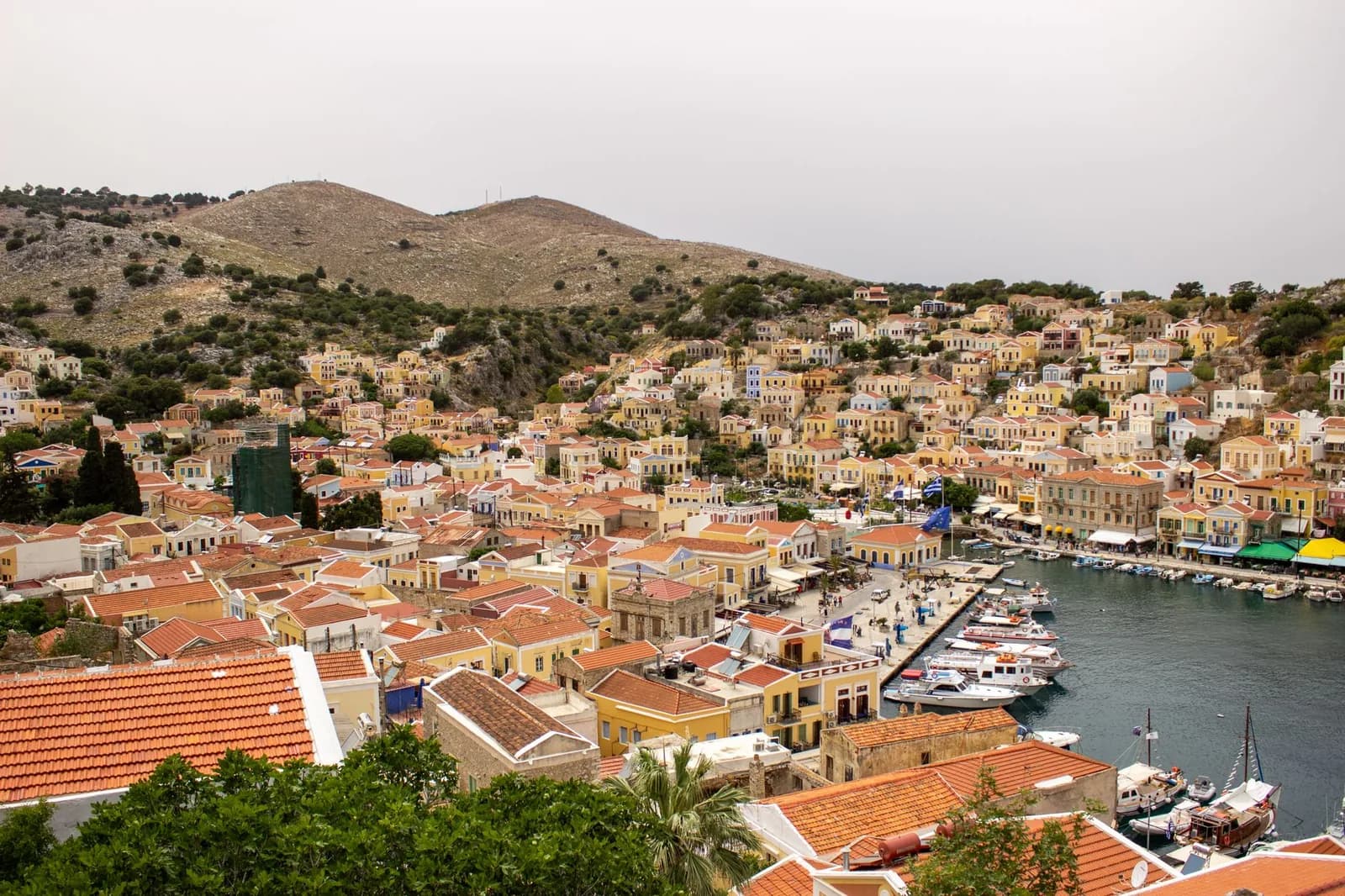
The Dodecanese: which island, and how they join up
Two of these islands take a direct flight from northern Europe. The other dozen take a boat from one of the two. Everything that goes wrong with a Dodecanese trip starts with not knowing which is which.
This is the chain that hugs the Turkish coast, from Patmos in the north down to Karpathos on the way to Crete. It is the only Greek island group with two international airports, and that is not a detail: it means you can fly in at one end, work your way along and fly home from the other, which is impossible almost everywhere else in the country. It also means the season here stretches weeks past the point where the Cyclades start shutting up shop.
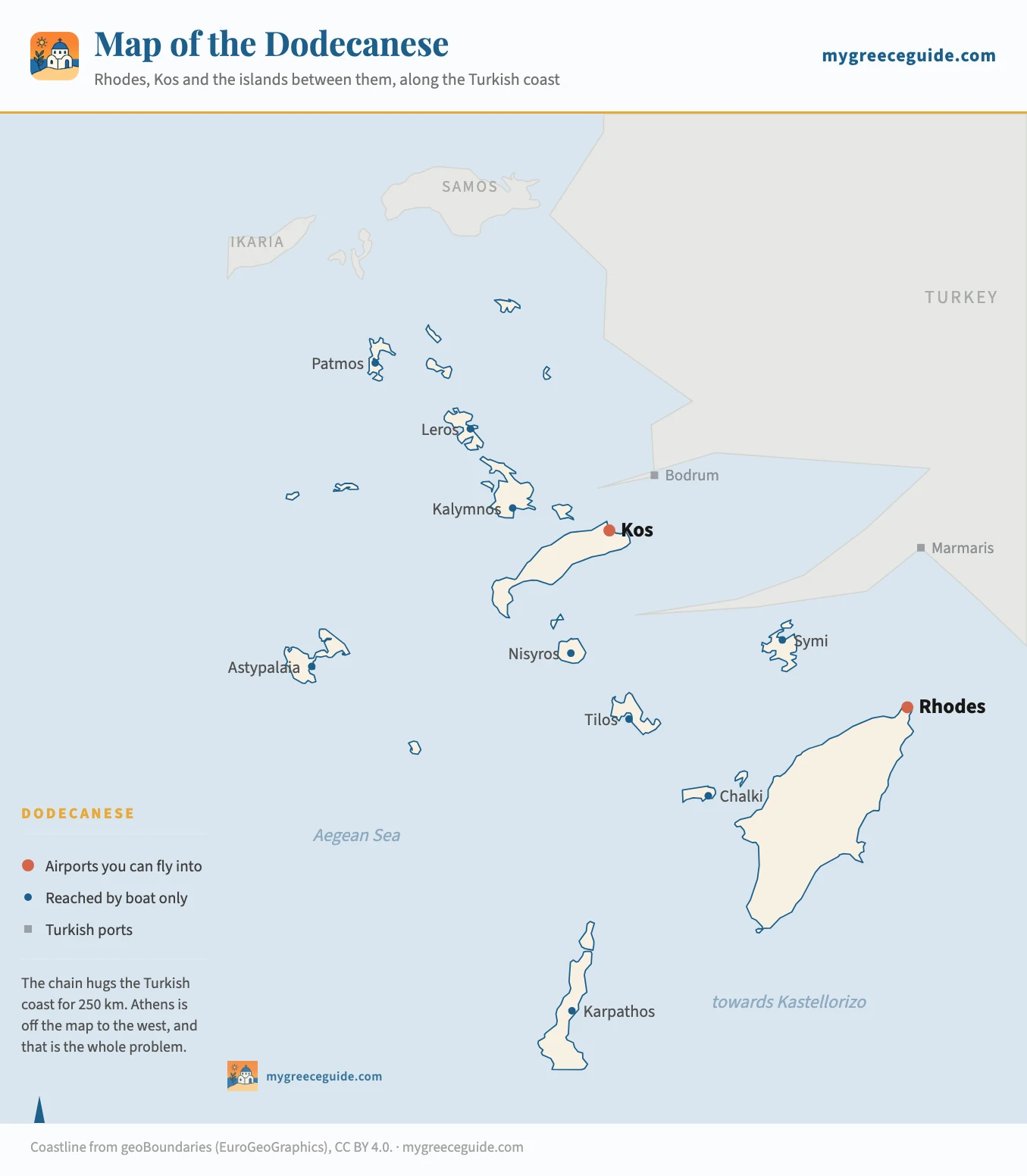
The chain
The Dodecanese runs for about 250 km along the Turkish shore, and every island on it is closer to Turkey than to Athens. Rhodes and Kos carry the flights, marked in terracotta. Everything else is reached by boat from one of the two, and the further you get from them, the fewer boats there are. Karpathos, well to the south-west, is the outlier: it belongs to the group administratively and to Crete geographically. Coastline from geoBoundaries (EuroGeoGraphics), CC BY 4.0.
If you are still working out where this group sits against the rest of the country, the six island groups laid out on one map settles it faster than any amount of reading. The short version: the Cyclades are in the middle of the Aegean, the Dodecanese are pinned to its eastern edge, and there is a great deal of open water between them.
Rhodes and Kos are the two doors
Both take charter and low-cost flights from the UK, Germany, the Netherlands and Scandinavia through the summer, and Rhodes keeps taking them well into October. If you are coming from outside Europe, both are also reachable on a domestic hop from Athens several times a day. No other island in the group has a runway that takes a jet from abroad. Karpathos, Kalymnos, Leros, Astypalaia and Kastellorizo have airfields, but they take small domestic aircraft routed through Athens or Rhodes, which usually costs you a night somewhere on the way.
The two are not interchangeable. Rhodes is big. Eighty kilometres from the medieval town at the northern tip to the empty south, with the resorts strung down the east coast in a rough order of nightlife, then families, then nothing at all. Where you book decides how much of the week you spend in a car, which is why the layout of the island is worth ten minutes before you book and why the choice between Ixia, Faliraki and Lindos is really a choice about transfers: twenty minutes from the runway, or an hour.
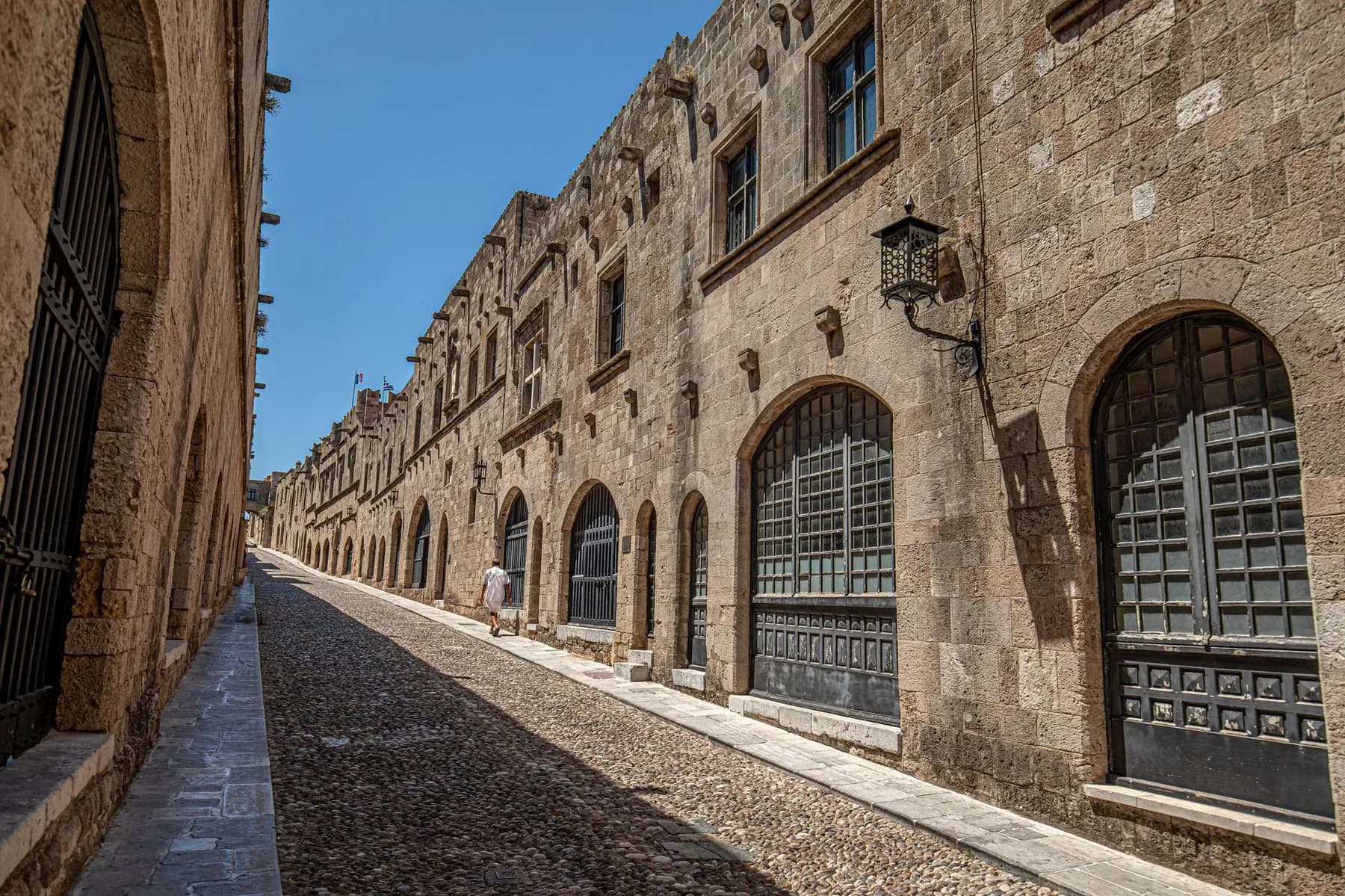
What sits at the northern tip
Kos is the opposite: flat, small and cyclable. The ancient sites are within reach of the town, the airport sits in the middle of the island at Antimachia rather than beside the main resort, and the transfer to your resort is the first thing to check because the two ends of the island are a long way apart by bus. Seeing where Kos Town, Kardamena and Kefalos actually fall makes the difference between hiring a bicycle for the week and hiring a car, and the hotels in each Kos resort follow from that choice.
What the smaller islands add, and who each one suits
None of these are versions of Rhodes with fewer hotels. They each do one thing that the two big islands do not, and picking on that basis works better than picking on beaches.
Symi is the harbour everyone has seen in photographs: tiers of ochre and cream neoclassical houses stacked around a deep inlet, built on sponge money in the nineteenth century and never modernised. Day boats from Rhodes fill it between late morning and late afternoon. Stay the night and you get the other version. There is very little flat ground and almost no beach you can walk to, so it suits people who want to sit and look rather than swim and drive.
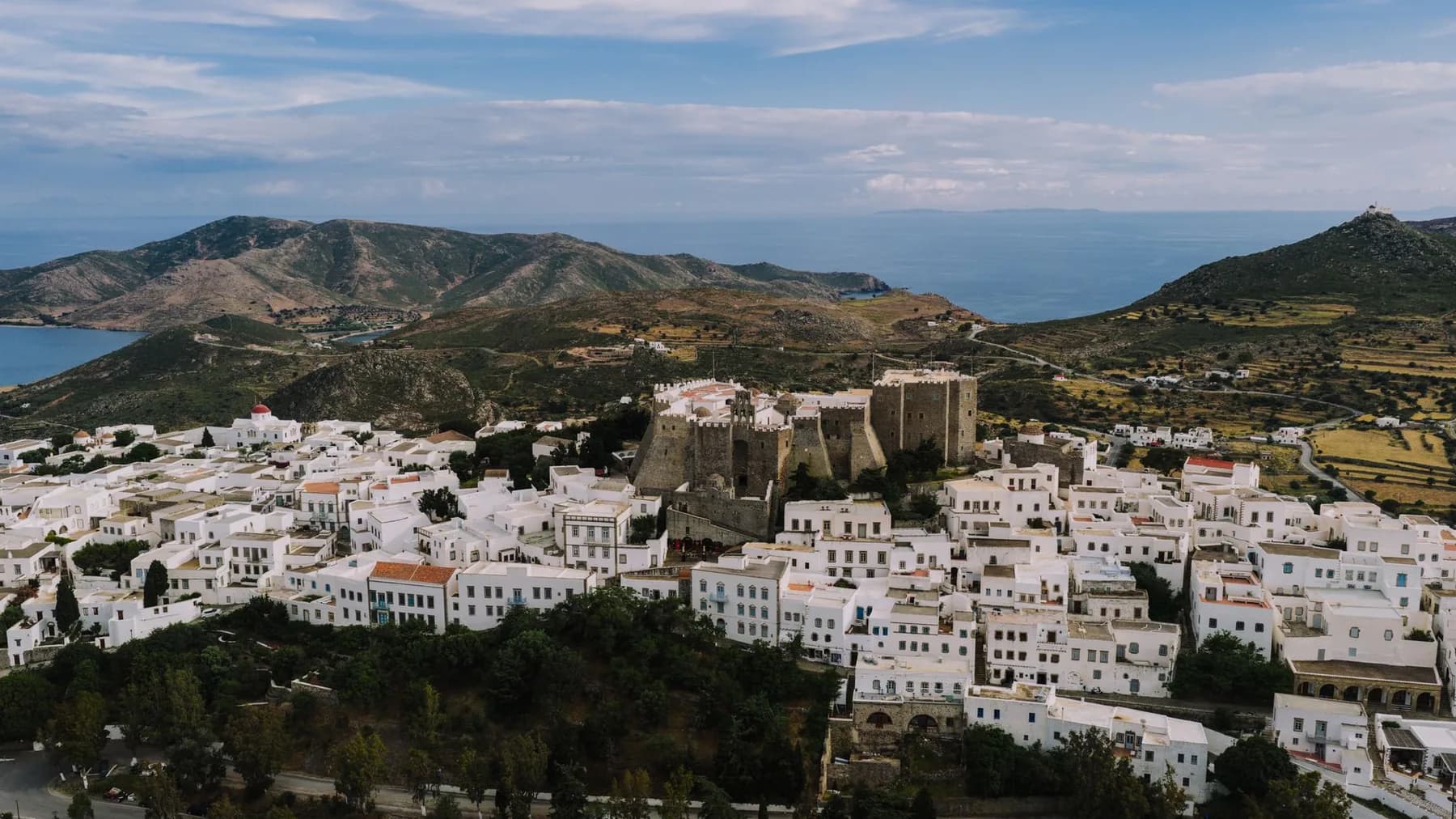
Patmos is the northern end of the chain and the one with real weight to it: the cave where the Book of Revelation was written, and the fortified monastery of Saint John above the white houses of Chora. Cruise ships call by day. The island suits people who want a place with a subject, and it is a long way from Rhodes, so it belongs to a Kos-based trip rather than a Rhodes-based one.
Patmos, from above the Chora
Kalymnos lives off sponge diving history and, since the 1990s, off rock climbing. The limestone above Massouri is one of the best sport climbing venues in Europe and it has quietly reshaped the island, which now has a season that starts in March. Pothia, the port, is a working town rather than a resort, and that is either a feature or a disappointment depending on what you came for.
Karpathos is the wild one. A long mountainous island between Rhodes and Crete, with a road over the spine that takes far longer than the distance suggests, a northern village at Olympos where the old dialect and dress survived because nothing could reach it, and a west coast that the north wind hammers all summer. It is the best windsurfing in Greece and the wrong island for a family who want still water.
Leros got Italian rationalist architecture instead of hotels: Lakki was built as a naval town in the 1930s and looks like nowhere else in Greece. Deep sheltered bays, a fortress above Platanos, almost no package trade. It is the quietest of the northern three by a distance.
Astypalaia is the odd one out geographically, sitting out west towards the Cyclades, and it looks Cycladic too: a white hilltop chora under a Venetian castle rather than the ochre of Symi. It is genuinely quiet. It is also the island whose connections disappoint people most often, so treat it as a destination rather than a stop.
Building a route from the airport you land at
The chain runs north from Kos and south from Rhodes, and the two halves do not mix well on a short trip. Pick your gateway first, then work outwards from it rather than trying to assemble a list of islands and find boats that link them.
Set the gateway and the length to get the hops
Where does the trip start?
And how long have you got?
Rhodes plus one neighbour. The chain runs north-west from here, so the second island is a short crossing rather than a day at sea.
Rhodes
4 nights
Fly in
Base in or near the town for the first half so you are not driving the coast road every evening.
Symi
3 nights
Regular boats from Rhodes in season, well under two hours
No airport, one real village, and no beach you can walk to. That is the trade: it is quiet because getting there is a decision.
One thing to watch. Tilos works instead of Symi if you want walking and empty beaches over the postcard, but sailings are thinner and you need to check the return before you commit.
Turkey is close enough to see, and that is a real option
From Kos you can see Bodrum across the strait, and small boats cross it daily in season. From Rhodes the run to Marmaris is longer but still a morning. Nowhere else in Greece puts a second country that close to a beach holiday, and a lot of people use it for a day out in a bazaar or a Turkish bath and come back for dinner.
Three things to understand before you book it. It is a full international border crossing, so you need your passport, not a driving licence, and you should check your own nationality's entry requirements for Turkey rather than assume. A single-entry Schengen visa is spent the moment you leave Greece, which catches people out every year. And your hire car cannot come with you: Greek rental contracts do not permit the vehicle to leave the country, and in practice they rarely permit it to leave the island either.
The crossing itself is run by small local operators on both sides, and the timetable is seasonal rather than fixed. Sailings thin out sharply outside the summer months, and the last boat back is early enough that missing it means a night in Turkey. The map of the group draws every crossing to the Turkish coast, with the distances and how long each one takes, which is the quickest way to see which islands have one and which only look as though they should.
Why this group does not combine with the Cyclades
It is the single most common planning mistake on this coast. Rhodes and Santorini look near each other on a map of Greece, and the ferry network says otherwise. The Greek ferry system is built around Piraeus, and the lines radiate out from it rather than running across the Aegean, so the natural way from the Dodecanese to the Cyclades is back through Athens.
There is one exception, and it deserves to be described honestly rather than sold. A seasonal Blue Star line does link Rhodes and Kos to Astypalaia and on to Naxos and Paros before ending at Piraeus. It runs a couple of times a week in high summer, the crossing is long, and if the day you need is not the day it sails, there is no second option. Inside the group itself the useful operator is Dodekanisos Seaways, whose catamarans work the chain between Rhodes, Kos and Patmos daily in season. Understanding which company covers which part of the map is more useful here than anywhere else in Greece, because the answer is not the same one you get in the Cyclades.
The practical conclusion: if you want Santorini and Rhodes in the same fortnight, fly between them or route through Athens, and budget a day for it either way. A look at the distances involved usually kills the idea before the ferry timetable does.
The season here runs longer than anywhere except Crete
This is the group's quiet advantage and hardly anyone plans around it. Rhodes and Kos sit far enough south and east to stay warm late, and they carry enough direct flights for the airlines to keep flying them after the Cycladic routes have stopped. October on Rhodes is a normal holiday: hotels open, restaurants open, sea still swimmable. The same week on Mykonos or Milos is a shuttered village and a domestic flight.
The other end of the year works too. Rhodes Old Town and the ancient sites on Kos are better in April and May than in August, when the heat and the cruise passengers arrive together. What you lose in the shoulder months is the small islands: boats to Symi, Tilos and Nisyros thin out, and a route that depends on three crossings becomes a route that depends on luck. Shoulder season here means one island, comfortably, rather than three in a hurry.
Getting around once you land
The buses on Rhodes and Kos are real and usable along the main coast roads, and hopeless everywhere else. On the small islands there is often one bus that meets the boat and nothing after it, which is why a scooter is the local answer on Symi, Tilos and Leros. On Karpathos the distances and the road over the mountain make a vehicle close to compulsory if you want to see the north.
Questions people ask about the Dodecanese
Which are the best Dodecanese islands?
For a first trip, Rhodes if you want a town to walk in the evening and a long coast to choose from, Kos if you want flat ground, ancient sites and short crossings in every direction. After that it splits by taste rather than quality: Symi for the harbour, Patmos for the monastery and the quiet after the cruise ships leave, Kalymnos for climbing, Karpathos for wind and empty beaches, Leros for Italian architecture and deep bays, Nisyros for a volcanic crater you walk into.
What are the names of the major islands in the Dodecanese?
The ones with regular connections and somewhere to sleep are Rhodes, Kos, Karpathos, Kalymnos, Patmos, Leros, Symi, Astypalaia, Tilos, Nisyros, Chalki, Kasos, Lipsi and Kastellorizo. Rhodes and Kos are the only two with international airports. Karpathos, Kalymnos, Leros, Astypalaia and Kastellorizo have small domestic airfields that connect through Athens or Rhodes rather than to Europe.
What are the 12 islands of the Dodecanese?
The traditional twelve are Rhodes, Kos, Patmos, Leros, Kalymnos, Astypalaia, Karpathos, Kasos, Symi, Tilos, Nisyros and Chalki. The name was a political label rather than a count: it came from the twelve islands that kept a measure of privilege under Ottoman rule, and Rhodes and Kos were not among them at first. The group as administered today holds fifteen larger islands and well over a hundred smaller ones.
What does the name Dodecanese mean?
It means twelve islands, from the Greek dodeka, twelve, and nisos, island. The label stuck in the nineteenth century and survived the Italian occupation, the Second World War and the union with Greece in 1948, even though the number has never matched the map. Nobody living there counts them.
Which is the largest island in the Dodecanese?
Rhodes, at around 1,400 square kilometres, which makes it the fourth largest Greek island after Crete, Evia and Lesbos. It is roughly 80 km from end to end, so it takes about an hour and three quarters to drive from Rhodes Town to the far south. Karpathos is second by area and feels far bigger than it is, because the road over the spine is slow.
Which Greek islands are not to visit?
None of them are bad islands, but plenty are bad matches. In this group, avoid Astypalaia if your trip depends on catching a connecting boat, because its links are thin and it sits away from the chain. Avoid Karpathos in high summer if you want calm water, because the north wind is the defining fact of the island. And avoid basing yourself in the far south of Rhodes without a car, because the bus timetable will decide your week for you.
Which is the prettiest and quietest Greek island?
Those two rarely come together, and in the Dodecanese the honest answers are different islands. Symi is the prettiest by a distance and it is only quiet after the last day boat leaves Rhodes, which is exactly why staying the night changes it. For quiet, Leros and Tilos are further down the chain, have no package trade to speak of, and stay that way in August.
