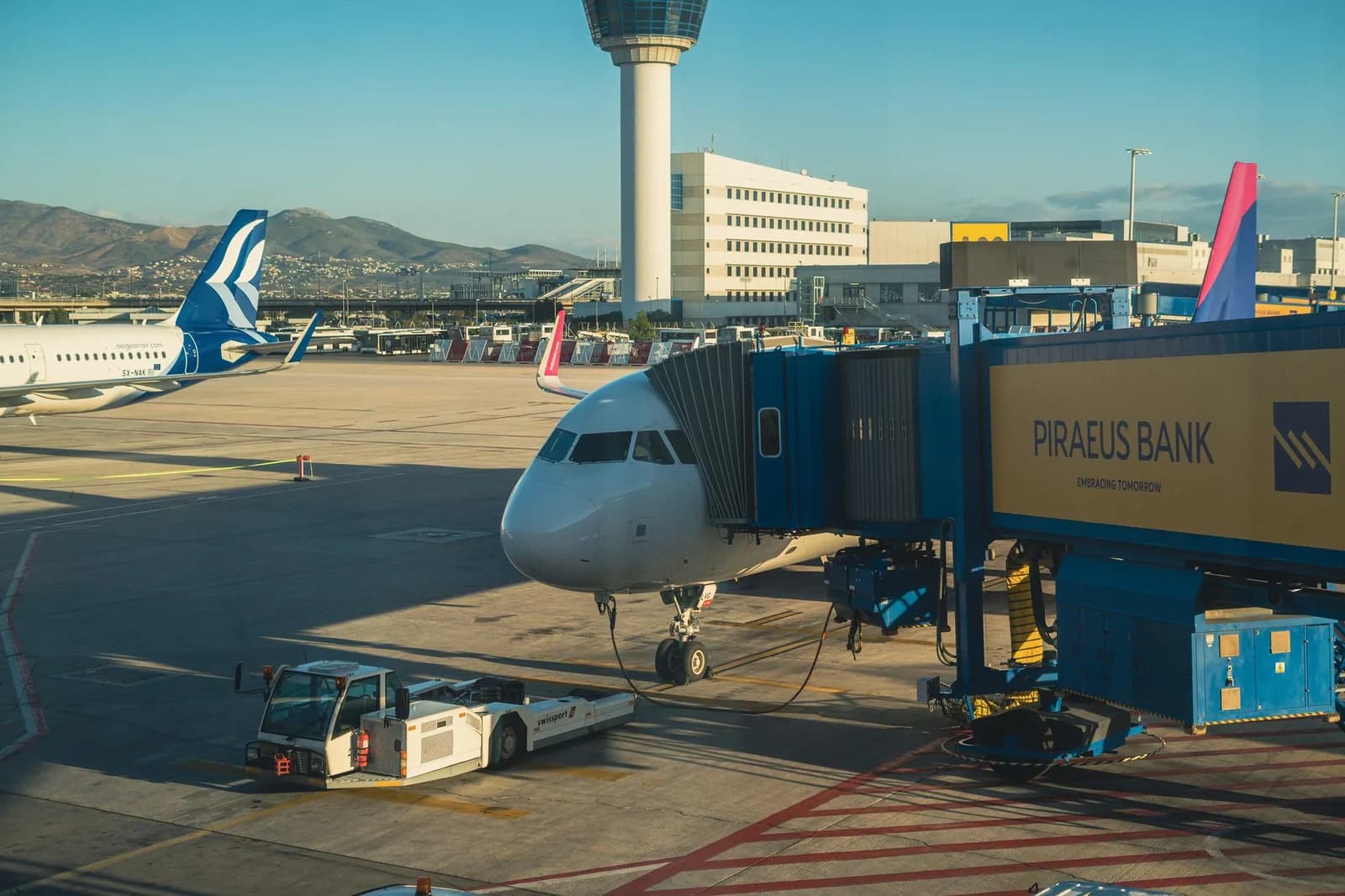
Athens airport: how it works and how you leave it
Athens International Airport is the one hub Greece has, so almost every trip passes through it, and most people pass through it twice. It is 33 km from the city, and the port nearest to it is not the one you have heard of.
Athens International Airport, formally Athens International Airport Eleftherios Venizelos and coded ATH, opened in 2001 and replaced the old airport at Hellinikon outright. It is the only Greek airport with a full long-haul network and the only one with a domestic network worth the name, which is why a Santorini trip flown from Manchester or Newark almost always touches down here first. The airport is not in Athens. It is at Spata, 33 km east, on the far side of Mount Hymettus, and everything below follows from that one fact.
Out of the airport
Where the airport actually is
Athens sits in a basin closed by mountains on three sides. There was no room for a modern airport inside it, so the new one went over the ridge, into the Mesogeia plain around Spata. That put 33 km and a mountain between the terminal and Syntagma Square, which is more than Gatwick is from central London. Every arrival at ATH begins with a journey of forty minutes or more, and no amount of planning shortens it.
What Greece got in exchange is a motorway and a metro line built at the same time as the runways. The Attiki Odos ring road runs from the terminal doors around the north of the city and out to the west, and metro line 3 shares the same corridor. Nothing about leaving Athens airport is improvised, which is not true of every Mediterranean capital.
There is one passenger terminal, with a main building for check-in and a satellite reached by an underground link. The Schengen and non-Schengen gates occupy different arms of the same building. You never change terminals at Athens, which removes the single most common way to miss a connection.
Getting from the airport into Athens
Metro line 3 is the default. It leaves from a station attached to the terminal, reaches Syntagma in about forty minutes and carries on to Monastiraki, which is where most visitors are actually staying. The catch is the frequency: only every second line 3 train continues past Doukissis Plakentias to the airport, so the wait can be half an hour even though the line itself is busy. Check the destination on the front of the train rather than trusting the platform.
The X95 bus is the cheaper version of the same trip, and its real advantage is that it never stops running. It leaves from outside arrivals, ends at Syntagma, and takes an hour in light traffic or considerably longer in the evening rush. If you land at three in the morning, this is the bus that saves you a taxi fare.
Taxis charge a regulated flat fare into the central zone, set by the authorities rather than the meter, with a higher night rate between midnight and five. That fare covers the car, not the person, so four people with luggage are close to the cost of four metro tickets and considerably less tired. Take the rank outside arrivals or a booked transfer, and ignore anybody who approaches you inside the building.
Every way out of the airport, compared
Times below are typical rather than promised, and the fares are orders of magnitude. Greek transport prices have moved more than once in recent years and the winter timetable is thinner than the summer one in every row.
| Where to | How | Time | Roughly how often | Indicative fare |
|---|---|---|---|---|
| Central Athens | Metro line 3, direct to Syntagma | 40 min | About every 30 min | €9 or so |
| Central Athens | Bus X95 to Syntagma | 1 h to 1 h 30 | Round the clock, every 20 to 30 min | €5.50 or so |
| Central Athens | Taxi, regulated flat fare | 35 to 60 min | Rank outside arrivals | €40 day, €55 night, or so |
| Piraeus (main ferry port) | Metro line 3, through to the port | 1 h 05 to 1 h 20 | About every 30 min | €9 or so |
| Piraeus (main ferry port) | Bus X96, along the coast | 1 h 30 or more | Round the clock, every 20 to 40 min | €5.50 or so |
| Rafina (port for Mykonos, Tinos, Andros) | KTEL Attica bus | 35 to 45 min | A handful of runs a day | Around €3 |
| Rafina (port for Mykonos, Tinos, Andros) | Taxi or booked transfer | 25 to 30 min | On demand | Metered, no flat fare |
| Lavrio (port for Kea and Kythnos) | KTEL Attica bus | About 1 h | Several runs a day | Around €5 |
| Kifissos coach station | Bus X93, for the mainland KTEL network | 1 h 05 to 1 h 30 | Round the clock, roughly hourly | €5.50 or so |
Fares are orders of magnitude, not quotes. The airport metro supplement, the express bus ticket and the regulated taxi flat fare have all been revised more than once since 2022, and timetables thin out between November and March. Check aia.gr and the OASA site for the day you travel.
If you are catching a ferry the same day
This is where most Athens arrivals go wrong, and the reason is a simple piece of geography nobody mentions at the booking stage. Rafina is closer to the airport than Piraeus is. The airport sits on the east side of Attica, Rafina is 20 km further up the same coast, and the road between them takes about half an hour. Piraeus is on the opposite side of the city, 45 km away, and the metro journey runs past an hour before you have found your gate.
Rafina serves the northern Cyclades: Tinos, Andros, the fast boats over to Mykonos and Paros on some sailings. Piraeus serves everything else, including Santorini, Crete, Naxos and the Saronic islands, and it is the port at the end of the metro line. So the honest rule is that the island decides the port, not your convenience. But when the island is served from both, which happens on the Mykonos run, Rafina turns a two-day arrival into a one-day one.
Whether landing and sailing on the same day is realistic depends on which crossing you have booked, and the four that come up most from an Athens arrival behave differently. Paros is the flexible one, sold from both ports, so an early landing can usually be turned into a boat that afternoon. The Naxos crossing leaves from Piraeus, which adds the trip across the city before anything else happens. Milos, out in the western Cyclades, is the longest of the four and the one where an afternoon arrival means sleeping in Athens whatever the timetable seems to promise.
The awkward part is that the bus between the airport and Rafina runs only a handful of times a day and is not coordinated with the boats. Look at both timetables before you buy the crossing, and price a taxi as the fallback, because on a tight connection it usually becomes the plan. The ferry guide covers which operator sails from where, and what the meltemi does to a fast boat in August.
What happens after you land?
Take
Metro line 3
One train, no change, and it puts you at Syntagma or Monastiraki inside forty minutes whatever the traffic on the Attiki Odos is doing. The station is signposted from arrivals and the platform is a covered walk away.
Two of you with two suitcases, or a party of four, and the taxi flat fare works out close to the same money for half the effort.
Connecting to a flight to the islands
Aegean and Sky Express fly the domestic network out of Athens, and between them they reach most islands with a runway. On a single ticket from anywhere in the EU the connection is straightforward: you land in the Schengen arm, walk to another gate in the same building, and never see passport control. Ninety minutes is enough, and the longest walk between far gates is around fifteen.
The domestic network
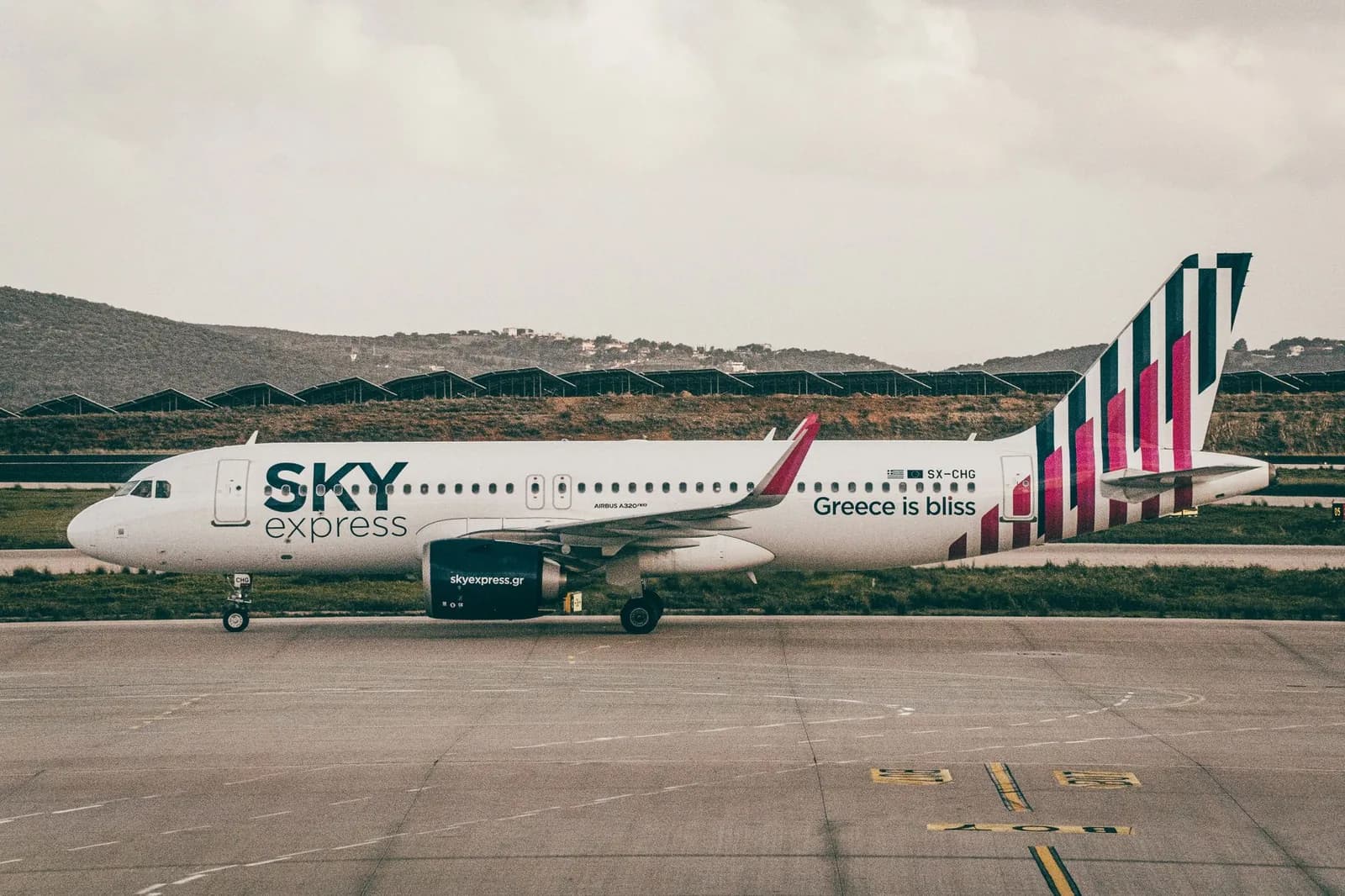
Two things break that. Arriving from outside the Schengen area, from the United Kingdom or the United States, puts you through passport control first, and the queue in July is not a formality. Booking the long haul and the island hop as two separate tickets breaks it completely: you collect your bag, leave the secure area, check in again, and no airline owes you anything if the first flight is late. Give yourself three hours if you have done that, and treat the saving as the price of the risk.
Early island flights, and whether to sleep out here
Island departures cluster at the start of the day. An aircraft that leaves Athens at six in the morning can fly four sectors before lunch, so that is when the airlines schedule them, and it is why so many Greek holidays begin with a five o'clock alarm.
Work the arithmetic backwards and the problem shows up. A six o'clock flight means being at the terminal by half past four, and the metro is not running then. From central Athens that is a taxi at four in the morning, at the night rate, on empty roads. From a hotel at Spata or Artemida it is a ten minute shuttle and an extra hour and a half in bed.
The counterargument is that this side of Attica has nothing to offer an evening. The airport hotels are functional, the villages around them are ordinary, and you have traded your last dinner in Athens for a car park view. Sleeping out here earns its keep before an early departure and almost never otherwise. Coming the other way, arriving at midnight, the all-night bus makes the centre perfectly reachable and the question does not arise.
Picking up a car at the airport
Be clear about what a car is for here. In Athens itself a car is a liability: the centre is walkable, the metro reaches the port and the airport, parking is scarce and expensive, and the traffic is genuinely bad. If your trip is Athens and then an island, you do not want one at all.
Where the airport desks earn their place is the mainland. Delphi, Nafplio, Cape Sounion and above all the loop around the Peloponnese all want a car, and collecting it at the terminal puts you straight onto the Attiki Odos without crossing the city. If Athens comes first in the itinerary, the move is to see the city on foot and pick the car up on the day you drive out, rather than paying for the days it sits parked. The Athens map shows how little of the centre actually needs wheels.
The other Greek airports work differently, and the island ones especially so. Each of them gets its own page as they are written, gathered on the airports guide.
Questions people ask about Athens airport
Are there two airports in Athens?
Only one that takes passengers. Athens International Airport, named after the statesman Eleftherios Venizelos and coded ATH, has handled every scheduled flight since it opened in 2001. The old airport at Hellinikon, on the coast south of the centre, closed the same year and its site is now being redeveloped as a park and a marina. If a booking or a taxi driver mentions Hellinikon, they mean the district, not an airport.
Is Athens airport easy to get through?
By the standards of a capital-city hub, yes. There is one passenger terminal, so a connection never involves a shuttle bus between buildings, and the walk from the furthest satellite gate to the main hall is on the order of a quarter of an hour. Signage is bilingual and unambiguous. What varies is the queue: an August morning with several long-haul arrivals stacked together puts a real wait on passport control, and the security lanes back up in the early evening departure wave. In April the same building feels half empty.
How early do you need to be at Athens airport?
Two hours before a European departure is the sensible default and three in July and August, when check-in desks, security and passport control all peak inside the same couple of hours. For a domestic flight to an island, ninety minutes is normally enough because there is no passport control and the gates are close. Add time on top if you are dropping a hire car, since the return lots are in the car park building rather than at the door.
What are the current issues at Athens airport?
The recurring one is capacity. Passenger numbers have grown faster than the building, which was sized around 2001 traffic, so the summer peaks are tight and an expansion programme is under way to add gates and floor space. That means construction hoardings in places and occasional reshuffled gates. Beyond that, the things that actually disrupt a trip in Greece are strikes, which are announced in advance and can hit the metro, the buses or air traffic control, and summer wind, which delays island flights rather than the airport itself.
What is Athens airport called, and where is it?
Athens International Airport Eleftherios Venizelos, code ATH, in Greece, at Spata in eastern Attica, 33 km from the centre of Athens. The name catches people out twice: Venizelos was a Cretan prime minister rather than a place, and there is a completely unrelated Athens in Georgia, in the United States, whose airport is AHN. If a fare looks impossible, check the code before you book.
Where do I check Athens airport arrivals and departures?
The airport's own site and app carry the live board, and it is the version that updates first when a flight slips. The screens in the terminal show the same feed. Search by flight number rather than by destination, because the island routes are flown several times a day by the same two carriers and it is easy to read the wrong row.
