The Cyclades: which island to pick, and how to string a week together
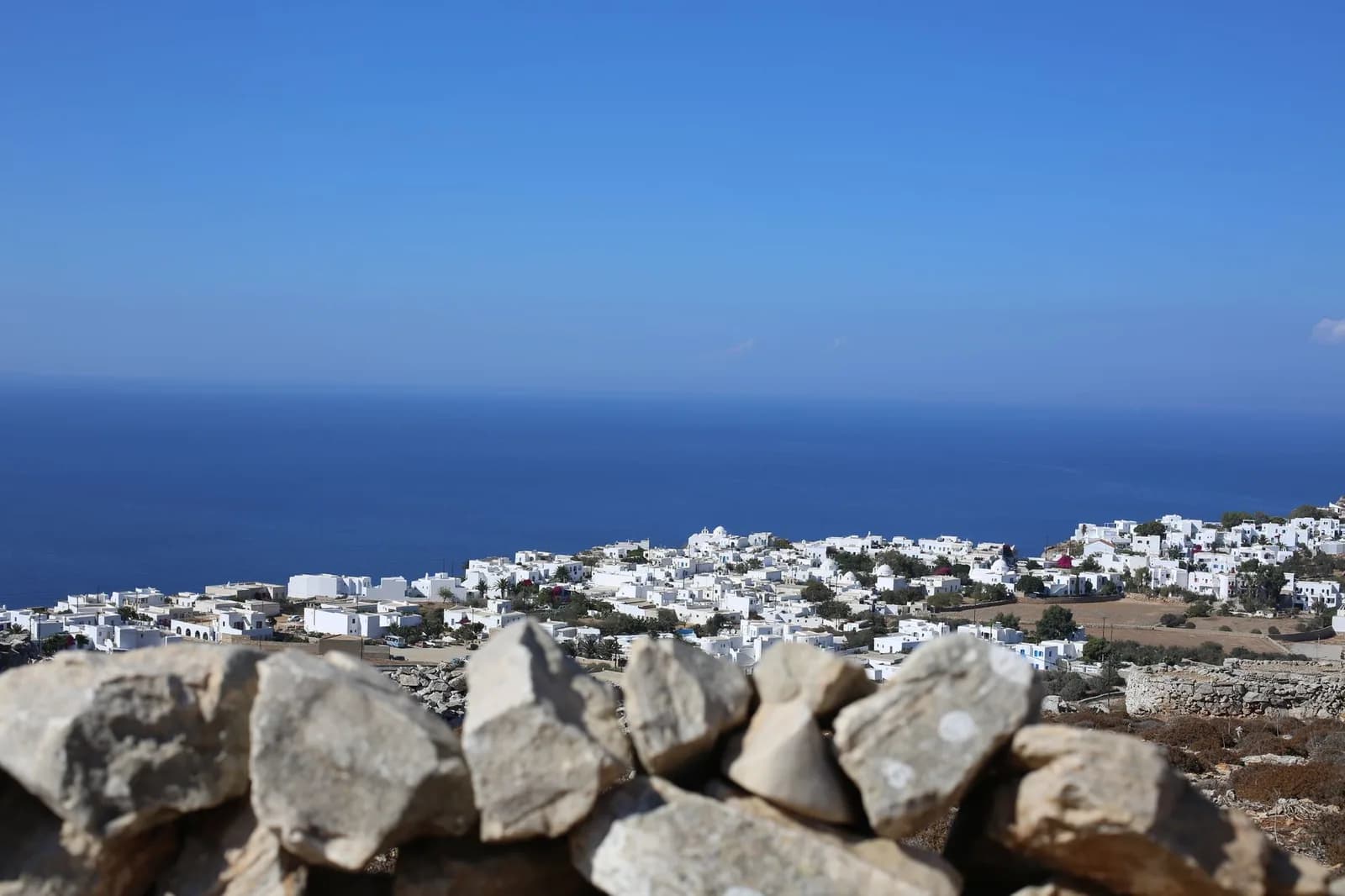
Around 220 islands, two dozen with people on them, and three ferry lines that almost never cross. Which island suits you matters less than which islands sit on the same line, because that is what decides whether your week is a holiday or a series of boats.
Most people arrive at the Cyclades from a photograph and leave with an itinerary that costs them two days of travel they did not plan. The reason is always the same. The islands look scattered at random on a map, so any two of them seem combinable, and they are not. Ferries here run in lines that radiate out of Athens rather than joining the islands sideways, and two islands twenty kilometres apart can be a full day and a change of boat away from each other.
The group
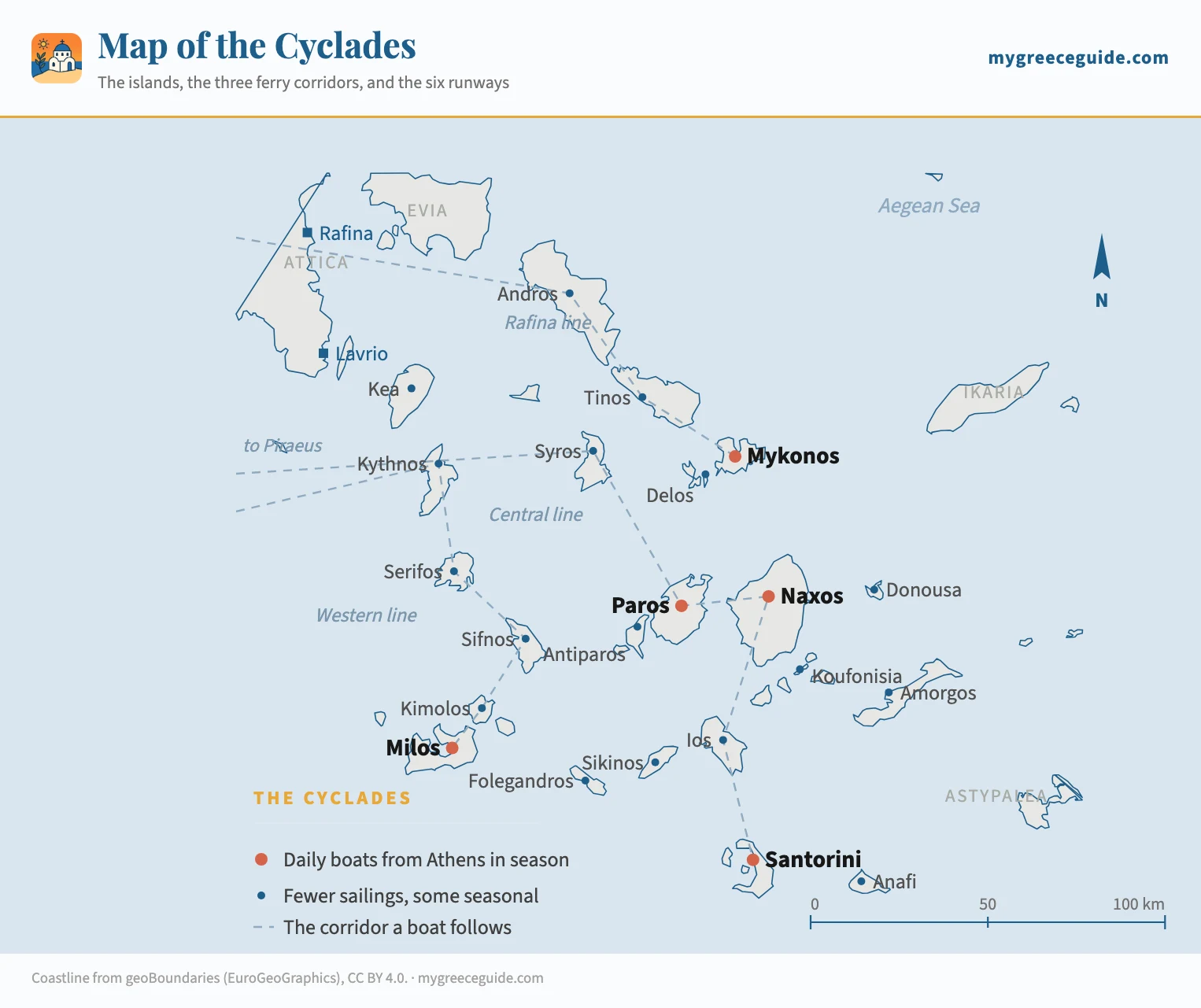
The group sits in the middle of the Aegean, south-east of Athens, and it is the one people mean when they say Greek islands without naming one. If you are still deciding between this group and another, it is worth seeing how the six groups are laid out across two seas first, because the Ionian and the Dodecanese are entirely different trips with entirely different airports. The same islands drawn the other way round, as a network of the direct crossings between them rather than three lines out of Athens, are on the map of the Cyclades and its ferry routes, which is the one to open once you know roughly where you are going.
Which islands, and in what order
Start from the shape of the week rather than from the island. Five nights is two islands at most, and honestly one if you are travelling with small children. Seven is three if they are on the same line and two if they are not. Ten will take four, but only if you accept that one of the days is spent moving. The chains below all run in one direction, so you fly home from where you finish instead of doubling back to Athens.
Set both, and the week rebuilds itself
How long have you got?
And what is it for?
7 nights, 3 islands, in this order
You want the postcard without spending the week on boats, and you would rather not discover on day three that your island has one beach and a supermarket.
Naxos3 nights
The island that gives you the most kinds of day: a walkable port town under a marble gate, a long sandy west coast, and mountain villages that have nothing to do with tourism.
The shortest crossing of the week, and the one with the most departures.
Paros2 nights
Half an hour of open water away and a completely different register: a harbour town in Naoussa built for the evening, and boats leaving for everywhere.
A longer run south, and the leg where the fast boat earns its price on a rough afternoon.
Santorini2 nights
Two nights is enough to see the caldera properly and one more to leave the rim. Book the room facing the volcano rather than the one described as near it.
Getting in and out. Sail out of Piraeus and fly home from Santorini. Done the other way round the trip ends with a ferry back to Athens on your last morning, which is the one leg nobody enjoys.
Two rules sit under all of that. Never plan a ferry on the day you fly, because a cancelled sailing turns a missed connection into a missed flight and the insurance rarely covers weather. And leave the famous island for the end: Santorini after Naxos is a spectacle, Naxos after Santorini feels like the holiday winding down. Naxos is also the one island here big enough to need its own map, because the beaches and the villages are an hour apart.
The comparisons people actually get stuck on
Nobody agonises over whether to visit the Cyclades. They agonise over three specific pairs, because in each case the two islands are described in the same words and are not remotely the same holiday.
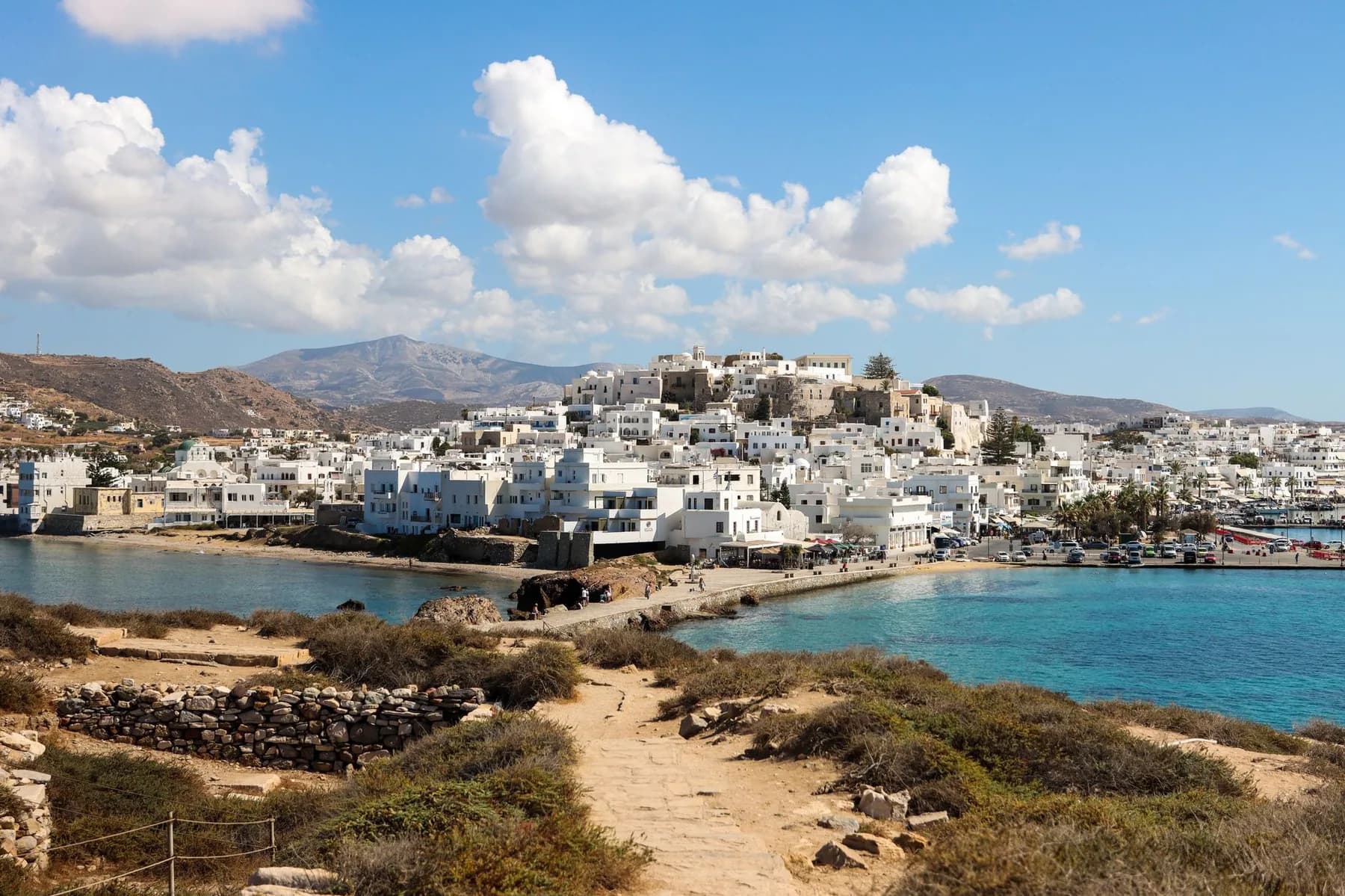
Naxos, from the causeway
Paros or Naxos
Naxos is a place, Paros is a junction. Naxos is the largest island in the group, with a mountain range down the middle, villages that farm and make cheese rather than rent rooms, and a west coast of long sandy beaches that are still cheap by Cycladic standards. It is the better island to stay on for a week, and the choice between the town and the beach strip is the only real decision it asks of you.
Paros is smaller, prettier at the edges and far better connected. Naoussa is the best evening in the central Cyclades outside Mykonos, Parikia handles the boats, and almost every route in the Aegean passes through, which is why the two harbours suit very different weeks. If you are hopping, Paros is the island to put in the middle of the trip: it is also one of the easiest islands to reach from Piraeus, with both conventional ferries and fast boats through the day. If you are staying put, Naxos gives you more to do on the days you do not want a beach, and the sailing down to it is barely longer.
Milos or Sifnos
Both sit on the western line, both are quieter than the central islands, and they are sold with the same adjective. Milos is about the coast, Sifnos is about the interior. Milos is a collapsed volcano, and what you go for is geology: the white lunar rock at Sarakiniko, the fishing village of Klima with boat garages painted under the houses, and the coves on the south coast that are only reachable by sea. You need a boat day, and on most of the island you need wheels.
Sifnos has an old network of stone paths linking its villages, restored and waymarked, so a week there can be walked rather than driven. It also has the best food in the group by general Greek agreement, and a pottery tradition still working. Rooms cluster in Apollonia inland and around the port at Kamares, while most of the beds on Milos are in and around Adamas near the ferry quay. Both are a straightforward run from Athens, and the boats that serve Milos call at Sifnos on the way down, which makes the two of them an obvious pair.
Mykonos or Santorini
They are not alternatives, they are different products that happen to cost the same. Santorini is a view, Mykonos is a night out. On Santorini the thing you came for is the caldera, which means the west-facing rim villages, which means the crowd walks the same path you do between Fira and Oia at the same hour. It works far better as two or three nights at the end of a trip than as a week, and the split between the rim and the beach coast is the thing to understand before booking anything. Which village you sleep in changes the trip more than the hotel does.
Mykonos is flatter, browner and much less photogenic away from the town, and it is excellent at exactly one thing. The beach clubs on the south coast and the lanes after midnight are the reason people come, and if that is not the reason, the island is expensive for what it gives you in daylight. That also decides which side of the island to sleep on, because only the town and the party coast let you walk home. The two islands are joined by a busy direct route, so running from one to the other by fast boat is the most common two-island trip in Greece, and also the one most likely to be cancelled in a strong meltemi.
If the night out is the point and the Mykonos prices are not, Ios does the same thing for a fraction of the money, one stop north of Santorini. There the question is simply how far from the square in Chora you want to sleep.
The three lines, and why they decide the itinerary
Look at the dashed corridors on the map again. The western line leaves Piraeus for Kythnos, Serifos, Sifnos, Kimolos and Milos, and it is the cheap, quiet half of the group. The central line is the busy one: Syros, Paros, Naxos, Ios, Santorini, with fast boats and conventional ferries running all day in season. The northern route out of Rafina serves Andros, Tinos and Mykonos, and it exists because Rafina is on the far side of Athens, twenty minutes from the airport instead of an hour.
That port distinction catches people out every summer. Landing at Athens airport at lunchtime and sailing from Rafina in the afternoon is comfortable. Landing at the same time and sailing from Piraeus is a taxi across the whole city. Choosing between the two ports for Mykonos is worth ten minutes before you book the flight, not after. Santorini is the opposite case: it sits at the far end of the central line, so the run down from Athens is the longest ordinary crossing in the Cyclades and the choice of boat changes the day entirely.
Crossing between lines is possible and it is never quick. Milos to Santorini exists but runs on a thin timetable. Mykonos to Sifnos means going through Paros. As a working rule, pick a line and stay on it, and treat any move sideways as a travel day rather than a transfer. Tickets on the busy summer sailings and on any route with only one boat a day should be held before you fly, because the conventional ferries fill with vehicles and the fast boats fill with people.
On the island itself, the question is whether you need a car. Naxos and Milos are the two where the answer is yes, for opposite reasons: Naxos because the interior is the best part of it and the bus does not go there, Milos because the beaches are spread around a coastline with no coherent road along it. Paros and Sifnos work on buses and a scooter. Santorini is better without a car at all.
When to go, and what the meltemi does to the plan
The Cyclades have a wind, and nobody mentions it in the brochure. The meltemi is a dry northerly that blows down the Aegean through the summer, strongest in July and August, and it is the single biggest variable in a Cycladic week. It flattens the humidity and makes the heat bearable, which is the good news. It also raises a short steep sea that closes north-facing beaches, and when it is really up, small fast boats stop sailing while the big conventional ferries carry on.
The practical consequences are simple enough. Pick a beach on the lee side on a windy day rather than fighting for the famous one. Take the large ferry rather than the catamaran if your connection cannot fail. And build one spare day into any trip that ends with a flight. June and September are the two months that get the most out of the group: the sea is warm, everything is open, the wind is milder and the prices sit below the August peak. May and early October are lovely and thinner, with fewer sailings to the small islands. Between November and March most of the group closes, ferries drop to a skeleton timetable, and only Santorini, Mykonos, Naxos, Paros and Syros keep enough open to be worth a trip.
Flying in, and flying home from somewhere else
Six islands in the group have runways: Santorini, Mykonos, Paros, Naxos, Milos and Syros. Only the first two take a full summer programme of direct flights from northern Europe. Paros, Naxos, Milos and Syros are served from Athens only, on small turboprops with a hard baggage limit, and Paros airport closes at dusk, so an evening arrival in Athens means a boat the next morning.
The useful move is an open jaw: fly into Athens or Mykonos and out of Santorini, or the reverse. It costs a little more than a return and it removes the backtrack, which is usually the difference between three islands and two. Worth knowing before you build the trip around it: the drive up from the runway to the caldera villages is short but the terminal is small and the queue at passport control after several simultaneous arrivals is not, so a tight connection on the way home is a gamble.
How a Cyclades week goes wrong
Too many islands. Four islands in seven nights reads well on a spreadsheet and means four mornings packing, four afternoons waiting at a port and four evenings finding your bearings. Three is the ceiling for a week, and two is often better.
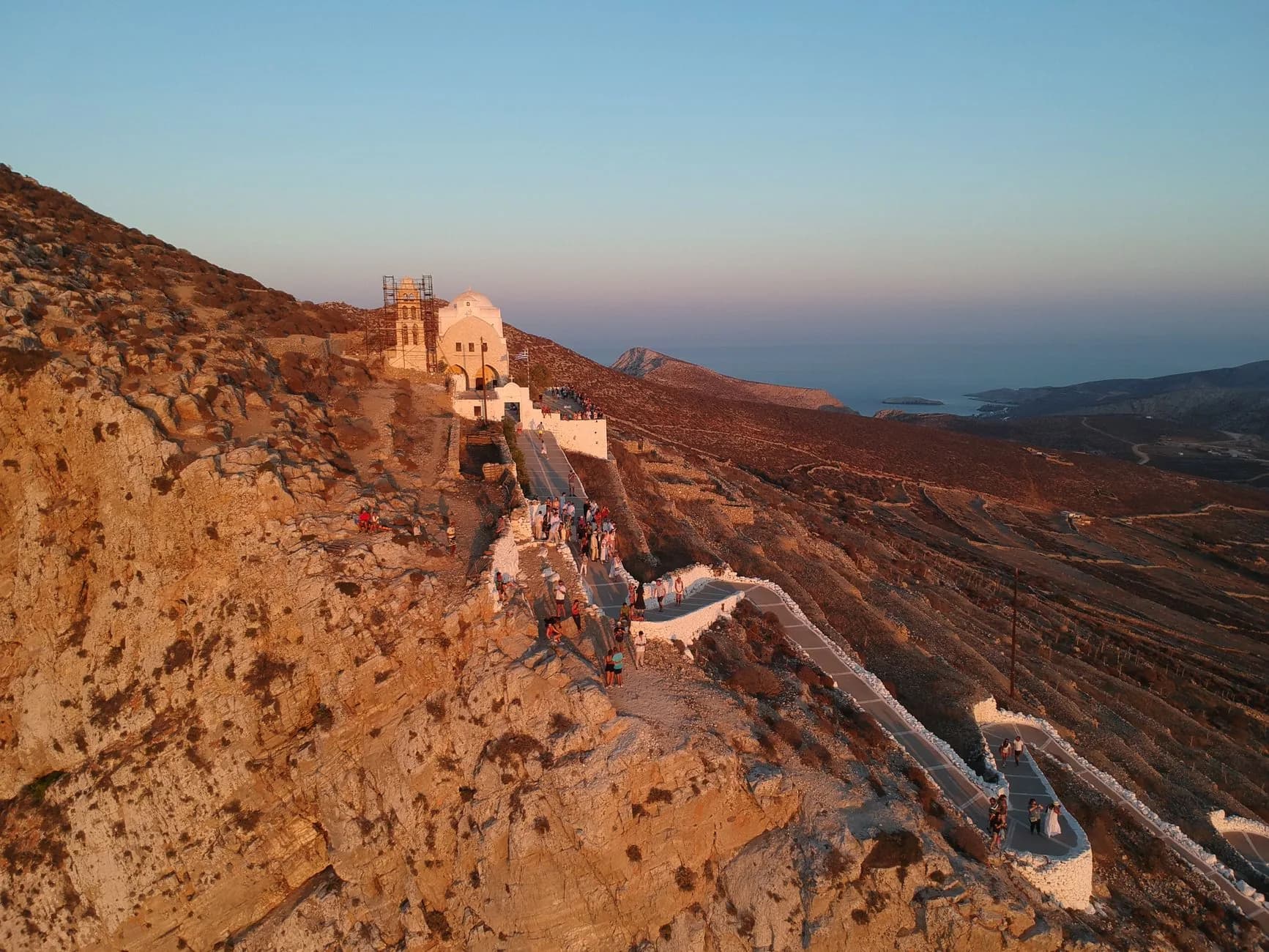
Where everyone ends up at seven
Islands from different lines. Mykonos and Milos in the same trip looks reasonable on a map and is a day of travel through Athens or a thin seasonal connection. If two islands are not on the same corridor, one of them is costing you a day.
Santorini first. Everything after it is measured against it and found wanting, which is unfair to islands that are quietly better places to spend time. Put it last and the arrival into the caldera becomes the climax of the trip rather than its opening scene.
A ferry on the last day. The wind decides, not the timetable, and a cancelled sailing the morning of an international flight is the one Cycladic problem with no good solution. Move to the airport island the night before and the risk disappears.
Questions people ask about the Cyclades
What are the main islands of the Cyclades?
The group runs to around 220 islands and only two dozen are inhabited, so the working list is short. Santorini and Mykonos are the famous two. Naxos is the largest and the most self-sufficient, Paros the busiest junction, Milos the one with the strange white coastline. After those come Ios, Sifnos, Serifos, Folegandros, Amorgos, Andros, Tinos, Syros, Kea, Kythnos, Antiparos, Sikinos, Anafi and Koufonisia. Delos is uninhabited and visited as a day trip from Mykonos.
Which island in the Cyclades is the best to visit?
For a first trip, Naxos, because it is the one island in the group that works whatever the week turns out to be: a port town you can walk, long sandy beaches, mountain villages inland, and boats leaving in every direction. Milos if the coastline is the point, Paros if you want to island-hop and want the connections to be easy, Sifnos if you want to walk and eat well, Folegandros or Amorgos if you want to be left alone, Mykonos or Ios if the evening matters more than the morning. Santorini is the one to add rather than the one to build a week around.
Which is the cheapest island in the Cyclades?
The western line is where the money goes further, and Serifos and Kythnos are the cheapest of the group in practice: short ferry tickets from Piraeus, no airport, and rooms that were never priced against a caldera view. Sikinos and Anafi are cheaper still but harder to reach. On the other side of the scale, Mykonos and Santorini run well above everything else in July and August, and Milos has climbed steeply as it has become better known. Naxos and Ios sit in the middle and are the usual answer for people who want cheap without being remote.
Which Cyclades islands have airports?
Six: Santorini, Mykonos, Paros, Naxos, Milos and Syros. Santorini and Mykonos take direct flights from across Europe through the summer, and Paros picks up a handful of seasonal international routes. Naxos, Milos and Syros are served from Athens only, on small aircraft with a strict baggage allowance, and those flights sell out well before the ferries do. Every other island in the group is reached by boat, which is why the ferry timetable rather than the flight search decides most Cyclades itineraries.
Which Cyclades island is best for couples?
Folegandros if you want the cliff-top village and nothing else to do, Milos if you want to spend the week finding coves by boat, Sifnos if dinner is the point, Amorgos if you both walk. Santorini deserves its reputation for the arrival by sea and the caldera light, but the rim is crowded from mid-morning to sunset and the romance is easier to find in Imerovigli or Firostefani than in Oia. The pattern that works is one quiet island first and the famous one at the end, rather than the reverse.
Which Cyclades islands are best for families?
Naxos and Paros, and it is not close. Both have long flat sandy beaches that shelve gently, a town with a supermarket and a pharmacy, short transfers from the port, and enough boats that a missed connection is not a lost day. Antiparos, a few minutes across the water from Paros, is small enough that children can be let loose in it. Santorini is the hardest island in the group with young children: the beaches are dark volcanic sand and a long way below the villages, and the rim paths are steep and stepped.
How do you get to the Cyclades from Athens?
By ferry from one of three ports, or by plane to one of the six island airports. Piraeus is the main port, half an hour from the centre by metro, and it serves both the central and the western lines. Rafina is closer to the airport than to the city and runs the northern route to Andros, Tinos and Mykonos, often faster than the same trip from Piraeus. Lavrio, further south, covers a short list of western islands. The port on your ticket is not always the one you assumed, and Piraeus to Rafina is an hour across Athens in traffic.
