Athens to Naxos by ferry: the crossing that drops you in the middle of the town
Five hours on a Blue Star, three and a half on a fast boat, and a quay that sits under the Portara rather than at the bottom of a cliff. This is the easiest arrival in the Cyclades, and the least talked about.
The Athens to Naxos ferry runs from Piraeus, takes about five hours on the conventional Blue Star boat and about three and a half on a high-speed one, and lands you on the waterfront of Naxos Chora with the old town directly above your head. That last part is the fact worth carrying away. You step off the ramp into the village, with no cliff road, no shuttle and no transfer to book, which is not how arriving on a Cycladic island usually goes.
Ferry, fast ferry or the little plane
Naxos is one of the few Cyclades with its own airstrip, so the plane belongs in the comparison. It just does not win it as often as people expect.
| Option | Who runs it | Journey time | Relative cost | Vehicles | In bad weather |
|---|---|---|---|---|---|
| Conventional ferry | Blue Star Ferries | About 5 h, with stops | The cheapest of the three | Yes, on every sailing | Sails in almost anything |
| High-speed ferry | SeaJets, Fast Ferries, Golden Star | About 3 h 30 | Roughly twice the conventional fare | On some vessels only | First to be pulled in wind |
| Flight | Olympic Air, Athens to JNX | Around 40 min in the air | Usually above the conventional fare | No | Small aircraft, sensitive to gusts |
Durations are the usual range rather than a promise: a conventional sailing that calls at Paros first runs longer than one that does not, and fares on this route move by a wide margin between February and August. Timetables are republished every season, so check the operator or a booking site for your own dates.
The flight is the option that surprises people. Naxos airport, JNX, sits behind the beach at Agios Prokopios and handles small turboprops on a short runway, with a handful of rotations a day from Athens in season and fewer outside it. The fare rarely undercuts the conventional ferry, and the 40 minutes in the air disappear into the trip out to Athens airport and the wait at the gate. It becomes genuinely useful in two cases: a late arrival into Athens when the last boat has gone, and a windy week when the fast ferries are being cancelled around you.
The port is the town, and that is the whole point
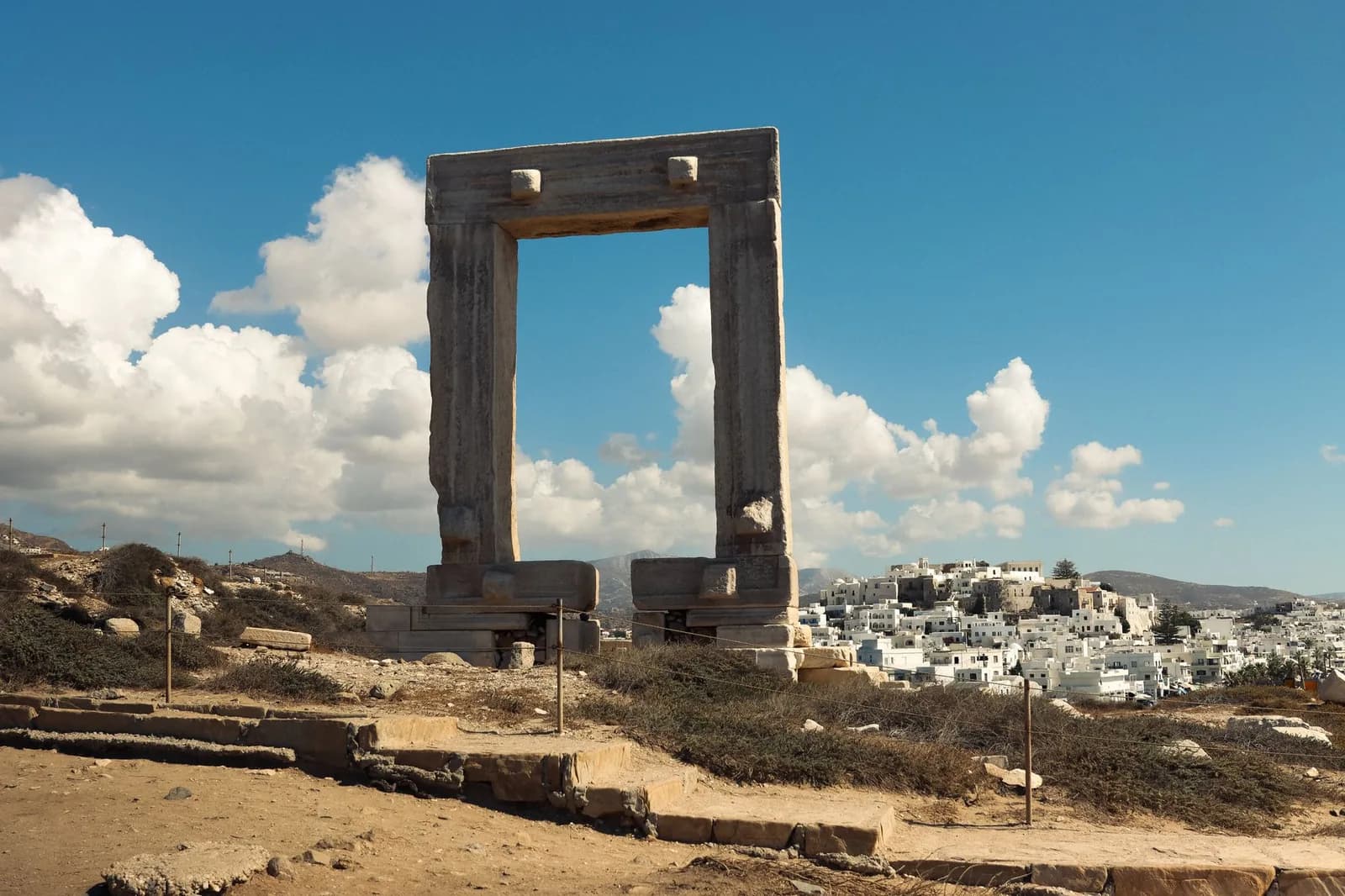
Naxos Chora wraps around its harbour. The quay runs along the seafront, the tavernas and the ticket agencies are on the other side of the road, the white lanes of the old town climb behind them to the Venetian Kastro, and the Portara stands on its islet at the end of a causeway a few minutes north of where the ferry ties up. Arriving here is a matter of picking up your bag and walking.
The arrival
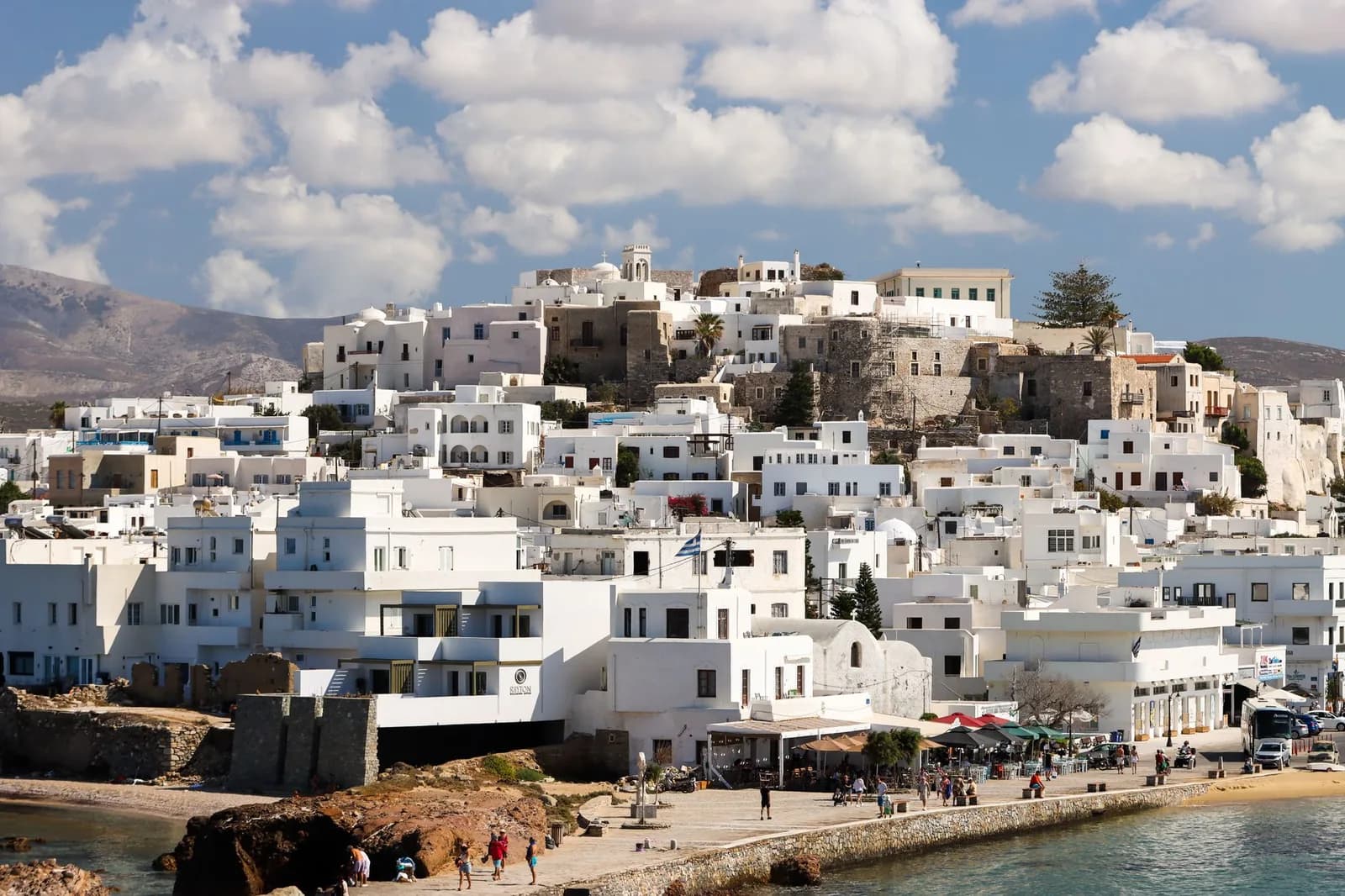
Compare that with the two islands most people book instead. Santorini lands you at Athinios, a concrete platform at the foot of the caldera with a hairpin road behind it and 25 minutes of climbing before you reach Fira. Mykonos lands you at the New Port, a few kilometres north of town, which means a bus or a taxi with everyone else off the same boat. On Naxos the transfer that eats the first hour of a holiday simply does not exist. For anyone travelling without a car, or landing after dark, that is worth more than the hour of sailing time a fast boat saves.
Leaving from Piraeus, and the Rafina question
Almost every sailing to Naxos leaves from Piraeus, the big working port south-west of Athens, about 40 minutes from the centre on metro line 1. What the metro map does not convey is the scale of the place. It is a live cargo harbour with berths numbered along kilometres of quay, the Cyclades gates are among the further ones from the station, and the good departures on this route go early. Budget 45 minutes to an hour at the port end and the morning stops being a sprint.
Rafina is the other Athens ferry port, on the east coast, and it does serve Naxos on seasonal high-speed sailings. Its real advantage is position: Rafina is roughly twenty minutes from Athens airport while Piraeus is an hour and a change of line away, which makes it the better port on the day you fly in or out. What it is not is dependable year round for this island. The Rafina schedule shifts from season to season, so check whether it runs on your dates before you build a plan around it. Seeing how far apart the two harbours and the city really are is the quickest way to understand why the choice of port decides your morning.
That choice is really a question about the plane at the other end of the day. If you are flying into Athens and sailing on, read the connections between the terminal and the two ferry ports before you buy the boat ticket, because a cheap sailing out of Piraeus can cost you the whole afternoon you saved by landing early.
Where Naxos takes you next
Naxos sits in the middle of the central Cyclades, which is why it works better as a base than as a stop. Pick where you are going after it and the practical shape of the hop becomes clear.
Sailing on to
The shortest hop in the central Cyclades, and the one that makes a two island trip work without losing a day to the water.
Naxos to Parikia
Well under an hour
Conventional and high-speed, several a day in season
Short enough that the boat is barely up to speed before it slows again. Both ports sit in their towns, so there is no transfer at either end.
Paros as a hub
Varies
Most Cyclades operators call there
Parikia is the busier interchange of the two islands. If a sailing you want does not exist from Naxos, it often exists from Paros the same day.
Plenty of people reach Naxos the other way, coming down from Mykonos rather than out from Piraeus. That crossing is under an hour on a fast boat, but it is also the one the meltemi closes first, and the Mykonos to Naxos ferry has its own page on times, boats and what to do when it is cancelled.
One connection deserves singling out. The Small Cyclades are reached from Naxos and effectively nowhere else, on a local ferry that exists to serve the people who live on Koufonisia, Schinoussa, Iraklia and Donousa rather than the people photographing them. It is a small vessel on an exposed stretch of water, the schedule thins right out in winter, and it is the first service to stop when the wind gets up. If those islands are the reason for your trip, build a spare day into the plan.
For the bigger neighbours the crossing is never the hard part, the bed is. Paros is close enough to treat as an afternoon, but staying over means deciding between the port town and the fishing harbour on the north coast, which are two different holidays at two different prices. Milos is the longer hop and the bigger commitment, since every base on that island assumes a hire car to reach the beaches. Working both out before you book the boats is what turns a list of crossings into an itinerary.
Why people who come once come back
Naxos is the largest of the Cyclades and the only one that feels like a place with a life of its own rather than a season. There are mountains in the middle, with Zas the highest point in the archipelago, marble villages like Apiranthos and Halki that were there long before tourism, terraced farms, cheese and potatoes and citrus that are genuinely local products rather than gift shop labels. The west coast beaches run for kilometres of sand without a cliff in sight.
None of that is a secret, and yet the island is regularly skipped for Santorini and Mykonos, both of which are further from Athens and considerably more expensive. Naxos is the cheaper island at the shorter end of the crossing, which is an unusual combination in Greece and the reason so many itineraries end up putting it in the middle. You reach it in five hours, you land in the town, and the boats out go everywhere.
The saving is real but it depends on where you sleep. A room in the Chora, on the west coast beaches or up in a mountain village are three different budgets and three different holidays, and only the first of them works without a car. The drive times from the port are what settles that one.
The meltemi and the fast boats
Every summer a dry north wind called the meltemi funnels down the Aegean, and it peaks in the weeks when the boats are fullest. It does not make the sea dangerous so much as it makes the light boats unusable: catamarans and hydrofoils get held in port by the harbourmaster well short of the point where a big ship would notice anything. The word usually comes the evening before or first thing in the morning, and in August the seat you are moved to may be on tomorrow's sailing rather than this afternoon's.
Blue Star's conventional ships sail through weather that keeps every catamaran tied up, so on this route the slow boat is also the reliable one. If your dates have no slack in them, the extra ninety minutes buys you a crossing that is far more likely to happen. The rest of the network, and how the operators compare across the islands, is covered in our rundown of the operators.
Naxos back to Athens
The return leg is the same crossing in reverse, with the same two speeds, and it is the one people plan badly. Sailings back to Piraeus run through the day in summer and thin out sharply in winter, when a route with several daily departures in August can drop to a few a week. Book the return at the same time as the outbound if you are travelling in peak season, because the popular afternoon boats fill first.
The rule that outranks all of that: a high-speed sailing should never be the last thing standing between you and an international departure. Fly out of JNX, put yourself on a big ship rather than a fast one, or simply come back a day early. It is the most expensive error on the Cyclades routes, repeated every summer by people who read a forecast and believed it.
One last practical thing. Greek operators differ on what counts as a ticket: some still issue paper that has to be collected at the port or from an agency, others accept a scan on your phone, and the rule follows the company rather than the route. Check yours before you travel, because a Piraeus gate half an hour before departure is not the place to find out.
Questions people ask about the Athens to Naxos ferry
How long is a ferry from Athens to Naxos?
Around 5 hours on a conventional Blue Star sailing from Piraeus, and around 3 hours 30 on a high-speed one. The exact figure depends on how many islands your sailing calls at, since most conventional boats stop at Paros first. Greek timetables are reissued every season, so confirm the sailing time for your own dates with the operator rather than working from last year's schedule.
Is it better to fly from Athens to Naxos or take a ferry?
The ferry, for most people. Naxos does have an airport, but it takes only small turboprops, there are few rotations a day and the fare rarely undercuts the conventional boat. Add the trip out to Athens airport and the check-in, and the 40 minutes in the air stop being a saving. The boat also ties up in the middle of the Chora, so there is no transfer at the other end. The flight earns its place when you land at Athens late and want to be on the island the same night, or when the wind has pulled every fast boat off the timetable.
How much does a ferry ticket from Athens to Naxos cost?
Fares are set season by season and vary with the operator, the month and how early you buy, so any number printed on a guide page is a guess with a date on it. The pattern is what to plan around: the high-speed boat costs roughly twice the conventional Blue Star fare, deck class is the cheapest way across and does not reserve you a seat, a numbered seat is a small supplement worth paying on a long summer sailing, and a car costs more than an extra passenger. Naxos is also one of the shorter Cyclades crossings, so it sits at the cheaper end of the range whichever boat you take.
Is Naxos, Greece worth it?
It is the island people come back to. Naxos is the largest of the Cyclades and the only one with a real life outside the season: mountains in the middle, marble villages like Apiranthos and Halki, farms that produce the cheese and potatoes the island is known for, and kilometres of sand down the west coast instead of a handful of coves. It is closer to Athens than Santorini or Mykonos, noticeably cheaper than either, and the ferry lands you in the town rather than at the foot of a cliff. What it does not offer is a single famous view, which is the only reason it gets skipped.
Where does the ferry dock on Naxos?
In the Chora itself, on the waterfront below the old town and a few minutes on foot from the Portara. There is no cliff road and no transfer to arrange. You walk off the ramp onto the seafront, and most hotels in town are within walking distance of the quay. It is one of the easiest arrivals in the Cyclades and one of the reasons Naxos suits people travelling without a car.
Do ferries from Athens to Naxos get cancelled?
The high-speed ones do, mainly because of the meltemi, the dry north wind that blows hardest through July and August. The port authority holds light craft in harbour well before conditions get dangerous, and rebooking in peak season can mean the next day. Blue Star's conventional ships keep sailing through weather that grounds the catamarans, which is the strongest argument for the slow boat when your dates are tight.
Can you take a car on the Naxos ferry?
Yes, on every conventional Blue Star sailing and on a handful of high-speed vessels. Book the vehicle space as soon as your dates are fixed, because the car deck sells out well before the passenger seats do in August. If you are hiring in Greece, check your rental contract first: many companies refuse to let their cars leave the island they were hired on, and taking one across without written agreement voids the insurance.
