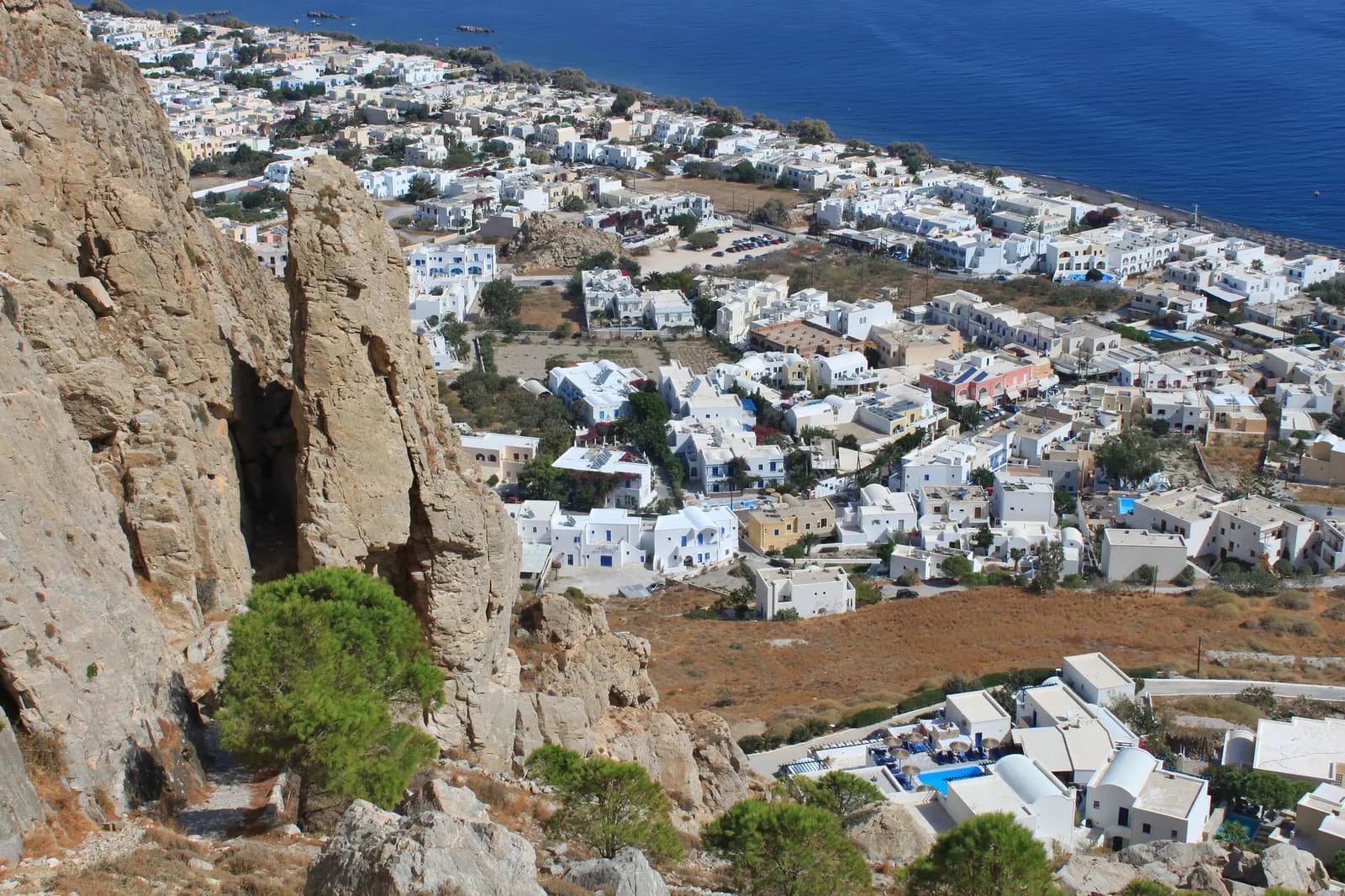
Santorini airport: a small terminal for a very busy island
JTR is 6 km from Fira on the flat east coast, ten minutes from Kamari and forty from Oia. It is also a very small building asked to deal with a very large crowd.
Santorini airport, officially Santorini (Thira) National Airport and code JTR, is the only airport on the island and the way most visitors arrive. It sits on the east coast near Kamari and Monolithos, roughly 6 km from Fira, on the one piece of flat ground Santorini has. The trouble with it is a mismatch of scale: one runway, one small terminal, and a couple of million arrivals a year wanting to use them.
Where Santorini airport actually is
The island is a crescent, and the two sides of it are nothing alike. The west is the rim of a drowned crater, a cliff with villages balanced on the edge and no room for anything wider than a lane. The east slopes gently to the sea, and that is where the runway had to go. JTR lies on the coastal plain between Monolithos and Kamari, with the bulk of Mesa Vouno to the south of it and the whole width of the island between it and Oia.
Position
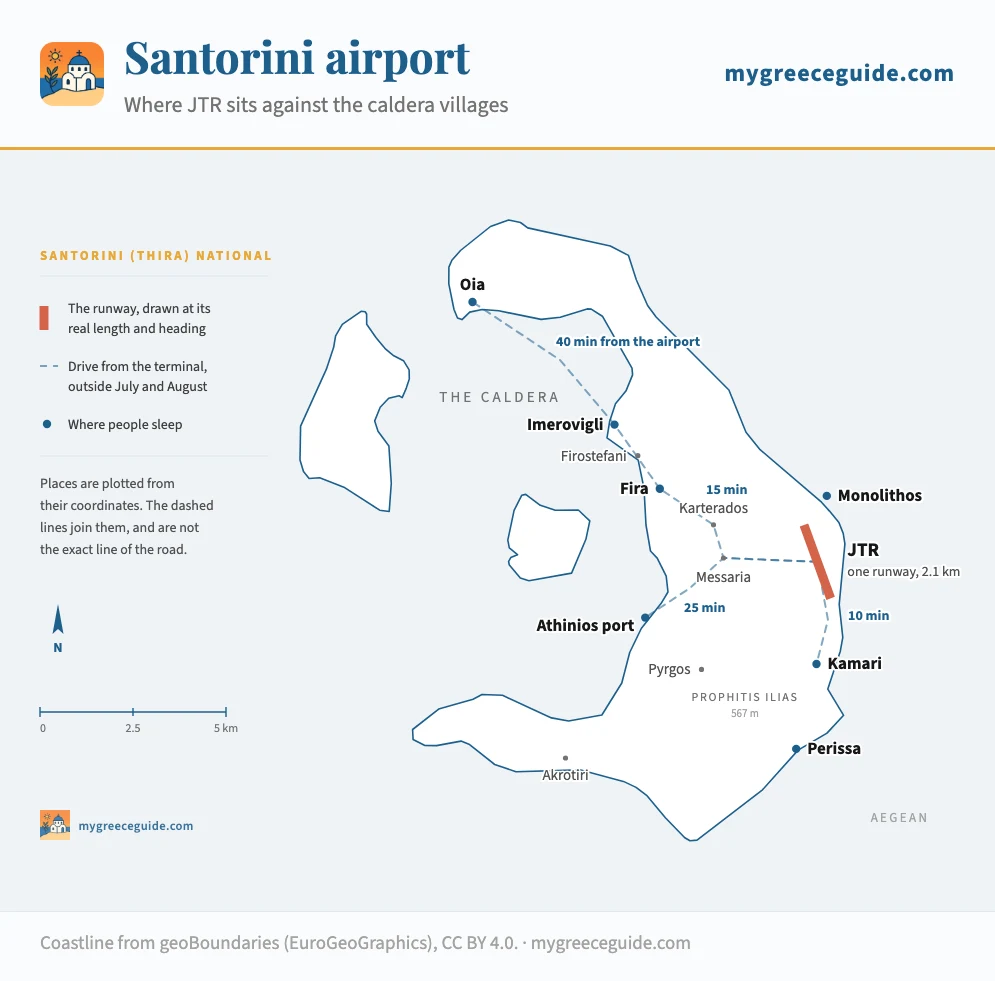
One thing the map makes obvious: there is no ring road. The caldera side is a cliff, so the network is a spine down the middle of the island with branches off it, and almost every route between two points goes through Fira. That is why a village 18 km away takes forty minutes, and why a bad afternoon in Fira is felt across the whole island at once.
How long the transfer takes
Santorini is 18 km from end to end, which leads people to assume the transfer is trivial and to book accordingly. These are the times that matter when you are deciding what to reserve and when to leave.
| From JTR to | Distance | By car | By bus | Worth knowing |
|---|---|---|---|---|
| Kamari | 3 km | 10 min | yes, via Fira | The closest base to the terminal, and near enough that you hear the odd departure |
| Monolithos | 2 km | 5 min | occasional | Immediately north of the runway, which is why the beach there is so quiet |
| Fira | 6 km | 15 min | yes, several an hour in season | The bus station is behind the main square, and every island route starts there |
| Perissa and Perivolos | 9 km | 20 min | yes, change in Fira | Round the far shoulder of Mesa Vouno rather than over it |
| Imerovigli | 9 km | 20 min | Fira, then the Oia bus | The last stretch is the rim road, narrow and slow behind a coach |
| Athinios port | 11 km | 25 min | timed to sailings, not to flights | Add half an hour if a large ferry is unloading when you arrive |
| Oia | 18 km | 30 to 40 min | no direct route, change in Fira | Half an hour on an empty road, an hour when the sunset traffic builds |
| Akrotiri and the south-west | 16 km | 35 min | a handful a day, via Fira | Everything crosses the middle of the island, so nothing here is direct |
Driving times are for a normal day outside July and August, and every one of them stretches in peak season. Bus journeys are the ride itself, not the wait for it: the island timetable is seasonal, most routes pass through Fira, and the last departures of the evening are much earlier than visitors expect. Check the operator the day before rather than trusting a figure printed on any website, this one included.
The road out of the airport is fine until it reaches Fira, and then it is everybody else's road too. Coaches, hire cars, quad bikes and the entire bus network converge on the same few junctions, and in the two hours before sunset the northbound stretch towards Imerovigli and Oia moves at walking pace. Nothing about that is visible in the distance figure.
The transfer depends entirely on where you sleep
Two people on the same flight can have a ten minute transfer and an hour long one. Pick your village below and the answer splits in two, because arriving and leaving are separate problems here. If the village is still undecided, the transfer is one of the things choosing between the caldera rim and the east coast should weigh: Kamari and Perissa are minutes from the runway, Oia is the far end of the island, and the view you are paying for is the reason for the difference.
Pick your village to get the transfer times
Where are you sleeping?
The middle of the caldera rim, 6 km from the terminal
- Drive from JTR
- 15 min
- By bus
- Several an hour in season, from the station behind the square
- Door to terminal
- Allow around 45 min of travel
Landing
The bus from the airport runs into Fira rather than around the island, which makes this the only base you can reach on public transport without changing. With luggage and a hotel up a stepped lane, a taxi or a booked transfer still ends up easier.
Flying home
Fifteen minutes on a clear road, and comfortably more when the town is full and the one road out is carrying every coach on the island. Leaving Fira at rush hour for a mid-afternoon flight is the classic way to lose half an hour you had counted on.
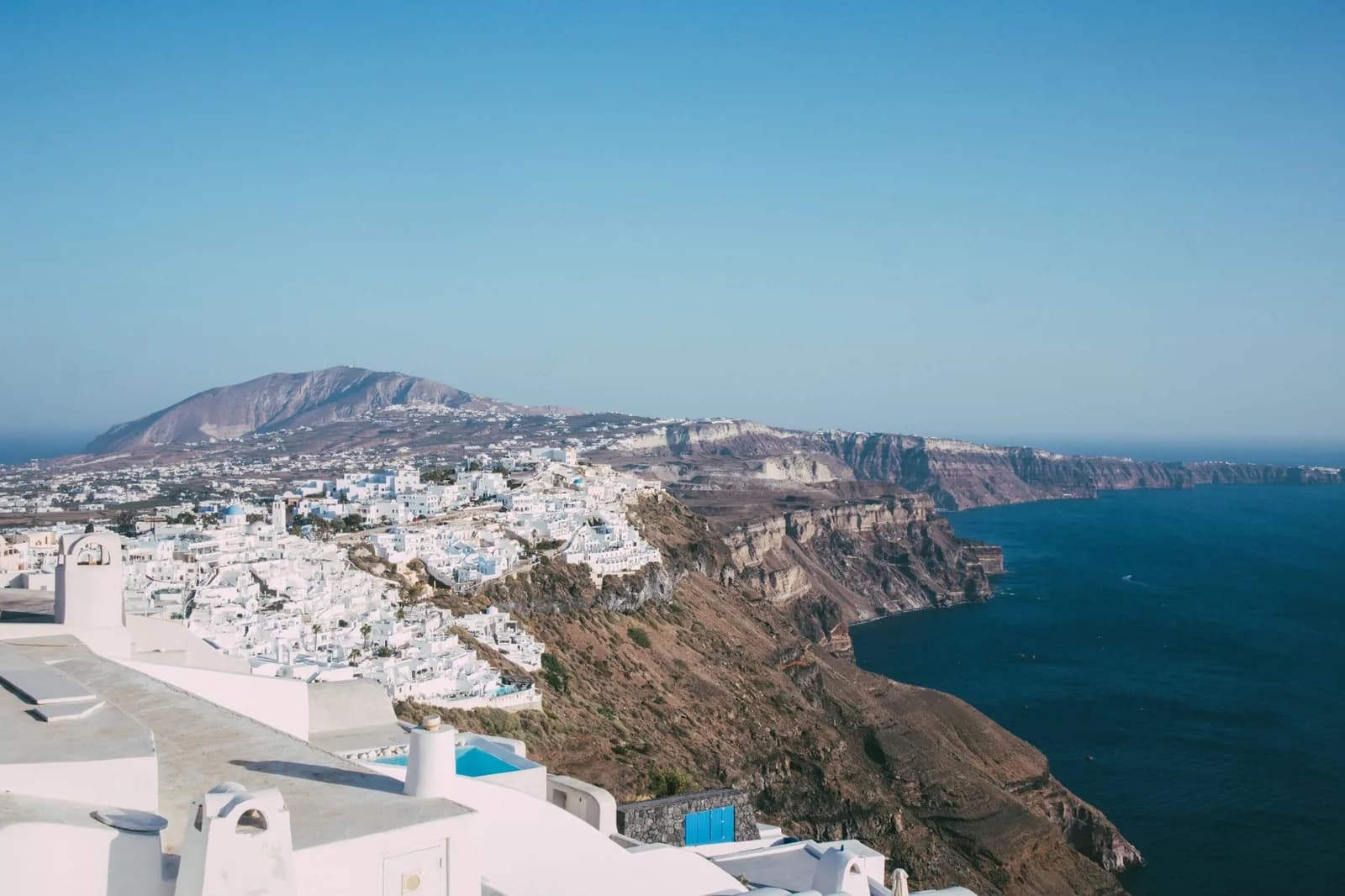
Fira is fifteen minutes from the runway and the junction every other route passes through. Staying on the rim buys the view and costs you the traffic.
Flying in, or sailing in to Athinios
Compare the two arrival points rather than the two journeys. The airport is on the flat side of the island with an ordinary road outside it. Athinios is a concrete shelf at the foot of the caldera cliff with one road out, and that road climbs the wall in switchbacks. When a large ferry unloads several hundred cars and a dozen coaches into it at once, twenty minutes to Fira becomes fifty, and the island has only a few dozen taxis in total.
None of which makes the boat a bad idea. The fast ferry from Athens takes about five hours against forty-five minutes in the air, but it lands you in the middle of the Cyclades rather than at an airport, and it does not care about the wind in the same way. Our guide to the ferry from Athens to Santorini covers the crossing itself. What matters here is that arriving by sea means arranging the pickup before you sail, not after you dock.
The same goes for the classic two-island trip, where the plane is not really an option at all. Flights between Mykonos and Santorini barely exist outside a handful of summer rotations, so the hop between the two is a boat question, and it lands at Athinios with the same climb out. Plan that leg as a morning rather than as something to slot in after a late departure.
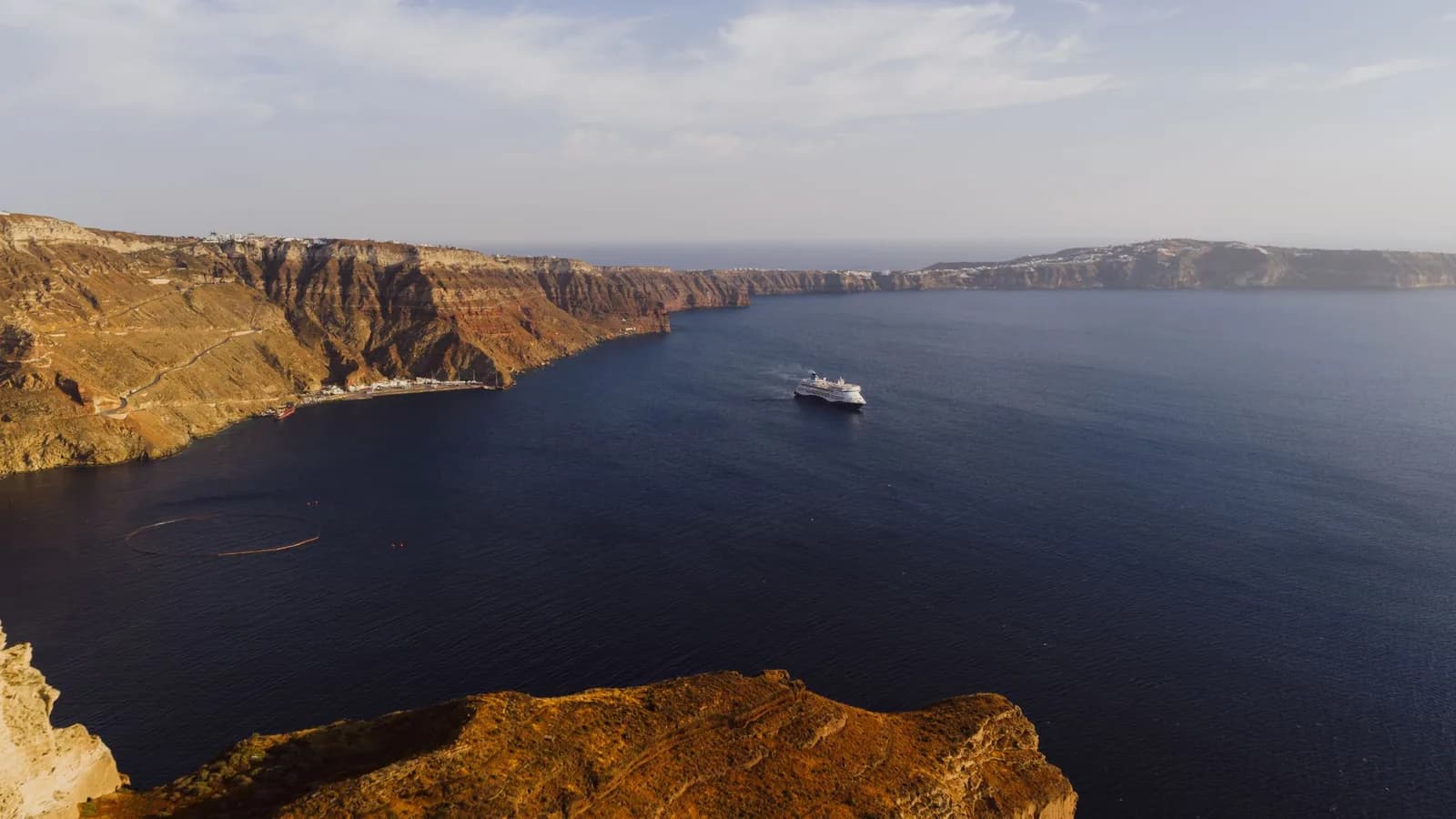
Athinios, on the far side of the island from the runway. The road out is the only one, and it goes straight up.
A short runway, an exposed coast, and the meltemi
JTR has one runway of a little over two kilometres, which is short for the aircraft that use it and leaves less margin than crews would like on a hot, still afternoon. Add the wind and you have the reason Santorini appears so often on delay boards. The meltemi blows down the Aegean through July and August, sometimes for a week without pause, and an exposed coastal runway reaches its crosswind limits sooner than a sheltered mainland one.
The individual delay is rarely the problem. The knock-on is. An aircraft held up here in the morning is late on every rotation for the rest of the day, and in a peak week the slippage accumulates. Book the connection in Athens with real margin rather than the minimum the booking engine allows, and treat a same-day onward long-haul in August as a risk you are choosing to take.
What the terminal is like in August
A newer building has taken over most of the passenger handling, and it is still sized for an airport that receives fewer people than this one does. In the peak weeks the security queue does not fit inside, and it forms across the forecourt and into the car park. Seating runs short, the airside area is small once you are through, and several departures are frequently processed in the same window.
The practical rule is to arrive earlier here than you would anywhere comparable. Three hours for a summer departure is sensible rather than nervous. In April or October the same building is quiet and ninety minutes is ample.
Whether to pick up a car at the airport
Santorini is one of the few Greek islands where a car for the whole week is arguably the wrong call. The island is tiny, the buses cover the rim and the beaches, and Oia defeats most drivers: the village itself is closed to traffic, its two car parks are full well before lunch, and by August the verge of the approach road has become the overflow, several hundred metres back. If you are staying on the rim and mostly want the view, the terrace and the sunset, you may spend more time looking for a space than driving.
A car earns its keep on the other side of the island, or for two days rather than seven: Ancient Akrotiri, the wineries on the slope, the lighthouse at the south-west cape, the beaches past Perivolos. Book before you fly whatever you decide, because walk-up rates in August are punishing and the small automatics go first.
Thira, Santorini, JTR: one airport, three labels
Searches for this airport split across half a dozen names, and it causes real confusion when people compare flights. Thira is the official Greek name of the island, Santorini is the Venetian one that stuck, and Fira is the capital village, which is the same word again worn down in local speech. The airport is registered as Santorini (Thira) National Airport, which is why timetables show Thira, why the ICAO code is LGSR, and why searching Santorini Airport Thira Greece and Santorini International Airport returns the same single terminal on the east coast. Whichever spelling your booking uses, there is only one airport on the island. Our map of Santorini shows how the rest of it fits together, and the codes for every other island are collected in one place.
Questions people ask about Santorini airport
What airport do you fly to for Santorini?
Santorini (Thira) National Airport, code JTR, on the east coast of the island between Monolithos and Kamari and about 6 km from Fira. It is the only airport on the island. It takes the year-round domestic flights from Athens and a heavy seasonal load of European charters and low-cost services between roughly April and October, so out of season almost every arrival is a connection through Athens. If JTR closes for wind, the only alternative way in is the ferry.
Are there two airports in Santorini?
No, one. The confusion comes from the names rather than from the runways: the same terminal is listed as Santorini Airport, Thira Airport and Santorini (Thira) National Airport depending on the airline, and the port at Athinios turns up in searches as though it were a second arrival point. It is a ferry harbour on the opposite side of the island. There is no second airfield and no airstrip on Thirassia across the caldera.
What does JTR stand for in Santorini?
The TR is Thira, the official Greek name of the island; Santorini is the medieval Venetian name that stuck in every other language. The J is not an abbreviation of anything, it is simply the letter the IATA list had free when the code was issued, which is why several Greek island airports start with it, JMK for Mykonos and JSI for Skiathos among them. The ICAO code, the one used in aviation rather than in ticketing, is LGSR.
Is it cheaper to fly into Athens or Santorini?
Athens is usually the cheaper airport to reach and rarely the cheaper trip once you add the second leg. Direct summer flights into JTR from northern Europe carry a season premium and sell out early, while Athens has far more competition on the same routes. What decides it is what you do next: a domestic hop to Santorini or a ferry both cost money and, more to the point, most of a day. Booking the two legs on separate tickets also means no airline owes you anything if the first one is late, which on a same-day island connection is the risk that matters.
How long does it take to get from Santorini airport to Oia?
About 18 km by road and around forty minutes, which is longer than the distance suggests. The route climbs the spine of the island and passes through Fira, where every other road on Santorini meets, so the last stretch is slow whenever the town is busy and slower still in the hour or two before sunset. Staying in Oia and flying out early, allow an hour and a half between leaving the hotel and being inside the terminal.
What is inside Santorini airport, and is there a lounge?
Not much, and that is the thing to plan around. There is a duty free shop, a handful of cafes and snack counters, a few gift stands and one small pay-per-entry lounge airside that also takes the usual card and airline programmes. The airside area is modest for the number of people passing through it in August, so seats run out and the queue at the counters is long at exactly the hours everyone is flying home. Eat before you leave the village rather than counting on the terminal.
