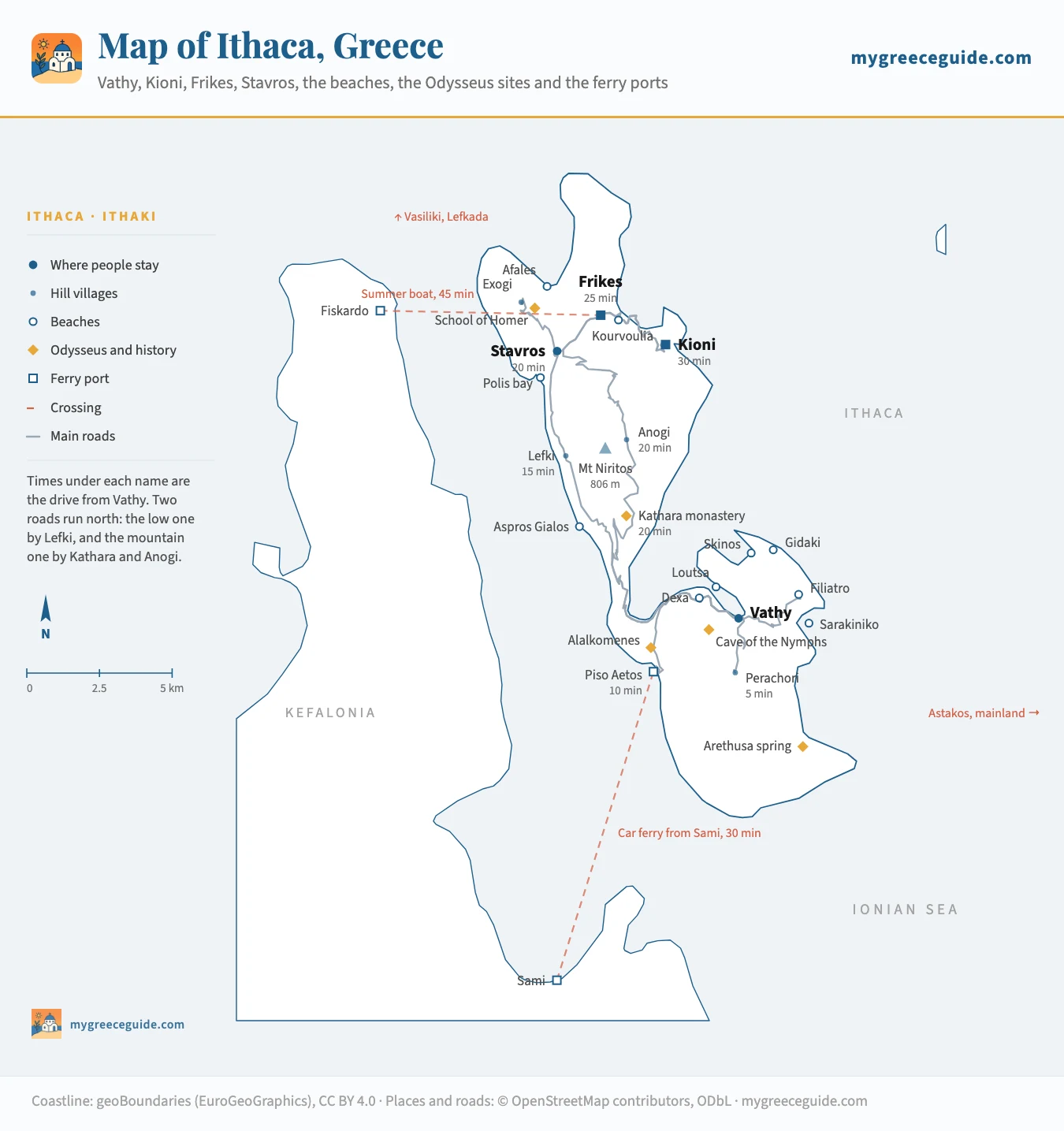
Ithaca map, Greece: villages, beaches and the ferry ports
Ithaca is two small mountains joined by a 600-metre neck of land. The capital sits in a bay at the bottom, the prettiest harbours at the top, and the ferry lands somewhere else entirely.
This Ithaca map is the Greek island, Ithaki, in the Ionian, not the town in New York. It is 23 km long and never more than 6 km wide, so nothing on it is more than half an hour from Vathy, the capital. Every village, beach, port and Odysseus site below is placed from its real coordinates, with the drive from Vathy under its name.
The thing the map makes obvious is that the ferry does not land in town. Car ferries from Kefalonia come into Piso Aetos, an empty quay on the west coast, and the summer boat from Fiskardo comes into Frikes in the north.
Where Ithaca is in Greece, and the shape of the island
Ithaca sits just east of Kefalonia, across a strait you can see over from either side, with Lefkada to the north and the mainland at Astakos to the east. The chain of Ionian islands runs down the west coast of Greece, and Ithaca is the one tucked behind the biggest of them. It covers 96 square kilometres and had 2,862 residents at the 2021 census.
The island is two blocks of limestone joined at the waist. The southern half rises to Merovigli, 669 m, and the northern half to Mount Niritos, 806 m, the highest point. Between them the isthmus of Aetos is only 600 metres wide. It separates the strait on the west from the Gulf of Molos on the east, whose southern arm is the long, closed bay of Vathy. The road from the ferry crosses that neck, which is why Piso Aetos is a ten-minute drive from town.
Kefalonia is so close that most visitors treat Ithaca as a day trip from it, and the map of Kefalonia shows the two ports, Sami and Fiskardo, that face this island. It is worth more than a day. The north alone is a different place from Vathy.
Ithaca villages on the map: Vathy, Kioni, Frikes and Stavros
Four villages do almost all the work, one in the south and three in the north. Where you sleep decides what is a walk and what is a drive.
Vathy, the capital in its closed bay
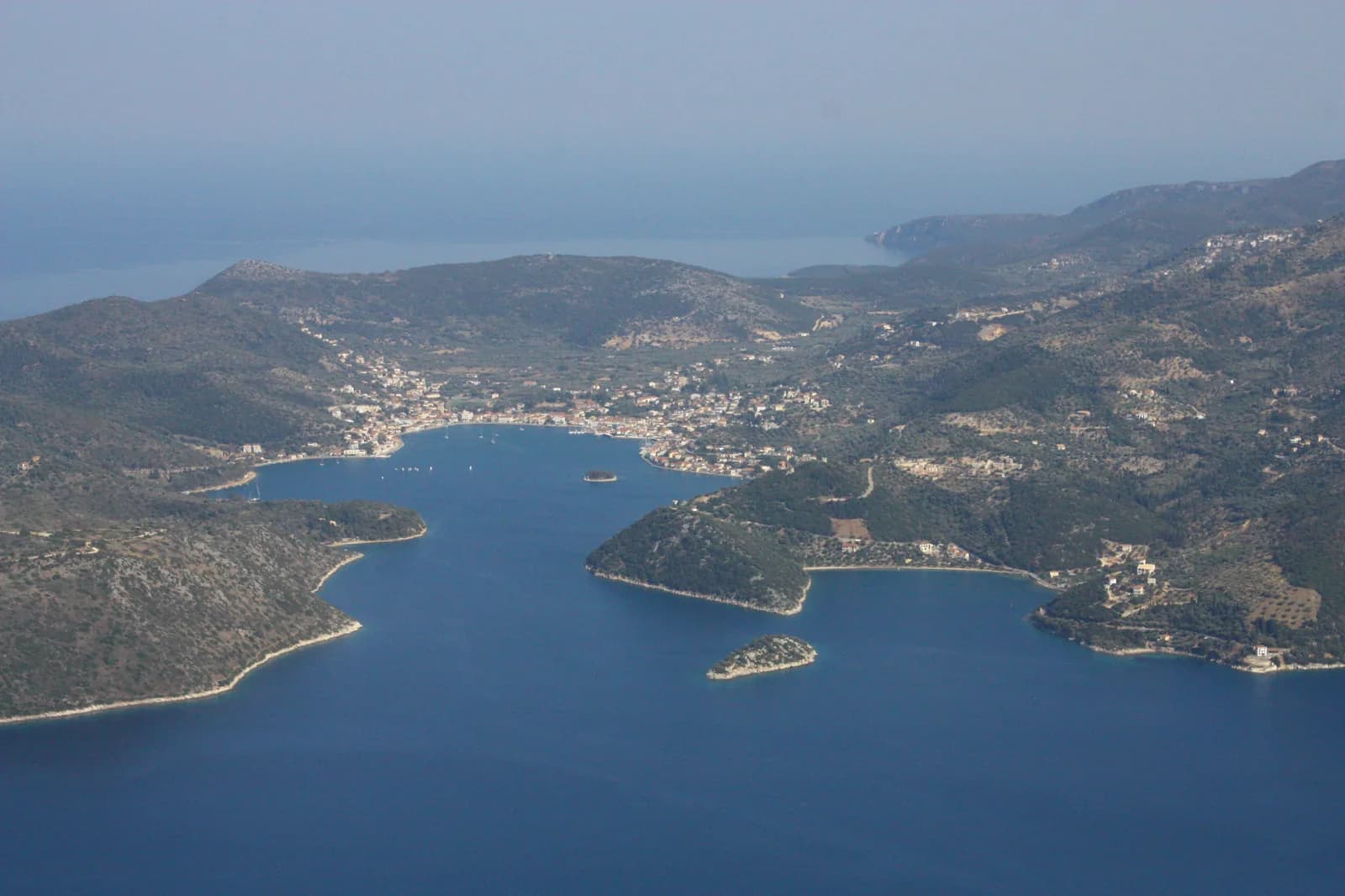
Vathy, also Vathi or Ithaki town, wraps round the end of a bay so enclosed it looks like a lake, with the islet of Lazaretto and its small church in the middle. It has the shops, the bank, the car hire, the yachts and most of the rooms. It also has the beaches at Dexa and Loutsa within 5 minutes and Filiatro within 10. The hill village of Perachori, five minutes above it, has the view down over the whole bay.
Kioni, the harbour on the north-east coast
Kioni is the picture on most Ithaca postcards: stone houses stepping down to a deep harbour, with three old windmills on the headland. It is 30 minutes from Vathy and the furthest village from the ferry, which keeps it quiet. Flotillas fill the quay on summer evenings, and the closest swims are at Plakoutses on the bay and the Kourvoulia coves towards Frikes.
Frikes, where the summer boat comes in
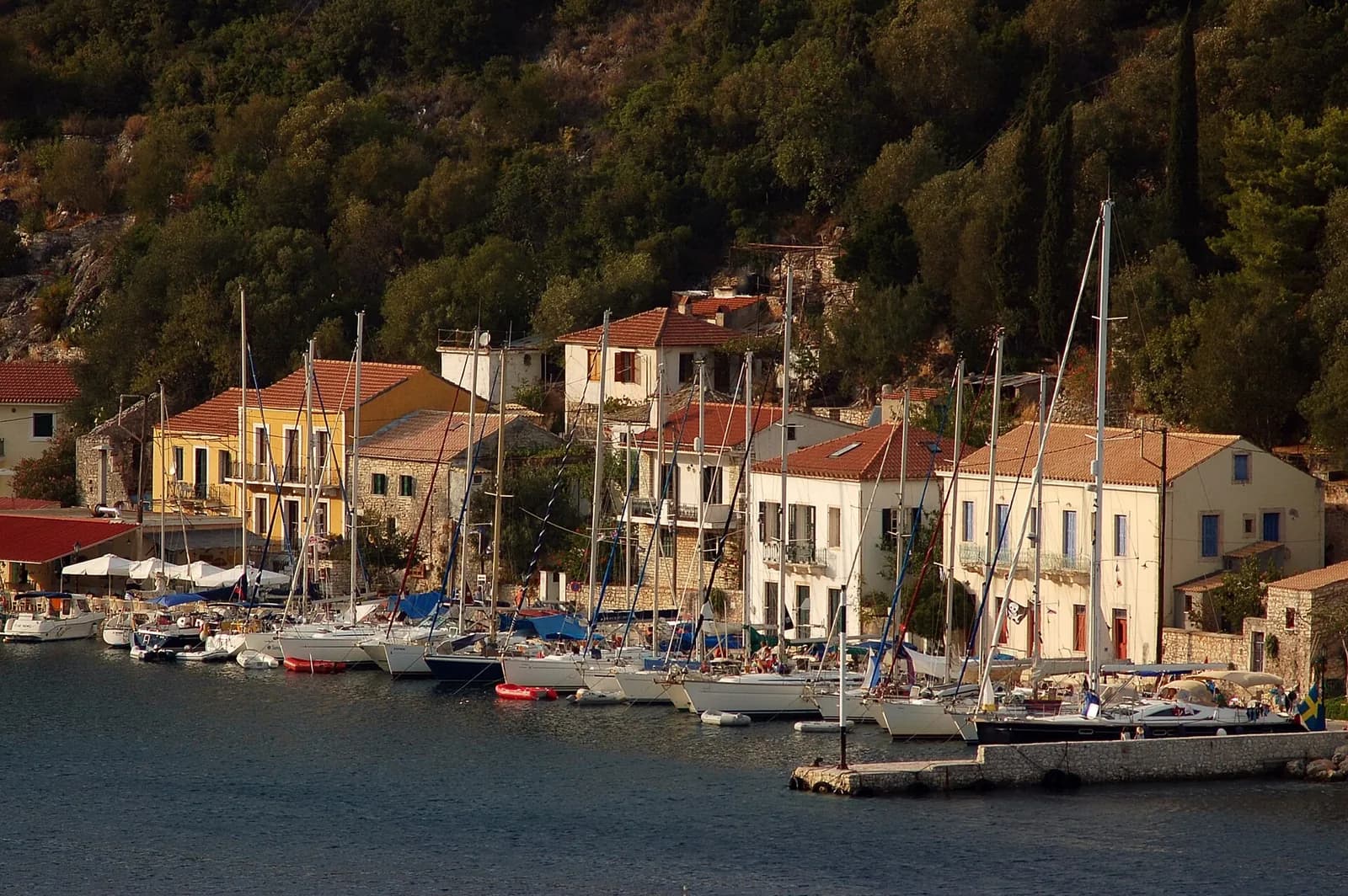
Frikes is a narrow inlet with a handful of tavernas on the quay, five minutes below Stavros. It matters on the map because it is the northern ferry port: the boat from Fiskardo on Kefalonia lands here from mid-June to late September, and so do the summer sailings from Astakos on the mainland. Kioni is 10 minutes along the coast.
Stavros, the crossroads of the north
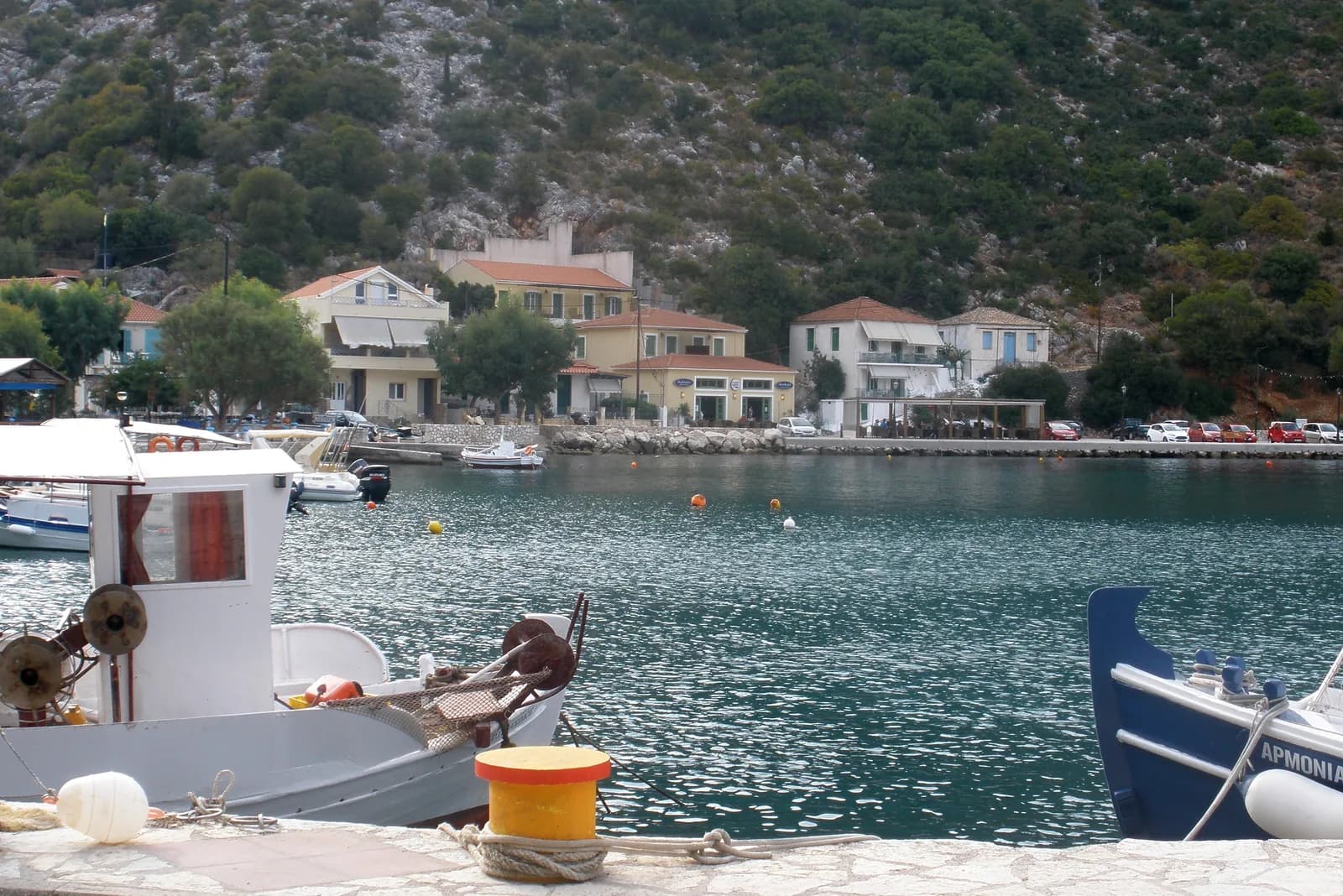
Stavros sits on the ridge above Polis bay, where both roads from the south arrive, and it is the second village of the island. It is a working village with a square and a bust of Odysseus rather than a harbour, and it is the base for the north's Odysseus sites: the School of Homer is just above it and Polis bay just below. Frikes and Kioni are 5 and 10 minutes away.
Anogi, Lefki, Exogi and the hill villages
The rest of the villages are small and high. Anogi, 20 minutes from Vathy on the mountain road, is the highest of them, with the tall standing stone of Arakli just outside it. Lefki sits on the low road above the strait facing Kefalonia. Exogi, Platrithia and Lachos are clustered above Stavros on the way to Afales bay. None of them has much to sleep in, and all of them are best reached by car.
Ithaca beaches map: the coves around Vathy and the northern bays
Ithaca has no long sandy beach. It has small pebble coves with very clear water, most of them a short drive from Vathy, and a few bays in the north worth the trip. The map marks the ten you are most likely to look for.
Beaches near Vathy: Dexa, Loutsa, Filiatro and Sarakiniko
Dexa is the nearest, 1.5 km out of town on the road to the port, a pebble cove on the inner bay. Loutsa and Mnimata are the next coves along the same shore. On the other side of the ridge east of town, Filiatro and Sarakiniko are both about 10 minutes from Vathy, and Filiatro is the closest organised beach to town.
Gidaki and Skinos, the two you work for
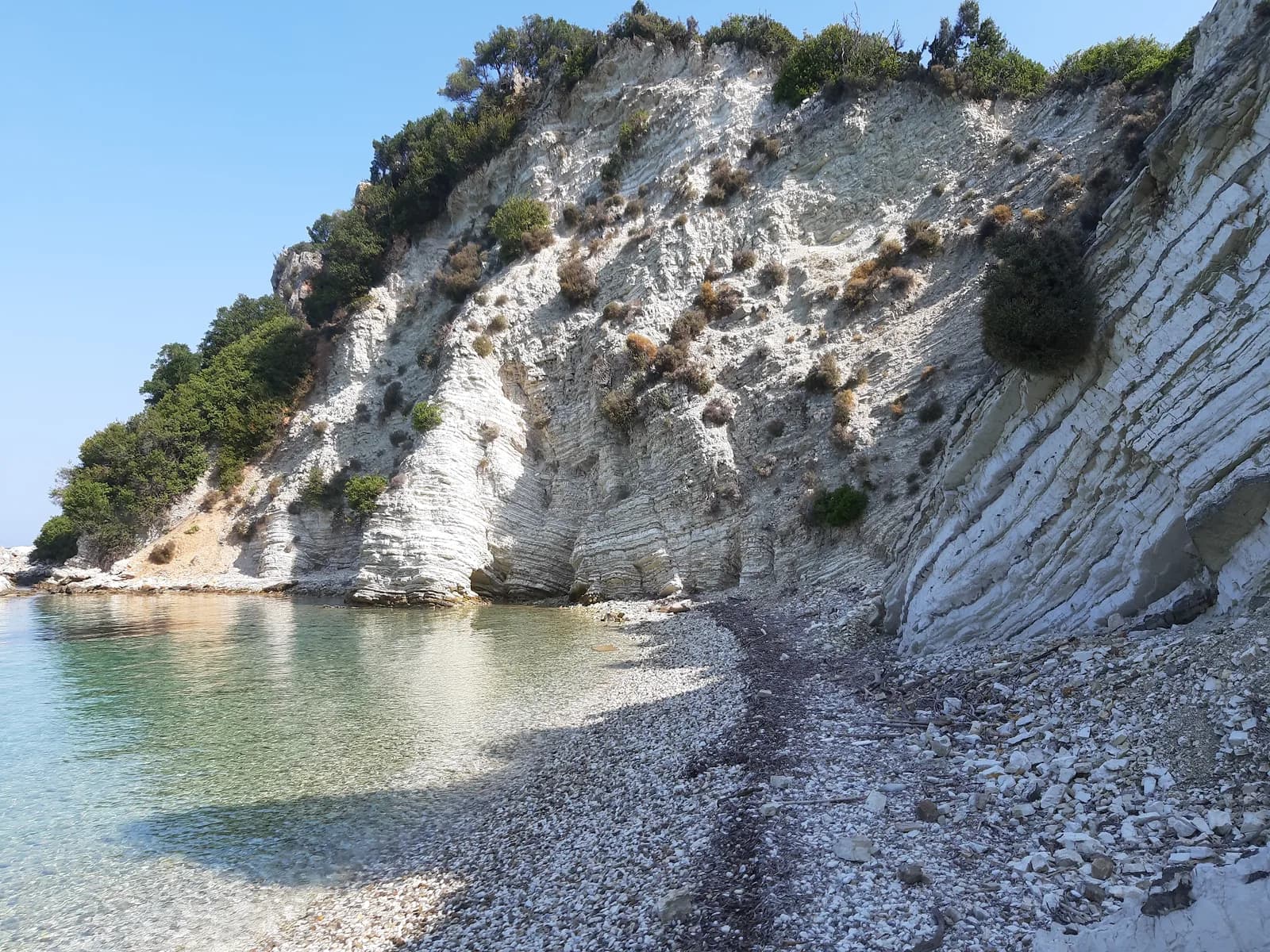
Gidaki is the beach people come to Ithaca for, a long white pebble curve under a green slope on the north-east side of the Vathy peninsula. The last stretch is a dirt track, so it does not fit in a driving table, and the excursion boats from Kefalonia stop here to swim. Skinos, on the same coast, is smaller and the road gets closer.
Beaches in the north of Ithaca: Polis, Afales and Kourvoulia
Polis bay sits below Stavros on the west coast, a pebble beach in the bay where the Loizos cave once stood. Afales, the big bay on the north-west tip, is the wildest beach on the island. Between Frikes and Kioni the coast road passes three small Kourvoulia coves, the easiest swim if you are staying up there.
The west coast: Aspros Gialos and Piso Aetos
On the strait side, Aspros Gialos below the hamlet of Agios Ioannis faces Kefalonia and gets the sunset. Piso Aetos has a small beach next to the ferry quay, handy for a swim while you wait for the boat back.
Ithaca ferry ports: Piso Aetos, Frikes and Vathy
Ithaca has no airport, so everyone arrives by sea, most of them after landing at Kefalonia airport and driving to Sami. The port you land at shapes the first half hour of the holiday. There are two ferry ports, and Vathy is not one of them.
Piso Aetos, the main port
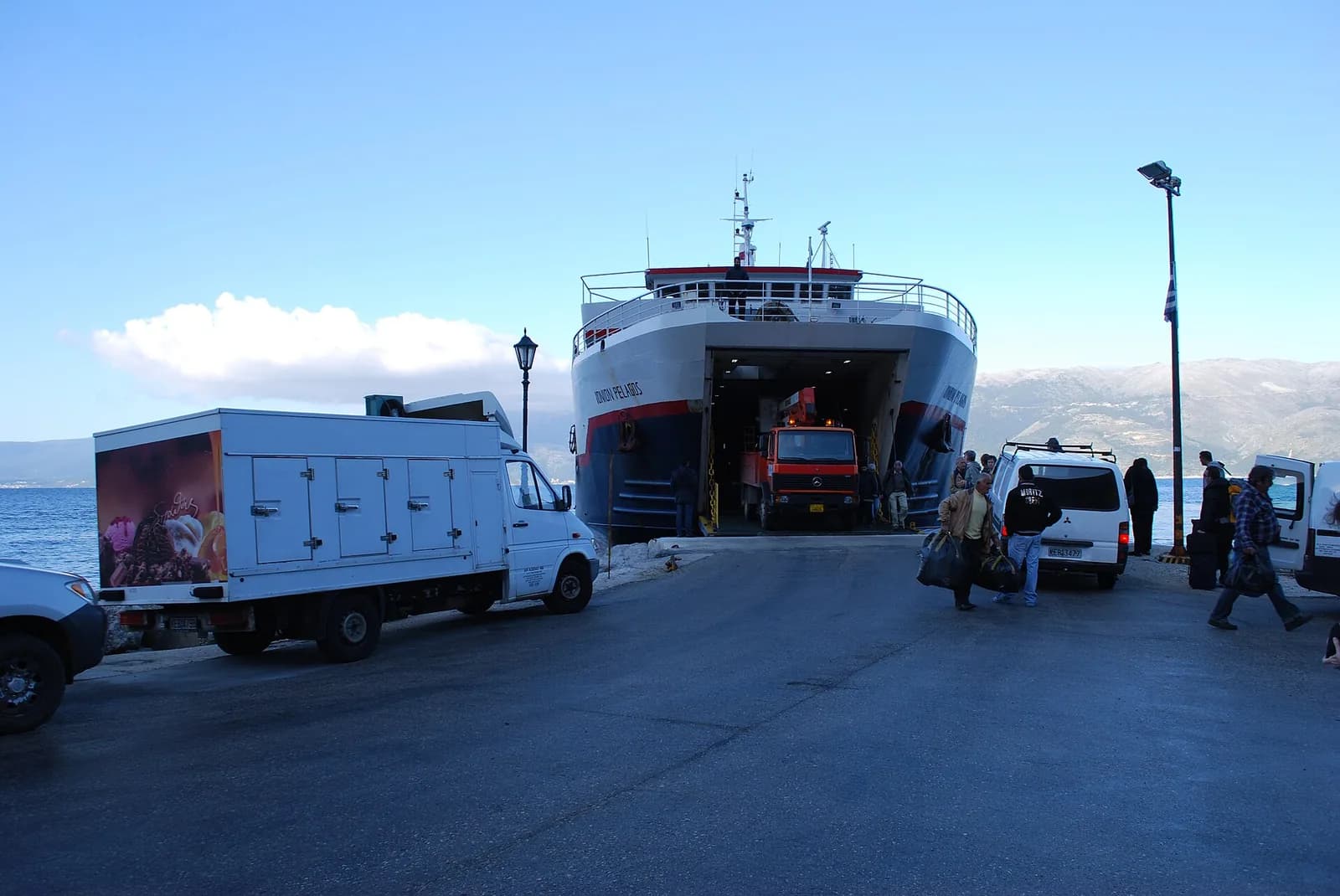
Piso Aetos, also written Pisaetos, is a ferry quay with a canteen on the west coast, under the hill of Aetos. The car ferry from Sami on Kefalonia lands here in about 30 minutes, and it runs all year. From the quay, Vathy is 7 km and 10 minutes over the isthmus, and Stavros is 20 minutes north without going through town. The Kefalonia to Ithaca ferry guide has the 2026 sailings and fares.
Frikes, summer only
Frikes takes the small ferry from Fiskardo, in the north of Kefalonia, about 45 minutes across, which continues to Vasiliki on Lefkada. It runs from mid-June to late September only. It is the better arrival for anyone staying in Kioni, Frikes or Stavros, and a way to hop on to Lefkada without going back through Sami.
Ferries from the mainland at Astakos
From the mainland, the crossing is from Astakos, on the coast of Aetolia-Acarnania. Ionion Pelagos runs it to Piso Aetos all year, in about 3 to 3.5 hours, and to Frikes in about 2 hours in July, August and September. It is the route for anyone driving from Athens, and the frequencies change each season, so check the week you travel.
Vathy harbour: yachts, not ferries
Vathy's harbour is full of sailing boats and excursion boats from Kefalonia, but no scheduled car ferry docks there. If a booking site shows "Ithaca", it means Piso Aetos or Frikes.
Odysseus sites on the Ithaca map
Ithaca has been claimed as the home of Odysseus since antiquity, and the island marks a handful of places with his name. Some are real excavations, others are a reading of Homer. Most of what was found is in the museums, not on site.
School of Homer at Agios Athanasios, above Stavros
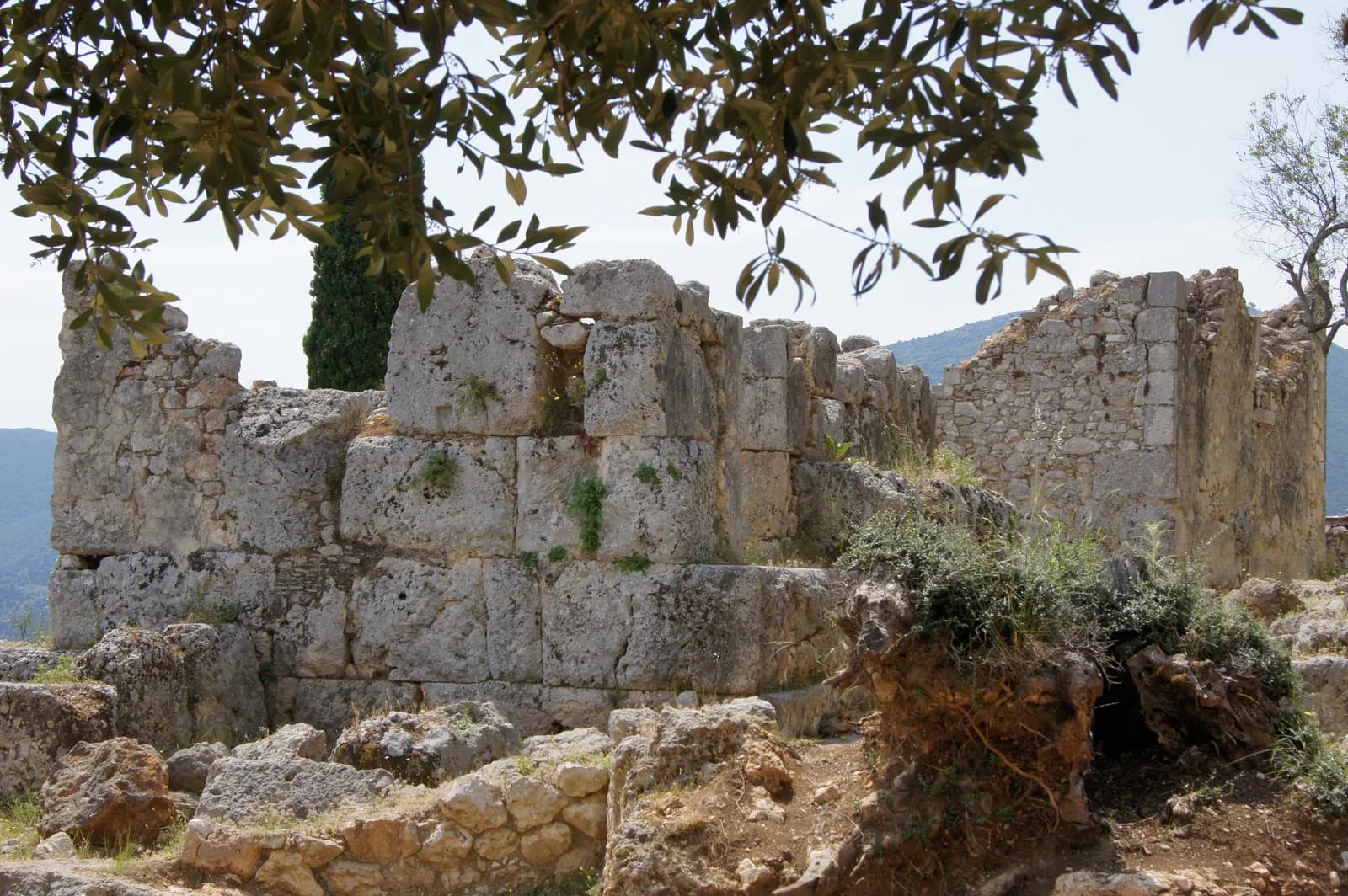
On the slope north of Stavros, the site called the School of Homer is where excavations uncovered a large building of the eighth century BC, announced in 2010 as a possible palace of Odysseus. It is the strongest archaeological claim on the island, and the one site in the Lefkada, Kefalonia and Ithaca triangle with possible Linear B inscriptions. What you see today is stone walls and terraces among the olive trees.
Polis bay and the Loizos cave
On the west side of Polis bay, below Stavros, stood a sea cave that has since collapsed. Excavated in the 1930s, it gave up twelve bronze tripods, which recall the tripods the Phaeacians give Odysseus in the Odyssey, and evidence of a cult running from the early Bronze Age to Roman times. Heinrich Schliemann took it for the cave of Odysseus. Today the bay is a beach and the cave is rubble.
Cave of the Nymphs above Dexa
The Marmarospilia, about 3 km from Vathy above Dexa beach, is identified locally with the cave where Odysseus hid the Phaeacians' gifts. The entrance is reported closed after rockfalls, so treat it as a walk to the mouth of the cave and ask in Vathy before going.
Alalkomenes on the hill of Aetos
On the hill above the Piso Aetos ferry quay, the ruins of the ancient town of Alalkomenes include an acropolis and stretches of cyclopean wall. It is the first Odysseus site you pass, on the road between the ferry and Vathy, and the climb gives the best view of both gulfs and the isthmus between them.
The Arethusa spring in the south-east
In the Odyssey, Athena sends Odysseus to the swineherd Eumaeus, who keeps his pigs by the Raven's Rock and the spring of Arethusa. The spring is marked on the map in the south-east of the island. The road ends in a track, so ask locally about the walk before setting out.
Kathara monastery and the Vathy museum
The monastery of Panagia Kathariotissa stands on the mountain road to Anogi, 20 minutes from Vathy, with a wide view over the south of the island. Its feast day is 8 September. In town, the Archaeological Museum of Vathy is open 08:30 to 15:30, closed on Tuesdays, with entry at €5. It holds finds from Geometric to Roman times, including from the digs at Aetos and the Loizos cave. Stavros has a small archaeological collection of its own, on the road to Platrithia.
Ithaca in a day, if you are based on Kefalonia
A coach tour covers the monastery and the villages by road. The two boat days go round the coves instead, Gidaki included, and stop long enough in Vathy for lunch.

From Kefalonia, hotel pickup
Ithaca full-day bus tour from Kefalonia
Ferry across from Kefalonia, then a coach round Ithaca with a monastery visit and a walk in town.
4.5 (169 reviews)10 hPickup included
From Skala, Kefalonia
Ithaca cruise with swim stops and Vathy visit
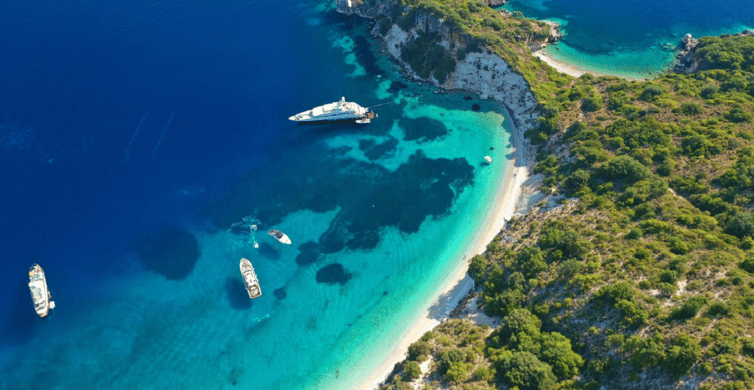
Sail from Skala to Ithaca, swim at coves including Gidaki and spend time in the capital, Vathy.
4.6 (247 reviews)8.5 h
From Agia Efimia
Small-group sailing day to Ithaca with lunch
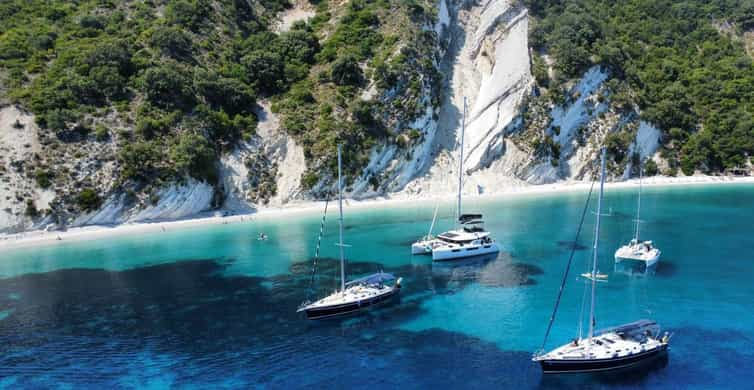
Small yacht from Agia Efimia to Ithaca, with swims at popular beaches and lunch on board.
4.9 (116 reviews)8.5 h
Prices, ratings and reviews from GetYourGuide, checked on October 29, 2026.
Ithaca roads and driving times from Vathy
From Vathy one road runs west to the isthmus, past the turn for Piso Aetos, then climbs north. Above the isthmus it splits into two roads to Stavros. The low road runs along the west side above the strait, past Agios Ioannis and Lefki, and is the quicker one at about 20 minutes. The mountain road climbs past Kathara monastery to Anogi and drops into Stavros from the east, about 25 minutes. Take one each way.
From Stavros, short roads fan out to Frikes, Kioni, Exogi and Afales. The table gives the drive to each place on the map, rounded up.
| From | To | Distance | Time | Worth knowing |
|---|---|---|---|---|
| From Vathy | ||||
| Vathy | Dexa beach | 1.5 km | 5 min | The closest swim, on the road out of town towards the port |
| Vathy | Perachori | 3 km | 5 min | Up the hill behind the town, the view down over the bay |
| Vathy | Filiatro | 4 km | 10 min | Over the ridge to the east, same road as Sarakiniko |
| Vathy | Piso Aetos | 7 km | 10 min | Across the isthmus to the ferry quay on the west coast |
| Vathy | Lefki | 12 km | 15 min | On the low road north, above the strait facing Kefalonia |
| Vathy | Kathara monastery | 14 km | 20 min | On the mountain road, before Anogi |
| Vathy | Anogi | 16 km | 20 min | The mountain road, slower and higher than the one by Lefki |
| Vathy | Stavros | 16 km | 20 min | By the low road, the quicker of the two ways north |
| Vathy | Frikes | 18 km | 25 min | Through Stavros and down to the harbour |
| Vathy | Kioni | 23 km | 30 min | The far end of the island, along the coast from Frikes |
| From the ferry at Piso Aetos | ||||
| Piso Aetos | Stavros | 17 km | 20 min | You do not need to go through Vathy to reach the north |
| Piso Aetos | Frikes | 19 km | 25 min | The same road on, down to the harbour |
| Piso Aetos | Kioni | 24 km | 30 min | The longest transfer on the island, and still half an hour |
| Around the north | ||||
| Stavros | Frikes | 2.5 km | 5 min | Downhill to the sea |
| Frikes | Kioni | 5 km | 10 min | The coast road past the Kourvoulia coves |
| Stavros | Kioni | 7 km | 10 min | Close enough to eat in one and sleep in the other |
Distances and times are routed on OpenStreetMap data and rounded up, because the roads here are narrow and steep. Add a few minutes in August, and more after dark.
Getting around Ithaca without a car
It can be done if you stay in Vathy. There is no bus timed to the ferries, but taxis and minibuses meet the boats at Piso Aetos and Frikes, and need booking ahead in July and August. For the north, a car or scooter for a day or two is the practical answer.
Header photo: Vathy from the air by Ellibah, via Wikimedia Commons, CC BY-SA 4.0.
Questions people ask about Ithaca
Where is Ithaca in Greece?
In the Ionian sea, off the west coast of Greece, not in the Aegean. Ithaca lies just east of the northern half of Kefalonia, separated from it by a narrow strait, with Lefkada to the north and the mainland coast at Astakos to the east. It is a small island: 23 km from end to end, 6 km at its widest and 96 square kilometres, the second smallest of the main Ionian islands after Paxos. There is no airport, so visitors fly into Kefalonia and take the half-hour ferry from Sami.
Why is Ithaca, Greece so famous?
Because it is the home Odysseus spends the whole of Homer's Odyssey trying to reach, ten years after the fall of Troy. The island has traded on it since antiquity: coins struck here carried the hero's head, and an inscription from the third century BC records games held in his honour. Today the draw is quieter than the myth. Ithaca has no airport, no resort strip and no package hotels, and people come for the three harbour villages, Vathy, Kioni and Frikes, the small pebble coves and the walking.
Was Ithaca a real place in Greece?
Yes. The modern island of Ithaca has carried the name since antiquity, and the geographer Strabon identified it with Homer's Ithaca two thousand years ago. What scholars argue about is whether Homer's description fits it. In the early twentieth century Wilhelm Dörpfeld argued for Lefkada instead, and a later theory placed Homer's Ithaca on the Paliki peninsula of Kefalonia, which geological studies have not supported. On the island itself, a large building of the eighth century BC excavated at Agios Athanasios above Stavros is presented locally as the palace of Odysseus.
How close was Odysseus to Ithaca?
Close enough to see it, in the most painful scene of the Odyssey. In Book 10, Aeolus gives Odysseus a bag holding the storm winds so that a single breeze carries his ships home. On the tenth day of sailing they are near enough to Ithaca to see men tending fires on the shore. Odysseus falls asleep, his crew open the bag thinking it holds gold, and the winds blow the ships all the way back out to sea. The journey home takes years more after that.
Does Ithaca have an airport?
No, and neither does Paxos. The nearest airport is Kefalonia's, EFL, near Argostoli, about 40 minutes by road from the port of Sami. From Sami the car ferry crosses to Piso Aetos on Ithaca's west coast in about half an hour, and from there Vathy is ten minutes away. In summer a second route runs from Fiskardo in the north of Kefalonia to Frikes, which suits anyone staying in Kioni or Stavros. Preveza airport, for Lefkada, is the other option when the summer boat from Vasiliki is running.
Do you need a car on Ithaca?
Only if you want to see both halves of the island. Vathy works on foot: the town, the museum and the beaches at Dexa, Loutsa and Filiatro are all within a short drive or a long walk. The north is 20 to 30 minutes away by road and there is no bus timed to the ferries. Taxis and minibuses meet the boats at Piso Aetos and Frikes, and need booking in July and August. Hire cars are available in Vathy, or you can bring one across from Kefalonia on the car ferry from Sami.

