Planning a trip to Greece: when to go, how long, which islands and budget
Six decisions, taken in the right order, turn a pile of island photos into a trip that works on the ground. The month comes first, because it decides which ferries run and what a room costs. Everything else follows from it.
To plan a trip to Greece, settle six things in order: when you go, how many days you have, which islands, how you move between them, where you sleep and what it costs. Most first trips go wrong at step three, when two islands that look close on a map turn out to be a day of ferries apart. Below are the six steps, a daily budget in euros and dollars built from 2026 prices, and the travel tips that save the most time once you land.
Plan a trip to Greece in 6 steps
- Pick the month. June or September if you can. They give you a warm sea and every ferry line without the August prices.
- Count your days. Seven days means Athens plus one island. Ten days means two islands. Fourteen means three, or two plus Crete.
- Choose islands on the same ferry line. Naxos and Paros chain together in an hour. Santorini and Corfu are on opposite sides of the country.
- Book the long legs first. International flights, then the Athens to island ferry or a domestic flight for islands far from Piraeus.
- Book rooms by area, not by hotel. In Athens, stay within walking distance of the Acropolis. On the islands, decide between the main town and a beach.
- Set a daily budget. Around €140 ($155) per person mid-range, before flights, plus a climate fee on every hotel night.
Each step has its section below. If you are still deciding between island groups, the map of the Greek islands shows where each group sits and which airports serve them.
When to go to Greece: month by month
The best time to visit Greece for an island trip is June or September. The season decides more than the weather: from November to March many island hotels and tavernas shut, and the fast boats mostly stop, so a winter trip works for Athens and Crete rather than for the Cyclades.
| Months | Verdict | What to expect |
|---|---|---|
| November to March | Athens and Crete only | Many island hotels and tavernas close. Conventional ferries still run, fast boats mostly stop. |
| April | Cities and walking | Easter week fills hotels. The sea is still too cold for most swimmers. |
| May | Good value | Islands reopen, prices are low, the sea is cool but swimmable by the end of the month. |
| June | Best overall | Warm sea, every ferry line running, before the August peak. |
| July and August | Peak, book early | Highest prices and crowds. The meltemi wind can cancel fast ferries. |
| September | Best overall | The sea is at its warmest, crowds thin after the first week. |
| October | Good value | Quieter and cheaper. Some small-island hotels close mid-month. |
July and August bring a second problem besides prices. The meltemi, a dry north wind, blows hardest then, and fast catamarans stay in port when the swell is too big. Keep a free day between your last island and your flight home.
How many days in Greece: 7, 10 or 14
Ten days is the right length for a first trip: enough for Athens and two islands without spending half the holiday on boats. Every island move costs you most of a day once you count checkout, the port and the crossing.
One week in Greece
Two days in Athens, then one island for five nights. Naxos, Paros or Santorini all work from Piraeus. Trying to squeeze in a second island in seven days usually leaves you with three nights on each and one of them spent packing.
Ten days in Greece
Two days in Athens and two islands on the same line, four nights each. Classic pairs are Naxos and Paros, Paros and Milos, or Mykonos and Santorini. The Cyclades guide explains which islands chain together and which do not.
Two weeks in Greece
Athens, two Cyclades, then Crete for the last four or five nights. There is a direct ferry from Santorini to Heraklion, and Crete has two international airports, so you fly home from there instead of going back to Athens.
Which Greek islands to visit on a first trip
Choose the island group first, then the island. Greece has six groups, and the ferries link islands inside a group far better than they link one group to another.
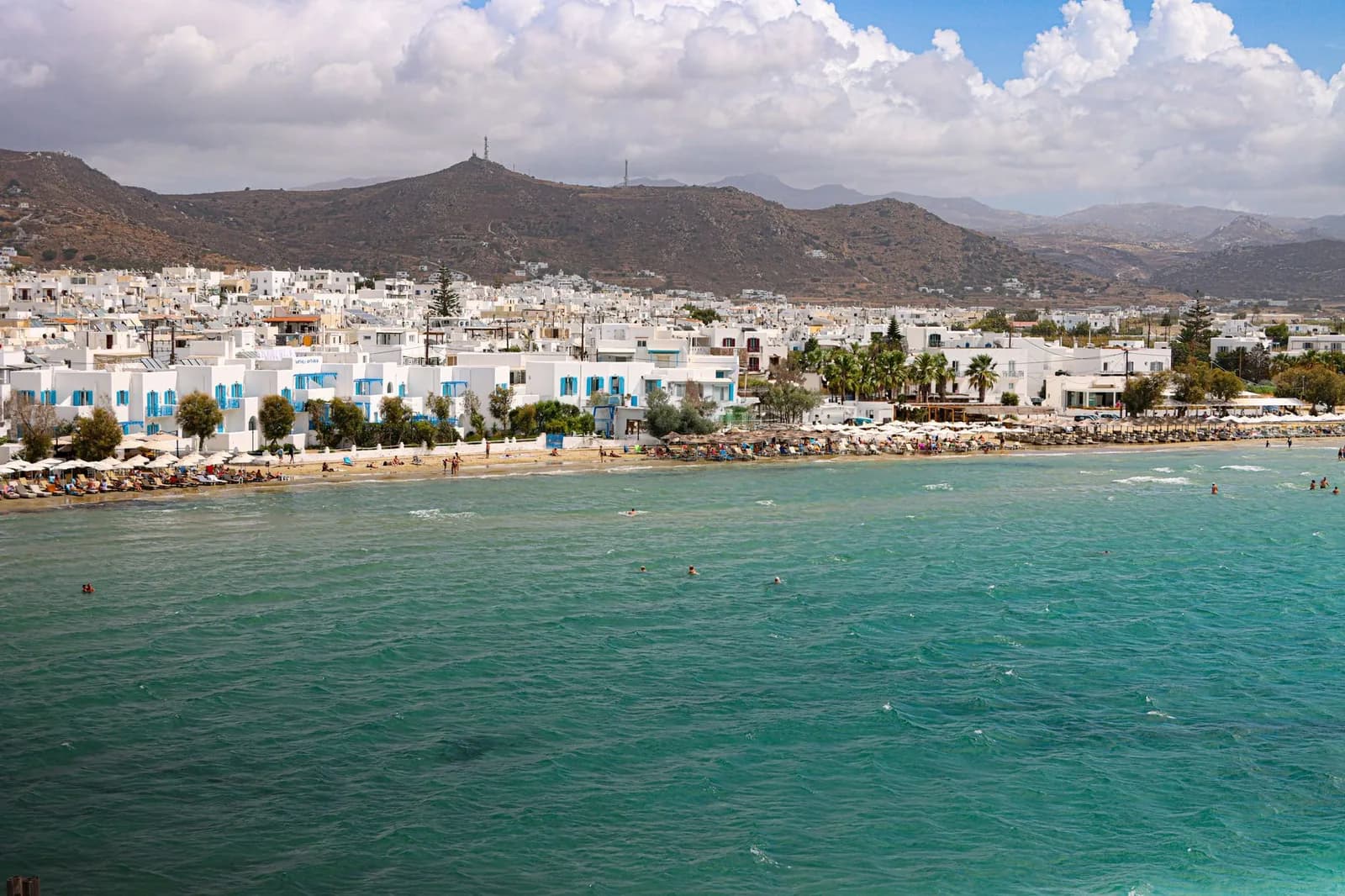
- The Cyclades: the white villages and blue domes. Santorini for the views, Naxos and Paros for beaches and better value, Milos for the coastline.
- Crete: big enough for a week alone, with mountains, gorges and the best food in the country. You need a car.
- The Ionian islands: green, on the west coast. Corfu, Kefalonia and Zakynthos are easier to reach by plane than by ferry from Athens.
- The Dodecanese: Rhodes and Kos, near Turkey, with direct summer flights from much of Europe.
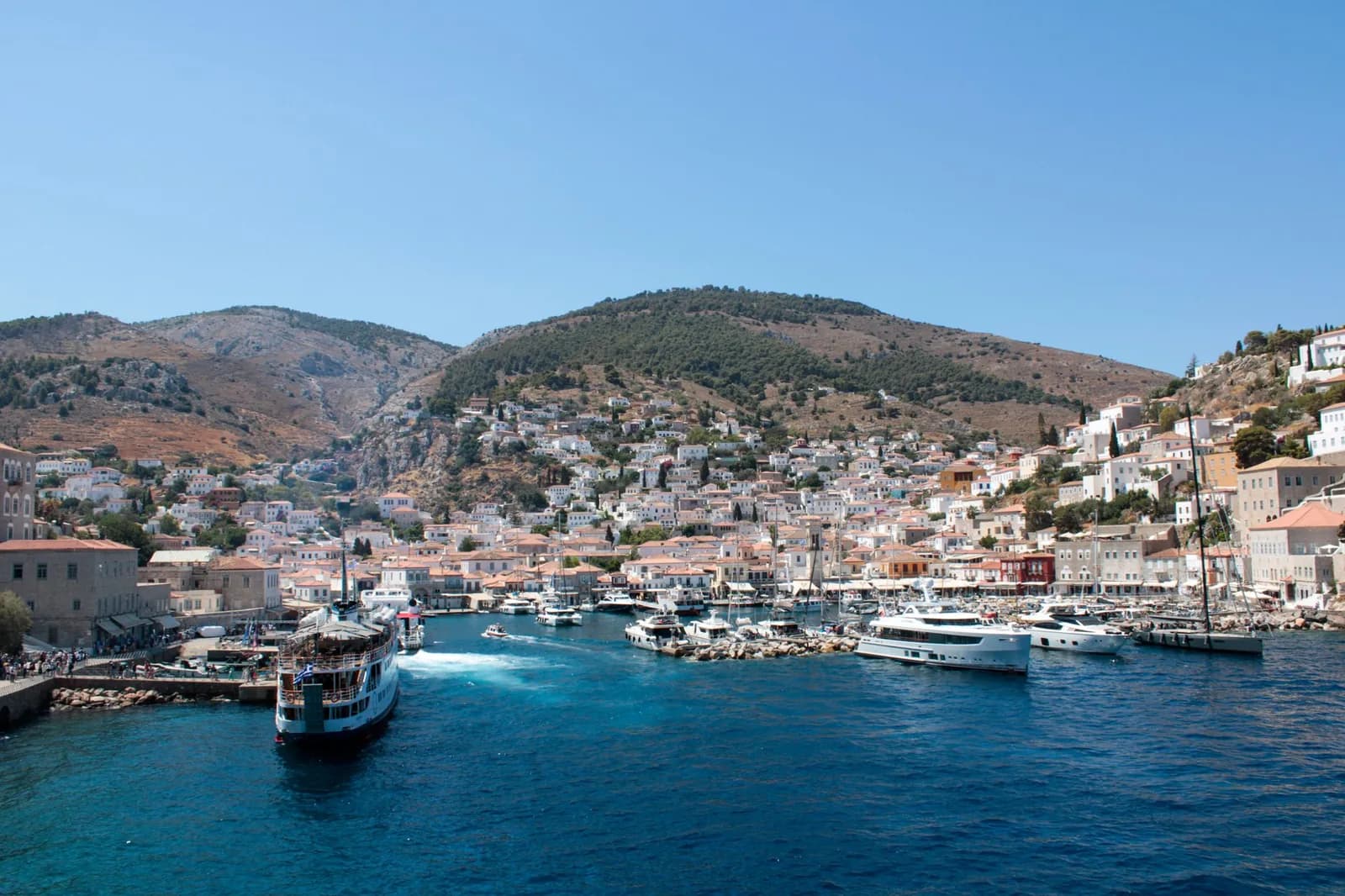
- The Saronic islands: Hydra, Aegina and Poros, close enough to Athens for a day trip.
Getting around Greece: ferries, flights and buses
Ferries for the Aegean islands, planes for the Ionian islands and Crete when time is short, buses and rental cars once you are on an island. From Piraeus, the fast boat costs roughly twice the conventional ferry to save two or three hours.
| Route | Conventional ferry | Fast ferry |
|---|---|---|
| Piraeus to Naxos | 5 h 05, from €42 | 3 h 10, from €78 |
| Piraeus to Mykonos | 4 h 35, from €44 | 2 h 35, from €88 |
| Piraeus to Santorini | 5 h 35, from €47 | 4 h 25, from €90 |
One way, adult, fastest crossing and lowest fare listed on Ferryhopper in November 2026. Fares move with the date.
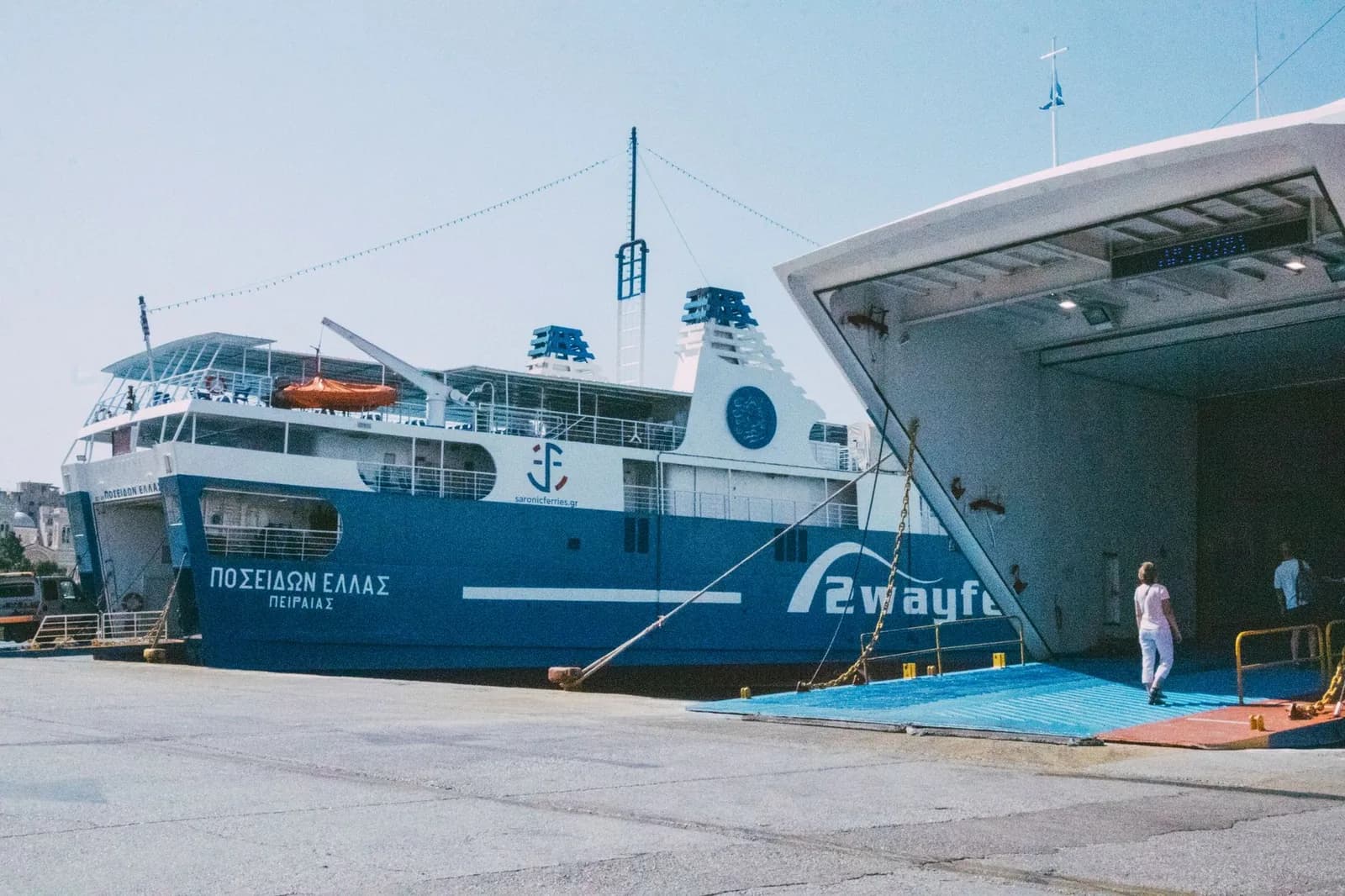
The big conventional ships, Blue Star for most routes, are cheaper, sail through most of the meltemi and let you walk the deck. Book them once your dates are fixed. In July and August, book the car spaces and cabins early. The Greek ferries guide covers the operators, the three Athens ports and how cancellations work.
Domestic flights on Aegean and Sky Express save a day on the long legs, Athens to Corfu, Rhodes or Chania. The guide to Greek airports lists which island has an airport and how far it is from town. From Athens airport to the centre, the metro costs €9, paid by contactless card at the gate, the X95 bus €5.50, and a taxi has a fixed fare of €40 by day and €55 at night.
Where to stay in Greece: Athens, then the islands
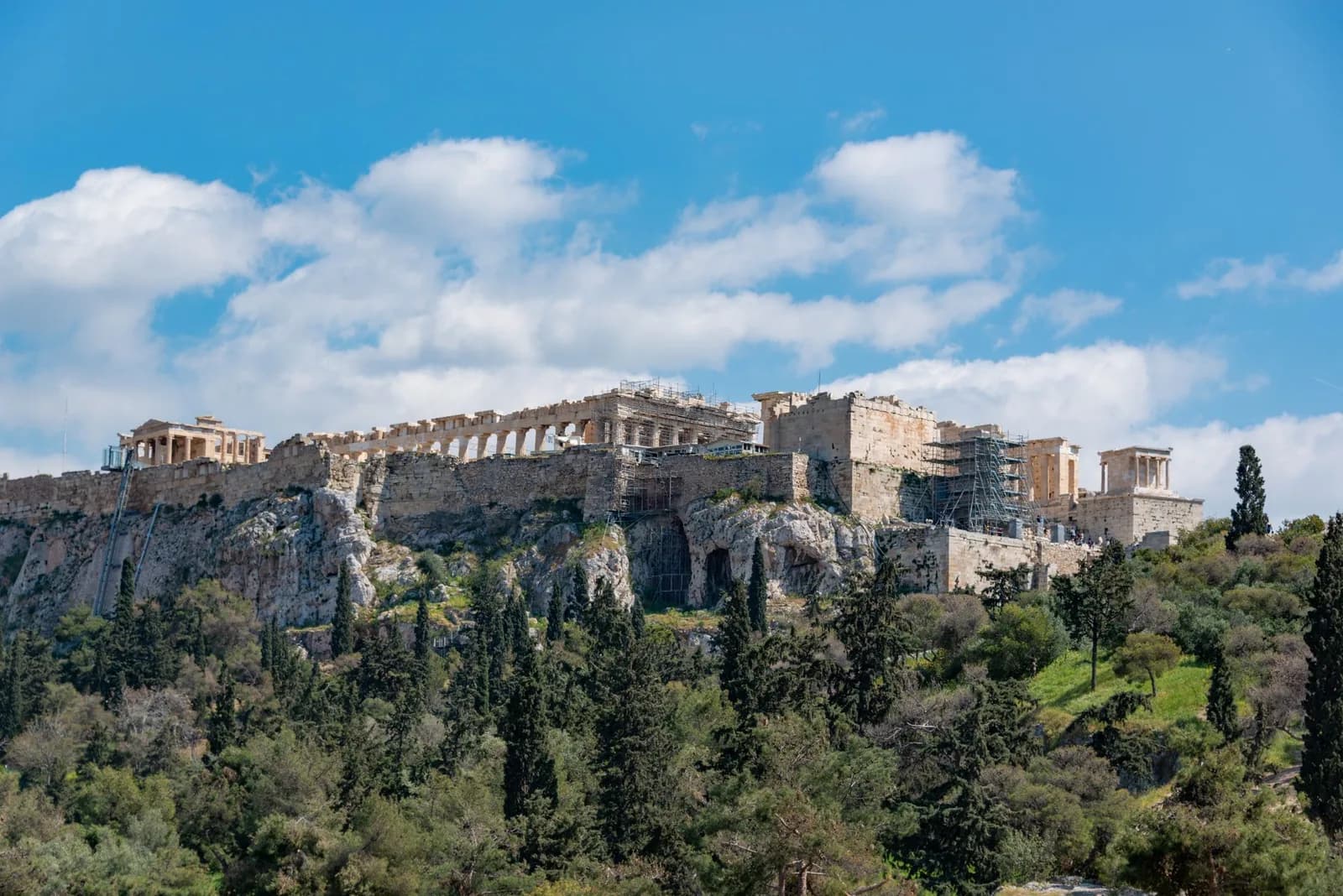
In Athens, stay in Plaka, Koukaki or Monastiraki, all within walking distance of the Acropolis, so you can be at the gate when it opens. On the islands the choice is between the main town, lively and next to the port, and a beach village, quieter but dependent on buses or a car.
As a reference, rooms we priced for a weeknight in late November 2026 came to a median of €85 a night in a 3-star and €107 in a 4-star, for two people. Expect roughly double in July and August, and far more on the caldera in Santorini. The Greece hotels guide goes island by island, with the hotels we picked in Athens, Naxos and Santorini.
Every hotel night also carries a climate resilience fee, per room and paid on top of the rate. From April to October it is €2 in a 1 or 2-star hotel, €5 in a 3-star, €10 in a 4-star and €15 in a 5-star. From November to March it drops to between €0.50 and €4. A week in a 4-star in summer adds €70 per room.
How much does a trip to Greece cost per day in 2026
Count about €140 ($155) per person per day for a mid-range trip in summer, sharing a double room, flights excluded. The table is our estimate, built from the prices we checked in November 2026 and converted at €1 = $1.12.
| Per person, per day | Budget | Mid-range | Comfort |
|---|---|---|---|
| Room (half a double) | €35 | €70 | €150+ |
| Food and coffee | €25 | €45 | €80 |
| Local transport and ferries | €5 | €15 | €30 |
| Sights and tours | €5 | €10 | €40 |
| Total per day | ~€70 ($80) | ~€140 ($155) | ~€300 ($335) |
| A week, per person | ~€490 ($550) | ~€980 ($1,100) | ~€2,100 ($2,350) |
Summer 2026, two people sharing a room. Ferries averaged over the stay. Dollar figures are rounded and move with the exchange rate.
What goes into it: a gyros costs €3 to €5, a meal in a simple restaurant around €15, dinner for two in a mid-range taverna about €50 before drinks, a cappuccino €3.50 and a city bus ticket in Athens €1.20. The Acropolis is €30, the most expensive ticket you will buy.

Greece on a budget: where the money goes
Three costs decide whether a Greece trip is cheap or expensive. First the month, because the same room can cost twice as much in August as in May. The island, because Santorini and Mykonos sit in a different price bracket from Naxos, Paros or Crete. And the ferries, where taking the conventional boat instead of the fast one saves around €40 a person on each leg.
Greece travel tips for a first trip
Book the Acropolis slot online
The Acropolis ticket is €30 all year, with a timed entry slot that you pick when you buy, on the official site tickets.hh.gr. The old combined ticket for seven sites was withdrawn in April 2025, so each site now has its own ticket. In July and August the morning slots sell out, so book as soon as your Athens dates are fixed.
Traveling to Greece from the US: EES and ETIAS
Americans need no visa for a tourist stay. Since 10 April 2026, the Entry/Exit System records your fingerprints and a photo at the first border crossing into the Schengen area, instead of a passport stamp, so allow extra time at the airport on arrival. ETIAS, the online authorisation, is not in force yet: its launch has moved to 2027 with no date fixed. Check travel-europe.europa.eu before you book, and ignore any site charging you for an ETIAS today.
Leave a day between the islands and your flight
Ferries get cancelled for wind, and strikes move sailings by a day. Spend your last night in Athens or on an island with an airport, never on a ferry the morning of an international flight.
Cards, cash and small things
Cards are accepted almost everywhere, but carry some cash for small tavernas, kiosks and beach bars. Toilet paper goes in the bin, not the toilet, in most of the country: the pipes are narrow. Tap water is safe in Athens. On many small islands people drink bottled water.
Is Greece safe to travel right now?
Yes. The US State Department puts Greece at its lowest level, exercise normal precautions. Check travel.state.gov for the current notice. The risks to plan for are summer wildfires, transport strikes and pickpockets on the Athens metro line to Piraeus.
Travel insurance for Greece
A US health plan rarely covers you in Greece, and a helicopter or ferry evacuation from a small island is expensive. Take a policy that covers emergency medical care and medical evacuation, and read what it says about trip interruption if a strike or the wind cancels a ferry.
Planning a trip to Greece: questions people ask
What is the best way to plan a trip to Greece?
Decide in this order: the month, the number of days, then the islands, and only then book. The month decides which ferries run and what rooms cost. The number of days decides how many islands you can fit: one island for a week with Athens, two for ten days, three for two weeks. Pick islands on the same ferry line, book the flights and the Acropolis slot, and book ferries once the dates are fixed.
How much does a trip to Greece cost?
Our estimate for 2026, per person and per day with a shared double room and flights excluded: about 70 euros (80 dollars) on a tight budget, 140 euros (155 dollars) mid-range and 300 euros (335 dollars) or more in caldera-view comfort. A week mid-range comes to roughly 1,000 euros (1,100 dollars) per person before flights. Summer on Santorini or Mykonos costs more, May and October less.
What is the best month to go to Greece?
June and September. The sea is warm, every ferry line runs, and you avoid the July and August peak, when prices are highest and the meltemi wind cancels fast boats. May and October are cheaper and quieter, with a cooler sea. From November to March many island hotels close, so winter suits Athens and Crete better than the small islands.
Is it risky to travel to Greece right now?
Greece is one of the safer countries in Europe for travellers. The US State Department has it at its lowest advisory level, exercise normal precautions, but check travel.state.gov before you go. The real risks are practical: wildfires in summer, ferry and transport strikes that move your plans by a day, and pickpockets on the Athens metro.
How many days do you need in Greece?
Ten days is the sweet spot for a first trip: two days in Athens and two islands on the same ferry line. Seven days works with Athens plus one island. With fourteen days you can add a third island or Crete.
Do Americans need a visa or ETIAS for Greece in 2026?
No visa for a tourist stay. ETIAS, the online travel authorisation, is not in force yet: as of November 2026 its launch has slipped to 2027 with no date fixed. What has changed is the Entry/Exit System, running since April 2026, which scans your fingerprints and face at the first border crossing into the Schengen area instead of stamping your passport.
