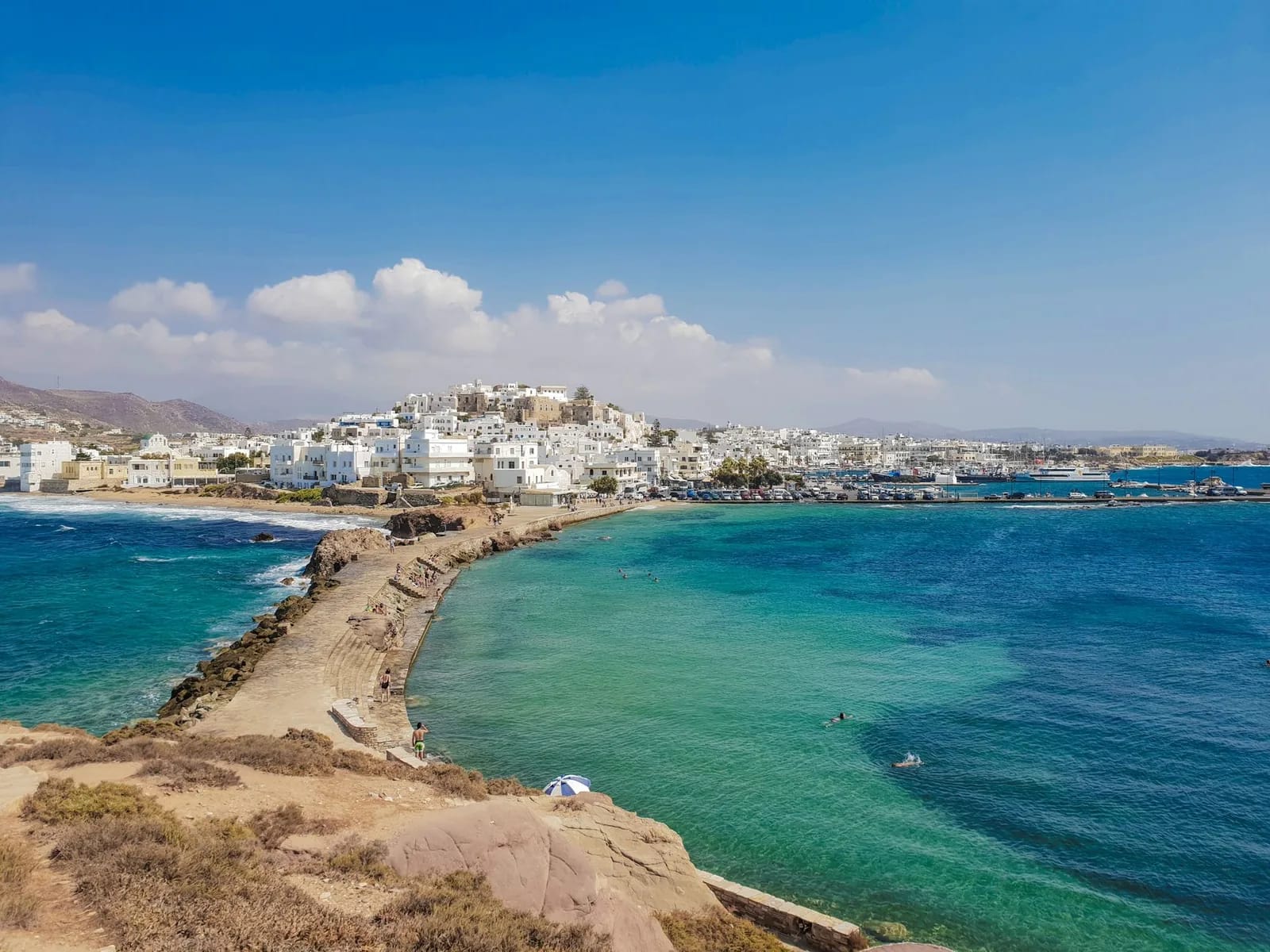
Naxos, Greece: things to do, Chora, villages and beaches
Naxos is the largest of the Cyclades: an old town under a Venetian castle, marble villages in the mountains, ancient statues left in their quarries and the longest sandy coast in the group. Give it four to six nights.
Naxos, Greece is the island people add to a Cyclades route as a stopover and then wish they had given a week. Chora is the base, with the Portara on its islet and the Kastro above the port. The mountains are the surprise: Halki, Filoti and Apeiranthos, Mount Zas and the unfinished kouroi. And the west coast, from Agios Prokopios to Mikri Vigla, is the best run of sand in the Cyclades.
Things to do in Naxos, Greece: the short list
Sixteen things, roughly in order of priority. The first six fit into three days.
- Watch the sunset at the Portara, the marble doorway on the islet by the port.
- Get lost in the Kastro, the Venetian quarter at the top of Chora.
- Drive the mountain villages in one day: Halki, Filoti and Apeiranthos.
- Swim at Agios Prokopios or Plaka, a bus ride from town.
- See the kouros of Flerio, an archaic statue lying in its garden near Melanes.
- Taste kitron at the Vallindras distillery in Halki.
- Take a boat to Koufonisia and the Small Cyclades.
- Climb Mount Zas, the highest summit in the Cyclades, early in the morning.
- Visit the Temple of Demeter at Sangri, open until 15:30 and closed on Tuesdays.
- Drive north to the colossus of Apollonas, 10.45 metres of unfinished marble.
- See the Cycladic figurines at the Archaeological Museum of Naxos, free entry.
- Walk from Chora to Agios Georgios, the town beach, for a swim before dinner.
- Learn kitesurfing at Mikri Vigla, where the meltemi blows in July and August.
- Order graviera, the island's protected cheese, in a mountain taverna.
- Swim in the coves of Alyko, under a wood of junipers and cedars.
- Take the small boat to Rina Cave on the south-east coast, from Panormos.
Naxos tours, Small Cyclades cruises and boat trips
Boat days are the tours that sell out first in summer, and all six offer free cancellation, useful when the meltemi keeps boats in port.
 Bestseller
From Naxos town
Naxos highlights bus tour
The day-long loop for those without a car, villages and sights with a guide, plus free time for lunch and a swim.
4.8 (2,098 reviews)8 hPickup included
From Naxos town
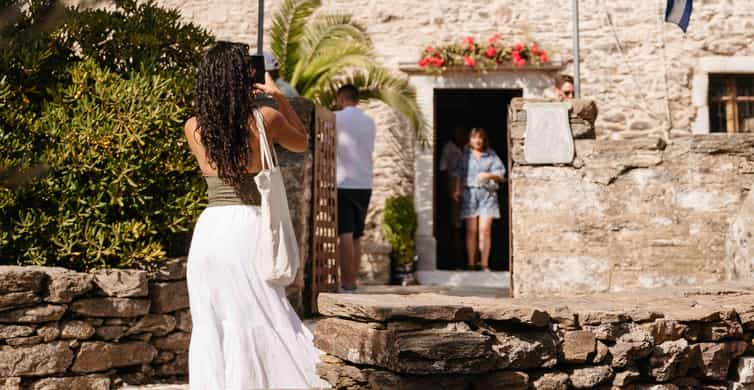
Half-day history and culture tour of Naxos
Four hours with a guide on the history of Naxos, the short way to make sense of the Portara, the Kastro and the island.
4.7 (702 reviews)4 hPickup included

From Agia Anna
Rina Cave and Koufonisia cruise with BBQ
The classic day to Koufonisia, with a swim at Rina Cave and a barbecue lunch on board.
4.8 (868 reviews)9.5 h
From Naxos
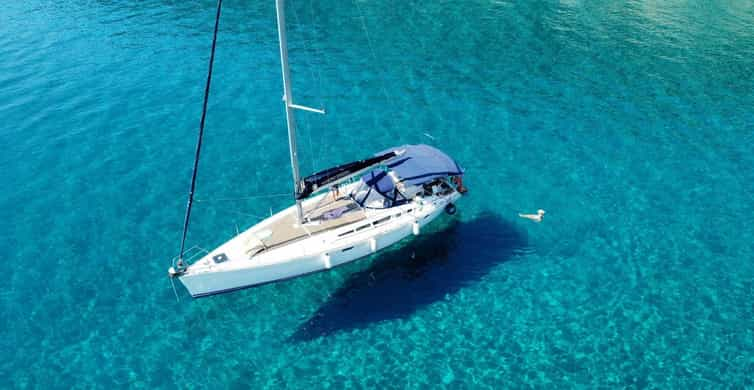
Small Cyclades sailing trip
The same islands under sail, a nine hour day to the Small Cyclades with lunch and drinks.
4.9 (142 reviews)9 h
From Panormos
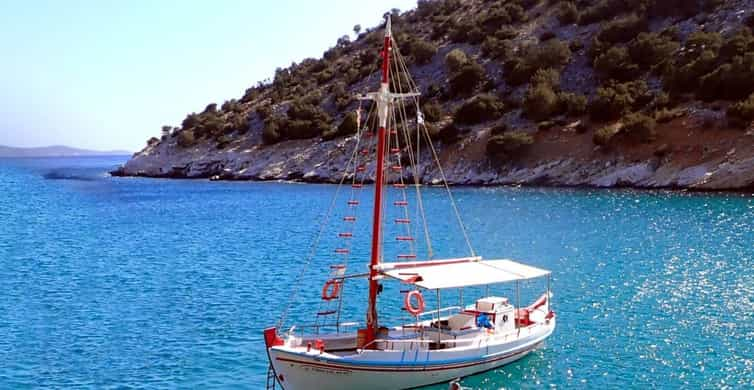
Two hour boat trip to Rina Cave
Two hours on a traditional boat from Panormos to Rina Cave, for those who want the cave without the full day.
5.0 (218 reviews)2 h
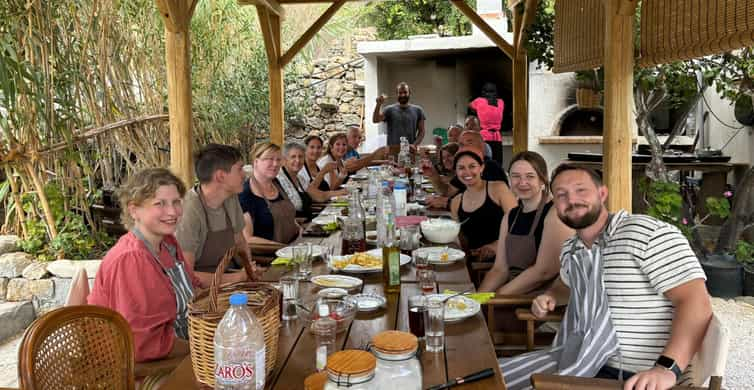
From Melanes
Farm visit and cooking class in Melanes
Graviera, potatoes and the island kitchen, cooked over a wood fire at a farm in Melanes.
5.0 (317 reviews)4 h
Prices, ratings and reviews from GetYourGuide, checked on November 18, 2026.
Naxos Town (Chora): the Portara, the Kastro and the old market
Naxos Town, called Chora, is where the ferry docks and where most visitors sleep. The waterfront is a strip of cafés and tavernas facing the port. Behind it, the old market is a maze of whitewashed lanes, arches and small shops that climbs to the Kastro. Everything here is within walking distance of the quay, which is why Chora is the easiest base on the island without a car. The map of Naxos shows how the town, the beaches and the villages fit together.
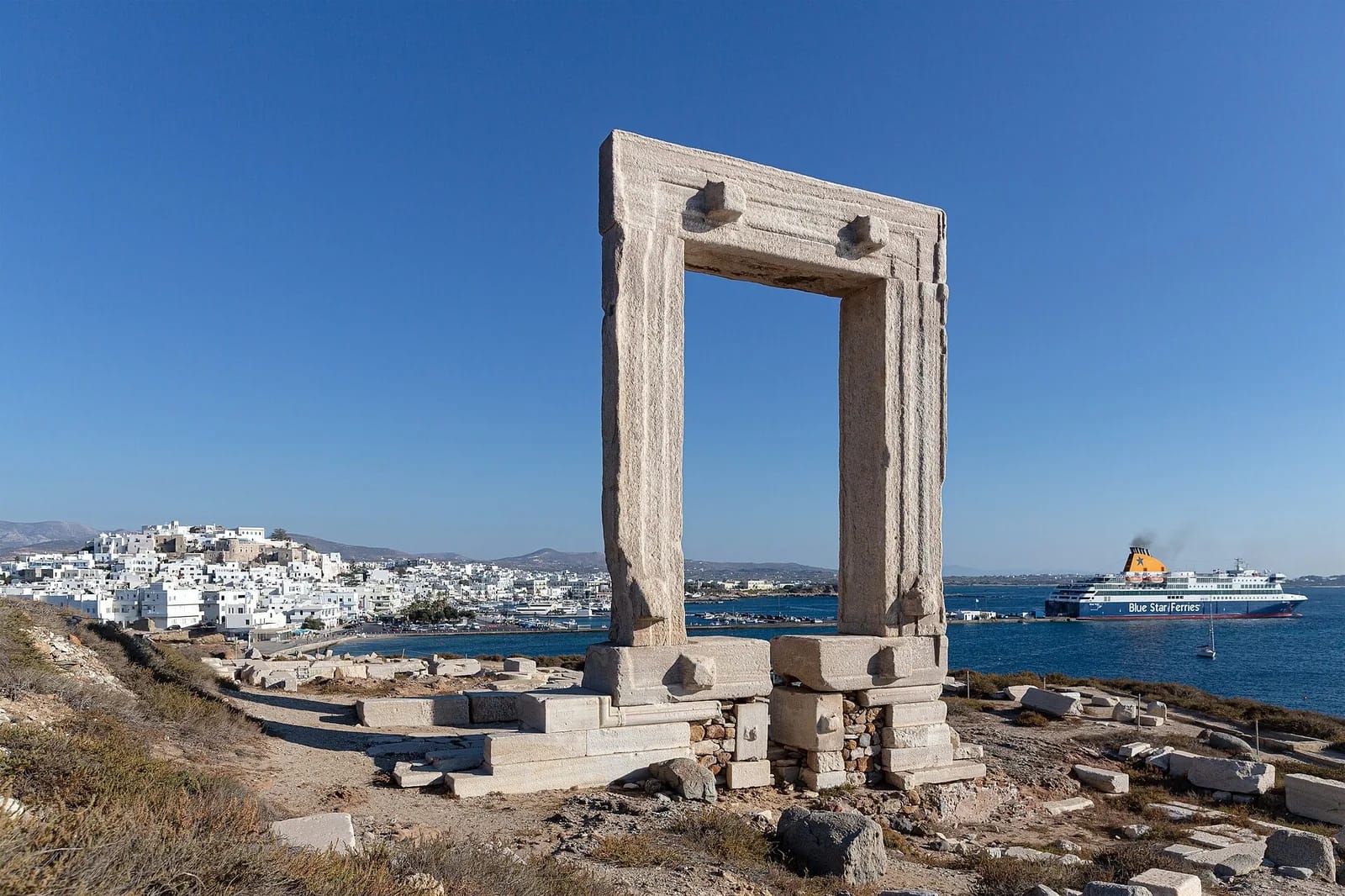
Portara, Naxos: the gate of the temple of Apollon
The Portara is the marble frame of the main door of a temple of Apollon begun around 530 BC under the tyrant Lygdamis and never finished. It stands on Palatia, a rocky islet joined to the harbour by a causeway, a few minutes on foot from the ferry. The doorway is made of a few huge blocks of Naxian marble, each weighing about 20 tonnes according to the municipality. The rest of the temple was taken apart over the centuries, and much of the stone ended up in the Kastro.
Everyone comes at sunset, so the islet is crowded for the last half hour of light. Go early in the morning for the doorway on its own, or watch the sunset from the causeway and the rocks below it, which frame the gate against the sky just as well.
The Kastro of Naxos and the Venetian museum
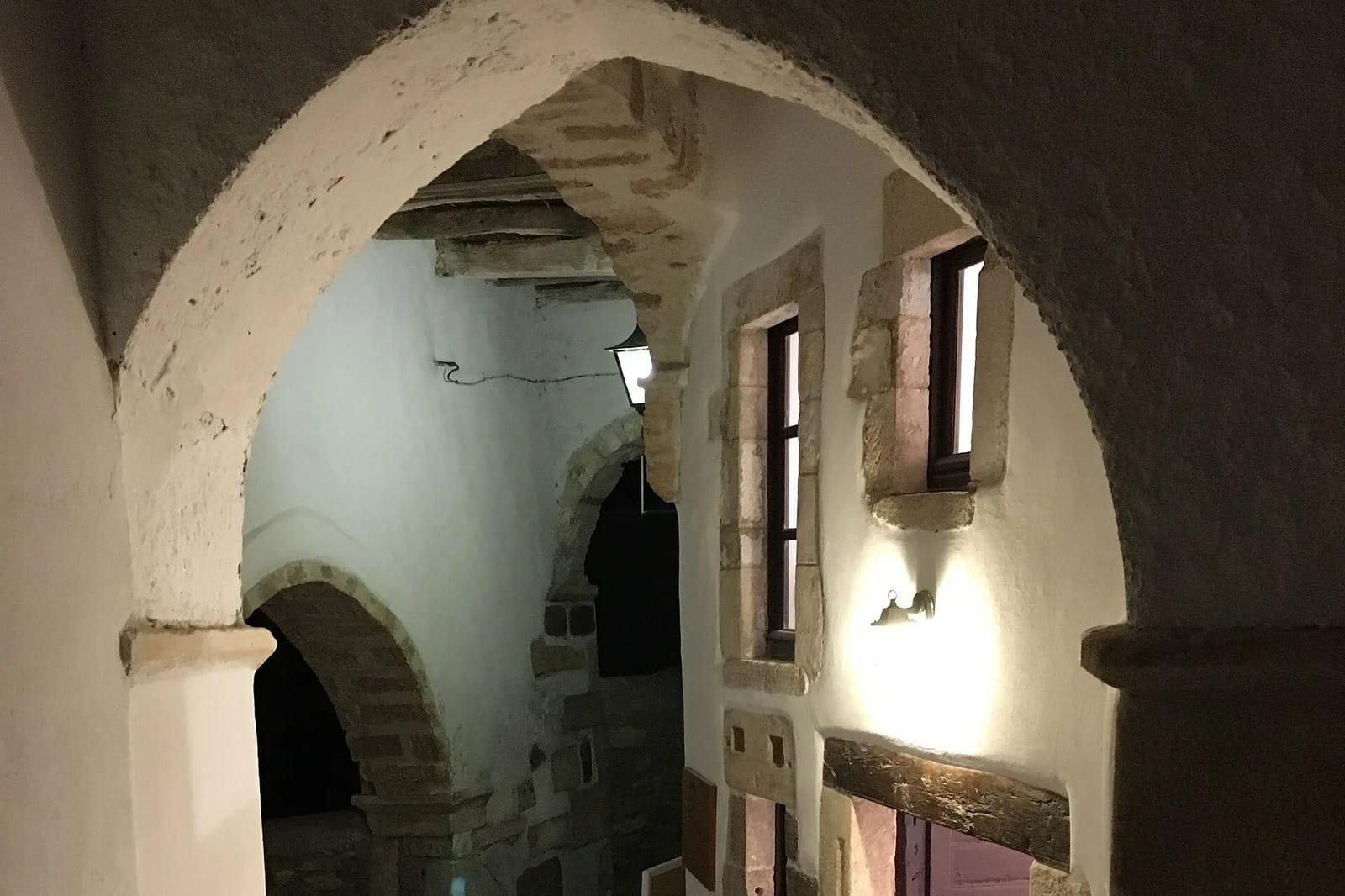
The Kastro is the walled quarter at the top of the town, built after the Venetian Marco Sanudo took the island in the 13th century and made it the seat of the Duchy of the Archipelago. Inside the walls, the lanes are narrower, the houses taller and many doors still carry Venetian coats of arms. You find the Catholic cathedral, the old Ursuline school that houses the archaeological museum, and the Della Rocca-Barozzi house, a Venetian mansion turned museum. Its opening hours differ from one source to the next, and some report it closed for works, so call ahead (+30 22850 22837) before you plan an evening around it.
Archaeological Museum of Naxos: hours and tickets 2026
The museum fills the old Jesuit and Ursuline buildings in the Kastro. Its strength is the Cycladic figurines, the flat marble idols of the third millennium BC, plus pottery and finds from the island's sanctuaries. According to the Ephorate of the Cyclades, it opens 09:00 to 14:00, entry is free, and it closes on Tuesdays from April to October, opening daily in winter. The short hours mean a morning visit: by early afternoon it has shut.
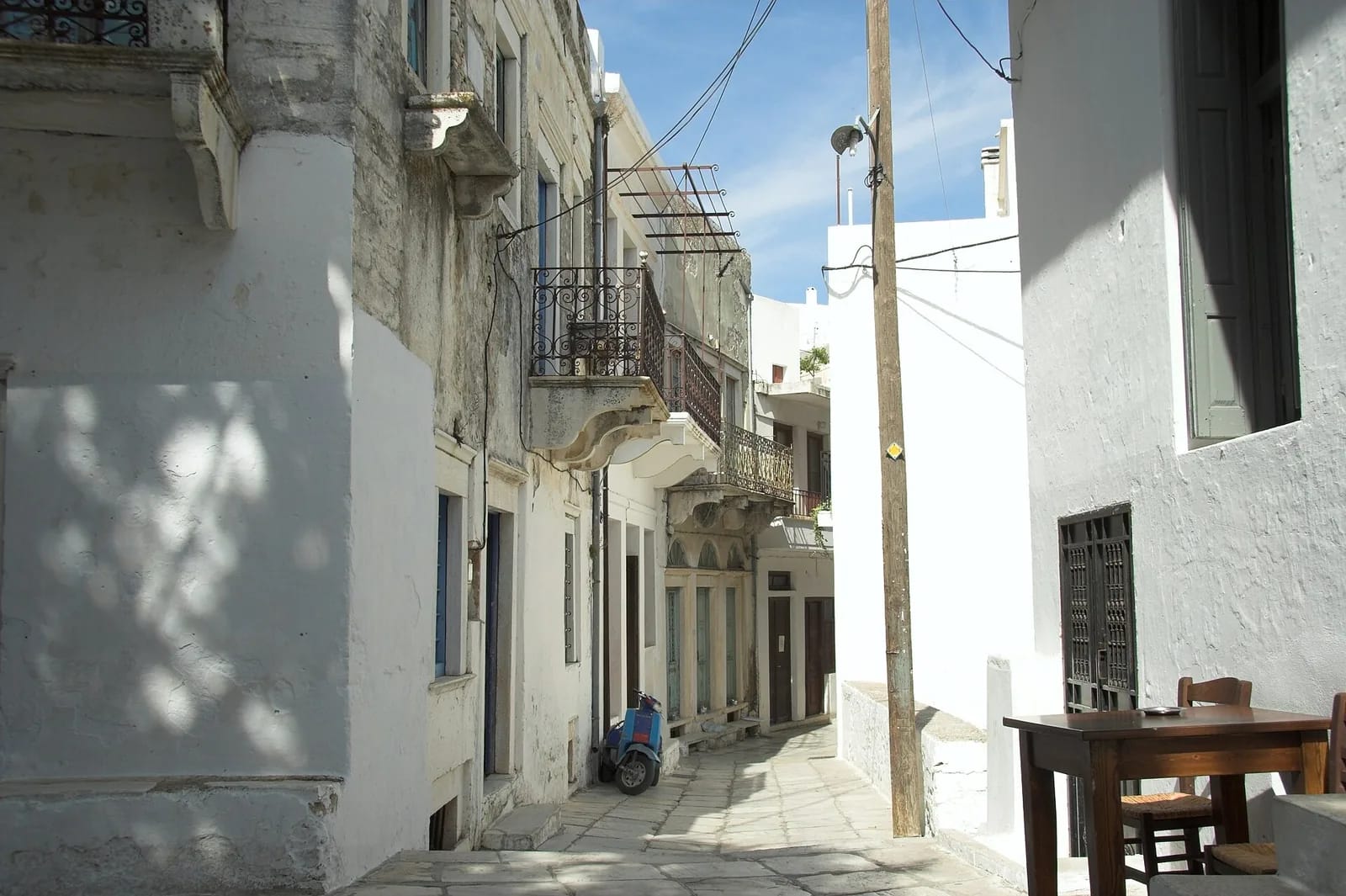
Mountain villages of Naxos: Halki, Filoti and Apeiranthos
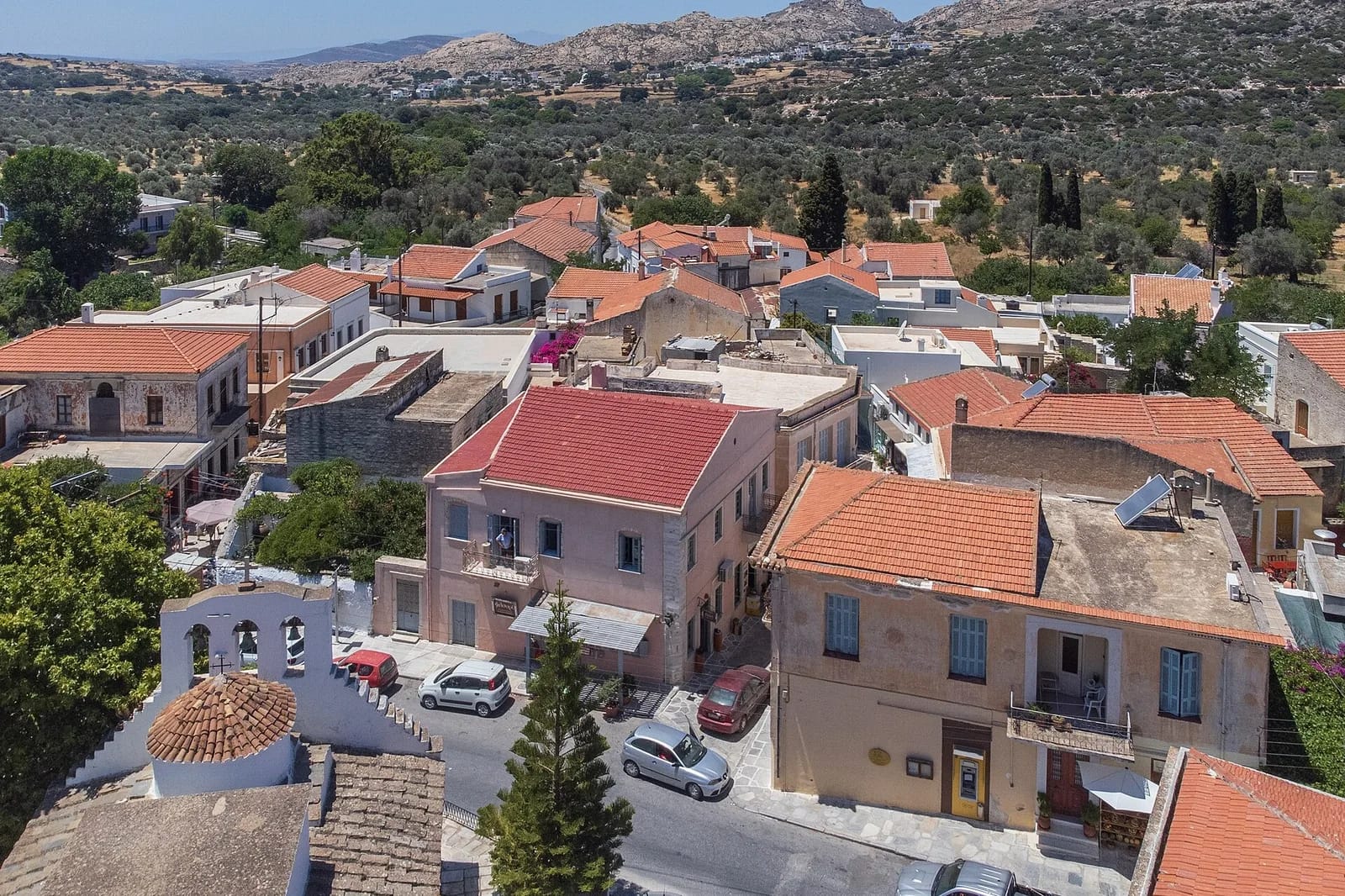
The interior of Naxos is the part most visitors skip and the reason to stay longer. The road climbs from Chora through olive groves and the Tragaea valley to a string of stone villages with Venetian towers and Byzantine chapels. One day by car covers Halki, Filoti and Apeiranthos, and if you leave early you can add the Temple of Demeter on the way up. A guided bus tour does the same loop for those without a car.
Halki and the Vallindras kitron distillery
Halki was the capital of the interior, and it shows: neoclassical mansions, a square under the trees, cafés, galleries and a Venetian tower. Its best known address is the Vallindras distillery, which has made kitron since 1896 and is now run by the fifth generation. Guided visits show the old distilling equipment and end with a tasting. The distillery does not publish fixed hours, so check locally before driving up for it.
Filoti and the hike up Mount Zas
Filoti is the largest village in the interior, spread on the slope below Mount Zas, 1,004 metres, the highest summit in the Cyclades. Its square by the church of the Panagia Filotissa is the place for lunch. The shortest way up Zas starts at the Aria spring, the last water on the route, about 2.5 km below the summit: allow two to three hours there and back. From Filoti itself the hike is longer, with a detour to the cave of Zas. There is almost no shade. Start at dawn and carry at least two litres of water each.
Apeiranthos, the marble village
Apeiranthos sits high on the eastern side of the mountain, and its lanes are paved with marble, between stone houses that look nothing like the white cubes of the coast. It has several small museums, among them an archaeological collection open 08:30 to 15:30, closed on Tuesdays, 5 euros (3 euros reduced). It is the furthest of the three villages from Chora and the one to keep for last, with time to walk.
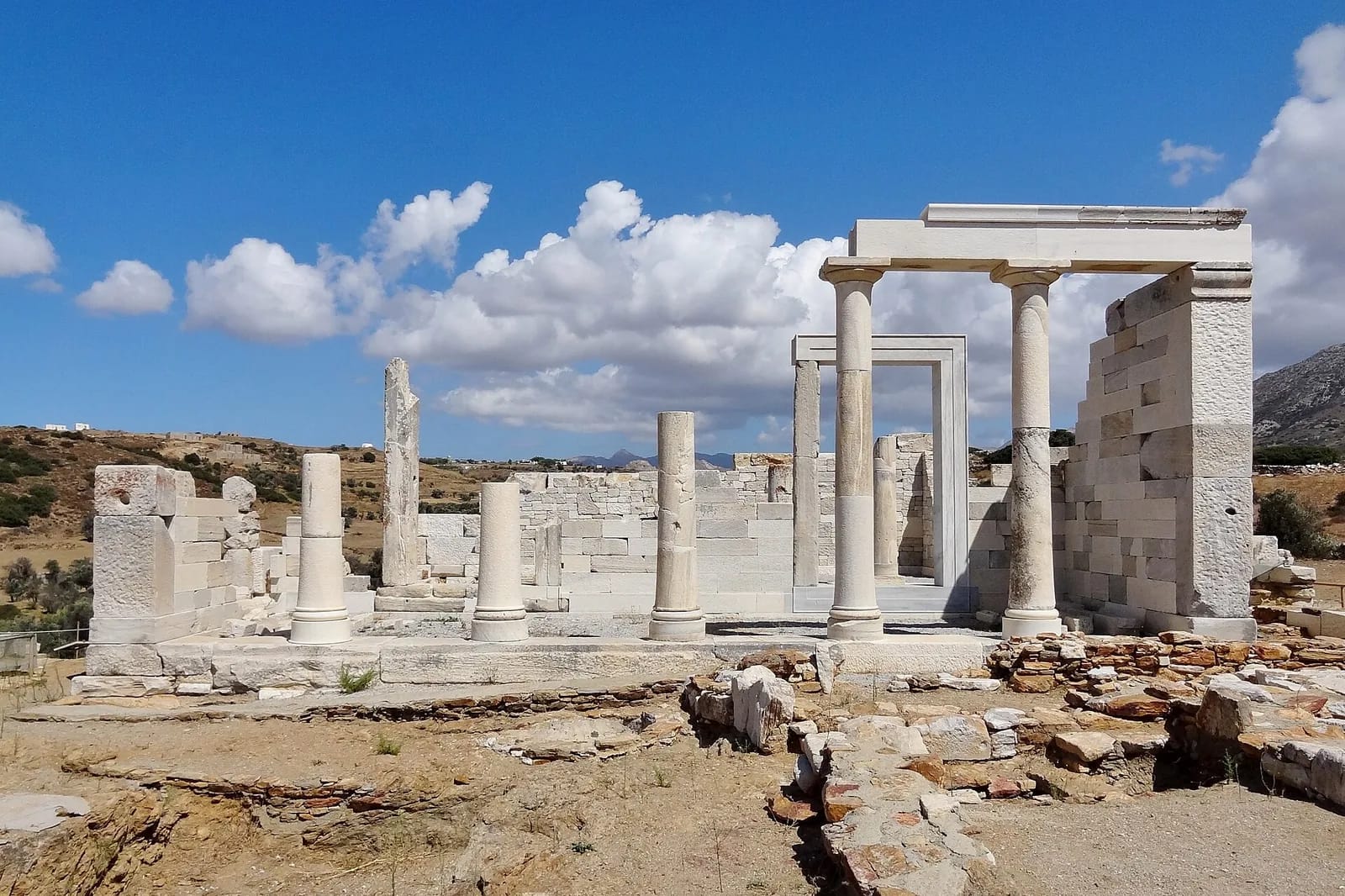
Temple of Demeter at Sangri: hours and tickets
South of Sangri, on a low hill among the fields, stands a marble temple of Demeter from the 6th century BC, partly rebuilt from its original blocks, with a small museum next to it. The Ephorate of the Cyclades lists it as open 08:30 to 15:30, closed on Tuesdays, with tickets at 5 euros (3 euros reduced), the same in summer and winter. Last entry is 20 minutes before closing, so it has to come before the villages, not after.
The kouros of Naxos: Flerio, Melanes and Apollonas
Naxos had the marble and the sculptors of archaic Greece, and three giant statues were abandoned in or near their quarries, probably because they cracked or were too heavy to move. They still lie there, in the open.
The kouros of Flerio, near Melanes
The easiest to reach, and the one to see if you only see one. It lies in a garden in the valley of Flerio, near Melanes, in the hills east of Chora. The Ephorate estimates its full height at 5.55 metres, and dates it to the first half of the 6th century BC. A marked path continues up the hill to a second kouros, at Farangi, of almost the same size, 5.50 metres. This is also the quarry area where the marble of the Portara was cut.
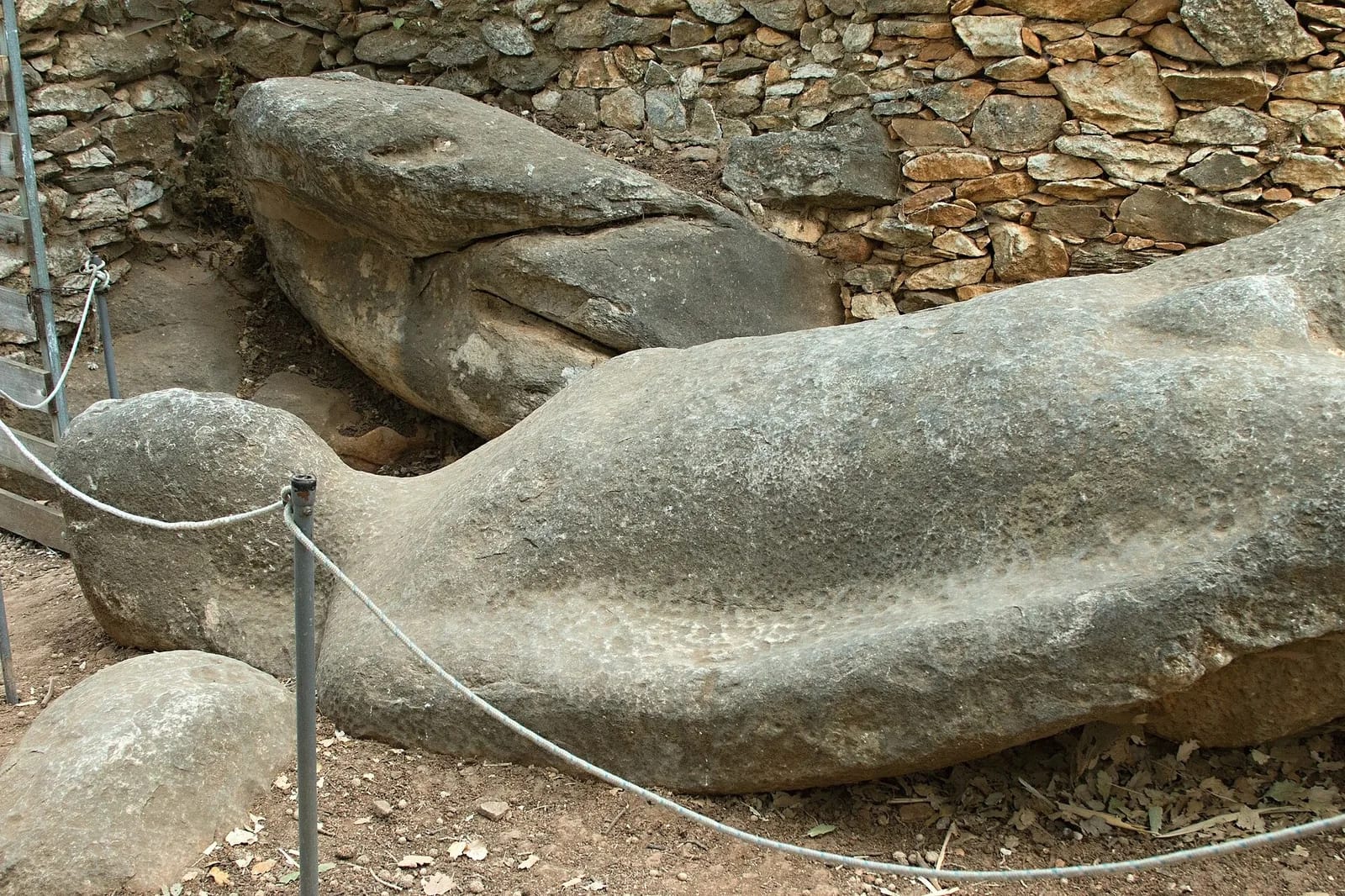
The colossus of Apollonas
At the northern tip of the island, on the hillside above the fishing village of Apollonas, lies the largest of the three: 10.45 metres long, the largest known sculpture of the archaic period according to the Ephorate. It is unfinished, roughed out in the rock of the quarry, and historians still argue whether it was meant to be Dionysos or Apollon. The drive from Chora takes 75 to 90 minutes without stops, so combine it with Apeiranthos on the way up or the north coast on the way back, and a swim in the bay of Apollonas.
Best beaches in Naxos: Agios Prokopios, Plaka and Mikri Vigla
The west coast south of Chora is one long sequence of sand. The nearer beaches, from Agios Georgios to Plaka, are on the KTEL bus line, every 15 to 30 minutes in summer. The further ones, Mikri Vigla, Alyko, Pyrgaki, are easier with a car. Organised beaches charge for sunbeds, but you can always lay a towel on the free sand.
| Beach | Where | Getting there | Best for |
|---|---|---|---|
| Agios Georgios | Edge of Chora | On foot, about 10 minutes from the port | Shallow water for children, no car needed |
| Agios Prokopios | West coast, south of town | KTEL bus, frequent in summer | Sand, clear water, sunbeds and tavernas |
| Agia Anna | Next to Agios Prokopios | KTEL bus | Small fishing port, boats to Koufonisia |
| Plaka | South of Agia Anna | KTEL bus | Kilometres of sand, more space the further south you walk |
| Mikri Vigla | South-west coast | Bus or car | Kitesurfing on the windy side, a calm bay on the other |
| Alyko and Hawaii | South-west, past Pyrgaki | Car only | Coves below a juniper and cedar wood, few facilities |
Agios Prokopios and Agia Anna
Agios Prokopios is the beach that does everything: fine sand, clear water, sunbeds, tavernas and frequent buses from town. Small hotels climb the hill of Stelida behind it. Agia Anna, next door, is smaller, built around a little fishing port from which several boat trips leave, and the two run into each other along a path by the water. This is the best base for a beach stay without a car.
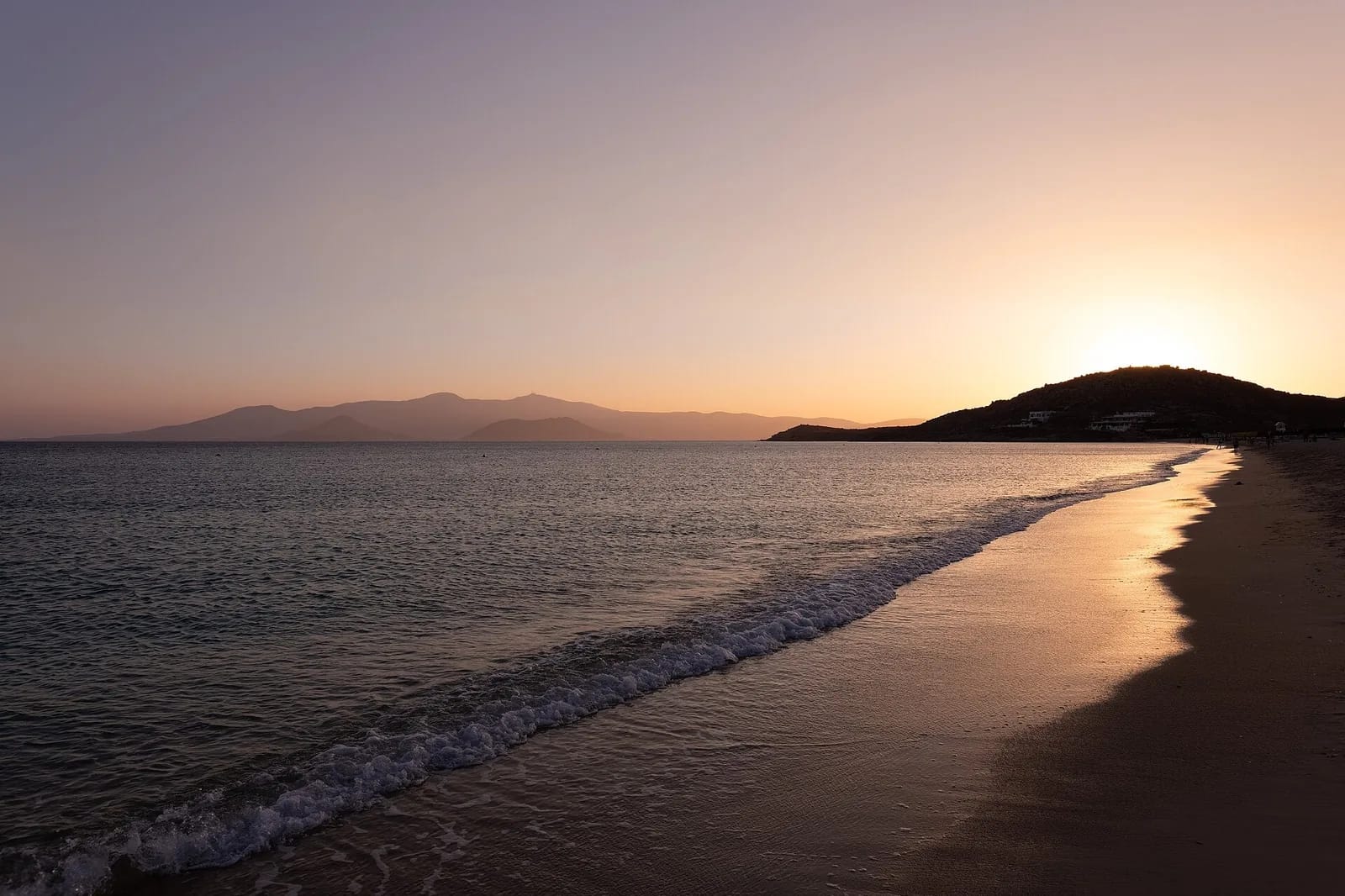
Plaka beach, Naxos
Plaka starts where Agia Anna ends and runs south for kilometres. The northern end has the beach bars and the bus stop. Walk south and the crowd thins out, the dunes get higher and the sunbeds stop. It is the beach for a long walk and a quieter afternoon.
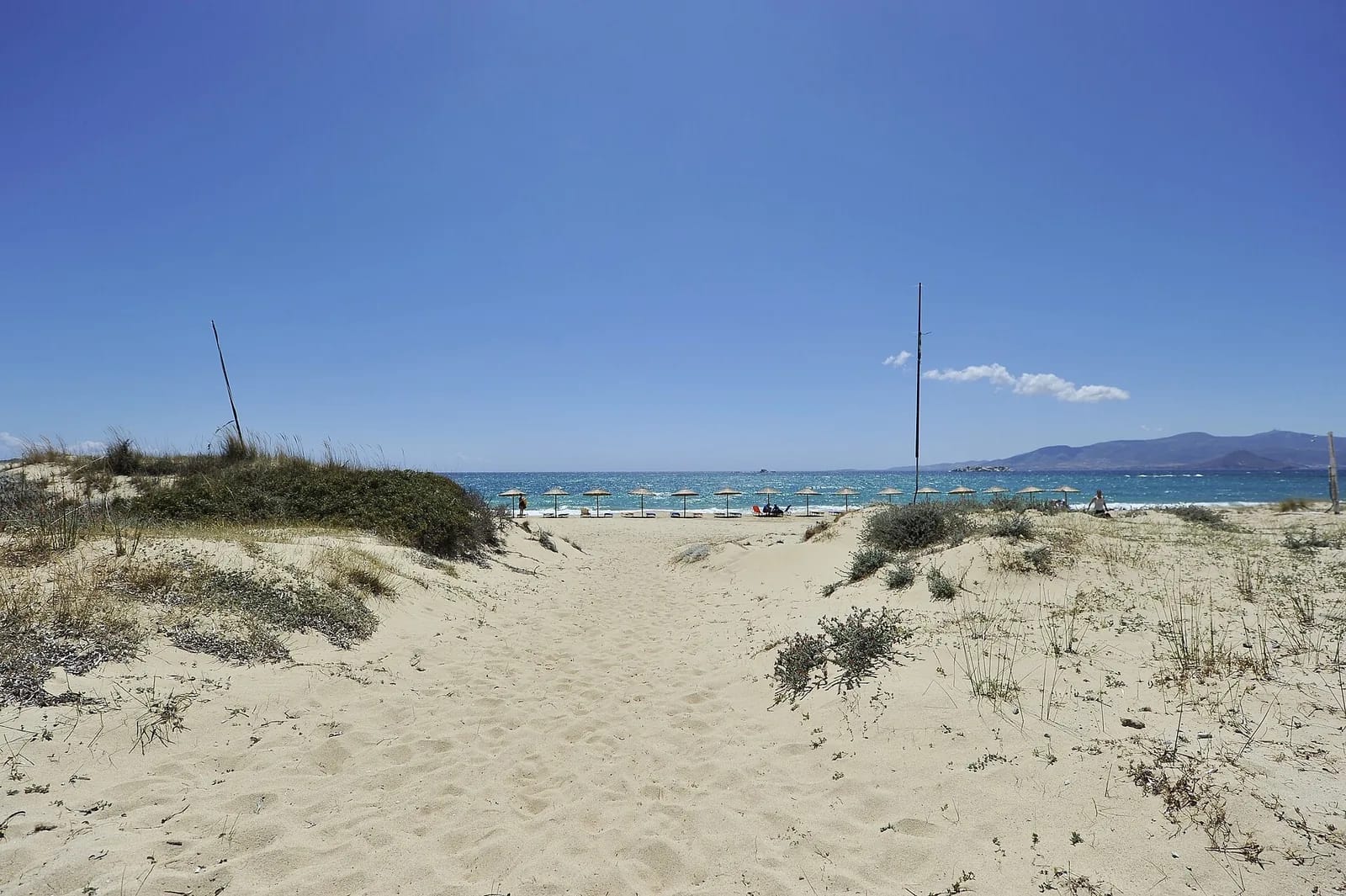
Mikri Vigla: kitesurfing and a calm bay
Mikri Vigla is a granite headland between two beaches. On the north side, the wind is the attraction: the meltemi blows steadily in July and August and the kitesurfing schools are set up on the sand. On the south side, the water is sheltered. Families take the calm bay and riders the windy one, a few minutes apart.
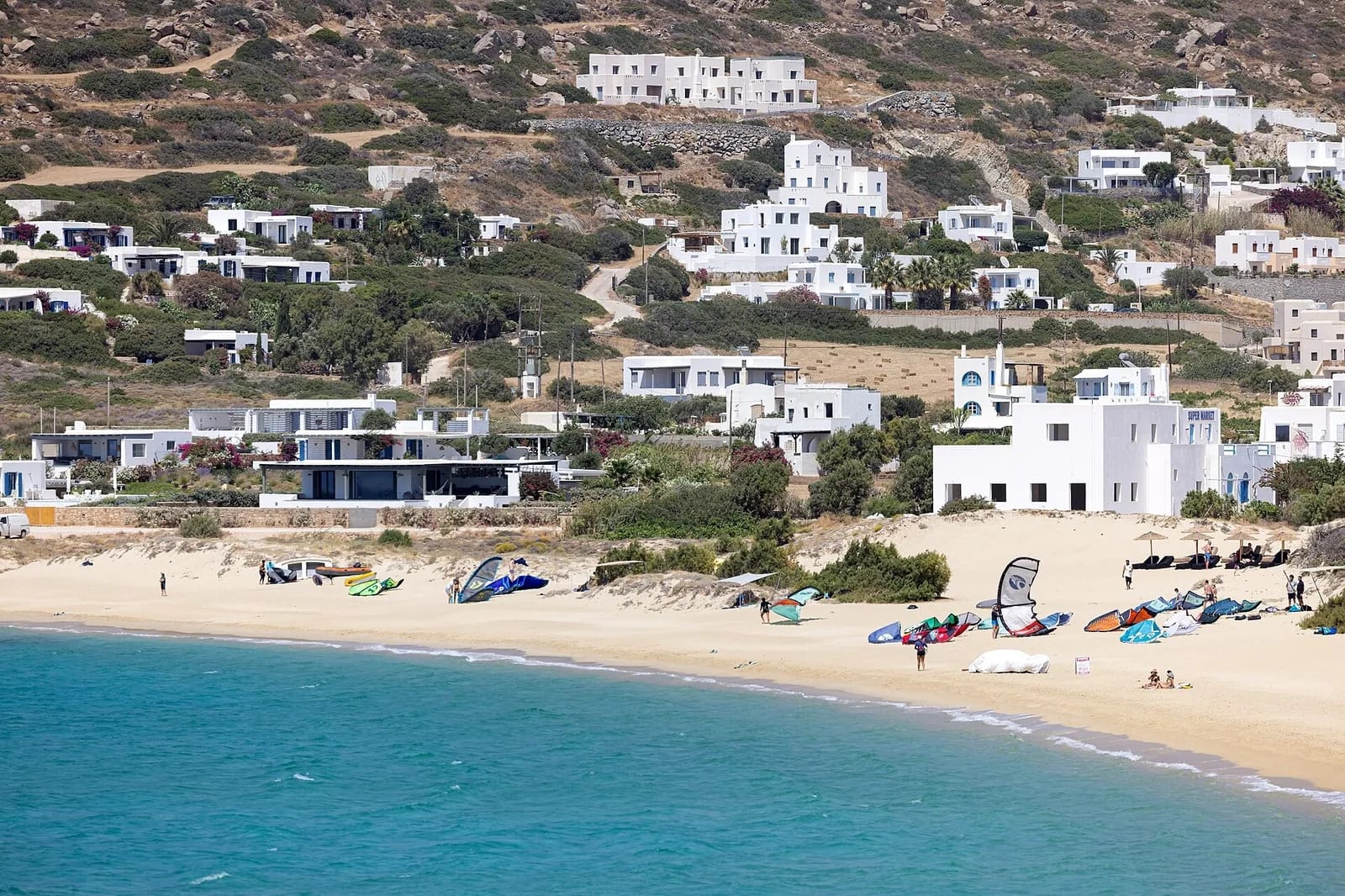
Alyko, Hawaii and the south-west coves
Further south, past Pyrgaki, the coast breaks into small coves below a wood of junipers and cedars on the Alyko peninsula. Hawaii beach, with its turquoise water, is the best known of them. There are few or no facilities, bring water and shade, and you need a car or a scooter to get there.
How many days in Naxos, and when to go
Naxos is about 430 km², more than twice the size of Paros, and the drive from Chora to Apollonas alone takes well over an hour. Four to six nights is the right length. Two is too short to leave town.
Three nights in Naxos: Chora, the villages and a beach
Day one in Chora: the Kastro and the museum in the morning, Agios Georgios in the afternoon, the Portara at sunset. Day two, a hired car: the Temple of Demeter before 15:00, then Halki, Filoti and Apeiranthos, back by the kouros of Flerio. Day three on the sand at Agios Prokopios or Plaka, by bus. This is the version for an island-hopping route with Paros or Santorini.
Four to six nights: add Zas, Apollonas and a boat day
With four to six nights, keep the three days above and add a morning on Mount Zas from the Aria spring, a day north to Apollonas and its colossus, and a boat to Koufonisia or Rina Cave. Keep one day free: in July and August, the meltemi can cancel a boat trip at short notice, and the beach plan swaps in.
When to go to Naxos
June and September are the best months: the sea is warm, every taverna is open and the beaches are not full. May and October are good for walking and the villages, but the sea is still cool in May. July and August are hot, busy and windy, with the meltemi at its strongest, which pleases kitesurfers more than swimmers. From November to April Chora keeps living, as Naxos has a year-round population, but the beach resorts close.
Is Naxos worth visiting? Naxos vs Santorini and Paros
Yes, if you want beaches, food and an island with a life of its own beyond tourism. Naxos farms, makes cheese and keeps its villages lived in year-round. What it lacks is the caldera of Santorini and the nightlife of Mykonos. It is also cheaper than Santorini and Mykonos, though no longer cheap in August. The table puts it next to its two neighbours, and our guide to Paros covers the island across the strait, less than an hour away by boat.
| Naxos | Santorini | Paros | |
|---|---|---|---|
| What you come for | Beaches, villages, food, hiking | The caldera view and sunsets | Naoussa evenings, beaches, ferries |
| Beaches | Long sandy west coast | Dark volcanic sand, far below the villages | Spread around the island, several windy |
| Inland | Marble villages, Mount Zas, kouroi | Vineyards on the outer slope | Lefkes and the Byzantine path |
| Prices | Lower than Santorini and Mykonos | Among the highest in Greece | Between the two |
| Size | About 430 km², a car helps | About 76 km² | About 196 km² |
Small Cyclades from Naxos: Koufonisia, Schinoussa and Iraklia
South-east of Naxos lies a group of small islands, the Small Cyclades: Iraklia, Schinoussa, Koufonisia and Donoussa. Koufonisia is the star, with turquoise coves and a single village. Regular ferries do call there from Naxos, the Blue Star and the small local ship of Small Cyclades Lines, but timetables change by day and by season and some sailings leave at night, so a same-day return is not guaranteed. For a single day, the organised cruises are the reliable option: they leave in the morning, stop at Rina Cave or the coves of Koufonisia and bring you back the same evening. To stay a few nights, take the regular ferry and check both directions before you book.
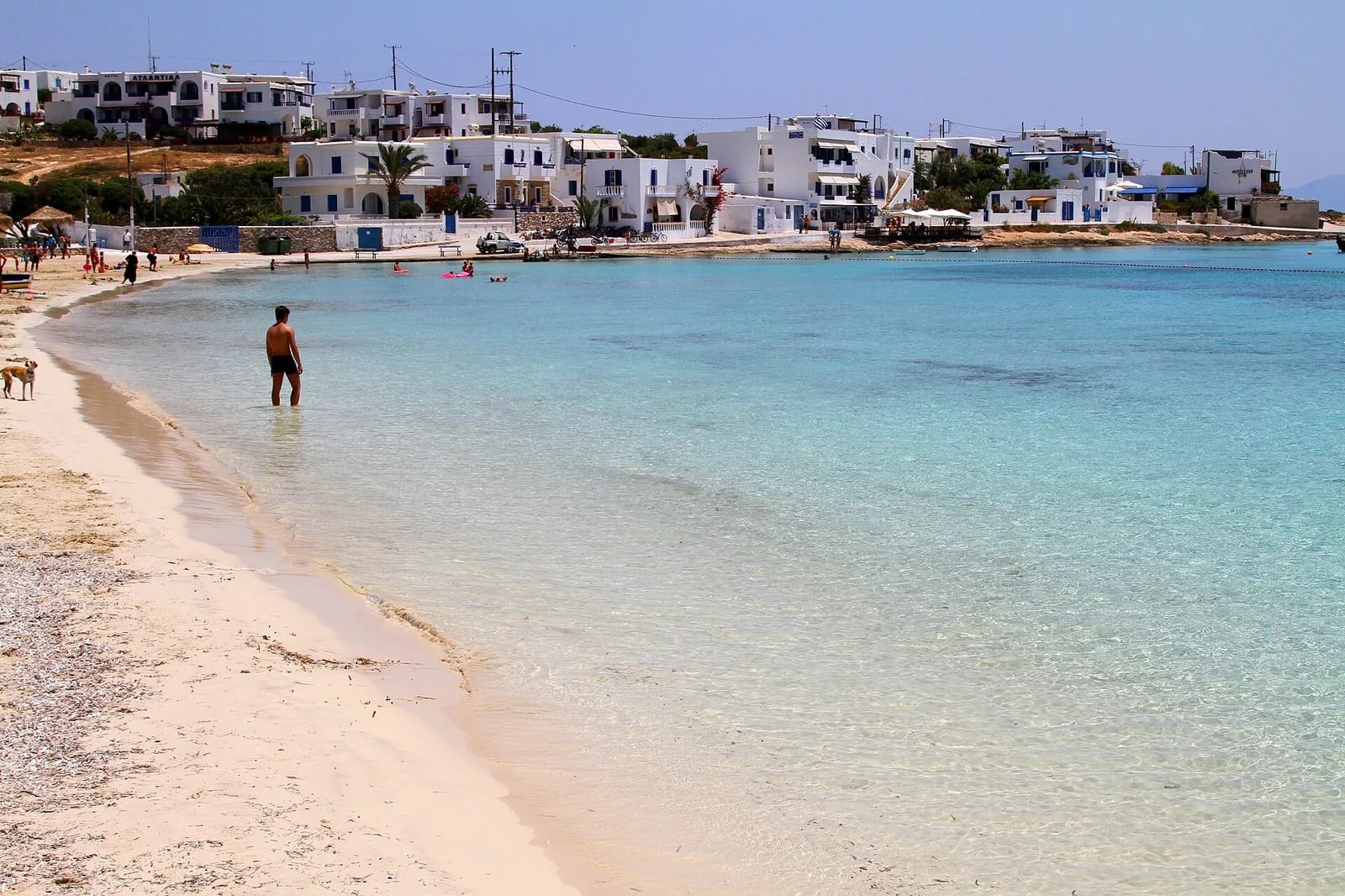
Naxos food: graviera cheese, kitron and what to order
Naxos is one of the few Cycladic islands that can feed itself, and the food is a good reason to come. Graviera of Naxos is a hard cheese made mostly from cow's milk, with a protected designation of origin since 1996, produced by the island's agricultural cooperative. Eat it fried, grated on pasta or on its own with honey. Naxian potatoes are sold across Greece, and the island also makes soft cheeses like arseniko and xinotyro.
Kitron is a liqueur made from the leaves of the citron tree, one of the three Greek liqueurs with a protected designation. It comes in three versions: green at 30 degrees, white at 33 and yellow at 36, from the lightest to the strongest. Mountain tavernas in Halki, Filoti and Apeiranthos serve roast pork (rosto), goat and local cheese pies, and the farm cooking class in Melanes shows how they are made.
Getting around Naxos: KTEL buses and car hire
The KTEL bus station is opposite the port in Chora. In summer, buses to the west coast beaches run every 15 to 30 minutes, and they are enough for a beach stay. Buses to the mountain villages are less frequent, and the north, Apollonas included, may have just one service a day, so check the return before you go. Buy tickets before boarding, at the KTEL office or a kiosk. Fares change with the season and sources disagree, so ask at the office (+30 22850 22291).
For the villages, the kouroi and the south-west coves, hire a car for at least one or two days. Pick a small one: village lanes are narrow and parking in Chora fills up in July and August.
Where to stay in Naxos: Chora, Agios Prokopios or Plaka
Chora for the port, the evenings and the bus station, Agios Prokopios and Agia Anna for a beach stay without a car, Plaka and Mikri Vigla for space and wind. Our guide to where to stay in Naxos compares each area and its hotels.
Two places to stay in Naxos
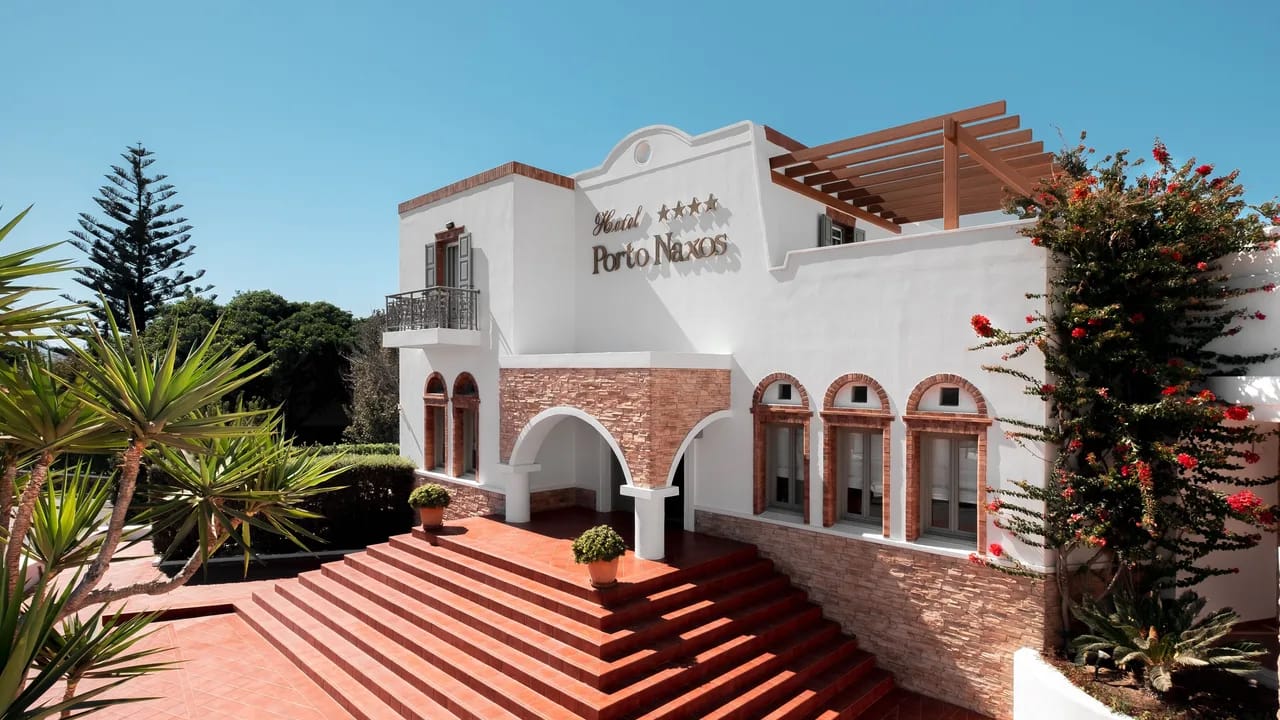 Photo: Expedia Group
Porto Naxos Hotel
Agios Georgios, Chora · Mid-range177 reviews
8.8/10
on Hotels.com177 reviews on Hotels.com
On the town beach, a walk from the port and the Kastro. The base that needs neither a car nor a bus.
- Town beach
- Walk to the port
- Pool
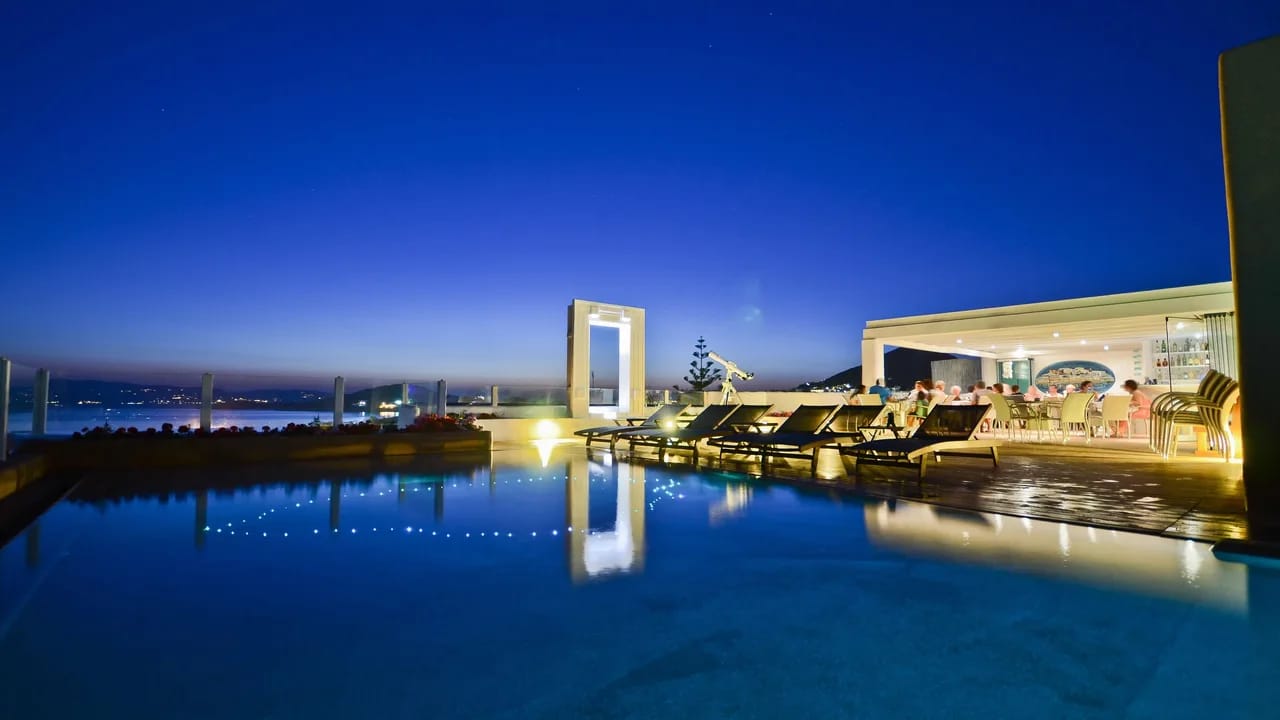 Photo: Expedia Group
Naxos Island Hotel
Agios Prokopios · Luxury142 reviews
9.2/10
on Hotels.com142 reviews on Hotels.com
Above the bay of Agios Prokopios, for a beach week with the bus to town at the bottom of the hill.
- Above the beach
- Pool and spa
- Sea views
Hotels.com ratings collected in November 2026. Prices and availability on Hotels.com depend on your dates.
Getting to Naxos by ferry and plane
Ferries dock in Chora, at the foot of the old town. From Piraeus, the Athens to Naxos ferry takes about 5 hours on a Blue Star and about 3 hours 30 on a fast boat, most often via Paros. Naxos is on the main line to Ios and Santorini, and the Mykonos to Naxos ferry links it to the northern Cyclades. The small airport, a few minutes south of Chora, has flights from Athens of about 40 minutes. For the full route through the islands, see the Cyclades guide.
Questions people ask about Naxos, Greece
Is Naxos, Greece worth visiting?
Yes, and for longer than most people plan. Naxos is the largest of the Cyclades, so it has what the smaller islands lack: a real old town around a Venetian castle, mountain villages with marble lanes, unfinished ancient statues lying where they were carved, and a west coast of long sandy beaches. It also makes its own cheese, potatoes and citron liqueur. Four to six nights is the right length.
Is Naxos or Santorini better?
They are different trips. Santorini is about the caldera, seen from cliff villages, with dark volcanic beaches below and high prices. Naxos has no caldera, but it has the better beaches by far, an inland of villages and hiking, food grown on the island and lower prices. If you can only pick one for a beach holiday, pick Naxos. For a couple of nights of views, Santorini. The fast boat between them takes about two hours.
Is Naxos a cheap island?
Cheaper than Santorini and Mykonos, but no longer cheap in July and August, when rooms near the beaches fill up. May, June, September and early October are when Naxos is good value: the sea is warm from June, tavernas are open and rooms cost noticeably less than in high season. Staying in Chora and using the bus keeps costs down.
How long is a ferry from Athens to Naxos?
About 5 hours on a conventional Blue Star ferry from Piraeus and about 3 hours 30 minutes on a fast boat. The exact time depends on how many islands the sailing calls at, most often Paros first. The ferry docks in Chora, at the foot of the old town.
How many days do you need in Naxos?
Four to six nights. Three is enough for Chora, one day in the mountain villages and a beach day, which suits an island-hopping route. Four to six adds the kouroi, Mount Zas or a boat to the Small Cyclades. A week suits families who want long beach days. Two nights is too short for an island this size.
Do you need a car in Naxos?
Not for Chora and the west coast beaches, which the KTEL bus serves often in summer. For the mountain villages, the kouroi and the north, a car for one or two days makes a real difference, because buses to the interior are less frequent. Pick a small car: village lanes are narrow and parking in Chora is hard in July and August.
What is Naxos known for?
The Portara, the marble gateway of an unfinished temple of Apollon on an islet by the harbour. Also its size and its farming: Naxos produces graviera cheese with a protected designation of origin, potatoes sold across Greece and kitron, a liqueur made from citron leaves. In myth it is where Theseus left Ariadne.
