Mykonos to Naxos Ferry: Times, Boats and the Meltemi
The shortest hop of the classic Cyclades trip, and the one that holds it together: under an hour on a fast boat, nine sailings on a busy August day, and a stretch of open water that the north wind closes more often than people expect.
The Mykonos to Naxos ferry is the link people forget to plan. It sits between the island they flew into and the island they are saving for the end, and at 35 minutes on the fastest boat it looks like a formality. Most days it is. On windy days in July and August it is the leg that strands people in Mykonos, so the boat you pick matters more than the time it leaves.
How long is the ferry from Mykonos to Naxos?
Between 35 minutes and 1 hour 25. Naxos lies about 20 nautical miles south of Mykonos, roughly 36 to 39 km depending on who measures, which makes this one of the shortest crossings in the central Cyclades. Seajets' Eurochampion Jet is the quickest boat on the route at 35 minutes, and most of the other high-speed sailings take 40 to 50.
The longer sailings, 1 hour 15 to 1 hour 25, are either a conventional ferry running at normal speed or a fast boat that calls at another island on the way. On a route this short the difference is half an hour at most, so speed is a weaker reason to choose a sailing than the hour it leaves and the kind of hull it is. Add 45 minutes at the Mykonos end, which is how early the operators want you at the quay, and the time it takes to get out to the port in the first place.
Mykonos to Naxos fast ferry or conventional?
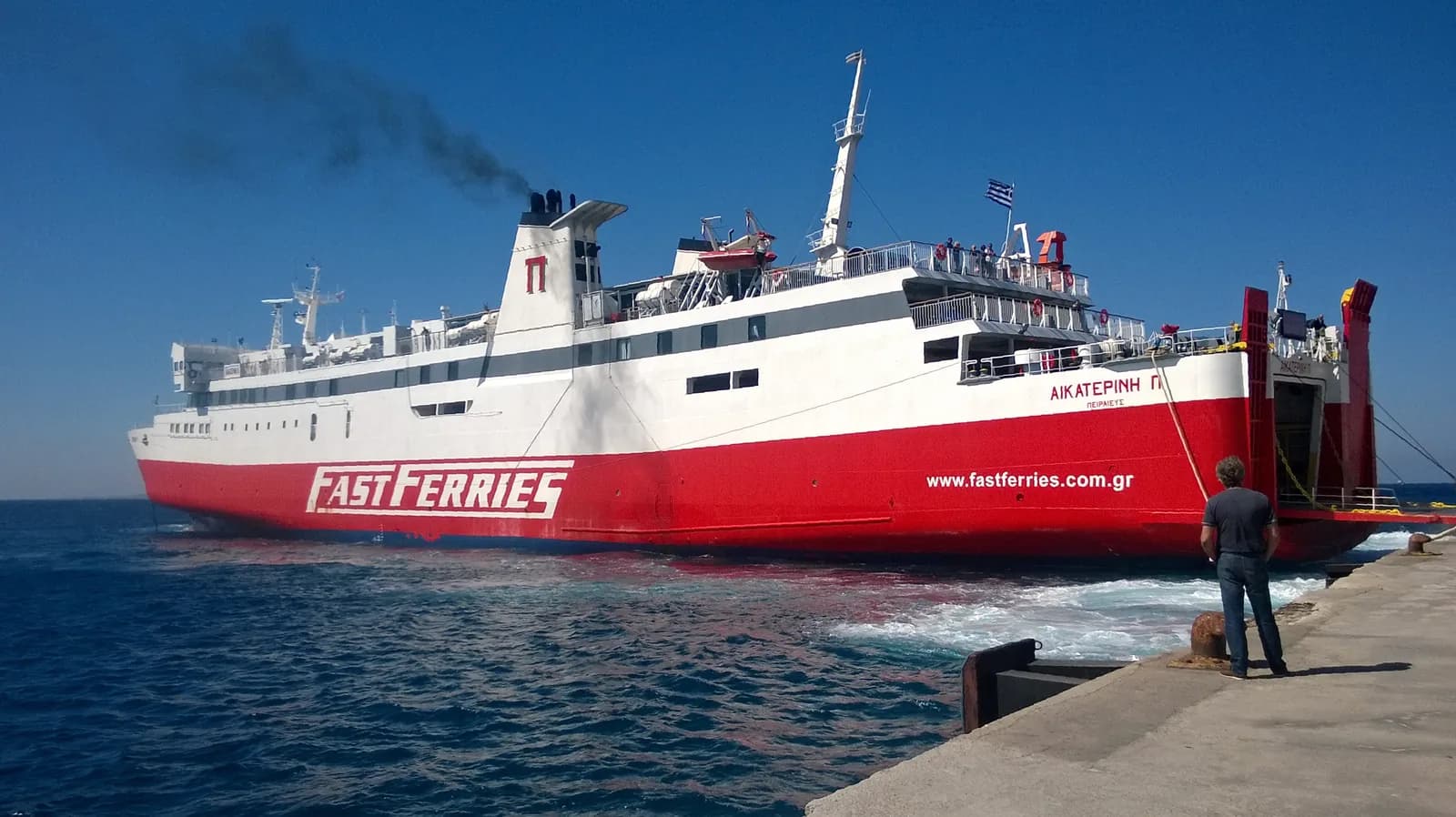
Three companies run the route. Seajets runs catamarans and other high-speed craft and carries most of the sailings. Golden Star Ferries runs the Golden Princess, a ship with a car deck that still does the crossing in 40 to 50 minutes, plus a slower Superferry. Fast Ferries runs a conventional ship a few days a week in some months. Blue Star appears on some booking sites for this route, but it was not on the 2026 timetables we checked. In calm weather take the fast boat. In wind, read the next sections first.
Mykonos to Naxos ferry times and prices in 2026
This is a real day rather than an average: 12 August 2026, at the peak of the season, when nine boats crossed. The first left at 09:05 and the last at 18:05. Times change from week to week and the fares are the lowest adult seat on each sailing, so treat the grid as the shape of a summer day, not a timetable to rely on.
| Leaves Mykonos | Arrives Naxos | Company and boat | Type | Crossing | Adult fare |
|---|---|---|---|---|---|
| 09:05 | 09:55 | Golden Star, Golden Princess | Ferry, car deck | 50 min | €53 |
| 09:50 | 10:25 | Seajets, Eurochampion Jet | Catamaran | 35 min | €53 |
| 11:30 | 12:10 | Seajets, Supercat Jet | Catamaran | 40 min | €44.70 |
| 12:20 | 13:35 | Golden Star, Superferry | Conventional | 1 h 15 | €36 |
| 12:35 | 13:50 | Seajets | High-speed | 1 h 15 | €44.70 |
| 15:45 | 16:25 | Seajets, Super Jet | Catamaran | 40 min | €57.70 |
| 17:00 | 17:40 | Golden Star, Golden Princess | Ferry, car deck | 40 min | €53 |
| 17:10 | 18:35 | Seajets, Speedrunner Jet | High-speed | 1 h 25 | €53 |
| 18:05 | 19:25 | Seajets, Champion Jet 2 | Catamaran | 1 h 20 | €57.70 |
Three things show up in the grid. Most of the boats on a summer day are Seajets high-speed craft, so a single operator decides most of your options. The cheapest seat is on the slow boat, €36 on the Superferry against €44.70 to €57.70 on the catamarans. And there is no early-morning or late-evening sailing in this direction, so you cannot squeeze the crossing in at either end of a beach day.
Outside August, Ferryhopper showed adult fares from about €30. On a Seajets boat the economy seat was €44.70, business €69 and VIP €78 on the sample day, and there are no cabins on a crossing this short. Two adults with a car came to around €85 one way, with the car itself from about €35. Luggage is free within reason, around 50 kg a person, and pets travel free but not in the indoor lounges.
Mykonos to Naxos in the meltemi: which boats stop first
The meltemi is the dry north wind that blows down the Aegean in summer. It usually builds from mid-July to the end of August, can start in late June and linger into September, comes in spells of a few days, and is strongest in the afternoon. Mykonos sits right in its path, and the channel south to Naxos and Paros is short but exposed. It is not the only fragile crossing in the Cyclades, since Mykonos to Santorini is just as exposed, but with almost every summer sailing on a fast boat, it has little to fall back on.
Nobody fixes a single wind speed at which ferries stop. The local port authority, under the Hellenic Coast Guard, bans departures by vessel class, and the high-speed craft are always the first to go. Greek press reports usually put the cut-off for catamarans somewhere around force 6 to 7 on the Beaufort scale, while big conventional ships sail on in wind that keeps the fast boats in port. On this route that matters a lot, because most summer sailings are Seajets high-speed craft. A morning with a strong wind can remove most of the day's departures at once.
Nobody publishes how often it happens. Travellers who do this trip every summer talk about three to five days between May and September when the fast boats stay in, which fits what the wind does but is not a statistic. What you can plan around is the pattern: the morning sailings are more likely to go than the afternoon ones, the ships with a car deck are more likely to go than the catamarans, and the notice usually comes the evening before or at breakfast.
When the Mykonos to Naxos ferry is cancelled
Your ticket will be moved to another sailing or refunded. Ask for the move first, and if you take the refund, check whether it is coming back to your card or as credit with that operator, because it is often the second. Then work through the options in this order.
- A heavier boat the same day. If the catamarans are banned, look for Golden Star's Superferry or the Fast Ferries ship. A conventional ship often still sails, just slowly.
- Via Paros. Mykonos to Parikia is about 35 minutes from €36, and Paros to Naxos 25 minutes from €15.50, with more than ten crossings a day between those two in summer. It is not faster, but Paros has more sailings, so it is a useful fallback when the direct boats are cancelled or full.
- Via Syros. 40 minutes to Syros, then 1 hour 10 to Naxos, from about €86 in total. Expensive, and only worth it when nothing else is sailing.
- Stay put another night. Often the cheapest answer, and the wind usually drops within two or three days. A short-notice room in Mykonos is the expensive part, so it is worth knowing which parts of the island still have beds at a sensible price before you need one.
The rule for the whole trip: do not put this crossing the day before a flight home. If Naxos is your last island and you fly out of Mykonos, come back with at least a day in hand, or fly home from Athens after the direct boat from Naxos to Piraeus, which is often a big conventional ship that sails in most weather.
Mykonos, Naxos, Santorini: why Naxos goes in the middle
Most people who search for this crossing are doing the same trip: fly into Mykonos, end on Santorini, and add one island in between. Naxos is the obvious middle island, and the reason is geography. It sits halfway down the line, so each leg is short, and it is one of the best-connected ports in the Cyclades, with boats to Santorini all year.
- Mykonos to Naxos: 35 minutes to 1 hour 25, up to nine sailings a day in August.
- Naxos to Santorini: 45 minutes to about 2 hours 10, Seajets on the fast boats and Blue Star on the conventional ones, up to eight sailings a day in summer and boats all year. You arrive at Athinios, the port under the caldera cliff, about 25 minutes by road from Fira.
- Mykonos to Santorini direct: two to three hours on a fast boat, and a crossing that cancels in the same wind. Splitting it at Naxos gives you two shorter legs, a night on the most varied island of the group, and more chances that one of the boats is running.
Go in that order, north to south. The meltemi blows from the north, so the boats you take run with the wind behind them, and you finish on Santorini, which has direct flights to the rest of Europe in summer. The usual split for ten nights is three on Mykonos, four on Naxos and three on Santorini. On a two-week trip Paros fits between Mykonos and Naxos, only 25 minutes from Naxos. That is our editorial suggestion rather than a rule. The point is to give Naxos the longest stay, because it has the beaches, the mountain villages and the cheapest beds of the three. The Cyclades drawn to scale make the logic obvious: the three islands sit almost in a straight line.
Mykonos to Naxos ferry port: Tourlos, not the Old Port
Boats to Naxos leave from the New Port at Tourlos, about 2 to 2.5 km north of Mykonos Town. The Old Port on the edge of town handles the Delos boats, water taxis and local craft. Going to the wrong one is the classic way to miss this sailing, and the map of Mykonos Town shows how far apart they are.
Getting out to Tourlos takes some planning in high season. A taxi from town costs about €10 to €15, and from the airport €18 to €25, but Mykonos has very few taxis for the number of visitors, and the queue on an August morning can be longer than the ride. The SeaBus water shuttle between the Old Port and Tourlos costs a couple of euros and takes about ten minutes. Its timetable changes from year to year, so check it locally the day before. Walking is 25 to 30 minutes along a road with little shade, fine with a backpack and miserable with a suitcase at noon.
Arriving at Naxos port
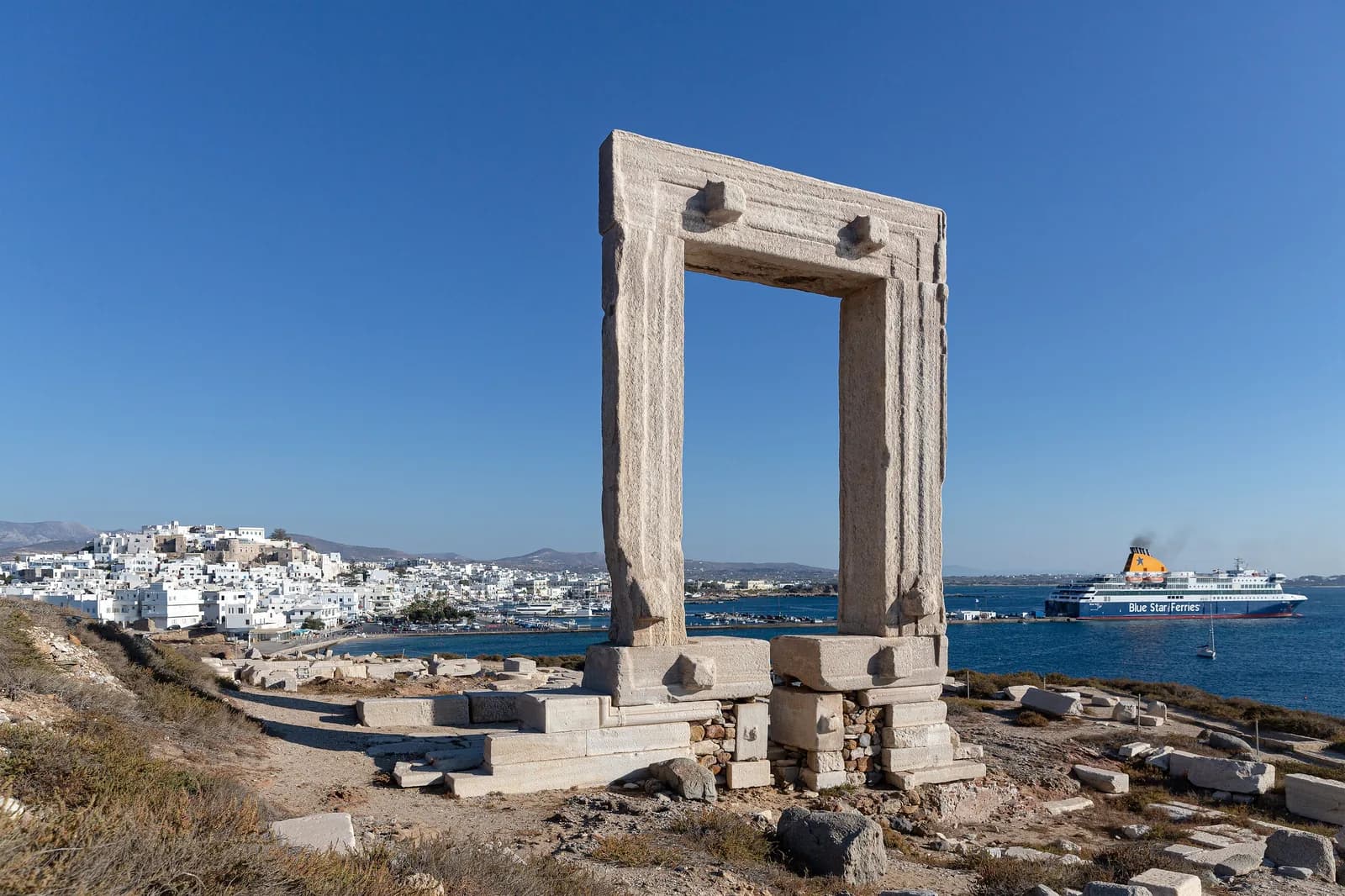
Naxos is much easier. Every boat docks at the port of Naxos Town, right in front of the Chora, with cafés, cash machines, car hire desks and the bus station on the quay. The Portara, the marble gateway on its islet, is a few minutes' walk away, and so are most rooms in town. The airport is about 3.5 km south, but it only has flights to Athens. If you are staying at a beach further down the west coast, the buses leave from the station by the port. The map of Naxos shows how far each beach is from the quay.
Ferries from Mykonos to Naxos out of season
From May to October there are several boats a day, and at least five on most days in high summer. Outside that window the route gets thin quickly. Ferryhopper lists sailings from January to November, on anything from one to seven days a week depending on the month, with one or two boats a day at most in the cold months. December and February are the gaps we could not confirm either way.
Last year's pattern, in the opposite direction from Naxos to Mykonos, gives an idea of who runs what: Seajets alone three days a week in January and daily in March, Fast Ferries four days a week in April, Golden Star and Seajets joining in May, and Seajets daily again in October and November on a boat that took 1 hour 25. In spring and autumn you can no longer pick your time, so build the trip around the boat rather than the other way round. Summer schedules are usually published four to six months ahead.
Naxos to Mykonos ferry, and the day trip
The return runs on the same boats, often as the second half of the same rotation, with up to seven crossings a day in high season. Two cases bring people back north. One is a flight home from Mykonos, in which case book the return as soon as you book the flight and leave a day between them. The other is starting on Naxos and going north for a few nights of Mykonos at the end, which works but means finishing on the most expensive island with the fewest cheap beds.
A day trip from Mykonos to Naxos is easy in summer. Take a morning boat, which lands you in Naxos Town by 10:30, and one of the late-afternoon sailings back. Golden Star sells a same-day return on the Golden Princess for €78.20 instead of €89. That leaves time for the Portara, the lanes of the Kastro and a swim at Agios Georgios, the town beach. It does not leave time for the villages in the mountains, which are the best reason to stay longer.
Booking the Mykonos to Naxos ferry
In July and August book once you know your dates, because the cheap seats and the morning departures go first. Some travellers say you can buy on the day and it is true in May or late September, when the boats run half empty. In August it is a gamble you gain nothing from. Pick a morning sailing: if it is cancelled, you still have the afternoon to find another way across. Then check three things on the ticket: the port, the boat name and the type of vessel.
For the other crossings on the same trip, the Greek ferry guide covers every operator and the routes they run.
Questions people ask about the Mykonos to Naxos ferry
How long is the ferry ride from Mykonos to Naxos?
Between 35 minutes and 1 hour 25. The two islands are only about 20 nautical miles apart, so the fastest catamaran, Seajets' Eurochampion Jet, does it in 35 minutes. Most high-speed boats take 40 to 50. The sailings that take well over an hour are either a conventional ferry or a fast boat that calls somewhere else on the way. Check the arrival time on the sailing you pick, not the headline duration for the route.
What is the cheapest ferry from Mykonos to Naxos?
The slow one. On a sample August day in 2026, Golden Star's Superferry was €36 against €44.70 to €57.70 for the catamarans, and Ferryhopper showed fares from about €30 on quieter dates. The conventional boats take 1 hour 15 instead of 35 to 50 minutes, which on a crossing this short costs you very little, and they are also the ones most likely to sail when the wind is up.
Can I take a car on the ferry from Mykonos to Naxos?
Yes, on the boats with a car deck: Golden Star's Golden Princess and Superferry, and the Fast Ferries conventional ship when it runs. Ferryhopper listed cars from about €35 one way in 2026. Allow 90 minutes at the port with a vehicle rather than 45, and check that your rental contract allows the car off the island before you book it on.
Can I do a day trip from Mykonos to Naxos?
In summer, yes, and it is easy. Take a morning boat, which lands you in Naxos Town before 10:30, and come back on one of the late-afternoon sailings. Golden Star sells a same-day return for €78.20 instead of €89. You will have time for the Portara, the Kastro and a swim at Agios Georgios, the town beach, but not for the mountain villages, which need a car and a full day.
Is there a flight from Mykonos to Naxos?
No. There is no scheduled flight between the two islands. Both airports connect to Athens, so flying means two flights and a change, which takes the best part of a day for a journey the ferry does in under an hour. The boat is the only sensible way across.
What happens if strong winds cancel my ferry?
The operator offers to move you to another sailing or refund the ticket. Ask for the move first, because the refund is often issued as credit with that company rather than back to your card. Then look at the other operators: a heavier conventional ship may still sail the same afternoon, and boats to Paros sometimes run when the direct ones do not, with a 25-minute hop on to Naxos from there.
